


St Peter’s Basilica is one of the world’s great churches, yet many travelers wonder if it is worth detouring to Vatican City when they do not plan to go inside. Tight schedules, mobility issues, long security lines or a simple preference for open-air spaces can all make the basilica interior feel like more effort than it is worth. The good news is that St Peter’s Square, the huge piazza in front of the church, offers enough history, atmosphere and visual drama to justify the journey on its own.
Get the latest updates straight to your inbox!
Understanding What St Peter’s Square Actually Is
St Peter’s Square, or Piazza San Pietro, is the monumental open space that acts as the forecourt to St Peter’s Basilica in Vatican City. Designed largely by Gian Lorenzo Bernini in the 17th century, it is famous for its enormous oval shape, sweeping colonnades and the Egyptian obelisk that anchors its center. The square is not simply a big open plaza. It was conceived as a kind of outdoor theater where tens of thousands of people could gather to see the pope appear on the basilica balcony or at a window of the Apostolic Palace.
Standing in the middle of the square, you are surrounded by Bernini’s two semi-circular colonnades, which he described as the embracing arms of the Church. Each colonnade is four columns deep, creating deep bands of shade on hot Roman afternoons, and above them line 140 statues of saints. Even if you never step into the basilica, you can study this sculptural ring from close range by walking under the arcades, noticing the different gestures and attributes of the saints, from key-holding St Peter to St Paul with his sword.
The square itself is vast. Roughly elliptical in the main section and opening into a trapezoid nearer the church facade, it is large enough to hold tens of thousands of pilgrims during major events. Its paving is not random either: radiating lines in the stone help orchestrate the flow of people toward the basilica and accentuate the visual pull of the obelisk. For architecture enthusiasts, you could spend an hour here simply walking its perimeter, observing how the space tightens and opens as you change angles.
Most importantly for those on the fence about visiting, access to St Peter’s Square is free and typically open from early morning until late evening. At most times of year you can wander the piazza without passing through security, since checks are usually reserved for entering the basilica or for major papal events. That makes it one of the easiest grand sites in Rome to visit spontaneously.
Atmosphere and Everyday Life in the Square
Beyond its architectural fame, St Peter’s Square is compelling because of its atmosphere. On a normal weekday morning, you might see nuns in habits hurrying across the cobblestones, tour groups bunching near their guides’ colored flags, and Vatican employees cycling quietly along the edge of the piazza. The soundscape is surprisingly gentle: the splash of the twin fountains, snippets of many languages, the tolling of bells from the basilica above you.
At sunrise, especially in winter or early spring, the square feels almost contemplative. The low sun rakes across the colonnades, throwing long shadows from the columns and casting a warm glow on the travertine stone. Photographers set up near the obelisk looking back toward Via della Conciliazione, hoping to capture the basilica dome turning pink. Even if churches are not usually your priority, standing in a nearly empty St Peter’s Square at this hour can be one of the calmest moments in Rome.
By late afternoon, the character shifts. Office workers cut diagonally across the square on their way to buses, pilgrims arrive clutching rosaries and small flags, and school groups spill out of coaches parked along Via della Conciliazione. Street vendors selling rosary beads and laser pointers tend to cluster just outside the Vatican border, and police patrol the edges of the piazza. For travelers who like to observe daily life as much as monuments, simply sitting on the low stone barriers near the fountains can be as entertaining as visiting a museum.
Even in high season, when nearby security lines for the basilica can stretch to an hour or more, the square itself often feels spacious thanks to its sheer size. Many people come only to take a few photos and move on, so if you are willing to linger, you can usually find pockets of calm. This everyday rhythm, from the first cleaners and maintenance staff at dawn to the last stragglers leaving around closing time, gives you a real sense of Vatican City as a functioning microstate, not just a sight on a checklist.
Key Sights You Can Enjoy Without Entering the Basilica
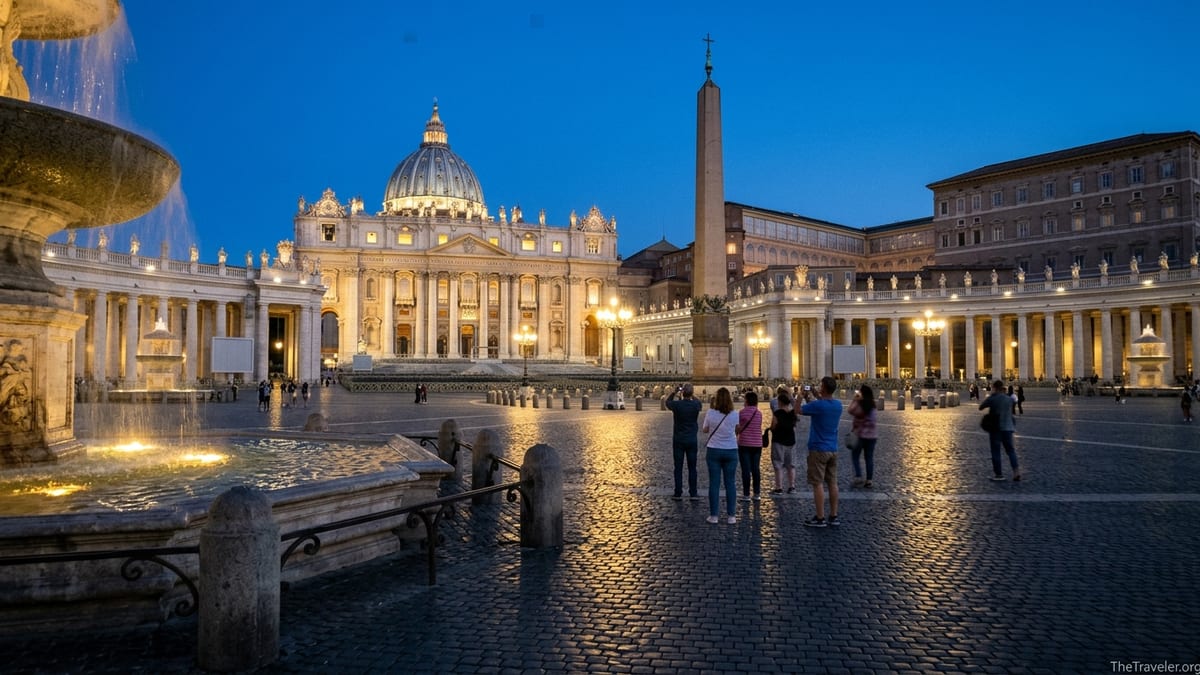
The most obvious feature you can appreciate fully from the square is the basilica facade and dome itself. From the center of the piazza, the view of St Peter’s is one of the iconic images of Rome: a massive Renaissance church crowned by Michelangelo’s dome, which rises above the skyline of the city. You can read the large Latin inscription across the facade, watch the play of light and shadow in the niches, and see the statues of Christ and the apostles lining the rooftop. Many travelers report that this exterior view alone feels as impressive as walking inside.
Nearby stands the Vatican obelisk, transported from Egypt to Rome in ancient times and later erected in its current position at the square’s center. You can walk right up to its base, where a simple inscription records its Christian re-dedication. The obelisk serves as a sundial of sorts in combination with the stones around it, and if you visit on a bright day you can see how its shadow sweeps across the numbered markers embedded in the paving.
The twin fountains on either side of the obelisk are another highlight. One was designed by Carlo Maderno and the other later reworked by Bernini to mirror it, creating a symmetrical frame for the obelisk and basilica. On hot days you will see children edging as close as they can to the spray while parents rest at the basin’s rim. The sound and movement of the water soften what could otherwise feel like an overwhelmingly monumental space.
From various points along the colonnades you also get excellent views of the Apostolic Palace, where the pope lives and where the papal apartments’ windows open onto the square. Even if you do not time your visit for the Sunday Angelus blessing, it is striking to stand in the piazza and imagine how it transforms when the pope appears and the entire space fills with pilgrims holding banners from across the world. In that sense, just being in the empty square lets you understand the scale of those gatherings in a way that photos cannot convey.
Special Moments: Papal Events, Christmas Tree and Night Views
Many of the most memorable experiences in St Peter’s Square require no entrance to the basilica at all. On most Sundays when the pope is in Rome, he delivers the Angelus or Regina Caeli prayer from a window overlooking the square at noon. Attendance is free and open-air. Pilgrims and tourists begin filtering into the piazza an hour or so beforehand, and by midday the crowd often fills much of the central ellipse. Even if you stand near the back, you can follow the event on large video screens set up around the square and feel the energy of a truly global gathering.
Major liturgical celebrations such as Easter and Christmas extend deep into the square as well. The Vatican erects seating and platforms, but huge numbers of people stand beyond these, often stretching to the colonnades. At Christmas, a towering tree and a life-size nativity scene are installed near the obelisk. These decorations usually stay in place from early December into January, and many visitors come in late afternoon or early evening specifically to see them lit. You can walk freely around the nativity scene and admire the craftsmanship of the figures without ever going indoors.
Nighttime in St Peter’s Square is a different world again. After sunset, soft floodlighting picks out the columns and the statues above them, while pools of light around the fountains and obelisk create a quiet, almost theatrical mood. Because the square typically closes late in the evening, you can visit after dinner when day-trip crowds from cruise ships and tour buses have gone. Couples strolling hand in hand, amateur photographers setting long exposures and small groups of friends lingering on the steps are common sights.
These special moments do require some practical planning. During large papal celebrations you may find that access to parts of the square is controlled by barriers and security checkpoints. On those days, it may be harder to simply wander. Conversely, on ordinary evenings you might arrive to find the piazza almost eerily peaceful, especially in winter. If your main goal is photography, consider staying nearby in the Prati district so you can visit at different times of day without worrying about late-night transport.
Time, Budget and Mobility: When the Square Alone Is Enough
Whether St Peter’s Square is “worth it” on its own depends largely on your constraints. If you have only two or three days in Rome and a long list of must-sees, visiting the interior of the basilica can mean investing a significant chunk of time. Even though entry to the church itself is officially free, security lines outside often stretch from the atrium into the square, especially between mid-morning and mid-afternoon in the busier months. Travelers commonly report waits of 60 to 90 minutes or more in peak season, and lines have been particularly long during recent Jubilee celebrations.
Skip-the-line style products for the basilica usually package faster security processing or guided tours at a cost that often ranges in the tens of euros per person. For a couple or family, that can add up quickly. If you are traveling on a tight budget, choosing to experience St Peter’s from the square instead of paying for priority access can be a reasonable compromise, especially if your main interest is exterior architecture and atmosphere rather than religious art.
Mobility and health considerations are also significant. The access route into the basilica involves security scanners, crowding and standing for extended periods. Visitors with limited mobility, small children or heat sensitivity may find these conditions uncomfortable or even unsafe on very hot summer days. In contrast, the square offers ample space, seating edges around the fountains and colonnades, and the freedom to step away, sit or exit entirely whenever you wish.
Finally, some travelers simply prefer outdoor experiences. If you are someone who quickly feels saturated by churches and museums, visiting only the square allows you to appreciate Vatican City in a way that suits your style. You can pair the piazza with a walk along the Tiber, a gelato stop on nearby Borgo Pio or a detour to Castel Sant’Angelo, creating an itinerary that balances grand sights with more relaxed neighborhood exploration.
How to Make the Most of a Square-Only Visit
If you decide not to enter the basilica, a bit of planning helps you extract the most value from St Peter’s Square. First, think about timing. Early morning, roughly from opening until about 9 am, often brings the softest light and the fewest people. This is ideal if you want clear photos of the colonnades, the obelisk and the basilica facade without large tour groups in the foreground. Late afternoon into sunset, especially in spring and autumn, offers another beautiful window when the sun strikes the dome from the side and the sky can turn pastel behind it.
Second, give yourself permission to slow down. Many visitors snap a few pictures from the end of Via della Conciliazione and leave within ten minutes. Instead, walk under the colonnades on both sides to appreciate the changing perspective. Stand on the small circular markers in the pavement where Bernini engineered an optical illusion: from those points, the four rows of columns line up so perfectly that they appear as a single row. This simple exercise reveals how carefully the space was designed.
Third, consider pairing the square with a short, focused activity nearby. For example, you could join a one-hour exterior-focused walking tour that explains the symbolism of the statuary and the political history behind the creation of the square, then continue on your own. Alternatively, if you are traveling with children, bring a sketchbook and pencil and let them draw the obelisk or fountains while you people-watch. Small touches like this can make the visit feel more intentional than just “looking around.”
Finally, be realistic about practicalities: carry water, especially in summer; dress in layers so you can handle cooler early mornings and warmer midday sun; and be mindful of bag size. Large backpacks may make you stand out to security officers even if you are not going inside. Keeping valuables discreet and staying aware of your surroundings, as you would at any major tourist site, will help ensure a smooth, enjoyable experience.
The Takeaway
St Peter’s Basilica is undoubtedly a world-class interior, yet St Peter’s Square has its own powerful appeal that does not depend on going inside the church. Between Bernini’s sweeping colonnades, the ancient obelisk, the life and color of pilgrims from around the globe and the changing light from dawn to nightfall, the piazza alone can deliver a rich and memorable experience.
If your time in Rome is short, your budget is tight or you simply prefer to keep moving outdoors, visiting only the square is a legitimate and rewarding choice. You will come away with the classic view of the basilica dome, a firsthand sense of the Vatican’s scale and atmosphere, and perhaps a few quiet moments in one of the most storied public spaces on earth, all without passing through a security scanner.
Ultimately, the decision comes down to your priorities. For some, the spiritual and artistic treasures inside the basilica will justify any wait. For others, the open sky above St Peter’s Square, the ring of saints on the colonnades and the buzz of the crowd are more than enough. There is no wrong answer, but knowing what the square offers in its own right makes it easier to choose the version of the Vatican experience that fits you best.
FAQ
Q1. Is it free to visit St Peter’s Square if I do not enter the basilica?
You can enter and walk around St Peter’s Square without paying any fee. The piazza itself is free to access, and you only encounter ticketed services if you decide to enter the basilica dome or join guided tours.
Q2. Do I need to go through security if I only want to see the square?
On most ordinary days, you can access the main area of the square without passing through security checkpoints. Security screening is normally required for entering the basilica or during large papal events when extra barriers are set up.
Q3. How much time should I allow if I am just visiting the square?
Many travelers spend 30 to 60 minutes in the square when they are not going inside the basilica. If you enjoy photography, architecture or people-watching, you may easily fill an hour or more exploring the colonnades and fountains.
Q4. When is the best time of day to see St Peter’s Square without heavy crowds?
Early morning, shortly after opening, is usually the quietest and often has the most flattering light for photos. Late evening can also be calm, especially outside peak holiday periods, and offers a beautiful view of the illuminated colonnades and basilica.
Q5. Can I see the pope from the square without entering the basilica?
Yes, during the Sunday Angelus or Regina Caeli prayer and some special events, the pope appears at a window or on outdoor platforms facing the square. These gatherings are open-air, and you can participate from the piazza without entering the church.
Q6. Is St Peter’s Square accessible for visitors with limited mobility?
The square itself is relatively flat and paved, making it generally manageable for wheelchairs and strollers. There are no steps required to move around the main piazza, though it is wise to allow extra time for navigating through crowds on busier days.
Q7. Are there places to sit in St Peter’s Square if I get tired?
While there are no traditional benches in the center of the square, many visitors rest on the low stone barriers, around the fountain bases and along the edges of the colonnades. These informal seating spots are usually sufficient for short breaks.
Q8. Is it worth visiting the square at night if I have already seen it by day?
Visiting after dark is worthwhile. The basilica facade, colonnades and fountains are softly lit, giving the piazza a very different mood from daytime. Many visitors find the nighttime atmosphere quieter and more contemplative.
Q9. What should I wear if I am only visiting the square and not entering the basilica?
There is no formal dress code enforced in the open piazza, so standard city sightseeing clothing is acceptable. However, if there is a chance you will decide to enter the basilica at the last minute, it is sensible to dress with covered shoulders and knees.
Q10. Can I combine a quick visit to St Peter’s Square with other nearby sights?
Yes, the square pairs easily with a walk along the Tiber River, a visit to Castel Sant’Angelo or a meal in the nearby Prati or Borgo neighborhoods. Even if you spend only an hour in the piazza, it fits naturally into a wider exploration of this part of Rome.