


St Peter’s Square is one of Europe’s great public spaces, but for many visitors the dominant memories are security queues, shoulder-to-shoulder crowds, and the feeling of being rushed. With a little planning, you can experience the colonnades, the vast travertine paving, and the basilica facade in relative calm, and still make time for a meaningful visit inside St Peter’s Basilica itself.
Get the latest updates straight to your inbox!
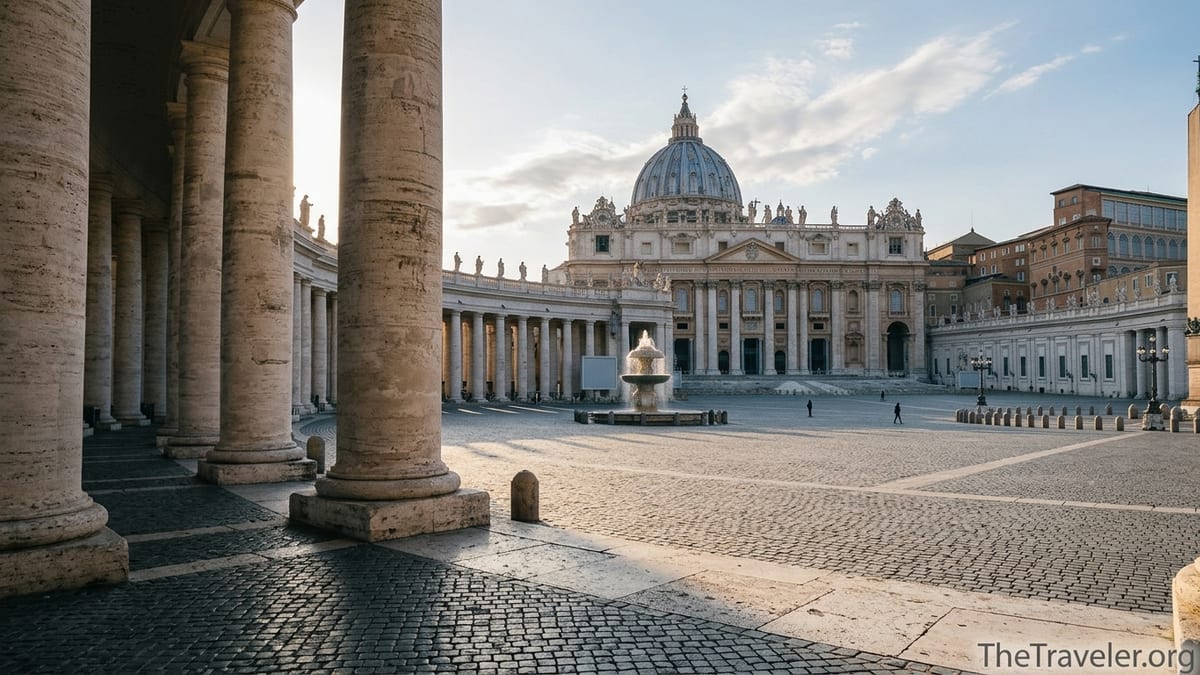
Know How the Place Works Before You Go
St Peter’s Square is the forecourt to St Peter’s Basilica and the main outdoor gathering place of Vatican City. Every visitor who wants to go into the basilica passes through security set up in the right-hand colonnade when you face the church, which is why the square often looks like an airport terminal moved outdoors. Admission to the basilica itself is free, but you cannot skip the scanners, and on busy days the security line can easily stretch across the square and add an hour or more to your visit.
The basilica usually opens at 7 am and closes around 7 pm throughout the year, while the dome, grottos, and treasury keep shorter hours and often stop admitting visitors by late afternoon. In practice this means the square starts to fill soon after 8:30 am as coach groups and tours arrive, stays busy through the late morning, and then quiets somewhat in the evening as day-trippers return to their hotels or cruise ships. Understanding that wave pattern is the first step to planning a quieter experience.
The square itself is open at all hours unless there is a major religious event or security perimeter in place. Early risers can walk under Bernini’s colonnades just after dawn when workers are out cleaning, and late in the evening you will often find only a few small groups and pilgrims saying the rosary. Even if you never step inside the basilica, those are the moments when the space feels most like a monumental piazza rather than a queueing area.
Finally, it is useful to remember that St Peter’s is both a working church and the center of global Catholic life. The calendar of papal liturgies, Wednesday general audiences, Sunday Angelus, canonizations, and jubilee events all affect how crowded the square feels and whether certain zones are closed. Checking your dates against an official Vatican calendar before you set an exact plan will help you avoid surprises like barriers, ticket-only sections, or closed access in the middle of the day.
Choose the Right Day and Time to Beat the Rush
If your priority is to see St Peter’s Square and the facade of the basilica in relative peace, the quietest days are usually Tuesday and Thursday, when there is no regular papal audience or Sunday Angelus. On Saturdays, tour groups pack the square from mid-morning, and on Sundays the area fills for midday prayer. Wednesdays see heavy crowds for the general audience, which typically runs through the late morning, and parts of the square may be sectioned off with seats and security barriers.
Within each day, the most reliable low-crowd windows are the first and last hours of basilica opening. Travelers who arrive at 6:45 am and are at security before the scanners open at 7 often report waiting only a few minutes and stepping into a nearly empty nave. Recent visitor accounts from spring and early summer note that arriving at around 6:50 pm has a similar effect: security can take two to ten minutes, and you then have roughly an hour before closing to walk the basilica with far fewer people and to exit back into a calmer square lit by the warm evening sun.
As a rule of thumb, try to avoid the period from 9:30 am to 2 pm if you dislike crowds. This is when cruise excursions and large group tours tend to converge, especially in high season from June to August. In those months it is not unusual for the security line to take 60 to 90 minutes, which is exactly the experience you want to avoid. If you only have one morning in Rome, it is still better to be in the square by 7:30 am, enjoy the space and the basilica for two hours, then leave as the heat and queues build.
Shoulders seasons such as November, January, and early February can be considerably calmer, but even then the pattern holds: early or late is best. If you happen to visit during a Holy Year or major papal celebration, assume every midday slot will be busy and build your plans around that, even if it means an early alarm or shifting a dinner reservation to capture that quiet last hour before closing.
Navigating Wednesdays, Sundays, and Special Events
Many visitors unintentionally plan their Vatican day on a Wednesday or Sunday because those are convenient days in a Rome itinerary. Both can work, but they require a different strategy if you want to avoid feeling trapped in a crowd. On most Wednesdays the Pope holds a general audience in St Peter’s Square beginning around 9 or 10 am. The square is filled with rows of chairs, ticket-holders enter early through dedicated checkpoints, and security around the whole area intensifies.
If you want to avoid the audience, treat Wednesday morning as effectively blocked. Either come very early, take a quiet walk through the square around 7 am as preparations unfold, then move on before 8, or shift your visit to the late afternoon after the audience has ended and the chairs are removed. By around 3 pm access is usually back to normal, though crowd levels remain higher than on a typical Tuesday.
Sundays revolve around the Angelus at noon, when the Pope usually appears from a window above the square to address the crowd. In the late morning, pilgrims and parish groups fill the open space, but there are often fewer tourists visiting the interior of the basilica during and immediately after the prayer. If you are willing to experience the square as part of a large but largely stationary crowd, you can join the Angelus, then linger for 30 to 40 minutes afterwards as the piazza rapidly empties and a more peaceful atmosphere returns.
Special events such as Easter, Christmas, canonizations, or jubilee celebrations transform the square into a controlled security zone, sometimes extending to the surrounding streets of Borgo and Via della Conciliazione. On those days, your goal should not be to avoid crowds but to decide whether you want to participate at all. If you do not, schedule St Peter’s for another day and simply enjoy distant views of the dome from the Janiculum or across the Tiber. If your Rome trip coincides only with such dates, accept that the experience will be crowded and focus on staying comfortable and patient.
Smart Arrivals: Getting to the Square Calm and Ready
How you reach St Peter’s Square has a surprising impact on how crowded it feels. Many visitors are funneled in via the busy Via della Conciliazione, the broad avenue lined with souvenir shops and group meeting points. At mid-morning this approach can feel chaotic even before you see the colonnades. If you want a gentler arrival, consider approaching from Borgo Pio, a narrow, largely pedestrian street of ochre buildings, small cafes, and religious goods stores. When you emerge from Borgo Pio onto the side of the square early in the morning, the basilica appears gradually rather than all at once.
Public transport can also be stressful at peak times. Bus 64, which runs between Termini Station and the Vatican area, is famous for being crowded and for attracting pickpockets. If you do use it to reach the square, board early in the route near Termini and get off at the stop near San Pietro train station, then walk five to ten minutes along Via della Conciliazione. A calmer alternative is the express bus 40, which follows a similar route with fewer stops, or the regional trains that stop at Roma San Pietro station if you are staying outside the center.
Another way to reduce stress is to allow a generous buffer before any timed booking. If you have an 8:30 am entry for the dome or a 9 am guided tour meeting at the base of the steps, plan to be in the vicinity of the square at least 60 to 90 minutes earlier in high season. That buffer means you can stop for a quick espresso on Borgo Pio, adjust clothing to comply with the dress code, and still be in the security line in good time without feeling rushed. It also lets you pause under the colonnades and appreciate their scale while the crowds are still thin.
Finally, pay attention to weather. The square is almost entirely exposed, with little shade except under the colonnades. In July and August the paving can be scorching by midday, and even a short wait at security feels longer under the sun. If you cannot visit early or late, carry water, wear a hat, and consider a cooling break under the trees in the nearby Piazza San Pietro or along the shaded streets behind the colonnades before you commit to a long line.
Using Tickets, Tours, and Security to Your Advantage
One of the most common misunderstandings is that buying a ticket or guided tour for St Peter’s Basilica allows you to bypass the security line entirely. In reality, every visitor must pass through the same X-ray scanners and metal detectors in the square. What reserved tickets and tours often provide is access to a separate, shorter lane at security, which can cut your wait on a busy day from well over an hour to somewhere in the 5 to 20 minute range. This can make a significant difference in your overall comfort.
If your main goal is to enjoy the square and the interior of the basilica without feeling rushed, you may not need a paid skip-the-line product at all. Arriving just before opening or near closing time usually makes queues short enough that paying extra offers little benefit. For example, independent travelers who reached the square at 6:50 pm in recent weeks reported getting through security in under five minutes, without any special ticket, and then having nearly empty aisles inside.
On the other hand, if you are locked into visiting at a peak time, such as a mid-morning slot in May or June, a reputable guided tour that includes priority entry can significantly reduce your time in the sun. Look for tours that clearly state they use the dedicated priority lane outside the basilica. Prices vary, but expect to pay from around 30 to 60 euros per person for a small-group basilica and dome tour, not including any Vatican Museums visit. Remember that even with such a tour, you still need to arrive early enough to clear security and find your guide at the meeting point in the square.
Security itself is similar to an airport check. Knives, scissors, and glass bottles are not allowed, and large backpacks may be searched or slowed down. To move faster, travel light: carry only a small day pack, a water bottle that you can empty before security if requested, and essential documents. Dressing modestly from the start, with covered shoulders and knees, prevents last-minute scrambling with scarves or jackets in the queue and avoids the risk of being turned away at the basilica doors.
Finding Quiet Corners and Meaningful Moments
Even on a busy day, there are ways to carve out quieter pockets of experience in and around St Peter’s Square. One simple tactic is to step under the colonnades rather than standing out in the open center of the piazza. The double rows of columns create shaded walkways where people tend to keep moving rather than lingering, and the sound of the crowd is noticeably muffled. Walking slowly along the inner edge, you can watch the constant flow of visitors while feeling surprisingly insulated from it.
The two fountains, one by Carlo Maderno and the other by Gian Lorenzo Bernini, are also natural gathering points that somehow feel calmer than the central obelisk. Early in the morning or near dusk, you can often find a spot on the low stone railings nearby to sit for a few minutes and let your eyes wander from the spray of the water to the statues on the colonnades and the facade of the basilica. Photographers often favor these angles because you can frame the dome with water droplets in the foreground and fewer people in the frame.
If you have time, consider combining your visit to the square with a walk up to the Janiculum Hill or along the riverside near Castel Sant’Angelo. From the terrace of the Janiculum, the dome of St Peter’s rises above the city’s rooftops, and you get a sense of the basilica’s scale without any crowds at all. Walking back down through the Trastevere neighborhood and across the Tiber, you can then re-approach the square in the evening when it is calmer, seeing it again with the perspective of distance.
Inside the basilica, the very front near the main doors and the space around Michelangelo’s Pietà are often crowded, but the aisles along the right and left sides can be quieter. After spending a few minutes at the central nave, move deliberately towards one of the side chapels, find a bench, and simply sit. Many visitors find that ten minutes of quiet reflection there, away from the constant movement, leaves a stronger impression than any number of photos of the altar or dome.
The Takeaway
Experiencing St Peter’s Square without the crowds is less about secret entrances and more about making informed, practical choices. Aim for Tuesday or Thursday if you can, and build your plan around the first and last hours of the basilica’s opening rather than the tourist midday peak. Pay close attention to Wednesdays, Sundays, and any major Vatican events, and adjust your expectations or schedule accordingly.
Arrive by calm back streets instead of the most crowded avenues, travel light through security, and decide honestly whether a skip-the-line tour is worth the cost for your specific timing. Once in the square, use the colonnades, fountains, and view points around the neighborhood to create your own pockets of space and perspective, rather than remaining where the crowd naturally thickens.
Above all, remember that St Peter’s is a place of ritual and continuity. The square has absorbed crowds, ceremonies, and quiet dawns for centuries. With a bit of forethought, you can step into that rhythm on your own terms, catching moments when the architecture, light, and silence briefly belong to you, even in the heart of one of the world’s busiest pilgrimage sites.
FAQ
Q1. What is the least crowded time to visit St Peter’s Square and Basilica?
The quietest times are usually right at opening around 7 am and during the last hour before closing, roughly after 6:15 pm, especially on Tuesdays and Thursdays outside major holidays.
Q2. Which days should I avoid if I dislike crowds?
Try to avoid Saturday late mornings, most Sundays around the noon Angelus, and Wednesday mornings when the Papal General Audience takes place in the square and security is tighter.
Q3. Do skip-the-line tickets let me avoid security queues?
No. All visitors must pass through security scanners in the square. Reserved tickets and guided tours often use a shorter priority lane, which can reduce waiting time but cannot remove it entirely.
Q4. Is there a way to see the square without going through security?
Yes. You can walk freely around most of St Peter’s Square, under the colonnades, and near the fountains without passing security. Screening is only required if you want to enter the basilica or secured event areas.
Q5. How should I dress to avoid any problems at the entrance?
Dress modestly with shoulders and knees covered for both men and women. Light trousers or skirts below the knee and tops with sleeves are usually fine. Avoid very short shorts, strapless tops, and see-through clothing.
Q6. What is the best way to reach St Peter’s Square on public transport?
Many visitors use bus 64 or the faster bus 40 from Termini area, getting off near the Vatican, or take a regional train to Roma San Pietro station and walk 10 minutes. Always watch your belongings, as these routes are busy.
Q7. Can I still visit the basilica on a Wednesday?
Yes, but plan around the Papal Audience. Either visit very early before preparations fully start, or wait until mid to late afternoon after the audience ends and the chairs are cleared, when access returns to normal.
Q8. Are there quiet spots to sit and reflect in or near the square?
The shaded walkways under the colonnades, the areas around the two fountains at off-peak times, and the side chapels inside the basilica often offer moments of relative calm even when the central space is busy.
Q9. Do I need a ticket just to enter St Peter’s Square?
No. Access to the square and its open areas is free and ticketless. Tickets apply only to certain events, tours, and paid areas like the dome climb or some special sections.
Q10. How long should I plan for a relaxed visit?
For a calmer experience, allow around two to three hours: time to pass security without rushing, walk the square and colonnades, visit the basilica interior, and pause in a quieter corner or viewpoint nearby.