


Two of Rome’s most unforgettable spaces could not feel more different. St Peter’s Square, the vast forecourt of the Vatican, is all spiritual drama and monumental Baroque design. Piazza Navona, a short walk away in the historic center, is intimate by comparison, a living room of fountains, cafés and street artists. Both are iconic. Both are free to enter. Yet they leave very different marks on travelers. This guide compares their atmosphere, history, logistics and real on-the-ground experience in 2026 to help you decide which Rome square will leave the bigger impression on you.
Get the latest updates straight to your inbox!
The First Glimpse: Scale vs Atmosphere
Your first sight of St Peter’s Square is usually from Via della Conciliazione, the broad avenue that funnels you toward the Vatican. The space opens suddenly into an immense ellipse framed by Bernini’s colonnades, with St Peter’s Basilica rising behind. The sense of scale is overwhelming: the square can hold tens of thousands of worshippers during papal events, and recent Jubilee celebrations have filled it with pilgrims from all continents. Many visitors describe feeling physically small yet emotionally charged the moment they step between the towering columns.
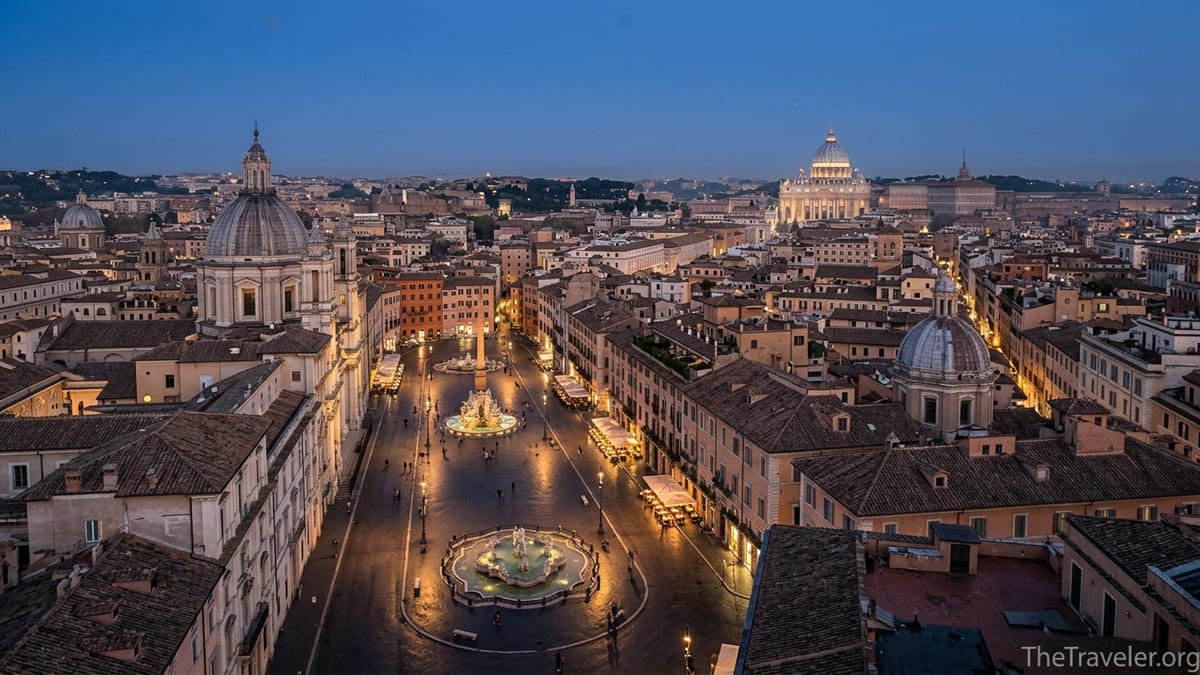
Piazza Navona, by contrast, reveals itself gradually through a tangle of narrower streets in the Centro Storico. You might emerge from a lane like Via del Governo Vecchio straight into the long oval of the old stadium, suddenly surrounded by ochre palazzi, restaurant terraces and the sound of buskers. Instead of looking up at a basilica façade, you look around at human-scale details: fountains at eye level, artists at their easels, children chasing pigeons around the cobblestones. The impact here is less about awe and more about atmosphere.
Travelers often recall St Peter’s Square as a “once in a lifetime” spectacle, linked to a specific moment such as a papal audience or evening prayers. Piazza Navona tends to stick in the memory as a place you return to: for an espresso at mid-morning, an aperitivo at sunset, or a late stroll when the fountains are lit. In other words, one square hits you with a single thunderclap of grandeur; the other seeps into your trip like a recurring melody.
Which first impression feels bigger depends partly on timing. Arrive at St Peter’s Square at dawn, when the cobblestones are still wet from cleaning and the colonnades are empty, and the serenity can be as moving as any crowd scene. Reach Piazza Navona on a warm Saturday night, with every table full and street performers in full swing, and its energy may eclipse anything you felt at the Vatican.
History You Can Feel Underfoot
St Peter’s Square condenses centuries of religious and political power into a single space. The obelisk at its center stood in ancient Egypt before being brought to Rome by Emperor Caligula and later moved to its present position in 1586. The colonnades, designed by Gian Lorenzo Bernini in the 17th century, were conceived as the “arms of the Church” embracing the faithful. Above you, 140 statues of saints line the entablature, looking down on visitors from every corner of the Catholic world. Simply standing here invites reflection on how many historic announcements, papal blessings and solemn funerals have unfolded on these stones.
For many visitors, that history becomes visceral at specific moments. Think of the crowd falling silent for the Urbi et Orbi blessing at Easter, or for a vigil held after a global tragedy. Even outside major events, loudspeaker chimes marking the Angelus at noon can give a sense that you are witnessing living traditions, not just architecture. The square is not just a backdrop to the basilica; it is a stage on which the modern papacy regularly appears.
Piazza Navona’s story begins even earlier, with Emperor Domitian’s stadium in the first century. The elongated oval of that ancient athletic arena still dictates the piazza’s shape today. Under your feet, several meters below the paving, lie the remains of the stadium’s seating and track, accessible via the small Stadio di Domiziano archaeological site facing the northern end. In 2026, entry to this underground section typically costs around 10 euros for adults, which includes an audio guide that helps you imagine horse races and gladiatorial spectacles in the same footprint now occupied by trattorias and gelaterias.
Above ground, Baroque Rome dominates. Bernini appears here too, with the Fountain of the Four Rivers at the center, its marble personifications of the Nile, Danube, Ganges and Rio de la Plata clustered around another Egyptian obelisk. The nearby church of Sant’Agnese in Agone, designed in part by Borromini, adds a layer of artistic rivalry to the square’s history. Over the centuries Piazza Navona has hosted everything from water festivals, when the drains were plugged to flood the piazza, to modern Christmas markets. That playful, secular history gives it a different tone from the solemn rituals of St Peter’s.
Visual Drama: Architecture and Photographic Impact
St Peter’s Square is one of the world’s great architectural set pieces, and it photographs accordingly. Wide-angle lenses capture the ellipse and the range of the colonnades; telephoto shots pick out details like the papal coat of arms, statues of saints or the intricate stonework of the façade. In the early morning, low sunlight grazes the columns, creating long shadows and making the travertine glow. Late afternoon is popular with photographers standing near the obelisk and shooting toward the basilica dome framed by the colonnades.
Yet the most memorable images here are often about people, not stone. A family wrapped in flags of their home country waiting for a blessing, a choir clustered near the barricades, or nuns chatting quietly under an umbrella during a passing shower. On Wednesdays and Sundays, when papal events draw enormous crowds, the square becomes a sea of faces, banners and folding chairs. Capturing that scale, whether with a smartphone panorama or a more serious camera, can translate the emotional punch of being part of something global.
Piazza Navona, on the other hand, rewards a slower, more intimate style of photography. Instead of battling a single monumental subject, you discover dozens of smaller scenes: the dramatic torsos of Bernini’s river gods, a violinist performing near a lamppost, laundry hanging above a narrow side alley, the glow of café lights reflected in a puddle after a spring shower. Because the buildings are human-scaled and the piazza is enclosed, evening photos with a standard phone camera often look atmospheric without special equipment.
For many travelers, Piazza Navona ends up yielding their favorite “this is Rome” shot: a gelato in hand, a fountain in the background, and a jumble of ochre façades behind that. St Peter’s Square might produce the postcard hero image of the trip; Piazza Navona fills your camera roll with the candid, in-between moments you remember long after you return home.
Crowds, Logistics and Real 2026 Wait Times
One of the biggest differences in how these squares feel is how you actually move through them. In 2026, St Peter’s Square remains one of the most heavily policed and queue-managed spaces in Rome. Security for entry to St Peter’s Basilica and for papal audiences means airport-style checks at multiple gates. Even with crowd control improvements after the 2025 Jubilee, visitors report peak-season waits of 60 to 90 minutes or more for basilica security in the late morning and early afternoon, particularly on days close to religious holidays or on Wednesdays when the papal audience is held.
This queue snakes through the right-hand side of the colonnade and can wind almost the full length of the square when demand is high. Entry to the square itself is free and open from early morning until late evening, but during major events access points may be rerouted, and at times the space can feel more like a managed venue than an open piazza. If you want to feel the square at its most contemplative, arriving before 8 am or after dinner is crucial. Many recent visitors describe walking straight through security to the basilica when they show up just after opening time around 7 am, then lingering in a nearly empty square on the way out.
Piazza Navona, by contrast, has no security gates or fixed entry points. It remains a living city square that locals cross on their way to work, children use as a playground and tour groups drift through. It can still be very busy in high season. By late morning in May or June, the central section around the Fountain of the Four Rivers is often ringed by organized groups following guides with colored flags, and finding an empty café table in the shade at lunchtime can be a challenge. Yet movement is fluid: you can always duck down a side street, pause on a bench at the southern end, or slip into a church to escape the crush.
From a purely practical standpoint, you are unlikely to lose large blocks of your day simply standing still at Piazza Navona. The only consistent queues here are for popular gelaterias on hot days and for tables at particularly well-reviewed restaurants in the evening. That flexibility helps the square feel more relaxed and spontaneous, even when it is crowded. For travelers who are sensitive to security checks or long waits, this alone can tilt the emotional balance in Piazza Navona’s favor.
Costs, Cafés and Everyday Experiences
Another factor in how strongly a place imprints on you is what you actually do there, and how much it costs. At St Peter’s Square, most activities tied directly to the space are free: walking under the colonnades, attending the Angelus on a Sunday, or simply sitting on the low barriers to take in the view. Costs begin when you add related experiences. Climbing the dome of St Peter’s Basilica, for example, typically costs a little over 10 euros for the stairs and a few euros more if you prefer to take the elevator to the terrace before continuing on foot. Many visitors pair their time in the square with a guided Vatican Museums tour, which easily adds 30 to 60 euros per person depending on group size and operator.
There are places to eat and drink around the Vatican, but the most atmospheric cafés and trattorias usually lie a few minutes’ walk away in the Prati district or back across the Tiber in streets like Borgo Pio. Prices here can be slightly higher than in less touristy neighborhoods. Expect to pay in the region of 2 euros for an espresso at the counter or 4 to 6 euros if you sit at a table with a view toward the dome, and around 12 to 18 euros for a simple pasta dish at a mid-range trattoria catering to visitors from the square.
In Piazza Navona, the square itself is the main commercial draw. Restaurant terraces line almost the entire perimeter, with menus ranging from classic Roman pasta and seafood to more international options designed for passing tour groups. Sitting at one of the prime front-row tables close to the Fountain of the Four Rivers, you might pay 6 to 8 euros for a spritz or small beer and 14 to 20 euros for a main course. Prices drop slightly if you retreat one or two streets away, where you can find wine bars serving glasses in the 6 to 7 euro range and neighborhood trattorias offering fixed-price lunch menus.
What makes Piazza Navona memorable for many travelers is the freedom to linger. You might arrive for a quick coffee and end up staying an hour, listening to a pianist set up near the central fountain, watching caricature artists banter with families, or browsing canvases of Rome’s skyline propped against the stone balustrades. In this sense the “cost” of Piazza Navona is not just in euros but in the time you are happy to give it, which can feel like a luxury in a city packed with must-see sites.
Spiritual Awe vs Street-Life Energy
Emotionally, St Peter’s Square and Piazza Navona operate on different frequencies. At the Vatican, the dominant notes are reverence and awe. Even non-religious visitors often describe a quieting effect when they step into the piazza. The alignment of the architecture, the presence of pilgrims who may have saved for years to be here, and the knowledge that major church decisions are made just beyond the colonnades all contribute to a heightened sense of place. During mass or a papal address, the square becomes a single organism, breathing and reacting as one crowd. For some travelers, that shared experience is the most powerful moment of their time in Rome.
Outside formal ceremonies, you still feel a certain solemnity. Groups reciting prayers near the obelisk, candles lit inside the basilica before people reemerge into the light, or a lone figure sitting on the steps of the fountains in quiet thought all give the square an introspective undertone. If you are seeking a place that might prompt reflection on history, belief or your own life journey, this space has a particular capacity to do so.
Piazza Navona’s emotional charge is more social. The square feels like a stage set for human interaction, whether it is a couple splitting a gelato on a bench, children playing tag around the Fountain of Neptune, or friends meeting for aperitivo before heading to dinner nearby in Campo de’ Fiori or Trastevere. Street performers provide a soundtrack that shifts through the day: acoustic guitar in the afternoon, small bands or classical duos in the evening. There is almost always some kind of hum here, a low-level festival atmosphere without a specific event.
Travelers who relish people-watching often rank Piazza Navona higher than St Peter’s Square because it feels more unpredictable. You might stumble onto a student art show, a small parade, or an elderly local arguing cheerfully with a waiter about the football results. That ordinariness amidst beauty is part of what makes the square feel profoundly Roman, and it may leave a stronger impression on visitors who connect more with everyday culture than with formal religion.
Accessibility, Safety and Seasonal Changes
Both squares are largely flat and paved, but there are practical differences in accessibility. St Peter’s Square has clearly defined security entrances with ramps, and the Vatican has invested in step-free routes suitable for wheelchairs or strollers. The surface is mainly large cobblestones, which can be slightly uneven but generally manageable. Dedicated restrooms lie just off the square near the colonnades, and signage is multilingual. Because of the constant police presence and metal detectors, the area feels very secure, though you should still be wary of anyone approaching you with unsolicited “official” tickets or tours near the approaches.
Piazza Navona’s cobblestones are older and more irregular in places, which can be trickier for wheelchair users or anyone with limited mobility, though accessibility-focused guides point out that the central section is broadly navigable and several cafés offer step-free seating. There is less formal security here, but also less of a funnel effect: you are never pushed into dense queues where pickpockets can easily work, as sometimes happens in the bottlenecks around St Peter’s security checkpoints. Common-sense precautions with bags and phones remain advisable, especially in the evening when visitors relax into drinks and conversation.
Seasonally, both squares change character. St Peter’s Square is deeply affected by the liturgical calendar. Holy Week around Easter, Christmas period, and special papal events can draw immense crowds. Planning a visit on a quieter weekday in shoulder season, such as November or early February, can give you a totally different experience from a summer Sunday when pilgrims overflow into surrounding streets. Piazza Navona hosts a traditional Christmas market in December, along with fairground stalls and lights that transform its look entirely. Summer evenings bring extended café hours and a noticeable rise in street performances, while quieter winter days can make the piazza feel almost local again, with more Romans than tourists crossing it on their daily routines.
Weather plays a role as well. St Peter’s Square is more exposed, with limited natural shade aside from the deep recesses of the colonnades. In July and August, standing in the central area under the midday sun can be punishing. Piazza Navona offers more patches of relief along the building sides and under café umbrellas, making it generally more comfortable to linger in hot weather. After rain, both squares take on a particular beauty, with reflections of domes and façades shimmering in puddles that photographers love.
So Which Square Leaves the Bigger Impression?
For many travelers, the “bigger” impression is emotional rather than visual. If your trip to Rome has a spiritual or historical focus, St Peter’s Square almost always feels like the apex. The knowledge that you are standing at the symbolic heart of global Catholicism, combined with the scale of the architecture, can be overwhelming in the best sense. People who attend a papal audience or mass here often describe it as a highlight of not just their Italian journey but of decades of travel.
On the other hand, if you measure impact by how much a place feels woven into your daily experience of Rome, Piazza Navona often wins. You might pass through it on the way to another site, return for coffee, revisit at dusk, and swing by again after dinner. Each time, the light, music and mix of people are subtly different. That repetition turns it into a personal reference point: a familiar space you claim as “your” square while in the city.
There is also the question of stress. St Peter’s Square, for all its beauty, is intertwined with crowd control, security checks and fixed schedules. Missing the last entry to the dome or underestimating the line for the basilica can leave you frustrated. Piazza Navona rarely carries that risk. You can treat it as a pressure valve, a place to decompress between more demanding sights. For travelers with limited time who dislike uncertainty, this can shape which square they remember more fondly.
In truth, the comparison is less about which is “better” and more about what kind of encounter you are seeking. A simple rule of thumb is this: if you want to feel the weight of history and faith, prioritize lingering in St Peter’s Square at a quiet time of day. If you want to feel immersed in Rome’s lived-in, sociable present, give Piazza Navona repeated visits at different hours. Many visitors only truly appreciate the contrast after seeing both, so if your schedule allows, plan your days to include an unhurried stop in each.
The Takeaway
St Peter’s Square and Piazza Navona are two sides of Rome’s personality. The first is ceremonial, vertical, choreographed: its impact comes from scale, symbolism and the events that unfold beneath the basilica dome. The second is informal, horizontal, constantly shifting: its impact comes from everyday pleasure, conversation and the simple act of being in a beautiful place with other people.
Instead of asking which square is objectively more impressive, it may be more useful to ask what you hope to remember from your time in Rome. If you picture yourself swept up in a global crowd, hearing a papal blessing echo between colonnades, then St Peter’s Square is likely to deliver your most indelible memory. If you imagine relaxed evenings, a glass of wine at a café table, and fountains murmuring as the sky turns pink, then Piazza Navona will probably linger longer in your mind.
For many travelers, the deepest impression comes from the interplay between the two. An early morning visit to St Peter’s can frame your understanding of Rome’s spiritual and political weight, while an unplanned hour in Piazza Navona after dinner can reveal its warmth and humanity. Seen together, they offer a fuller picture of the city than either could alone, and that combined experience may be what ultimately defines your Roman journey.
FAQ
Q1. Which square should I visit if I only have one day in Rome?
If you have a single day and want the most iconic experience, St Peter’s Square usually takes priority, especially if you plan to visit the basilica or attend a papal event. However, if large crowds and security checks feel overwhelming, Piazza Navona offers a more relaxed slice of Rome without the time pressure.
Q2. Is there an entry fee for St Peter’s Square or Piazza Navona?
No, both squares are free to enter and open to the public. Costs arise from related activities, such as climbing the dome at St Peter’s, visiting Vatican Museums, or eating and drinking at cafés and restaurants around Piazza Navona.
Q3. How much time should I plan for each square?
For St Peter’s Square alone, 30 to 45 minutes is enough to walk under the colonnades and absorb the atmosphere, but add at least two to three hours if you intend to visit the basilica and dome. Piazza Navona can be enjoyed in 20 minutes as a quick stop, but many travelers happily spend an hour or more lingering over a drink or exploring nearby streets.
Q4. When is the best time of day to visit St Peter’s Square?
Early morning is ideal, typically before 8 am, when security lines for the basilica are shorter and the square is calmer. Evenings after dinner also offer a quieter, more reflective atmosphere, with the façade and colonnades beautifully lit and far fewer tour groups.
Q5. When is the best time of day to visit Piazza Navona?
For a peaceful stroll and easier photography, visit in the early morning when café staff are setting up and locals cut across the square on their way to work. For a livelier experience with musicians and a busy restaurant scene, arrive at sunset or after dark, especially in spring and summer.
Q6. Are both squares suitable for children and strollers?
Yes, both squares are broadly stroller friendly, though cobblestones can be a bit bumpy. St Peter’s Square has clearer ramps and more structured pathways but can feel cramped in heavy queues. Piazza Navona offers more space for children to move freely, especially around the southern end, though parents should keep an eye on little ones near fountains and café terraces.
Q7. Which square is better for photography?
St Peter’s Square is better for dramatic, large-scale shots featuring the basilica, obelisk and colonnades, especially at sunrise or sunset. Piazza Navona excels for intimate street photography, capturing fountains, performers and everyday life. Many photographers visit both, using St Peter’s for grand vistas and Piazza Navona for characterful close-ups.
Q8. Is it safe to visit these squares at night?
Both areas are generally considered safe in the evening, with a steady presence of visitors and, around the Vatican, visible security. Standard city precautions still apply: keep valuables secure, avoid dim side streets if you are alone late at night, and be cautious of anyone offering unsolicited help or tours.
Q9. Can I easily visit both squares on the same day?
Yes, it is straightforward to include both in a single day. Many itineraries pair a morning at the Vatican, including St Peter’s Square, with an afternoon or evening walk through the historic center that naturally passes Piazza Navona. Walking between the two takes around 20 to 30 minutes at a leisurely pace.
Q10. Which square offers a more “local” experience?
Piazza Navona, despite being popular with tourists, often feels more integrated into local life, with nearby residents using it as a meeting point and children playing after school. St Peter’s Square is more focused on pilgrims and visitors, and while powerful, it feels less like a neighborhood space and more like a global religious stage.