


Thailand has evolved from an early backpacker‑nomad hub into one of the most mature remote work ecosystems in Asia. By early 2026 it combines nationally strong digital infrastructure with dense urban coworking networks and an established service environment geared to remote workers. This briefing evaluates whether Thailand is practically suitable for digital nomads in 2026, focusing on work‑critical factors such as internet performance, workspace availability, reliability, and operating conditions across the country’s main hubs.
Overall Assessment of Thailand for Digital Nomads in 2026
From a purely work‑infrastructure perspective, Thailand in 2026 ranks as a strong location for digital nomads. The country consistently appears in global broadband speed tables with median fixed download speeds around the mid‑200 Mbps range in 2025, placing it well above the global average and in the upper tier of remote work destinations. Mobile 5G coverage has also expanded rapidly, providing high‑bandwidth backup connectivity in most urban centers.
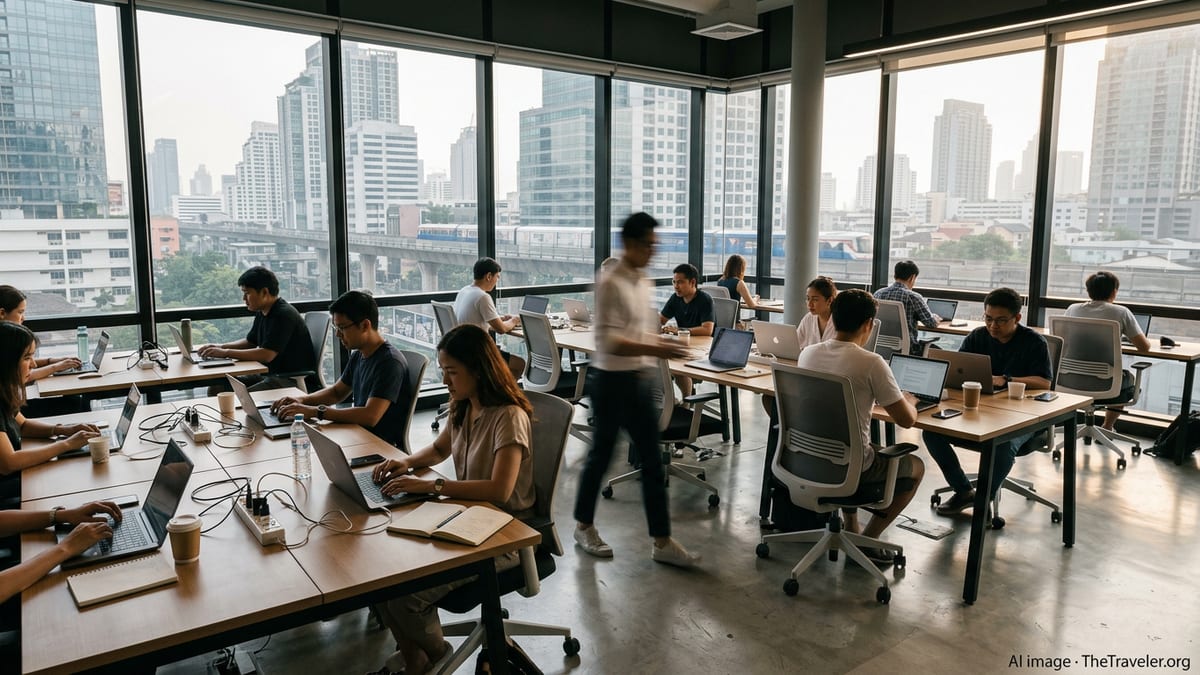
Major hubs such as Bangkok and Chiang Mai offer dense concentrations of coworking spaces, laptop‑friendly cafes, and serviced offices, giving remote workers multiple options at different price and formality levels. In parallel, the service economy around these hubs is accustomed to international remote workers, which reduces friction for day‑to‑day operations such as printing, meeting rooms, quiet call spaces, and extended opening hours.
Challenges remain in specific segments. Outside key cities and well‑developed resort islands, connectivity and workspace options can still be inconsistent, particularly in rural provinces and smaller islands. Power reliability can vary, and some areas remain heavily dependent on mobile connectivity rather than fiber. For location‑independent professionals whose work is mission‑critical and time‑sensitive, this creates a clear divide between “safe hub” locations and more experimental secondary destinations.
For most knowledge workers whose tasks are compatible with time zone differences and who base themselves in Thailand’s established hubs, the country in 2026 offers work‑grade infrastructure that compares favorably with many Western and East Asian cities. However, nomads must plan location choices carefully and avoid assuming country‑wide uniformity of conditions.
Internet Speeds, Coverage and Technical Reliability
Digital connectivity is the core determinant of Thailand’s suitability for digital nomads. On a national level, Thailand sits among the faster countries worldwide for fixed broadband, with reported median download speeds in late 2025 around 230–240 Mbps. In global comparisons this places Thailand alongside or ahead of many European economies, although speeds vary by provider and location.
Bangkok, as the primary metropolitan area, benefits from extensive fiber‑to‑the‑home deployment and competitive pricing between major providers. Independent measurements for 2025 indicate that leading operators in Bangkok delivered average fixed download speeds above 200 Mbps over the year, with premium packages advertising symmetric speeds of up to 1 Gbps in many central districts. For most remote workers, even mid‑tier plans comfortably support multiple simultaneous video calls, cloud‑based workflows, and large file transfers.
Chiang Mai and other northern urban centers typically show slightly lower but still robust performance, often in the 100–200 Mbps range for fixed lines in central neighborhoods and popular nomad districts. Feedback from remote workers indicates that mid‑range residential connections and coworking‑space networks are sufficient for high‑definition calls and always‑on collaboration tools, though throughput can dip during peak evening hours in some buildings.
In terms of mobile connectivity, Thailand’s 4G and 5G networks are widely regarded as strong. Independent user reports from 2024 and 2025 frequently describe 5G speeds in the 250–400 Mbps range in major cities and good 4G coverage even on many islands. For digital nomads this enables viable tethering when fixed lines underperform or during short‑term stays. However, performance still varies inside buildings and in dense urban zones, so a dual‑SIM setup and testing multiple providers remain prudent risk‑mitigation practices.
Coworking Spaces, Work‑Ready Cafes and Workspace Density
Thailand’s coworking ecosystem has matured significantly, with a wide variety of options in 2026. Bangkok hosts a large number of branded and independent coworking operators, ranging from enterprise‑oriented spaces with dedicated offices and soundproof phone booths to budget day‑pass environments focused on individual remote workers. Central business and lifestyle districts such as Sukhumvit and Sathorn concentrate many of these facilities within short walking distance of public transport.
Chiang Mai, often labeled a long‑standing digital nomad hub, continues to sustain a high density of coworking venues relative to its population. Popular areas such as Nimmanhaemin (Nimman) host multiple established spaces, often combining high‑speed fiber, extended opening hours, and amenities like meeting rooms, podcast studios, and ergonomic seating. Pricing for monthly memberships is generally lower than in Western cities, which can encourage nomads to maintain both a home connection and a coworking membership as redundancy.
Beyond formal coworking spaces, Thailand offers an extensive ecosystem of work‑compatible cafes in major cities. These typically provide free or low‑cost Wi‑Fi, air conditioning, and power outlets. For location‑independent professionals who do not need strict privacy or fixed‑desk arrangements, this creates a flexible and cost‑efficient work pattern. However, policy toward laptop workers is highly venue‑specific; in some branches time limits, minimum spends, or Wi‑Fi usage fees still apply. Noise levels can also be unpredictable, making cafes best used as secondary rather than primary work environments for those with frequent calls.
In resort locations such as parts of Phuket and Koh Phangan, dedicated coworking spaces have emerged to serve long‑stay visitors, though density is lower and options can be concentrated in a few neighborhoods. For nomads considering these areas, proximity to a known coworking operator remains critical, as moving just a few kilometers away can reduce access to reliable workspace and backup power solutions.
Urban Hubs vs Secondary and Rural Locations
Thailand’s attractiveness for digital nomads is highly uneven across geography. Bangkok and Chiang Mai represent the most work‑reliable hubs, followed by mid‑tier cities such as Phuket Town and certain neighborhoods on Samui and Phangan that host established remote work communities. In these urban hubs, infrastructure investment, competition among internet providers, and the presence of international businesses create an environment where professional‑grade connectivity can be assumed, subject to normal due diligence.
Secondary provincial cities and emerging “creative towns” often provide acceptable 4G or 5G coverage and access to consumer fiber products, but the quality of building wiring, router equipment, and electrical stability can vary. In such locations, digital nomads frequently rely more heavily on mobile tethering and must verify apartment‑level speeds before committing to medium‑ or long‑term stays. Power outages remain more common than in Bangkok or Chiang Mai, though durations are often short. For remote workers handling time‑sensitive tasks, these environments introduce additional risk that must be evaluated against lifestyle preferences.
Rural areas and small islands away from major tourist or expat centers are the least suitable for work‑reliant nomads in 2026. While 4G and even 5G coverage has extended surprisingly far, capacity can be constrained at peak times, and base station saturation is more likely. Fixed fiber is not universally available, and where it exists, support response times for faults may be longer. Nomads considering extended stays in such locales should treat them as temporary retreats rather than default work bases, and should test both fixed and mobile connectivity under realistic conditions before relying on them for client‑facing work.
This geographic divide means that Thailand functions as a tiered ecosystem for digital nomads. Those prioritizing work stability cluster in a few proven hubs, while others accept higher connectivity risk in exchange for quieter or more scenic locations. Effective planning requires recognizing this tier structure rather than viewing Thailand as a uniform “good” or “bad” destination.
Work Environment Quality, Noise, and Ergonomics
Internet performance is only one dimension of work suitability. The physical work environment and ergonomics in Thailand’s digital nomad hubs also merit consideration. Coworking spaces in Bangkok and Chiang Mai increasingly target professional remote workers and small distributed teams. Many spaces provide adjustable chairs, large desks, quiet zones, call booths, and meeting rooms with adequate soundproofing, which is important for long hours of computer‑based work.
However, not all spaces are optimized for concentrated work. Some coworking venues still prioritize community events and networking over quiet focus areas, leading to higher ambient noise during peak periods. Nomads who require consistent silence for calls or deep work should evaluate multiple spaces on‑site before purchasing long‑term memberships, paying attention to noise levels, desk spacing, and availability of enclosed call rooms.
Work‑oriented cafes present a mixed picture. While many are well designed in terms of lighting and air conditioning, they may offer seating that is comfortable for short visits but suboptimal for full workdays. High stools, small tables, and limited power outlets are common limitations. In addition, sound environments can shift quickly as venues become busy. Professionals planning to work largely from cafes should consider portable ergonomics solutions such as laptop stands and external keyboards, and should maintain alternative options such as libraries or coworking drop‑ins.
Overall, Thailand’s work environments in major hubs are sufficiently developed that a digital nomad can assemble an ergonomic, low‑distraction routine, but this usually involves combining multiple venues rather than relying on a single all‑purpose location. Thorough on‑the‑ground inspection remains necessary to avoid committing to spaces that look appealing but underperform for everyday professional needs.
Operational Risks, Redundancy and Business Continuity
For decision‑grade evaluation, nomads must consider operational risks that could interrupt their work. Thailand is not immune to connectivity outages, local flooding, or political events that can disrupt urban transport and office access. While large‑scale nationwide internet failures are rare, building‑level outages and local power cuts occur often enough in some areas that remote workers should plan for redundancy.
In practice, many experienced digital nomads in Thailand rely on a layered connectivity strategy in 2026. This typically includes a primary fixed fiber connection at home or in a coworking space, at least one high‑data mobile package with 4G or 5G tethering, and familiarity with backup work locations such as alternative coworking spaces or hotel lobbies with verified internet performance. Such planning reduces the business impact of localized outages or building maintenance.
Another operational consideration is time zone alignment. Thailand operates on Indochina Time (UTC+7) with no daylight saving adjustment. For nomads working with European or North American clients, this often implies early‑morning or late‑evening calls. While this factor is not unique to Thailand, its fixed time zone means that nomads must assess whether their personal schedules can accommodate regular calls outside typical local working hours. The prevalence of 24‑hour cafes and flexible coworking access in major hubs can partially mitigate this by providing safe, connected venues during off‑peak times.
From a risk‑management standpoint, Thailand can support location‑independent professionals whose work requires high availability, provided that they adopt sensible redundancy and scheduling practices. Those who expect single‑connection, “plug‑and‑forget” reliability in non‑central neighborhoods or rural settings may find the operational risk profile less acceptable.
The Takeaway
In 2026, Thailand remains a strong option for digital nomads from a work‑infrastructure perspective. Nationally high fixed broadband speeds, competitive mobile networks, and a dense concentration of coworking spaces in cities like Bangkok and Chiang Mai create a technical environment that can easily support modern remote work demands. When combined with the presence of experienced remote‑worker communities and a service economy accustomed to international professionals, the country offers a relatively low‑friction setting for sustained location‑independent work.
At the same time, Thailand is not uniformly suitable across all regions or for all work profiles. Professionals whose income depends on uninterrupted connectivity and quiet, ergonomic workspaces will find the best conditions in a limited number of urban hubs and select resort neighborhoods with established coworking options. Secondary cities, rural provinces, and smaller islands can be workable but introduce higher variability in connectivity quality, power reliability, and workspace standards.
For relocation decision‑making, Thailand should be viewed as a tiered remote‑work ecosystem offering high‑reliability zones alongside more experimental locations. With careful hub selection, verification of building‑level internet performance, and implementation of basic redundancy strategies, Thailand in 2026 can provide digital nomads and remote teams with a solid operational base. Those unwilling to engage in such planning or determined to work from remote areas may find the risk profile less aligned with their professional requirements.
FAQ
Q1. Is Thailand’s internet fast enough for full‑time remote work in 2026?
Yes, in major hubs like Bangkok and Chiang Mai typical fixed broadband speeds are well over 100 Mbps, with many connections significantly higher, which is adequate for most remote work.
Q2. Are coworking spaces easy to find in Bangkok and Chiang Mai?
Yes, both cities have a high density of coworking spaces, with options ranging from budget shared desks to premium offices with meeting rooms and call booths.
Q3. Can digital nomads rely on mobile data as a backup in Thailand?
In most urban areas mobile 4G and 5G networks are strong enough for tethering, making them a practical backup when fixed connections fail, though performance varies by provider and location.
Q4. Is it realistic to work remotely from Thai islands or rural areas?
It is possible in some developed islands and larger towns, but connectivity and power can be less reliable, so these locations carry higher risk than the main urban hubs.
Q5. How stable is electricity for remote work in Thailand?
Power is generally stable in major cities, but brief outages can still occur and are more common in provincial and rural areas, so having mobile and location backups is advisable.
Q6. Do most cafes in Thailand support laptop work?
Many cafes in hubs like Bangkok and Chiang Mai are laptop‑friendly and offer Wi‑Fi and power outlets, but policies, time limits, and noise levels vary by venue.
Q7. Are Thai coworking spaces suitable for frequent video calls?
Many modern spaces provide dedicated call booths or quiet rooms, but not all do, so nomads should check call facilities and noise levels before committing to a membership.
Q8. How does Thailand’s time zone affect collaboration with Europe or North America?
Thailand’s UTC+7 time zone often means early‑morning or late‑evening calls for clients in Europe or North America, which some nomads find challenging to sustain long term.
Q9. Is Thailand a good base for remote workers who move frequently within the country?
It can be, but conditions change significantly between hubs and rural areas, so frequent movers need to test connectivity in each new location rather than assuming uniform standards.
Q10. Overall, is Thailand recommended for digital nomads in 2026?
Yes, Thailand is recommended for digital nomads who base themselves in established hubs, verify connectivity, and plan redundancy, but less so for those wanting to work primarily from remote rural or island locations.