


Mexico has become one of the most visible hubs for remote workers and location independent professionals, particularly from North America. For digital nomads considering a medium to long term relocation in 2026, the core question is whether Mexico provides reliable digital infrastructure, workspace options, and day to day operating conditions that support consistent remote work. This briefing evaluates Mexico’s suitability as a digital nomad base from a connectivity and work environment perspective, using recent data and observable 2024–2025 trends.
Connectivity Foundations: Internet Penetration and Coverage
For digital nomads, the most fundamental requirement is stable, reasonably fast internet. Mexico has made significant progress in network coverage and digitalization over the last decade, though gaps remain between major cities and rural areas. Recent assessments indicate that by 2024 roughly two thirds of the population had regular internet access, with internet usage above 80 percent in urban areas and considerably lower in rural and indigenous communities. Urban rural disparity has narrowed but remains material, which means location selection inside Mexico is critical for remote workers.
Mobile broadband availability is relatively strong by regional standards. Estimates for 2024 and 2025 suggest that about 97 percent of the population is covered by at least 4G services, while early 5G rollouts reach a smaller share of inhabitants, likely in the mid 40 percent range and concentrated in large metropolitan zones. In practical terms, this translates into broadly usable mobile data in and around cities, but potentially unstable connectivity in small towns, mountain regions, and remote coastal areas.
Fixed broadband capacity has also improved, especially in dense urban corridors where fiber and high speed cable options are increasingly available. However, deployment remains uneven, and there are still neighborhoods in secondary cities where home internet relies on older copper or wireless technologies with lower speeds and higher latency. Nomads who depend on video conferencing and large file transfers usually need to prioritize districts with proven fiber connectivity, not just city labels.
For 2026 planning, Mexico can be characterized as having a solid, but not universal, connectivity foundation. In major cities and established tourist metros, network quality is generally sufficient for professional remote work. In smaller, less developed areas, digital infrastructure constraints may still be a binding limitation.
Internet Speeds and Reliability for Remote Work
Speed metrics in Mexico have trended positively. Global benchmarking data through early 2025 shows median mobile download speeds increasing by roughly one third year on year, reflecting ongoing investment by national operators. Typical mobile download speeds in large cities now often fall in the broad 30 to 60 Mbps range, with fixed broadband connections in urban fiber served neighborhoods capable of much higher throughput where available.
For most digital nomads whose workloads involve cloud based productivity tools, video conferencing, and standard file exchange, these speeds are adequate. Latency on 4G and 5G networks is generally sufficient for real time communication, though consistency can vary at peak times or in crowded districts. Reliability is notably higher in the central business and affluent residential areas that operators prioritize for investment.
The main operational risk lies not in headline speed but in variance. In some coastal or smaller inland cities, connectivity can fluctuate significantly across neighborhoods, and weather related or infrastructure issues occasionally cause short service interruptions. Digital professionals who require uninterrupted uptime commonly mitigate this by combining a primary fixed line connection with a backup high data mobile plan that can be tethered when necessary.
On balance, Mexico in 2026 offers a connectivity environment that is workable to strong for remote work in well chosen locations, but it is not uniformly reliable across the entire national territory. Due diligence at the neighborhood level and redundancy planning remain essential for mission critical remote roles.
Mobile Networks, 4G/5G Availability, and Nomad Use Cases
Mexico’s mobile market is mature, with total mobile lines exceeding the country’s population and multiple network operators competing for subscribers. The main providers have extended 4G LTE coverage to almost all urban centers and a large share of populated corridors. Independent field measurements in 2024 indicated that leading operators delivered 4G or 5G connectivity to users more than 80 percent of the time, which is reasonably robust for day to day nomad use.
5G deployment remains in a growth phase. Commercial 5G launched only a few years ago and is currently concentrated in major cities and specific zones within them. Coverage in Mexico City, Monterrey, Guadalajara, and selected tourist conurbations appears substantially better than in smaller urban areas, where many users still rely primarily on 4G. This unevenness matters mainly for high bandwidth or latency sensitive work, such as heavy media production or technology roles requiring large dataset transfers.
For typical nomad workflows including calls, messaging, cloud office suites, and standard business applications, 4G connectivity is usually sufficient. The main benefit of 5G for nomads at this stage is not basic usability but improved speed and resilience in congested districts. Digital nomads relying on mobile data as a backup should ensure their devices and plans support relevant bands used in Mexico and confirm that their preferred neighborhoods have recent infrastructure rather than assuming nationwide 5G availability.
Given these dynamics, Mexico in 2026 supports a broadly mobile friendly workstyle, especially for nomads who adopt a dual strategy: structured workdays from fixed locations with stable Wi Fi and flexible work from cafes or public spaces supported by solid 4G data connectivity in core urban areas.
Coworking and Flexible Office Ecosystem
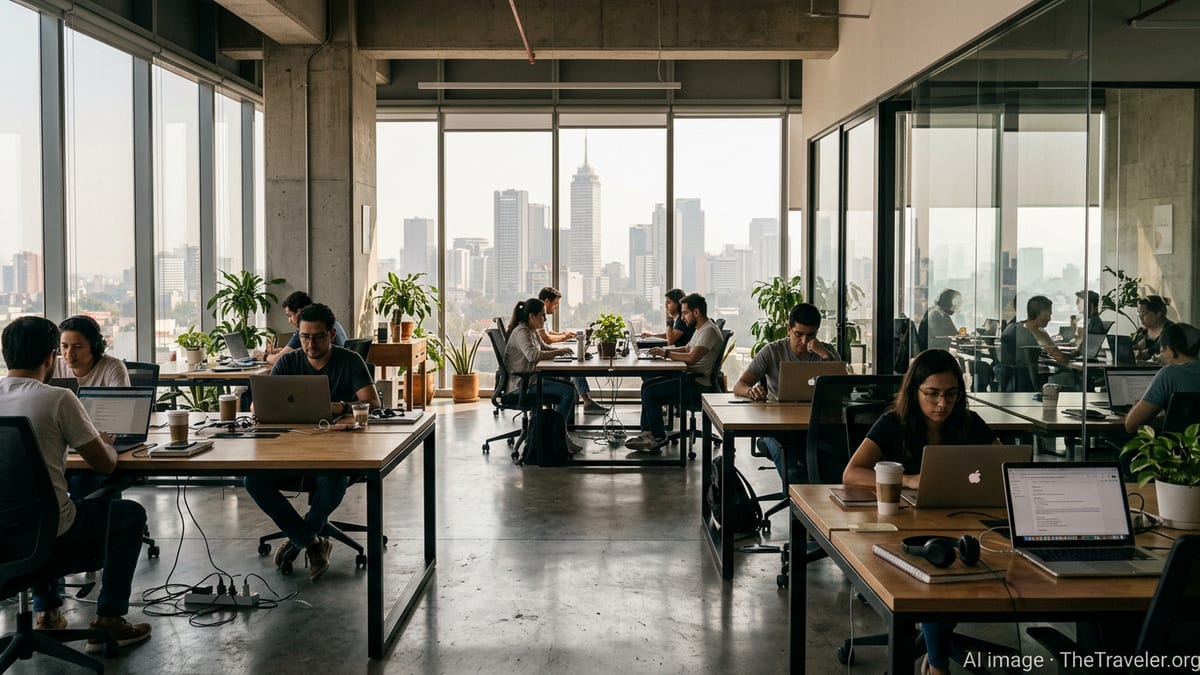
Mexico’s coworking sector has grown rapidly and is a key asset for digital nomads. Sector research valued the national coworking market at around 170 million US dollars in 2023 with forecasts projecting a tripling of market size by 2030 at a high double digit compound annual growth rate. This expansion reflects both increased local demand for flexible offices and sustained interest from international operators.
Recent mapping of physical coworking locations suggests that there are now several thousand coworking spaces across Mexico, heavily concentrated in a few states. Mexico City alone accounts for close to 700 spaces, representing more than one fifth of the national coworking inventory. Other major hubs include the State of Mexico, Jalisco, Nuevo Leon, Quintana Roo, Queretaro, Oaxaca, Yucatan, and Chihuahua. These figures indicate that nomads basing themselves in large metropolitan zones will have abundant options for shared workspaces.
For digital nomads, the depth of the coworking ecosystem translates into practical advantages: ready access to ergonomic workstations, dedicated meeting rooms with reliable connectivity, and professional environments suitable for client calls. National and international brands maintain presence across multiple cities, which can be beneficial for nomads rotating between different Mexican locations while keeping a single membership.
In secondary and tertiary cities, coworking capacity is more limited but still expanding. Prospective relocators should anticipate fewer choices and more variability in quality outside the main corridors. In established tourist destinations, especially along the Caribbean and Pacific coasts, niche spaces oriented toward international remote workers have emerged, but overall density remains lower than in the capital and industrial hubs.
Practical Working Conditions: Power, Redundancy, and Urban Infrastructure
Beyond internet access and formal workspaces, digital nomads need a stable operating environment that supports day to day productivity. Mexico’s major cities generally provide reliable electricity supply, modern office towers, and business services comparable to other upper middle income economies. However, localized power outages can still occur, particularly during storms, heatwaves, or infrastructure maintenance events.
Many mid to high tier coworking spaces and modern apartment buildings are equipped with backup power systems, surge protection, and business continuity measures. Digital nomads who depend on uninterrupted workdays often prioritize such buildings and may keep individual power banks and mobile hotspots as additional layers of redundancy. In smaller towns and older housing stock, backup infrastructure is less common, which increases the risk of temporary downtime after severe weather or grid issues.
Urban transport conditions indirectly affect nomad work routines. Traffic congestion in large cities can be substantial, which may complicate commuting between housing and coworking spaces at peak hours. Consequently, a micro location strategy that minimizes commute times usually contributes more to productivity than attempting to optimize only for rent or lifestyle. Districts with integrated residential and office developments around transit hubs tend to be more practical for regular coworking use.
For 2026, it is reasonable to characterize Mexico’s core urban infrastructure as adequate to support a professional remote work routine, with residual risks that can be mitigated through careful choice of neighborhood, building type, and redundancy tools.
Regional Variations: Best Performing Locations for Nomads
Mexico is highly heterogeneous, and digital nomad experiences differ substantially by region. The most favorable environments for remote work typically combine strong connectivity, dense coworking supply, and reasonably predictable urban services. Mexico City stands out with the highest concentration of coworking spaces, the most advanced telecommunications infrastructure, and competitive broadband offerings in central districts. Monterrey and Guadalajara follow as industrial and technological hubs with solid fixed and mobile network coverage and growing flexible office ecosystems.
Tourist centric regions such as Quintana Roo and parts of the Yucatan Peninsula offer an increasing number of coworking venues and acceptable internet speeds, especially in larger urban nodes. However, connectivity quality can degrade quickly outside main towns and resort corridors, and backup options may be limited in more remote beach or rural communities that appeal to some digital nomads for lifestyle reasons.
In central and southern states with weaker infrastructure or high rural populations, there may be pockets of good connectivity in state capitals but far less pervasive digital infrastructure elsewhere. Nomads looking for long stays in such regions need to validate conditions at the building and street level, not just at the city scale. In many cases, working primarily from a well equipped coworking or serviced office while treating home connections as secondary is the safest operational model.
Overall, Mexico in 2026 offers several city level ecosystems that can be considered strong or very strong for digital nomads, alongside a large number of locations where connectivity and infrastructure constraints still reduce suitability for professional remote work.
The Takeaway
Evaluated strictly from the perspective of digital work infrastructure, Mexico in 2026 presents a mixed but generally positive picture for digital nomads. The country delivers wide 4G coverage, expanding 5G presence in major cities, improving median internet speeds, and a rapidly growing coworking and flexible office sector anchored in Mexico City and a handful of other metros.
At the same time, structural disparities between urban hubs and peripheral regions, intermittent power and service reliability in some areas, and neighborhood level variation in fixed broadband quality mean that Mexico is not uniformly suitable across its territory. Digital nomads need to adopt an informed, location specific strategy that prioritizes connectivity data, coworking density, and building level infrastructure when selecting a base.
For professionals whose remote work can tolerate moderate levels of variability and who are prepared to invest in redundancy measures such as dual connections and power backup, Mexico’s leading cities can function as effective and cost competitive bases. For roles requiring near enterprise grade uptime and bandwidth, only a subset of districts within the main metropolitan areas will fully meet expectations.
Consequently, Mexico can be considered good for digital nomads in 2026, provided relocation decisions are grounded in granular connectivity research and a realistic understanding of regional infrastructure variations rather than broad national averages or purely lifestyle considerations.
FAQ
Q1. Is internet in Mexico generally reliable enough for full time remote work?
Internet in major Mexican cities is usually reliable enough for full time remote work, especially when combining fixed broadband with a backup mobile data plan.
Q2. What mobile speeds can digital nomads realistically expect in Mexican cities?
Digital nomads in large urban areas commonly experience mobile download speeds in the tens of Mbps range, often around 30 to 60 Mbps, sufficient for video calls and cloud tools.
Q3. Is 5G widely available for digital nomads in Mexico in 2026?
5G is available in many large cities and specific zones but is not yet nationwide. Most smaller towns still rely primarily on 4G networks for mobile data.
Q4. Are coworking spaces easy to find in Mexico?
Coworking spaces are abundant in major hubs like Mexico City, Monterrey, Guadalajara, and key tourist metros, but options are more limited in smaller or rural locations.
Q5. How do power outages affect digital nomads working from Mexico?
Short power interruptions can occur, particularly outside core business districts. Many coworking spaces and modern buildings use backup systems, and nomads often maintain personal redundancy.
Q6. Which Mexican cities currently offer the best conditions for digital nomads?
Mexico City, Monterrey, and Guadalajara generally provide the most robust combination of connectivity, coworking density, and urban infrastructure suitable for sustained remote work.
Q7. Can digital nomads work effectively from smaller beach towns in Mexico?
Some beach towns have adequate connectivity and coworking options, but quality can vary by neighborhood, and backup infrastructure is often weaker than in large cities.
Q8. Is mobile data coverage good when traveling within Mexico?
Mobile data coverage along major highways and between large cities is usually good, but coverage and speed may drop in remote, mountainous, or sparsely populated areas.
Q9. Do most coworking spaces in Mexico provide stable high speed Wi Fi?
Mid to upper tier coworking spaces in main cities typically offer stable high speed Wi Fi as a core service, although quality can vary in smaller, independent venues.
Q10. Overall, is Mexico a good long term base for digital nomads focused on work performance?
Mexico can be a strong long term base for digital nomads who choose infrastructure rich cities, verify neighborhood level connectivity, and implement reasonable redundancy for power and internet.