


In Dubrovnik’s Old Town, two Baroque landmarks compete quietly for your attention: the Church of St Blaise on lively Luža Square and the Cathedral of the Assumption of the Virgin Mary, usually called Dubrovnik Cathedral, a few minutes’ walk away. Both are deeply woven into the city’s history and both are free or inexpensive to visit, which leaves many travelers wondering which one is truly more impressive. The answer depends less on size and fame and more on what kind of experience you want from your time in Dubrovnik.
Get the latest updates straight to your inbox!
First Impressions: Setting and Atmosphere
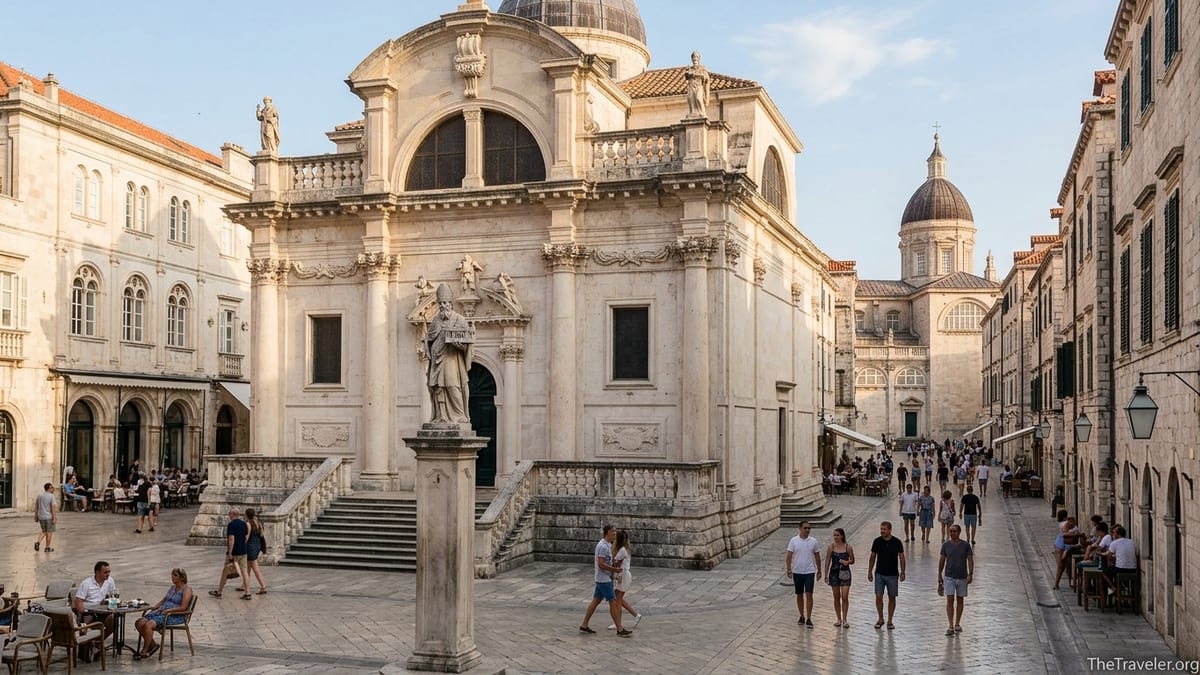
If you enter the Old Town through Pile Gate and follow the polished limestone of Stradun toward the clock tower, the first of the two you will likely notice is the Church of St Blaise. The compact Baroque facade stands at the meeting point of several main streets, with outdoor café tables, buskers and groups from cruise ships collecting nearby. The church feels part of the everyday theatre of Dubrovnik life, especially in the late afternoon when the sun drops behind the walls and the square glows in soft reflected light.
Dubrovnik Cathedral lies only a few minutes away, down a side street and past stone staircases and Renaissance palaces. Its position is quieter, slightly removed from the main pedestrian flow. The front square is broad but usually less crowded, so the building reads more clearly as a separate monument. In the early morning, when shop shutters are still down, the cathedral’s pale stone facade and large dome catch the first light and give a sense of calm that can be hard to find elsewhere in the Old Town in peak season.
For travelers who want an impressive church as part of a lively urban scene, St Blaise has the stronger impact at first sight. Those looking for a spacious, more contemplative setting may find the cathedral’s location and larger scale more compelling on arrival.
Architecture and Exterior Detail
The present-day Church of St Blaise was completed in the early 18th century in a confident Venetian Baroque style. It is relatively modest in height but richly modeled, with a central staircase, Corinthian columns and a semicircular gable. On the balustrade above, a stone statue of Saint Blaise holds in his hand a model of medieval Dubrovnik, a detail that rewards a closer look if you step back toward the Sponza Palace side of the square and zoom in with a phone camera.
Dubrovnik Cathedral, rebuilt after the devastating 1667 earthquake, is a larger Roman Catholic cathedral with a cross-shaped ground plan, a tall dome and a broad, classically ordered facade. Its lines are cleaner than those of St Blaise, with a strong emphasis on vertical pilasters and a high central pediment. When seen from the city walls or from the hilltop viewpoint on Mount Srđ, the cathedral dome is one of the defining elements of the Old Town skyline, while St Blaise blends more into the dense fabric of palaces and townhouses.
In terms of pure architectural power, the cathedral typically wins. It reads unmistakably as a major Baroque cathedral comparable, in its proportions if not in scale, to those in larger Mediterranean cities. St Blaise, by contrast, impresses through its refinement and its close relationship with the surrounding square rather than through size or dominance.
Interior Experience: Space, Light and Art
Inside, the two landmarks offer very different experiences. The Church of St Blaise has a compact single nave with a Greek-cross-inspired plan and a low dome. Visitors often comment on the feeling of intimacy: white and light-colored walls, marble altars with gilded detail and a central focus on the main altar and the silver statue of Saint Blaise. On a typical summer visit you might share the space with a handful of worshippers lighting candles, plus a few small tour groups slipping in for a brief photo stop between walks along the city walls and a boat trip to Lokrum.
Dubrovnik Cathedral’s interior is more expansive and brighter, with high vaults and large windows in the Baroque manner. The main altar holds a polyptych attributed to Titian that depicts the Assumption of the Virgin, a clear highlight for visitors interested in Renaissance and Baroque painting. Side chapels contain further artworks and altars, and the light stone and plaster create a calmer, more luminous atmosphere than in many darker Gothic cathedrals elsewhere in Europe.
If you are particularly drawn to art, the cathedral has the edge, largely because of the Titian altarpiece and the wider range of paintings in the chapels and treasury. If, instead, you prefer a smaller space focused on a single figure and story, St Blaise’s interior, centered on Dubrovnik’s patron saint, may feel more personally moving.
History, Relics and Religious Significance
Few places in Dubrovnik have a stronger symbolic role than the Church of St Blaise. Saint Blaise has been honored as the patron of Dubrovnik for centuries, associated with legends of protecting the city from attack and disease. The current Baroque church stands on the site of an earlier medieval church that survived the 1667 earthquake but burned in 1706. Some of the key objects saved from that fire, including a cherished Gothic statue of the saint in silver, are preserved inside today’s building.
Every year on 3 February, the Feast of Saint Blaise transforms the space in front of the church into an open-air religious and civic stage. Banners from parishes across the region are carried into the Old Town, Mass is celebrated at the church, and a procession passes both St Blaise and the cathedral, with the blessing of throats using crossed candles. For travelers who happen to be in the city around that date, witnessing even part of these celebrations can leave a deeper impression than a normal sightseeing visit.
Dubrovnik Cathedral, meanwhile, holds a remarkable treasury of more than one hundred relics, including reliquaries of the head and limbs of Saint Blaise, as well as relics traditionally associated with the True Cross and items linked to the life of Jesus. Many of these reliquaries are elaborately crafted in gold and silver by local and Italian artisans from the 13th to the 18th century. The presence of Saint Blaise in both churches underlines how tightly his story is woven into the fabric of the city; at the cathedral, however, this is expressed through the sheer number and variety of sacred objects on display.
In terms of historical and religious depth, the cathedral treasury arguably offers the more impressive ensemble, especially for travelers accustomed to visiting major European cathedrals. Yet the lived devotion on display at St Blaise, particularly during local feast days and regular parish life, may feel more immediate and human-scale.
Practical Visit: Opening Hours, Tickets and Crowds
For most of the year, entry to both churches for basic visits is free, though donations are appreciated. The Church of St Blaise usually has its main doors open throughout the day, particularly in high season, with short closures before and after Mass. Because it is right on one of the main crossroads of the Old Town, you can easily duck in for a few quiet minutes between other sights without planning your timing too carefully.
Dubrovnik Cathedral also allows free access to the main nave outside of service times, but there is a small separate ticket for the treasury, sold from a desk just inside to the right. Recent visitor reports suggest the fee is modest by Western European standards, generally in the range of a few euros per person, payable in cash or card. For many travelers this feels like good value, especially compared with the relatively high cost of walking the city walls or taking a cable car ride.
In terms of crowding, St Blaise can feel busier at the entrance as groups briefly block the doorway for photos or guides’ explanations. Inside, however, the number of people tends to ebb and flow quickly, and early morning or late evening can be surprisingly serene. The cathedral, being larger, absorbs groups more comfortably, but the treasury room itself can feel tight when a tour group arrives. If you are visiting in July or August and dislike crowds, going to the treasury in the first opening hour of the day or near closing time usually offers a more relaxed experience.
Overall, in practical terms, both sites are easy and inexpensive to visit. The cathedral requires a bit more planning if you want to see the treasury at its quietest; St Blaise rewards spontaneous drop-ins throughout the day, especially if you are already exploring Stradun and Luža Square.
Which Is More Impressive for Different Types of Travelers?
For visually oriented travelers and photographers, the answer may differ by time of day. St Blaise photographs beautifully in the blue hour after sunset, when the church is illuminated and reflections shimmer on the worn stone paving of the square. It also makes a strong backdrop for street photography that captures local life, children playing around the nearby fountain, or couples strolling past in evening dress on their way to dinner.
Dubrovnik Cathedral, by contrast, reveals its strongest photographic angles from elevated viewpoints and side streets. A common approach is to walk partway along the city walls and frame the dome with terracotta rooftops and the Adriatic in the background. Inside, the high nave and altar by Titian reward careful composition with a wider lens; many visitors use a phone in ultra-wide mode or a mirrorless camera with a 24 mm lens to capture the full sweep of the interior.
For travelers most interested in art and history, the cathedral generally feels more impressive because it concentrates so many significant works in one place, from the main altarpiece to the treasury’s reliquaries and paintings. For those who are drawn to living traditions and local identity, St Blaise may leave a stronger memory: this is the church whose image appears on city flags, festivals and souvenirs, and whose feast day still brings people from across the region into the Old Town streets.
If you have time for only one interior visit and want a classic “big church” experience comparable to other European cathedrals, choose Dubrovnik Cathedral and pay to see the treasury. If, however, you are already feeling saturated by large churches from other trips and want something more intimate and specifically tied to Dubrovnik’s story, St Blaise might feel more special and less interchangeable.
The Takeaway
Deciding whether the Church of St Blaise or Dubrovnik Cathedral is more impressive ultimately depends on what you value most in a landmark. The cathedral is larger, brighter and richer in art, with a treasury that rivals those of much bigger cities and a dome that anchors Dubrovnik’s skyline. It satisfies travelers looking for a sense of grandeur and for highlights that can be easily compared with other famous European cathedrals.
St Blaise, on the other hand, derives its power less from scale and more from meaning. It is the spiritual heart of the city’s patron saint cult, an everyday parish church embedded in the busiest square, and the stage for one of Dubrovnik’s most important annual celebrations. Its Baroque facade, detailed interior and close relationship with the surrounding streets make it feel inseparable from the life of the Old Town.
For most visitors, the best answer is not to choose between them but to see both in different ways: walk past St Blaise several times at different hours to feel how it anchors daily life, then set aside a quieter block of time to explore the cathedral interior and treasury in depth. Taken together, they tell a complementary story of Dubrovnik as both a proud former city-state with far-reaching connections and a living community still gathered under the protection of its patron saint.
FAQ
Q1. If I have time for only one, should I visit the Church of St Blaise or Dubrovnik Cathedral?
Both are close together, but if you must choose one, Dubrovnik Cathedral is generally the better single stop because of its larger interior, major artworks and paid treasury, which offers a concentrated collection of relics and liturgical art.
Q2. Is there an entrance fee for either church?
Entry to the main interiors of both St Blaise and Dubrovnik Cathedral is usually free, though donations are appreciated. The cathedral treasury requires a small separate ticket, typically just a few euros, while St Blaise does not charge for standard visits.
Q3. How much time should I plan for each landmark?
Most travelers spend about 10 to 20 minutes inside St Blaise, longer if they sit for quiet reflection. Dubrovnik Cathedral can be seen in similar time, but if you visit the treasury and take time with the artworks, plan for 30 to 45 minutes.
Q4. Which church is better for photography?
St Blaise excels in exterior photos, especially around sunset and in the evening when the facade is lit and the square is busy with people. Dubrovnik Cathedral offers stronger interior photography and impressive skyline shots of its dome from the city walls or higher viewpoints.
Q5. Are there specific dress codes for visiting these churches?
As active Catholic churches, both ask visitors to dress respectfully. Shoulders and knees should be covered where possible, and beachwear is inappropriate. In practice, staff are often understanding in summer, but carrying a light scarf or shawl is recommended.
Q6. Can I attend Mass at St Blaise or Dubrovnik Cathedral?
Yes, both are functioning parish churches with regular Masses, especially on Sundays and feast days. Schedules can change seasonally, so it is best to check locally at the church noticeboards or with your accommodation if you want to attend a specific service.
Q7. Which church is more suitable for a quiet, reflective visit?
Despite its central location, St Blaise can be very peaceful early in the morning or later in the evening, with only a few worshippers inside. The cathedral offers more physical space and can also feel calm, particularly outside peak tour-group hours, so either can work if you choose your time carefully.
Q8. Is the Dubrovnik Cathedral treasury worth the extra cost?
For most visitors interested in history, art or religion, the treasury is worth the modest fee. It houses an extensive collection of reliquaries of Saint Blaise, other saints and precious liturgical objects crafted over several centuries, items you would not otherwise see just by entering the main nave.
Q9. Are guided tours necessary to appreciate these landmarks?
Guided tours are not essential but can add context, especially for understanding the legends of Saint Blaise and the significance of specific artworks. Many walking tours of the Old Town include a stop outside St Blaise and sometimes inside the cathedral, while audio guides and printed leaflets also help independent visitors.
Q10. How accessible are the Church of St Blaise and Dubrovnik Cathedral?
Both churches are in the pedestrian-only Old Town with some uneven stone paving. Each has a short flight of steps at the entrance, which may present challenges for visitors with limited mobility. There are usually no long queues, but those needing extra time should avoid peak midday hours when crowds and heat are at their worst.