


Trenton, New Jersey’s often overlooked capital, tends to flash by in a blur of train windows and interstate exit signs. Many travelers only know it from the phrase on the Northeast Corridor rail line: “Trenton makes, the world takes.” But if you are planning a trip between New York and Philadelphia, or driving through central New Jersey, is Trenton worth a dedicated visit or better treated as a quick stop to stretch your legs and grab a coffee?
Get the latest updates straight to your inbox!
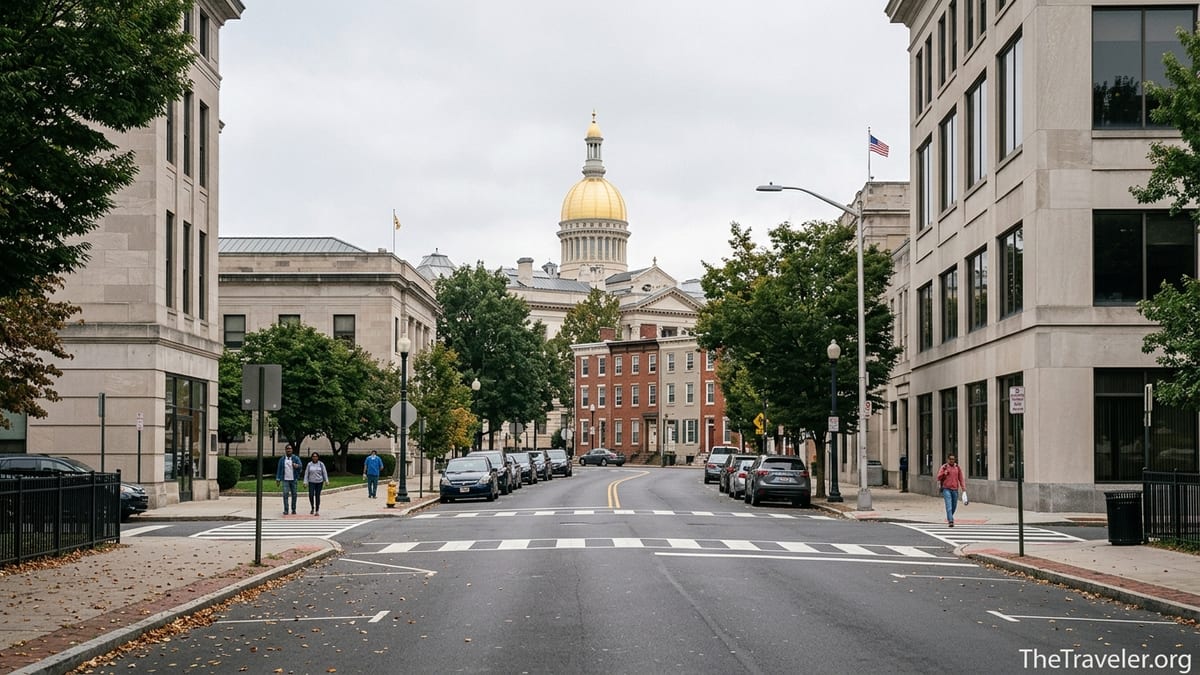
First Impressions: A Small Capital with Mixed Reputation
Trenton is a compact, working government town rather than a polished tourist showpiece. The New Jersey State House, courts and office buildings anchor a downtown that can feel quiet after working hours, especially compared with nearby Princeton or Philadelphia. For many visitors, this low-key atmosphere, combined with headlines about crime, raises a fair question: should you linger, or simply change trains and move on?
On the ground, the picture is more nuanced. Around the State House complex and Mill Hill Park, daytime streets typically see state workers, students and a trickle of visitors heading to the New Jersey State Museum or the Old Barracks Museum. You might notice a few closed storefronts and a generally worn urban fabric, but also historic brick row houses, murals, and the broad sweep of the Delaware River not far away.
Where Trenton differs from more familiar city-break destinations is scale. The key sites are tightly clustered: the State House, State Museum with its planetarium, Old Barracks, and the William Trent House are all within a roughly 10 to 15 minute walk of each other. That makes Trenton an easy half-day destination, but it also means that once you have seen the core, you may run out of obvious things to do unless you plan around an event.
The city’s reputation for crime is not unfounded, and visitors should approach it as they would any under-resourced American downtown: stay in the central areas by day, avoid wandering unfamiliar blocks late at night, and plan transport ahead. For many travelers, this context tips the scales toward a focused, time-limited visit rather than a leisurely urban getaway.
When Trenton Is Worth a Dedicated Half‑Day
If you are interested in American Revolutionary history, state politics, or mid‑century civic architecture, Trenton rewards a deliberate half‑day visit. The Old Barracks Museum, a restored 18th‑century British barracks used during the French and Indian War and the Revolutionary War, is a genuine standout. Small-group guided tours walk you through timbered barracks rooms, officers’ quarters, and interpretive exhibits that explain Trenton’s role in George Washington’s 1776 crossing of the Delaware. As of 2026, adult admission is typically in the mid‑teens in dollars, with discounts for students and seniors, which most history‑minded visitors find reasonable for the depth of interpretation provided.
Just a few minutes’ walk away, the New Jersey State Museum combines art, history, and science under one roof. Admission to the main galleries is free, and the collections range from fossils and Native American artifacts to New Jersey landscape paintings and contemporary art. Families in particular tend to appreciate that they can spend an hour or two exploring without worrying about ticket costs, then pay separately for planetarium shows if they are interested.
The adjacent planetarium, one of the largest in the state, usually runs several shows per day on weekends and one mid‑afternoon show on weekdays. Tickets are priced roughly at the level of a movie matinee, with cheaper rates for children and modest discounts for seniors and students. For a family riding Amtrak or NJ Transit through the corridor, planning a three‑hour layover to catch a planetarium show and browse the museum can turn a boring travel day into something memorable, especially for school‑age children fascinated by space and dinosaurs.
Rounding out a focused visit, a free guided or self‑guided look at the New Jersey State House offers an inside view of a working capitol, with domed chambers, ornate legislative halls, and exhibits on how state government functions. Visitors who enjoy touring places like the Pennsylvania Capitol in Harrisburg or the Massachusetts State House in Boston will find Trenton’s counterpart similarly interesting, albeit on a smaller scale.
Perfect as a Strategic Stop on the Northeast Corridor
Where Trenton truly shines for many travelers is as a convenient pause between bigger destinations. It sits roughly halfway between New York City and Philadelphia on both the Amtrak and NJ Transit rail corridors, and just off Interstate 295 and Route 1 for drivers. Instead of grabbing a rushed sandwich at a highway rest area, you can step off the train, walk 10 to 15 minutes, and be standing inside an 18th‑century barracks or a modern planetarium.
For rail travelers, a practical itinerary might look like this: arrive at Trenton Transit Center late morning, store a small bag in a station locker if available or travel light, then walk via Mill Hill Park toward the State House area. You can tour the Old Barracks Museum around midday, have a simple lunch from a downtown deli or a casual Latin or soul food spot, then spend an hour in the New Jersey State Museum before heading back for a late‑afternoon train. With careful planning of train times, this sequence can fit comfortably into four or five hours.
Drivers can exit near the capitol complex, park in one of the public garages used by state employees on weekdays, or in surface lots that are often free or lower‑priced on weekends. For example, visitors commonly use garages along Lafayette or Warren Streets when visiting the Old Barracks or State Museum. Metered street parking around West State Street can work for short museum visits, particularly on quieter weekends.
Another way to leverage Trenton as a stop is to connect it with a visit to nearby Princeton. You might spend a night in Princeton, explore the university town’s bookstores and restaurants, then drive or take a short train hop to Trenton the next morning for a focused museum and history circuit. This approach lets you enjoy Princeton’s more polished hospitality options while still experiencing the capital’s historical core without feeling pressured to stay after dark.
Safety, Comfort, and Choosing Where to Spend Time
Any realistic assessment of whether Trenton is worth visiting must address safety. Statistically, the city’s crime rates are higher than the New Jersey average, particularly in certain residential neighborhoods far from the capitol complex. Visitors, however, tend to spend their time along a narrow corridor between the Transit Center, Mill Hill Park, the State House, and the State Museum. During business hours on weekdays, these areas see steady foot traffic from state workers and visitors, and most people experience nothing more concerning than the occasional panhandler or boarded‑up storefront.
The main practical advice is to treat Trenton like any small, economically stressed American city. Plan sightseeing during daylight, keep valuables out of sight, and avoid wandering into unfamiliar residential blocks in search of coffee or nightlife. Around the Transit Center in particular, evenings can feel desolate after commuters have left, and travelers report feeling more comfortable waiting for trains inside the station rather than lingering on the streets outside.
Mill Hill, the historic neighborhood near the park of the same name, is an exception worth noting. Here you will find restored 19th‑century brick row houses, small gardens, and occasional community events like house tours and open‑studio days. Many state employees and local professionals choose to live here precisely because it offers a more stable and neighborly feel than Trenton’s reputation suggests. Visitors walking between the station and the State House via Mill Hill Park during the day often describe the route as pleasant, with a small waterfall, stone bridges, and mature trees softening the urban setting.
If your priority is a sense of security above all else, you may prefer to base yourself in an outlying suburb such as Hamilton or Lawrenceville, then drive in for a daytime visit. Mid‑range chain hotels along Route 1, for example, typically offer free parking, familiar room standards, and quick freeway access, making them practical bases for travelers who want to explore the region without committing to an overnight stay in Trenton itself.
Experiences You Can Only Have in Trenton
Though modest in scale, Trenton offers a few experiences that you will not easily replicate elsewhere along the Northeast Corridor. The Battle of Trenton story, anchored at the Old Barracks Museum, is one of the most tangible ways to connect with the turning point of the Revolutionary War. Standing in the same courtyard where Hessian soldiers once mustered, watching a costumed interpreter demonstrate musket drill, or stepping into the crowded barracks rooms gives a more visceral sense of 18th‑century military life than a textbook ever could.
Close by, the Trenton Battle Monument, a tall stone column marking the site of the American artillery placement, looms over a largely residential intersection. Although the immediate surroundings are not particularly scenic, history buffs often appreciate the chance to see the physical geography of the battle laid out before them, comparing it to well‑known paintings and diagrams of Washington’s surprise attack on the town.
Beyond Revolutionary history, the New Jersey State Museum’s collections highlight the state’s paleontology and industrial heritage. Fossil displays drawn from digs in central and southern New Jersey help visitors imagine the region when it was home to marine reptiles and early dinosaurs, while industrial exhibits connect the capital’s past as a manufacturing hub to the famous “Trenton Makes, The World Takes” sign on the Lower Trenton Bridge that Amtrak riders still pass under today.
Trenton’s cultural calendar also punches above its weight on certain weekends. Events like Art All Day, which opens up galleries and studios across the city with trolley or bike tours, or community festivals in Mill Hill Park, give outsiders a glimpse of a creative scene that exists beneath the city’s rougher edges. If you time your visit to coincide with one of these events, you may find Trenton far more engaging than its daily rhythm might suggest.
When Trenton Works Best as Just a Quick Stop
For many travelers, especially those short on time or not particularly interested in history or museums, Trenton makes more sense as a quick, utilitarian stop than as a destination in its own right. If your main goal is to get from Boston or New York to Washington, you may simply appreciate Trenton for its transportation function: a place to change from NJ Transit to SEPTA, or to step off an Amtrak train for a 30‑minute break between long rail segments.
In that scenario, your interaction with the city might be limited to the Transit Center itself, a walk across the street for coffee or a snack, and perhaps a brief view of the “Trenton Makes” bridge from the train window. For some travelers, especially solo passengers arriving after dark, this feels like the right balance of convenience and caution.
Drivers heading south on Interstate 295 or north on Route 1 might similarly choose a quick refueling stop on the outskirts rather than navigating downtown. Large service plazas and big‑box clusters outside the core offer predictable fast‑food chains, fuel stations, and supermarkets with long opening hours. If you are traveling with children who are tired after a long day, the simplicity of a roadside meal and a standard motel in a nearby suburb can be more appealing than steering into an unfamiliar small city at night to search for parking.
It is also fair to say that Trenton lacks the concentrated restaurant and bar scene that would make it an obvious destination for an evening out. While there are some beloved local spots, especially for Caribbean, Latin American, and barbecue dishes, they are scattered rather than grouped into an easy‑to‑navigate dining district. Travelers looking for atmospheric streets lined with bistros and cocktail bars are more likely to find what they want in Princeton, New Brunswick, or Philadelphia, all within an hour’s travel.
The Takeaway
So, is Trenton worth visiting or better as a quick stop? The answer depends on your interests, schedule, and comfort level. If you care about American history, enjoy mid‑sized museums, and appreciate peeking behind the curtain of state government, Trenton can easily justify a focused half‑day visit. The Old Barracks Museum, New Jersey State Museum with its planetarium, and the State House together offer a compact, meaningful slice of New Jersey’s story that you can experience without a car, straight from the train.
If your priorities lean toward nightlife, shopping, and polished urban ambience, or if you are traveling late in the day and prefer places that feel busy into the evening, Trenton is more likely to function as a strategic pause in your journey. In that role, it excels: a convenient link between New York and Philadelphia, a quick lunch or museum break off the highway, a moment to stretch your legs in Mill Hill Park before moving on.
Perhaps the most realistic way to think about Trenton is as a city best appreciated with intention and boundaries. Arrive during daylight, know what you want to see, focus on the capitol and museum district, and give yourself three to five hours. Treated this way, Trenton becomes more than a passing blur outside the train window, without demanding that you rearrange your entire itinerary around it.
FAQ
Q1. Is Trenton safe for tourists during the day?
Trenton’s central government and museum district is generally manageable during daylight for visitors who take normal urban precautions: stay on main streets, be aware of your surroundings, and avoid wandering into unfamiliar residential areas. Many visitors tour the State House and museums without incident, but the city does have higher crime rates than the state average, so extra awareness is sensible.
Q2. How much time do I really need to see Trenton’s main sights?
A well‑planned three to five hours is usually enough to see the Old Barracks Museum, browse the New Jersey State Museum, and walk past the State House and Trenton Battle Monument. If you add a planetarium show, plan closer to half a day.
Q3. Is Trenton worth a special trip, or only if I am passing through?
For most travelers, Trenton makes the most sense if you are already passing between New York and Philadelphia or staying nearby in places like Princeton. History enthusiasts or families interested in the museum and planetarium may find it worth a dedicated side trip, but it is rarely chosen as a standalone city‑break destination.
Q4. Can I visit the main attractions on foot from the train station?
Yes. From Trenton Transit Center, it is roughly a 10 to 15 minute walk through Mill Hill Park and downtown streets to reach the State House, Old Barracks Museum, and New Jersey State Museum. Many rail travelers make this walk in daylight; if you prefer, taxis and rideshares are also available for a short ride.
Q5. Are there good places to eat near the museums and State House?
The immediate area around the State House has a handful of casual options that primarily serve state workers, such as delis, diners, and small cafes open on weekdays. For a broader range of restaurants, many visitors choose to eat in nearby suburbs or in Princeton, then come into Trenton mainly for sightseeing.
Q6. Is Trenton a good base for exploring New Jersey?
As a base, Trenton has limited hotel and dining options compared with nearby towns. Travelers often prefer to stay in Princeton, Hamilton, or Lawrenceville, where chain hotels and restaurants are more plentiful, then visit Trenton as a short daytime excursion.
Q7. What is the best way to include Trenton on a Northeast Corridor trip?
One practical approach is to schedule a midday stop between New York and Philadelphia. You can arrive late morning, store or carry light luggage, walk to the museums and State House, have lunch, and continue by train in the afternoon, turning a long transit day into a more interesting journey.
Q8. Are the museums in Trenton family‑friendly?
Yes. The New Jersey State Museum in particular is popular with families thanks to its dinosaur fossils, hands‑on science exhibits, and planetarium shows. The Old Barracks Museum offers engaging tours that help children visualize Revolutionary War history, though very young kids may tire quickly.
Q9. Should I avoid Trenton at night?
Many visitors and commuters choose to limit their time in central Trenton after dark, especially on quieter evenings when downtown streets empty out. If you must arrive or depart at night, staying close to the Transit Center, using taxis or rideshares, and avoiding long walks through unfamiliar areas are common‑sense precautions.
Q10. If I only have one hour in Trenton, what should I do?
With just an hour, your options are limited. From the train station, a brisk walk through Mill Hill Park to glimpse the State House exterior and back can give you a feel for the city. If time is tighter, you may simply choose to stay near the Transit Center, grab a coffee or snack, and use Trenton as a brief rest point before continuing your journey.