


Most people know Trenton, if at all, from a quick glimpse of the “Trenton Makes, The World Takes” sign flashing past a train window. The New Jersey capital is treated as a blur between New York and Philadelphia, a place to change trains or hop off the turnpike for gas. Spend even a few unhurried hours here, though, and a different city emerges: one of Revolutionary War turning points, brick-lined streets, and riverside parks where history still shapes the skyline.
Get the latest updates straight to your inbox!
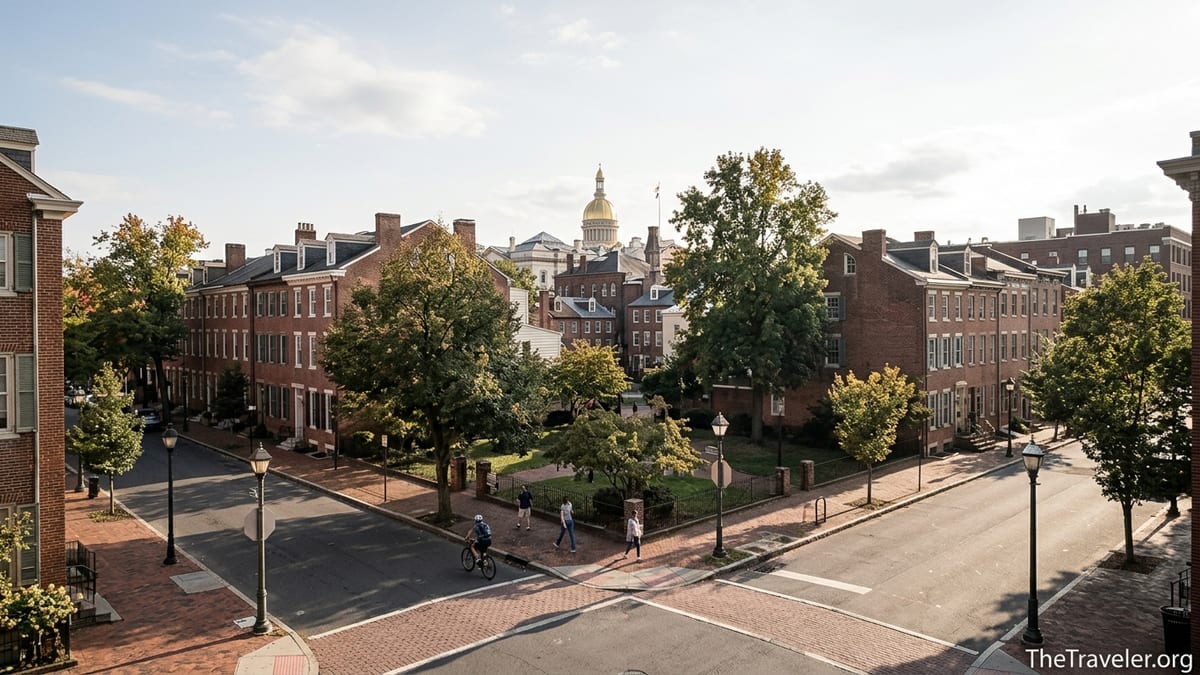
Why Trenton Is More Than a Place You Pass Through
Trenton sits on one of the busiest transportation corridors in the United States, and that is both its blessing and its curse. High-speed Amtrak trains and commuter services from New Jersey Transit and SEPTA slide into the Trenton Transit Center all day long, but most riders stay in their seats and continue to New York or Philadelphia. Drivers glimpse the gold dome of the New Jersey State House as they cross the Delaware River on Route 1 and then simply keep going. For many travelers, the city becomes shorthand for a bridge slogan rather than a destination with its own layered story.
That habit of passing through means visitors often miss how walkable Trenton’s historic core really is. Within a 15 minute stroll of the transit center you can stand where George Washington’s artillery opened fire during the Battle of Trenton, wander among 19th century brick rowhouses in the Mill Hill Historic District, and step inside one of the last surviving colonial military barracks in the country. You can see the “Trenton Makes” bridge up close, not as a blur from the train, and trace how the riverfront helped turn the city into an industrial powerhouse. For travelers who enjoy smaller, less polished historic cities like Providence or Albany, Trenton offers a similar depth with fewer crowds and a distinctly Revolutionary flavor.
It is important to be realistic about context. Trenton struggles with issues of disinvestment and has neighborhoods where a casual visitor has little reason to wander. Yet that should not overshadow the areas that are welcoming and full of character, particularly in daylight hours: the government district around the State House, the Old Barracks Museum, Mill Hill, and stretches of the Delaware riverfront. With basic urban common sense and a plan, Trenton rewards the traveler who steps off the train or makes a deliberate side trip.
Walking Through a Turning Point in the American Revolution
Trenton’s most compelling historic story centers on a single winter morning: December 26, 1776. After crossing the ice-choked Delaware River on Christmas night, George Washington led Continental troops into Trenton and surprised the Hessian garrison stationed there. The Battle of Trenton was brief but pivotal, lifting American morale at a dark moment in the Revolutionary War. Today the outline of that battlefield is woven into the modern street grid, and you can trace it on foot in under an hour.
The natural starting point is the Old Barracks Museum, a low, stone-and-brick building tucked just off West State Street. Built in 1758 to house British soldiers during the French and Indian War, it later served as quarters and a hospital during the Revolution. Today, costumed interpreters lead small-group tours through its interior rooms, describing how soldiers lived and how wounded troops were treated in the cold winter of 1776 and 1777. Standard adult admission is typically in the mid-teens in dollars, with discounts for children and seniors, making it an easy half-day stop for families interested in hands-on history.
From the barracks it is a ten minute walk north along Warren or Broad Street to the Trenton Battle Monument. Rising roughly 150 feet above a small park at a junction known historically as Five Points, the Beaux Arts column marks the position of Washington’s artillery during the battle. Look up to see the bronze statue of Washington atop the column, gazing south toward the center of town. Plaques at the base explain how cannon placed here dominated the streets and helped trap the Hessian forces. The monument itself is often quiet, with a few locals sitting on benches, which makes it easy to pause and imagine the sound of artillery echoing off the surrounding brick buildings.
To get a sense of the broader Revolutionary landscape, combine these stops with a short walk over to Assunpink Creek near Mill Hill Park, where the Second Battle of Trenton unfolded days later. Interpretive panels in the park outline how the creek formed a defensive line and how Washington used it to his advantage. If you are staying in nearby Princeton or New Hope, you can easily connect Trenton’s sites with Washington Crossing and Princeton Battlefield in a single day, following what heritage planners call the “Ten Crucial Days” corridor.
Mill Hill: Brick Streets, Rowhouses and a Sense of Community
A few blocks southeast of the State House, Mill Hill feels like a different world from the wide state office plazas. Narrow, tree-lined streets are flanked by late 19th century rowhouses with brightly painted doors and flower boxes. The neighborhood developed around one of central New Jersey’s earliest industrial sites, a mill along Assunpink Creek that dates back to the late 1600s, and its surviving architecture reflects Trenton’s growth as a manufacturing center in the 1800s.
The Mill Hill Historic District covers just over thirty acres and includes close-set houses built in styles ranging from Italianate to Second Empire. Many have been carefully restored, and property markers along the sidewalks identify individual structures and their approximate construction dates. For visitors, this creates a self-guided walking museum of residential architecture. On a typical weekend morning you might see residents walking dogs or tending small front gardens, and you are likely to share the sidewalk more with locals than with tourists.
Mill Hill Park sits at the edge of the neighborhood, folding the area’s industrial and Revolutionary history into a green space. Stone remnants and signage hint at former millworks, while a small bridge crosses the creek that once powered them. In warmer months, the park hosts community events such as outdoor concerts or art festivals, and food trucks sometimes line the adjacent streets. If you are in town on a Saturday during one of Trenton’s citywide arts events, you may find the park serving as a hub for walking tours and open studios, with local volunteers happy to point you toward their favorite historic corners.
For travelers nervous about navigating unfamiliar urban neighborhoods, Mill Hill’s compact, well-maintained streets make it a comfortable place to wander in daylight hours. The route from the transit center or State House is straightforward, and pairing a stroll here with visits to the Old Barracks and Assunpink Creek creates a varied picture of Trenton: not only a battlefield and capital city, but a place where people live and invest in their historic homes.
Inside the State House and Around the Civic Core
Trenton is one of the few small American cities where you can combine Revolutionary-era sites with a working capital complex in a single walk. The New Jersey State House, topped by its distinctive gilded dome, stands a short distance from the Old Barracks. Portions of the building date back to the 1790s, and it has been expanded and renovated over the centuries. On weekdays, security-screened public tours usually allow visitors to step inside legislative chambers, peek into hearing rooms, and learn how modern state politics operate in a building steeped in history.
Even without joining a formal tour, it is worth circling the State House grounds to take in the mix of monuments and memorials that dot the surrounding lawns. Nearby government buildings, including the State Library and various departments, stand on sites that were once part of the early town. The result is a layered streetscape where 18th century stories sit beneath 20th century facades and modern office towers.
Close to the State House, the War Memorial auditorium offers another glimpse into Trenton’s civic past. Opened in the early 1930s as a tribute to New Jersey residents who served in World War I, the limestone building houses a large performance hall and is used today for concerts, graduations, and official ceremonies. From the outside you can appreciate its classical detailing and carved inscriptions that reflect the era’s idealism.
Give yourself time simply to walk this civic core. On a weekday you will likely see a mix of state workers on lunch breaks, lawyers heading to nearby courthouses, and school groups visiting the Old Barracks. Coffee shops and casual eateries cluster along West State Street and its side streets, many geared toward office workers. Grabbing a simple lunch at one of these spots, then returning to sightseeing, can make the day feel less like a rushed museum circuit and more like a temporary immersion in the life of New Jersey’s capital.
The Riverfront: From Industrial Powerhouse to Quiet Promenades
Trenton’s story does not make sense without the Delaware River. Long before the famous bridge sign lit up, the city’s docks, factories, and rail yards lined the water, feeding industries that produced everything from wire rope to pottery. Much of that heavy industry is gone or greatly reduced today, but the riverfront is still where you can best feel Trenton’s connection to the wider region.
The most recognizable feature is the Lower Trenton Bridge, better known by its giant illuminated slogan: “Trenton Makes, The World Takes.” The message originated in the early 20th century to promote the city’s manufacturing strength. Trains crossing the river on Amtrak and commuter lines pass directly through the bridge’s steel framework, giving passengers a dramatic view of both the sign and the water below. On foot, you can approach viewpoints from the New Jersey side to photograph the bridge with downtown Trenton or the river in the background, particularly attractive around sunset when the lights flick on.
Nearby, small riverfront parks and walkways offer space to pause and watch boat traffic or migrating birds, and to picture how different the shoreline would have looked when factories and coal yards lined its edge. A short drive or rideshare south along the river connects you with other Delaware towns that share Trenton’s industrial roots, such as Bordentown and Burlington, which can be combined with a Trenton visit for travelers exploring the region by car.
If you are arriving by train, the riverfront sits close to the transit center but not directly in front of it, so it is wise to study a map before heading out. Stick to obvious routes in daylight, especially if you are not familiar with the city, and consider combining your riverfront walk with a visit to the Battle Monument or Mill Hill so that you are moving between well-defined points of interest instead of wandering without a plan.
Practical Tips: Getting There, Staying Safe and Making a Day of It
Trenton is easy to reach even if you do not have a car. The Trenton Transit Center lies on the busy Northeast Corridor rail line, with frequent service from New Jersey Transit trains running between New York and Trenton, as well as Amtrak regional trains and SEPTA commuter trains from Philadelphia. From the station, most of the historic sites mentioned here fall within a 15 to 20 minute walk, or a short taxi or rideshare trip if you prefer not to walk.
Many travelers experience Trenton most comfortably as a day trip or part-day stop. For example, if you are staying in New York City, you might catch a morning train to Trenton, spend four or five hours visiting the Old Barracks, State House, Battle Monument, and Mill Hill, and then continue on to Philadelphia. From Philadelphia, the reverse is just as easy, and regional rail tickets are generally priced to be affordable for casual visitors. Timetables and fares change often, so checking schedules shortly before your trip is essential.
As in any small city with pockets of concentrated poverty, visitors should use ordinary urban awareness. Stick to main walking routes between the transit center, State House, Old Barracks, Battle Monument, and Mill Hill during daylight hours, and avoid wandering aimlessly into unfamiliar residential areas, especially at night. If you plan to drive, be prepared for a mix of on-street metered parking and surface lots near government buildings; on weekends, some streets can be quieter and parking less regulated, but always read posted signs carefully to avoid tickets.
Trenton’s dining scene reflects its diverse population, with casual options ranging from long-running Italian and Portuguese spots to Latin American and West African eateries. Many are family-run businesses located on or near the main arteries you will be walking along anyway. Ask staff at the Old Barracks or local residents in Mill Hill where they would send a friend for lunch; their suggestions will give you a more grounded taste of the city than any national chain.
The Takeaway
It is easy to let Trenton remain a blur outside a train window, a place that exists mostly as a joke about a bridge sign or a reputation borrowed from crime statistics. Yet for travelers who take even half a day to explore, the city offers something more interesting and more complicated: a landscape where Revolutionary War strategy, industrial might, and everyday neighborhood life overlap within a surprisingly small radius.
Walking from the Old Barracks to the Trenton Battle Monument, then on to Mill Hill and the Delaware riverfront, you move through chapters of American history that often get compressed into a few lines in high-school textbooks. In Trenton they are written into the corners of brick rowhouses, the curve of a creek, and the view from a hill where cannon once stood. You will not find the polished tourism infrastructure of larger East Coast cities, but you will find room to breathe, learn, and look closely.
So the next time your train stops in Trenton, or you see the gold dome and bridge slogan from the highway, consider getting off for a few hours. With a little planning and a willingness to walk, you can turn a place that was always something to pass through into a destination that deepens your understanding of New Jersey, the Revolution, and the way American cities evolve over time.
FAQ
Q1. Is Trenton safe for visitors who want to explore its historic sites?
Trenton has areas that struggle with crime, but the main historic sights around the State House, Old Barracks, Mill Hill, and the Battle Monument are commonly visited in daylight without incident. Using normal city awareness, sticking to well-traveled streets, and planning your routes in advance will help you feel more comfortable.
Q2. How much time do I need to see Trenton’s main historic attractions?
A focused four to six hour visit is enough to tour the Old Barracks Museum, walk to the Trenton Battle Monument, explore Mill Hill and its park, and take a brief look at the State House and riverfront. History enthusiasts could easily stretch this into a full day.
Q3. Can I visit Trenton’s historic district without a car?
Yes. The Trenton Transit Center is served by regional trains, and from there it is roughly a 15 to 20 minute walk to the State House, Old Barracks, and Mill Hill. Taxis and rideshares are available if you prefer not to walk between sites.
Q4. When is the best time of year to explore Trenton’s historic side?
Spring and fall are ideal, with comfortable temperatures for walking and colorful foliage along streets and in Mill Hill Park. Winter visits can be atmospheric around the anniversary of the Battle of Trenton, while summer offers longer daylight hours but can be hot and humid.
Q5. Do I need to book tickets in advance for the Old Barracks Museum?
For individual travelers and small groups, it is often possible to purchase admission on arrival, especially on weekdays. During busy periods, school holidays, or special events, checking hours and considering advance arrangements is wise, particularly for larger groups.
Q6. Is the Trenton Battle Monument open to go inside?
The monument grounds and surrounding park are accessible to the public, but interior access and elevator operation can be limited or suspended depending on maintenance and staffing. Plan on appreciating the structure from the outside and consult local information if you are hoping for an interior visit.
Q7. What should I wear for a walking tour of historic Trenton?
Comfortable walking shoes are essential, as sidewalks can be uneven and routes involve modest hills, especially around the Battle Monument and Mill Hill. Dress in layers suitable for the season and bring water and sun protection in warmer months.
Q8. Are there guided tours of Trenton’s historic sites?
Guided tours are sometimes offered by the Old Barracks Museum, local historical organizations, or during citywide events and commemorations. Availability varies throughout the year, so checking ahead with visitor information sources can help you plan if you prefer a structured experience.
Q9. Can I combine Trenton with visits to other Revolutionary War sites nearby?
Yes. Trenton pairs naturally with Washington Crossing, where Washington’s army crossed the Delaware, and Princeton Battlefield, where they fought days after the Trenton engagements. All three can be visited in one or two days by car, creating a compact Revolutionary itinerary.
Q10. Is Trenton a good stop with kids who like history?
Trenton can work very well for families, especially if your children enjoy stories of battles and old buildings. The Old Barracks Museum in particular offers engaging, tangible exhibits, and the short walking distances between sites help keep younger visitors from getting too tired.