


Yaverland Beach sits at the quieter northern end of Sandown Bay on the Isle of Wight, directly beneath the dramatic white chalk of Culver Down. Less developed than nearby Sandown and Shanklin, it is known for open sands at low tide, dinosaur fossils, and a local, low-key feel. But is it actually worth carving out time to visit, especially if you have only a couple of days on the island? This in-depth guide weighs up what Yaverland Beach really offers, where it falls short, and which types of travellers will get the most out of a visit.
Where Exactly Is Yaverland Beach and What Is It Like?
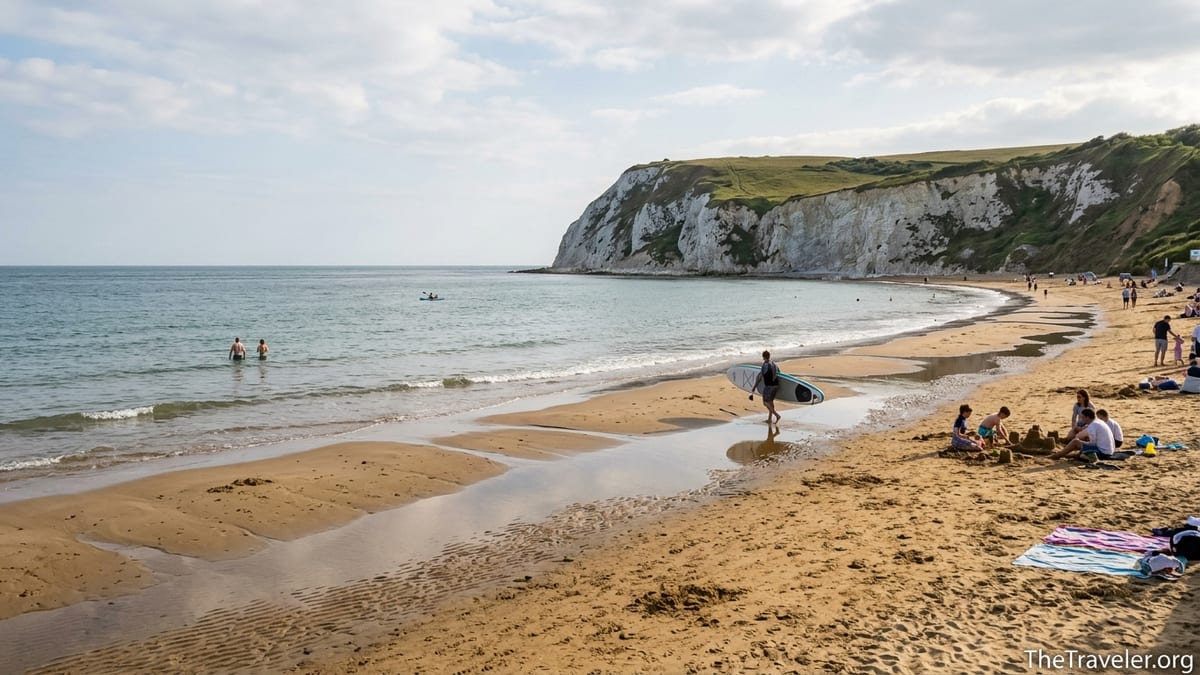
Yaverland Beach lies on the eastern side of the Isle of Wight, forming the northern arc of Sandown Bay. It stretches from just beyond the Wildheart Animal Sanctuary and Yaverland Sailing and Yacht Club up towards the base of Culver Cliff, a prominent white chalk headland visible from much of the bay. At low tide, the beach opens out into a broad expanse of firm golden sand with shallow water and extensive wet-sand shallows, while at high tide the sea can push right up, leaving only a narrow strip of beach in places.
Compared with central Sandown, where amusement arcades, ice cream kiosks and seafront hotels line the esplanade, Yaverland feels more natural and uncluttered. The backdrop is mostly open fields, a caravan park further inland, and the impressive white cliffs rather than a continuous block of buildings. Many locals treat it as their everyday dog-walking and swimming spot precisely because it feels calmer and more spacious than the resort-fronted section of Sandown Bay, especially outside peak summer weekends.
In practical terms, the main access is from Yaverland Road, where a council-run long-stay car park serves both the beach and Dinosaur Isle museum. From there, a short ramp and slipway lead straight onto the sand. It usually takes less than five minutes to walk from your parked car to the water’s edge at mid-tide, which is a welcome contrast to larger, more spread-out resort beaches where families can find themselves hauling kit for some distance.
The overall atmosphere is relaxed and low-key. On a typical summer afternoon you might see paddleboarders setting off from the shore, local open-water swimmers gathering for a timed dip, a few families with windbreaks closer to the slipway, and fossil hunters heading towards Culver Cliff with rucksacks and small hammers. There is usually enough space that people can spread out without feeling hemmed in, even in school holidays, once you walk a few minutes north from the main access point.
Swimming, Watersports and Safety at Yaverland
For confident sea swimmers and paddlers, Yaverland can be an excellent place to get in the water. The beach shelves gently, creating shallow areas that warm a little in summer and are ideal for wading or for children to paddle under close supervision. The firm sand underfoot is comfortable, and the water quality for Sandown Bay is routinely monitored and published by the authorities, which attracts local open-water swimming groups that choose Yaverland as a regular venue for early-morning and evening swims.
One important caveat is that, unlike the central stretch of Sandown Beach, Yaverland typically does not have a seasonal lifeguard service patrolling the water. Official information for the bay highlights lifeguard cover in the main resort section, with safety advice to stay between the red and yellow flags there. By contrast, Yaverland is more of a self-reliant swimming spot. Families with weaker swimmers or visitors not used to the sea might therefore prefer to swim on the lifeguarded section of Sandown during the busiest part of the day and use Yaverland for paddling, walking and picnics instead.
Watersports are a strong feature here. Local businesses in Sandown and Shanklin hire out kayaks and stand up paddleboards, and the northern end of the bay around Yaverland is regularly used by paddleboarders, kayakers and windsurfers because there is space to launch without weaving between rows of deckchairs. The swimming and watersports zones are usually informally separated, so you will often see paddlers heading slightly further out while swimmers remain nearer the shore. When the breeze picks up, kite surfers sometimes work further along the bay, using the length of open water and consistent onshore winds.
Conditions can change quickly, especially along the cliff-backed stretch towards Culver Down. Locals often time their visits with the tide tables, arriving a little before low tide to maximise sandy area for games and walking, then planning to retreat back towards the main slipway before the water pushes in. Visitors should be particularly careful not to linger too close to the cliff base when the tide is rising, as there are occasional rockfalls from the soft Cretaceous strata that make up the cliffs.
Facilities, Parking and Accessibility
One of the main practical questions travellers ask is whether Yaverland has enough facilities to be convenient for a full beach day. Compared with bigger resort beaches, the offer is limited but sufficient for many visitors. The council’s own beach information notes that catering at Yaverland is very limited, with just a small cafe close to the entrance that serves items such as hot drinks, ice creams and basic snacks in season. For a wider choice of sit-down meals, you are likely to head a few minutes by car or a 15- to 20-minute walk back along the seafront towards Sandown, where places like The Reef, Driftwood Beach Bar and family-friendly pubs around the High Street provide more substantial options.
Toilets are available near the car park and museum complex, but opening hours can be seasonal, especially outside school holidays. This is worth bearing in mind if you are visiting in late autumn or winter. There are no long rows of seafront shops immediately behind the beach at Yaverland, so if you need beach toys, sun cream or buckets and spades at short notice, you are better off picking them up in Sandown beforehand rather than relying on last-minute purchases beside the slipway.
Parking is one of Yaverland’s strengths. The long-stay Yaverland car park, managed by Isle of Wight Council, sits almost directly behind the beach. Recent council parking reports indicate that tourist permits for council-operated car parks across the island have risen modestly in price in recent years, with Yaverland, including the Dinosaur Isle area, mentioned among locations where general parking charges still apply. In practice, that means you should expect to pay for parking during daytime hours in peak months, often for a minimum stay of a couple of hours, though charges do not currently escalate far beyond what you would pay in central Sandown.
Accessibility is relatively good for a natural-feeling beach. A ramp and slipway offer step-free access onto the sand, which is firm enough at mid to low tide that beach wheelchairs, when available in the Sandown area, can be used. Local discussion frequently points out that Yaverland’s compacted sand and gentle slope make it easier for visitors with mobility challenges to move around than on steeper or rockier beaches elsewhere on the island. Parking spaces close to the ramp also reduce the distance that those with limited mobility need to cover between vehicle and shoreline.
Fossils, Dinosaur History and Cliff Walks
One of the standout reasons to consider Yaverland Beach is its link to the Isle of Wight’s dinosaur heritage. The cliffs between Yaverland and Culver Cliff form part of a classic Early Cretaceous geological section, noted in geological guides as an important source of fossil reptiles, including the dinosaur Yaverlandia, a small theropod whose remains were first found in this area in the 19th century. The underlying rock layers are part of the Wealden Group, which also crops out on the island’s western coast and is famous among palaeontologists for its dinosaur and crocodile remains.
In modern practice, this means that Yaverland is sometimes referred to as one of the island’s “dinosaur beaches.” Organised fossil walks regularly depart from nearby Dinosaur Isle museum, taking visitors along the beach towards the cliffs while guides explain how to spot fossilised wood, plant impressions and occasional dinosaur bone fragments washed out of the strata. Amateur collectors are normally encouraged to search for loose material on the foreshore rather than to hammer directly into the cliff, both for safety reasons and because the cliffs are protected.
Even without joining an organised walk, casual fossil hunting is possible at low tide, especially after winter storms have scoured the base of the cliffs. Typical finds for day-trippers might include pieces of ironstone with embedded plant fragments, small sections of fossilised wood, and occasionally pieces of bone that local experts can identify. Children often find the prospect of uncovering anything “dinosaur-related” particularly exciting, and combining an hour on the beach with a visit to Dinosaur Isle next door makes for a coherent half-day outing.
Above the beach, the walk to Culver Down provides one of the more striking short hikes in the area. Paths from close to Yaverland climb onto the downland above the cliffs, offering wide views over Sandown Bay, with the sweep of the beach laid out below. On a clear day, you can see across to Shanklin and beyond, while inland the ridge of chalk continues towards Bembridge. Many visitors choose to spend their beach time at Yaverland, then finish the day with a later-afternoon walk towards Culver Down’s lookout points or the coastal path, timing their return before dusk.
Family Appeal, Dogs and Seasonal Crowds
For families, Yaverland offers a trade-off between space and on-the-doorstep entertainment. The sand is ideal for bucket-and-spade play and beach games, and at low tide the wet sand creates long, shallow pools where younger children can splash under close adult supervision. However, there are no permanent amusements, playgrounds or mini-golf courses directly behind the beach, and the single cafe near the entrance cannot match the choice of snacks and rainy-day distractions found in central Sandown or Shanklin.
Many parents use Yaverland strategically. A common pattern is to spend the morning in the busier, lifeguarded section of Sandown Beach, perhaps hiring deckchairs or visiting seaside arcades, then drive or walk five to ten minutes up the bay to Yaverland for a quieter late afternoon of sand play and a picnic. This way, children get both the classic resort experience and the more natural, open feel of Yaverland without adults sacrificing convenience entirely.
Dog owners are often particularly positive about Yaverland. Local dog-friendly beach guides rate the northern end of Sandown Bay, including Yaverland, as a good off-lead walking area outside the main summer restriction period. Council beach information describes the primary award beach section as dog free in peak season, with specific signed zones where dogs are prohibited from roughly May to September, but outside those dates and beyond the award area the beach is widely used for dog walking. Regulars comment that they return repeatedly for long, low-tide walks with dogs along the hard sand, especially in winter when the bay is almost empty.
Crowds at Yaverland are still significant on hot weekends in late July and August, but they are rarely as dense as on the resort-fronted beaches. If you are seeking near-solitude on a peak summer day, Yaverland might not deliver, but if you simply want to avoid row upon row of windbreaks and hired loungers, you can usually do so by walking a little way from the slipway. Visitors should be aware that further along towards the more remote part of the bay by the cliffs there is an unofficial naturist section that has been mentioned by locals, although it is not formally signed as such. Families who prefer to avoid this area generally stay closer to the main access point and car park.
Comparing Yaverland with Other Isle of Wight Beaches
To decide whether Yaverland is worth visiting, it helps to compare it with some of the Isle of Wight’s other well-known beaches. Versus central Sandown and Shanklin, the most obvious difference is the reduced level of commercial development. Sandown and Shanklin have esplanade-fronted hotels, amusement arcades, multiple cafes and beach gear shops, plus regular public events in summer. Yaverland trades that in for quieter sands, an outlook dominated by cliffs and countryside, and an easier sense of space.
On the island’s south-west, Compton Bay offers perhaps the closest match in terms of a natural, fossil-rich shoreline backed by cliffs. However, Compton is further from major public transport hubs and lacks any immediate attractions like Dinosaur Isle. For visitors basing themselves in Sandown, Shanklin or Ryde without a car, Yaverland is notably easier to reach, with bus routes stopping on Yaverland Road and the walk from Sandown station taking around 30 to 35 minutes on level ground. It also integrates neatly into a wider Sandown Bay day that might include the Wildheart Animal Sanctuary, the pier and town centre.
Families deciding between beaches might weigh up Yaverland against Ventnor and small coves like Steephill. Ventnor’s south-facing aspect creates something of a suntrap with a charming Victorian seafront, but its beach is more enclosed and parking can be more pressured in high summer. Steephill Cove is atmospheric and characterful but accessible only by walking, with a steep approach that can be challenging with pushchairs. By contrast, Yaverland’s drive-up access, large car park and simple layout make it more straightforward for those carrying cool boxes, beach tents and children’s kit.
If surfing is your main goal, you may look elsewhere; the island’s more exposed west coast beaches pick up bigger Atlantic swells, whereas Sandown Bay generally offers more modest, family-friendly waves. However, for paddleboarding, kayaking, gentle swimming and basic bodyboarding, Yaverland’s conditions are often ideal, particularly on calmer summer days when the bay can be glassy and sheltered.
The Takeaway
So, is Yaverland Beach worth visiting on the Isle of Wight? For many travellers, the answer is yes, particularly if you value space, natural scenery and a quieter environment over a heavily serviced resort seafront. Yaverland excels as an accessible, family-friendly stretch of sand backed by impressive chalk cliffs, with enough facilities to be practical for a few hours yet few enough commercial distractions that the beach retains a distinctly local feel.
It is especially appealing for visitors interested in the island’s dinosaur heritage, thanks to its proximity to Dinosaur Isle and the fossil-rich cliffs between Yaverland and Culver. Add in good parking immediately behind the beach, easy step-free access onto firm sand, and the option to combine a relaxed beach visit with cliff-top walks to Culver Down, and the case for including Yaverland in an Isle of Wight itinerary becomes strong.
That said, it is not the best choice if you want lifeguarded swimming right in front of your towel, instant access to a long strip of cafes and amusements, or guaranteed wide sandy areas at all states of the tide. In those cases, central Sandown, Shanklin or Ventnor may better fit your needs, with Yaverland reserved for a quieter side trip or evening stroll.
If you are staying anywhere along the east coast of the island, it is easy to give Yaverland a try. Arrive a little before low tide on a fine day, pack your own snacks and drinks, and allow time to wander either along the waterline towards the cliffs or up onto Culver Down. For many visitors, that first look back across the long curve of Sandown Bay from Yaverland’s sands is enough to make them glad they took the detour.
FAQ
Q1. Is Yaverland Beach suitable for young children?
Yes, the beach has gently shelving sand and wide shallows at low tide that many families use for paddling and sand play, though there is no regular lifeguard presence directly at Yaverland, so close supervision is essential.
Q2. Are there lifeguards on Yaverland Beach?
No, Yaverland itself is not typically lifeguarded; the main lifeguard coverage in Sandown Bay is focused on the central resort section of Sandown Beach, so weaker swimmers may be better off swimming there.
Q3. Is Yaverland Beach good for fossil hunting?
Yes, the cliffs between Yaverland and Culver Cliff are part of a famous Cretaceous fossil area, and organised walks from nearby Dinosaur Isle often explore this stretch, with casual visitors sometimes finding fossil wood and occasional bone fragments on the foreshore.
Q4. Can I bring my dog to Yaverland Beach?
Dogs are allowed on much of Yaverland outside the main summer restriction period, with specific dog-free award sections signed in season; many locals use the beach for long off-season dog walks along the firm sand.
Q5. How easy is parking at Yaverland Beach?
Parking is relatively straightforward, with a council-run long-stay car park directly behind the beach near Dinosaur Isle; charges apply during the day in peak months, but spaces are usually easier to find than in the busiest resort centres.
Q6. Are there cafes or restaurants at Yaverland?
There is a small seasonal cafe near the beach entrance offering drinks and snacks, but for a wider choice of meals and indoor seating you will need to head back towards Sandown’s seafront and town centre.
Q7. Is Yaverland Beach accessible for people with limited mobility?
Yes, access is generally good, with a ramp and slipway leading from the car park onto firm sand; the short distance from parking to the shore and the relatively level terrain make it one of the more accessible natural-feeling beaches on the island.
Q8. What is the best time of day to visit Yaverland Beach?
Many visitors aim for a couple of hours around low tide, when the sandy area is widest and there is more space for walking and play; early mornings and evenings are also quieter and popular with local swimmers and dog walkers.
Q9. Is Yaverland Beach usually crowded in summer?
It can be busy on hot school-holiday days, but it is generally less crowded than the central Sandown and Shanklin beaches, and walking a short distance from the main access point normally gives you more room.
Q10. Can I walk from Sandown to Yaverland along the beach?
Yes, you can walk along the sand from central Sandown to Yaverland when the tide is suitably low, or use the seafront promenade and pavement above the beach; the walk typically takes around 20 to 30 minutes at a relaxed pace.