


Italy currently combines relatively high institutional resilience with a more confrontational political climate and tighter public-order legislation. For foreign residents, the overall environment remains broadly stable compared with many non-European destinations, but key political risk signals have shifted since 2022 under the right-wing government of Prime Minister Giorgia Meloni. Monitoring these developments is important for assessing personal security, civil liberties, and the predictability of the regulatory environment in which foreign nationals live and work.
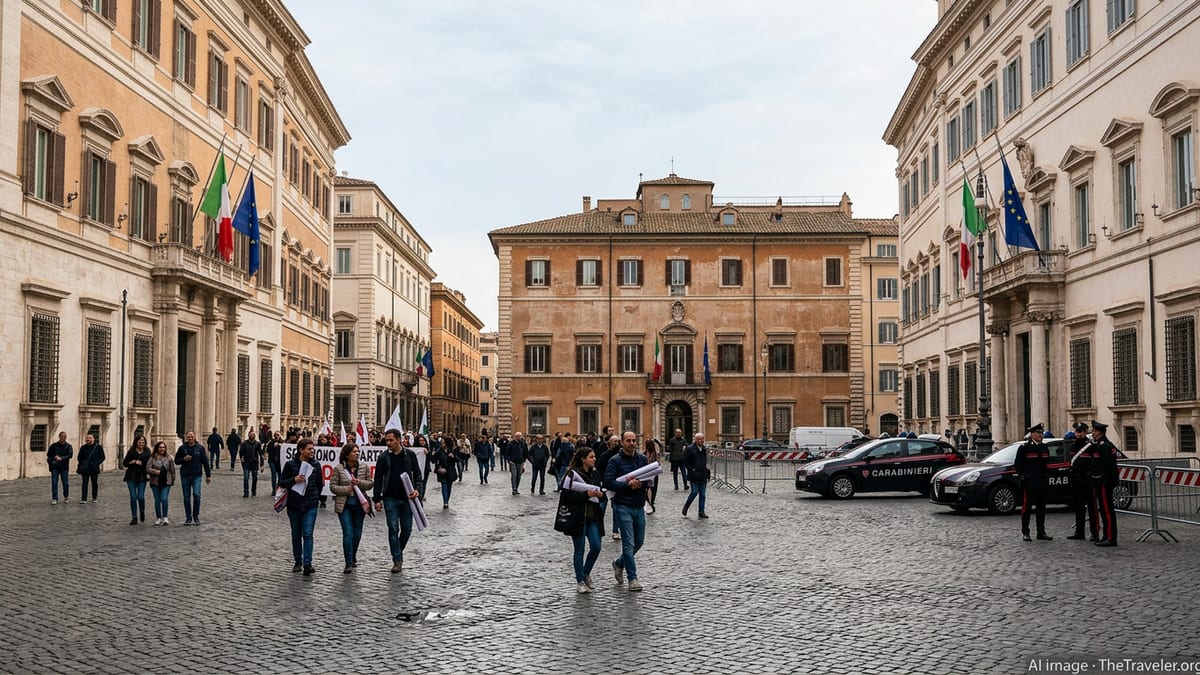
Political System Overview and Current Government Context
Italy is a parliamentary republic with a multi-party system, a written constitution, and membership in the European Union and NATO. Checks and balances are provided by a bicameral parliament, an independent constitutional court, and close monitoring by European institutions. These factors historically limit extreme policy swings, even when governments change.
Since October 2022, Italy has been governed by a right-wing coalition led by Giorgia Meloni’s Brothers of Italy party, alongside the League and Forza Italia. As of early 2026 this coalition has proved more durable than many previous Italian governments, which historically often lasted around one year. Recent analyses by business and industry groups highlight an improvement in perceived political stability since around 2018, with greater continuity of executive leadership and more predictable coalition management.
For foreign residents, this means that sharp, short-term reversals of major national policies are less likely than in earlier decades. However, it also means that the current policy direction on security, migration, and civic space has enough continuity to reshape the risk landscape over a multiyear horizon rather than being a brief interlude.
The next general election is due by 2027 unless early elections are called. In the interim, political risk is shaped less by government survival and more by the content of security legislation, relations with the judiciary and media, and the interaction between central authorities and opposition-led regions or municipalities.
Government Stability and Scenarios to Watch
Relative government stability reduces the probability of sudden institutional crises, but it does not eliminate political risk for residents. Key signals for foreign nationals include coalition cohesion, regional election outcomes, and public approval trends that could trigger leadership changes inside the governing bloc.
Regional and local elections in 2024 and 2025 largely confirmed an entrenched pattern: center-right coalitions remain strong in many regions, while center-left forces continue to hold others such as Tuscany and parts of the south. Several regional contests in 2025 saw incumbents from both right and left re-elected with comfortable margins, but on significantly reduced turnout, reflecting disengagement rather than immediate instability. The balance between blocs has therefore not shifted dramatically, reducing the likelihood of a near-term national realignment driven by regional results.
Foreign residents should monitor three main stability indicators: first, any open rifts between coalition partners that translate into parliamentary rebellions; second, corruption or judicial investigations involving senior figures that could force resignations, as has occurred in some regional governments; and third, large-scale protests that substantially erode public confidence in the government’s handling of security and social policy.
At present, most expert assessments still classify Italy as a consolidated democracy with medium political risk compared with the global average, but recent reputational downgrades by civil-society monitors on civic space and rule-of-law concerns point to a more polarized and contentious domestic environment than existed a decade ago.
Civil Liberties, Protest Law, and Civic Space
The single most important political risk development for foreign residents in the past two years has been the adoption of a far-reaching security law package affecting protests and public order. In April and June 2025, the government used decree powers and subsequent parliamentary approval to criminalize certain forms of non-violent protest, including passive resistance and some forms of road or rail blockages. New penalties include prison sentences, in some cases up to several months for blockages and potentially years where authorities deem threats or violence to be involved.
Human rights organizations, including Amnesty International and Human Rights Watch, as well as European democracy trackers, have criticized these measures as disproportionate and at odds with international standards on freedom of assembly. One global civil-society monitor downgraded Italy’s civic space rating in 2025, citing not only the text of the laws but also their practical enforcement, including surveillance of activists and harsher responses to demonstrations.
For foreign residents, this trend does not typically translate into systematic targeting based on nationality, but it does affect the risk profile of participating in public demonstrations, including those related to international causes. Incidents in 2025, including large pro-Palestinian and anti-war protests, show that while most marches proceed peacefully, clashes can occur where smaller radical groups are present, and new legal thresholds mean that behavior previously treated as minor civil disobedience can now carry criminal consequences.
Residents should closely monitor: the exact wording and implementation decrees of security laws; local police practices in their city; and statements from independent watchdogs about patterns of enforcement. Changes in these areas can rapidly alter the practical level of civil-liberties risk, even if constitutional guarantees remain formally unchanged.
Public Protest Dynamics, Policing, and Political Tensions
Italy has a long tradition of street mobilization, with thousands of protests annually across the country on issues ranging from labor rights and climate policy to migration and foreign conflicts. Since late 2024 and throughout 2025, a new protest cycle has emerged, linked in part to the war in Gaza and concerns about domestic security legislation. Large marches in Rome and other cities have drawn tens of thousands of participants, often organized by opposition parties, unions, and civil-society groups.
While most demonstrations remain peaceful, the period from mid-2025 into early 2026 has seen more frequent confrontations between specific protest groups and police. Reports in European and Italian media describe incidents involving property damage, attempts to storm symbolic venues such as major train stations, and clashes near sensitive political events. In response, the government has repeatedly emphasized a law-and-order narrative and used strong rhetoric against what it labels extremist or anarchist elements.
For foreign residents, the principal short-term risks are localized: temporary disruption to public transport, heightened police presence around city centers, and a low but non-zero risk of being caught in a confrontation if present at or near a protest site. The new legal environment also means that bystanders who become involved in blocking roads or resisting police instructions could face more serious charges than in the past.
Foreign nationals should therefore track scheduled protests in their area, particularly around symbolic dates, international summits, or high-profile trials, and treat major railway hubs, government districts, and university areas as potential flashpoints during these times. Participation in demonstrations should be a deliberate, informed choice rather than an incidental activity, given the stricter policing approach.
Rule of Law, Judiciary, and Media Environment
Rule-of-law trends are a structural component of political risk. In 2024 and 2025, several European and domestic reports expressed concern about proposed and enacted reforms that could increase political influence over parts of the judiciary and public broadcasting, along with pressure on critical media. A coalition of civil liberties groups in early 2025 identified Italy as one of several European states experiencing a measurable erosion in rule-of-law standards, citing heavy intolerance of media criticism and efforts to reshape the governance of public institutions.
The European Commission’s 2024 rule-of-law report on Italy noted ongoing structural issues such as lengthy court procedures and resource constraints, but also flagged debates over appointments to key judicial and prosecutorial posts. National civil-rights organizations have pointed to episodes where police sought to identify journalists covering protests or where legal actions were initiated against activists and NGOs.
From a resident’s perspective, Italy still offers significantly stronger institutional safeguards than many non-EU jurisdictions, and foreign nationals benefit from the same constitutional protections as citizens. However, gradual pressure on independent institutions increases long-term uncertainty about how disputes with authorities, landlords, employers, or service providers might be adjudicated ten or fifteen years ahead.
Relocation decision-makers should therefore monitor: official European Union assessments of Italy’s rule-of-law performance; reforms to public broadcasting and media regulation; and any constitutional court rulings that either reinforce or limit recent security and justice initiatives. These signals provide a forward-looking picture of whether institutional checks are holding or weakening.
Regional Variations and Urban–Rural Political Landscapes
Italy’s political risk profile is uneven across regions and cities. The north-south economic divide, long-standing regional identities, and differing party balances create distinct local climates. Some regions and large cities are governed by center-left coalitions that openly oppose the national government’s approach on security and civic space, while others align closely with Rome and apply national policies more expansively.
Recent regional elections illustrate this diversity. Left-leaning incumbents retained control in traditional strongholds such as Tuscany and Puglia, while center-right coalitions remained dominant in regions like Calabria and parts of the northeast. In several cases, regional leaders under investigation for corruption sought renewed mandates, indicating that local political dynamics can be highly personalized and do not always map neatly onto national trends.
Major metropolitan areas such as Rome, Milan, Turin, Bologna, and Naples tend to host both the largest protests and the most intensive policing. They also concentrate media scrutiny and civil-society capacity, which can mitigate some risks by providing oversight. Smaller towns and rural areas typically see fewer demonstrations but may have less visible accountability regarding local power networks, public contracts, and policing practices.
Foreign residents assessing specific destinations within Italy should therefore track: which political coalition governs the region and municipality; whether the area has recently experienced high-profile security incidents or corruption scandals; and how local authorities communicate with residents in crises. These factors influence how national-level political risk actually manifests in everyday life.
International Environment, Migration Politics, and Social Polarization
Italy’s political risk is also shaped by external factors such as European Union debates on migration, fiscal policy, and foreign conflicts. The current government has taken a firm stance on irregular migration and maritime rescue operations, advocated restrictive policies at the EU level, and framed parts of its agenda as defending national sovereignty. These themes can influence social attitudes toward foreigners, particularly those perceived as migrants or asylum seekers.
While EU membership constrains drastic policy shifts, tensions periodically arise between Rome and Brussels over budget rules, civil-liberties concerns, and migration burden-sharing. If these tensions escalate, they could lead to short-term uncertainty around specific policy areas or trigger stronger rhetoric about external interference, further polarizing domestic politics.
Foreign residents who are visibly integrated into professional, academic, or business networks generally encounter a more pragmatic environment. However, groups associated in public discourse with irregular migration, student activism, or radical politics may face higher scrutiny. Periods of international crisis, such as conflicts in the Mediterranean region or large refugee movements, typically result in sharper domestic debates and more visible policing at borders, ports, and transport hubs.
Monitoring international negotiations involving Italy, especially on migration and security, helps anticipate when domestic rhetoric and policing might harden temporarily. High-profile international events hosted in Italy can also prompt stronger security postures and a lower tolerance for protest activity in host cities.
The Takeaway
For prospective foreign residents, Italy in 2026 presents a mixed political risk profile. On one hand, it benefits from EU membership, strong formal institutions, and a government that has provided unusual continuity by Italian standards. On the other, an assertive security agenda, a measurable narrowing of civic space, and heightened political tensions around protests and cultural institutions have moved the country closer to the edge of what is typical among western European democracies.
The most practical implications concern the right to protest, exposure to crowd-control operations, and the broader climate for dissent rather than day-to-day personal safety in ordinary circumstances. Political violence remains rare compared with many global contexts, and most residents experience political risk mainly through occasional disruptions, intense media debates, and evolving rules on public expression.
Decision-makers should not view Italy as a high-risk political environment, but they should incorporate into relocation assessments a close reading of current security legislation, regional political dynamics, and EU-level rule-of-law evaluations. Regular monitoring of these signals will help foreign residents and employers anticipate shifts in civic freedoms and adjust risk management practices accordingly.
FAQ
Q1. Is Italy considered politically stable for foreign residents in 2026?
Italy is relatively stable compared with many non-European countries, with a durable government and functioning institutions, but exhibits growing tensions over civil liberties and protest regulation.
Q2. How likely is a sudden change of government that could disrupt everyday life?
In the near term the likelihood is moderate to low. The current coalition has proven cohesive, and any leadership change would likely follow regular electoral or parliamentary processes rather than abrupt breakdown.
Q3. Are foreign nationals specifically targeted by recent security laws?
The new protest-related laws are framed broadly and apply to all residents rather than targeting foreign nationals. However, foreigners participating in demonstrations are subject to the same heightened penalties as citizens.
Q4. How safe is it to attend political protests as a foreign resident?
Most protests are peaceful, but the combination of stricter laws and a more confrontational policing style increases legal and physical risk. Participation should be carefully considered and informed by local guidance.
Q5. Do regional differences significantly affect political risk?
Yes. Large cities and politically contested regions experience more frequent protests and heavier policing, while some regions have more entrenched local power structures. The governing coalition in each region and city matters.
Q6. Is there a risk of widespread political violence similar to past decades?
Currently the risk of large-scale political violence resembling the historic “years of lead” is assessed as low. Isolated clashes and small-scale extremist incidents are more plausible than a generalized violent wave.
Q7. How do international issues, such as conflicts abroad, influence political risk inside Italy?
External crises can trigger domestic protests, sharper rhetoric, and temporary tightening of security measures, especially around embassies, transport hubs, and symbolic sites, but usually without systemic destabilization.
Q8. What institutional indicators should be monitored for long-term risk?
Key indicators include EU rule-of-law assessments, changes to judiciary governance, media freedom evaluations, and civil-society reports on police powers and surveillance practices.
Q9. Does political risk in Italy affect business operations and employment for foreigners?
For most sectors the impact is limited to reputational and regulatory considerations rather than operational disruption, though heavily regulated or politically sensitive industries may face more scrutiny and policy volatility.
Q10. How often should foreign residents reassess Italy’s political risk environment?
Regular review every 6 to 12 months is advisable, with more frequent checks during election periods, major protest waves, or when significant new security or justice legislation is proposed.