


Italy and Thailand are both prominent destinations for remote workers, but they offer very different tradeoffs on living costs, day‑to‑day work environment, and tax treatment. This analysis compares Italy and Thailand across three dimensions that matter most for location‑independent professionals: overall cost levels, practical lifestyle factors affecting remote work, and personal income taxation. The aim is to provide decision‑grade input for remote workers evaluating which country is more suitable as a medium‑ or long‑term base.
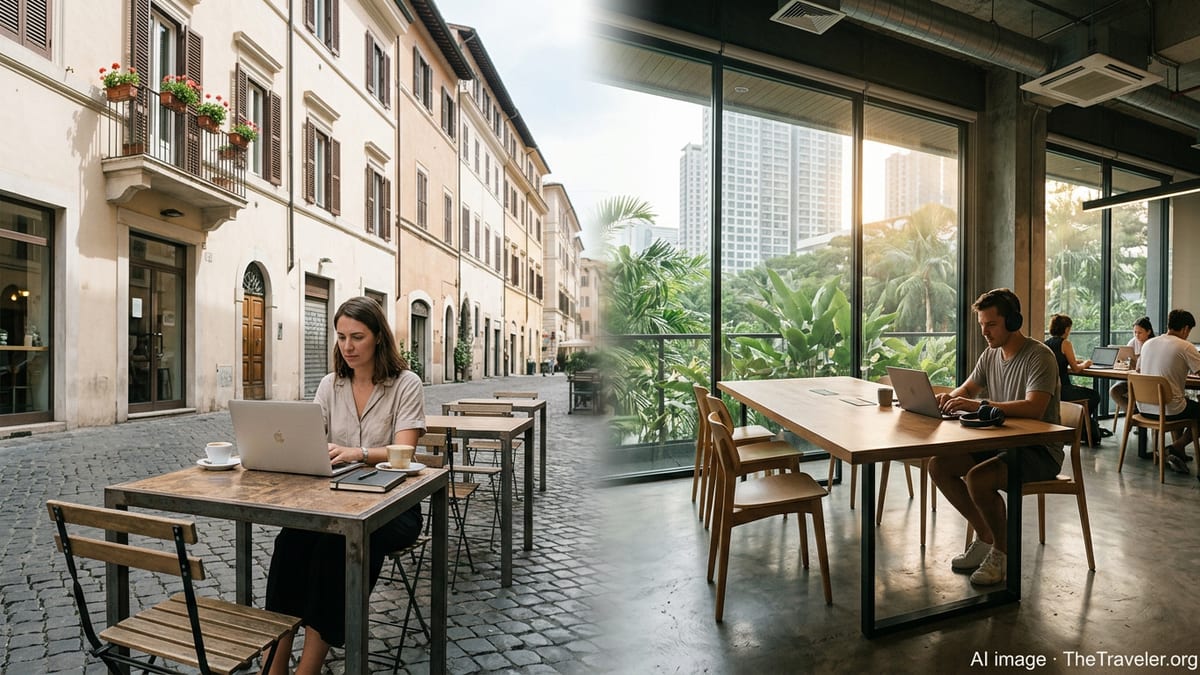
Cost of Living Benchmarks for Remote Workers
For remote workers, the core cost question is how far a foreign income stretches in each country’s main hubs. In Italy, recent expat benchmarks for comfortable single living in large cities such as Rome or Milan often cluster around 1,800 to 2,500 euros per month, including rent for a modest one‑bedroom apartment, basic utilities, food, transport, and moderate discretionary spending. Mid‑sized cities and smaller regional centers can be materially cheaper, with some estimates indicating workable budgets closer to 1,400 to 1,700 euros for similar standards, mostly due to lower housing and dining costs.
In Thailand, widely referenced 2025 and 2026 cost breakdowns indicate that Bangkok is no longer a rock‑bottom option but still significantly cheaper than major Western European cities in most categories. A single remote worker in Bangkok typically spends the equivalent of roughly 1,000 to 1,800 US dollars per month depending on housing standard and lifestyle, with rent representing the largest variable. Secondary hubs such as Chiang Mai usually come in 20 to 30 percent below Bangkok for similar quality of accommodation and daily expenses, which allows sustainable budgets from roughly 800 to 1,400 US dollars per month for many remote professionals.
On a like‑for‑like basis at typical remote worker comfort levels (private apartment, eating out regularly, modern connectivity), Thailand generally undercuts Italy. Even after several years of price increases in Thailand, accommodation, local food, and local transport usually remain noticeably cheaper than in Italian metropolitan areas. However, imported goods, some specialized services, and international schooling can narrow this gap for those with more complex family or consumption profiles.
Overall, for a solo remote worker aiming for a mid‑range but comfortable lifestyle, Thailand often delivers a lower absolute monthly budget, meanwhile Italy will generally require a higher income threshold to maintain the same level of discretionary savings after living costs.
Housing, Workspace, and Everyday Spending Patterns
Housing is the dominant cost driver in Italy for remote workers. One‑bedroom apartments in central areas of Rome or Milan commonly rent for around 900 to 1,400 euros per month, with more modern or recently renovated units priced higher. Shifting to outer districts or smaller cities can cut this significantly, sometimes bringing monthly rent into the 600 to 900 euro range for comparable space. Utilities such as heating, electricity, and building fees can add another 120 to 200 euros monthly depending on usage and season, which remote workers should factor in given higher daytime home occupancy when working from home.
By contrast, Thailand offers a wide spread of housing options at generally lower price points. In Bangkok, modern one‑bedroom condominiums in central or transit‑connected neighborhoods often range from approximately 15,000 to 30,000 Thai baht per month, roughly equivalent to 400 to 850 US dollars, depending on building age, facilities, and exact location. In Chiang Mai, remotely located professionals routinely secure adequate one‑bedroom apartments or condos for 10,000 to 20,000 baht (around 280 to 560 US dollars), often including amenities such as pools or gyms in mid‑range developments.
Workspace and working‑day costs also diverge. In Italy’s major cities, coworking memberships for a flexible desk typically fall somewhere between 150 and 300 euros per month, with higher pricing for prime central locations and more comprehensive services. Coffee purchases and casual lunches near coworking hubs or in city centers add meaningfully to daily expenses, with a reasonably priced sit‑down lunch often costing 10 to 15 euros. In Thailand, recent data indicates that coworking spaces in Bangkok commonly charge in the range of about 120 to 350 US dollars per month depending on the operator and level of access, with Chiang Mai coworking typically cheaper, often closer to 80 to 200 US dollars for monthly memberships.
Daily discretionary spending further accentuates Thailand’s cost advantage for many remote workers. While supermarket prices in Italy for staples are moderate by European standards, eating out regularly, relying on cafes, and using private transport can compound monthly budgets. Thailand retains a substantial edge in inexpensive prepared food; frequent use of local eateries and reasonably priced ride‑hailing or public transport makes it easier to maintain a comfortable lifestyle without aggressively monitoring spending.
Connectivity, Infrastructure, and Workday Practicalities
While both countries provide workable environments for remote work, the specific infrastructure profile differs. Italy’s fixed broadband infrastructure across major cities generally provides stable high‑speed connections suitable for video calls, cloud collaboration, and content uploads. Typical fixed‑line speeds in urban areas are sufficient for most remote roles, and 4G or 5G mobile coverage is broad in cities and regional towns, though coverage and speeds can be more variable in rural or mountainous areas. Remote workers choosing smaller Italian towns or countryside locations for lifestyle reasons must therefore assess local connectivity quality with more diligence.
Thailand, particularly in Bangkok, Chiang Mai, and other established hubs, is widely reported to offer robust internet connectivity oriented toward heavy mobile and home usage. Commercial coworking spaces often highlight 100 to 300 Mbps connections, and modern condominiums in urban centers usually provide high‑speed fiber options. Mobile data is competitively priced, and 4G coverage is near‑universal in populated zones, with 5G expansion underway in major urban areas. For remote workers whose roles are bandwidth intensive or who rely on constant video conferencing, Thailand’s practical connectivity environment is usually more than adequate.
Everyday workday logistics are also relevant. In Italian cities, many remote workers use a combination of public transport, walking, and occasionally private vehicles or ride‑hailing. Urban transport networks can be extensive, but congestion, parking constraints, and comparatively high fuel prices add friction and cost, particularly if a car is necessary. Thailand’s urban centers present their own congestion challenges, especially in Bangkok, but the combination of mass transit options where available, motorbike taxis, and ride‑hailing often results in lower absolute transport costs for similar trip volumes.
From a remote‑work practicality standpoint, both countries can support fully remote roles in metropolitan areas, but Thailand’s combination of widely available coworking, relatively inexpensive last‑mile transport, and strong mobile coverage tends to maximize flexibility and minimize incidental workday costs. Italy offers high‑quality infrastructure in many cities but at a higher average spend, particularly when commuting or moving frequently inside large urban areas.
Personal Income Taxation: Italy
Italy operates a progressive personal income tax system, with national income tax rates complemented by regional and municipal surcharges. Recent reforms have simplified the national brackets into three main bands. Current guidance for 2024 and 2025 indicates national rates of approximately 23 percent for lower incomes, then 35 percent and 43 percent for higher levels. Additional regional and local surcharges can add several percentage points, which means effective marginal rates for higher income remote workers can exceed the top national band. Tax residency generally applies when an individual spends more than half the year in Italy or has Italy as a primary center of vital interests.
For incoming workers and some categories of professionals, Italy offers special regimes that can significantly reduce the effective tax burden under specific conditions. Examples include incentives for new residents, regimes tailored to workers relocating with employment, and simplified schemes for certain types of self‑employed professionals. For remote workers, access to these regimes depends on factors such as domicile history, the share of work performed in Italy, and whether the worker is classified as employee, contractor, or business owner. These regimes are structured and rule bound rather than open‑ended tax holidays, and they typically require formal registration and compliance with Italian filing requirements.
Remote workers should also consider that Italy taxes worldwide income once tax resident, subject to double taxation treaties. This means foreign‑sourced employment or business income that continues to be paid from abroad will usually fall into the Italian tax net, even when the work is entirely online. Social security contributions may apply in addition to income tax depending on employment structure and treaty coverage. The combined impact of income tax, regional charges, and social contributions can lead to effective total burdens that many mobile professionals describe as medium to high by international standards.
Given the complexity and the presence of multiple optional regimes, the actual tax paid by a remote worker in Italy can vary widely. Someone qualifying for specific incentive regimes might achieve a substantially lower effective rate for a fixed number of years, whereas a similar worker on standard rules without reliefs can face a significantly higher combined burden. Thorough pre‑arrival tax planning, including an assessment of residency triggers and treaty interaction, is essential for accurate comparisons with Thailand.
Personal Income Taxation: Thailand
Thailand also applies a progressive personal income tax system, but at lower nominal rates than Italy. The Thai schedule for recent years applies a zero rate on the first segment of taxable income, then progressively higher bands that rise through 5, 10, 15, 20, and 25 percent, with a top rate of 35 percent on higher incomes. Various personal allowances, deductions, and specific reliefs can reduce the taxable base, especially for lower and middle income levels. In practice, many mid‑income remote workers who are Thai tax residents but not at the very top of the income scale experience effective income tax rates that are meaningfully below those typically seen under standard Italian rules.
The key issue for remote workers in Thailand is the treatment of foreign‑sourced income. For many years, Thailand followed an approach where foreign income was commonly considered taxable only if remitted in the same year it was earned, which allowed some timing flexibility. However, recent guidance and legislative updates from 2024 onward have signaled a stricter approach to taxing foreign‑sourced income of Thai tax residents that is brought into Thailand, regardless of when earned. Commentary from professional tax firms emphasizes that foreign employment or business income received by a Thai resident and used in Thailand can be subject to Thai tax, although practical application is still evolving.
Tax residency in Thailand is generally triggered when an individual spends 180 days or more in the country in a calendar year. Once resident, Thai authorities may treat worldwide personal income as taxable under domestic law, subject to relief from double taxation treaties. For remote workers paid by foreign companies or clients, this can mean that salary, freelance income, or business profits connected to online work may fall under Thai tax if remitted or otherwise deemed received in Thailand. The details can be nuanced, especially where funds remain offshore or in foreign companies, and professional advice is often necessary to map the precise exposure.
Despite the move to tighten taxation of foreign‑sourced income, Thailand’s headline tax brackets and the available personal allowances often lead to lower effective rates for many remote workers compared to standard Italian treatment, particularly at middle incomes. However, reduced social security obligations in Thailand may be offset by the need for private arrangements for retirement and insurance. The overall tax landscape is thus more favorable in nominal rate terms but evolving in its treatment of international remote work income.
Cost, Lifestyle, and Tax Tradeoffs: Comparative View
When combining cost, lifestyle‑related work factors, and taxes, the tradeoffs between Italy and Thailand for remote workers become explicit. From a pure cost of living perspective, Thailand typically offers a clear advantage for solo professionals: lower rents in core remote work hubs, cheaper local food and everyday services, and relatively low local transport costs. This can translate into either materially higher savings on the same income or the ability to sustain a comfortable lifestyle on a lower income threshold. Italy requires a higher monthly budget for equivalent standards in its large cities, though smaller Italian towns narrow the gap and may appeal to those prioritizing quieter environments.
From a lifestyle related work perspective, both countries provide credible infrastructure but with different strengths. Italy offers European time zone alignment attractive for roles tied to European business hours, as well as robust urban infrastructure in major cities. However, daily operational costs such as commuting, eating out, and coworking are relatively high. Thailand delivers strong broadband and mobile coverage in key hubs, a dense coworking ecosystem in popular cities, and inexpensive everyday services, but operates in a time zone better suited to Asia Pacific or with late hours for European or American clients.
From a tax perspective, Italy is generally a higher tax jurisdiction, especially once regional and municipal surcharges and social security contributions are considered. Special incentive regimes can change the picture but are not universally accessible and may come with time limits and behavioral conditions. Thailand applies lower marginal income tax rates overall and, despite increasingly assertive rules on foreign‑sourced income, often remains more favorable for many mid‑income remote workers in effective rate terms. However, evolving enforcement and the importance of precise residency and remittance patterns mean that the Thai advantage cannot be assumed without individualized analysis.
The net decision for a remote worker choosing between Italy and Thailand typically involves weighing Italy’s higher structural costs and heavier standard tax regime against its time zone, perceived stability, and European context, versus Thailand’s lower cost base and generally lighter tax schedule counterbalanced by regulatory evolution on foreign income and the implications of long‑term residency in a different regional environment.
The Takeaway
For remote workers assessing Italy and Thailand side by side, three main conclusions emerge. First, Thailand currently offers a significantly lower overall cost of living for most solo remote professionals, especially in secondary hubs such as Chiang Mai, giving it a strong advantage in terms of the ratio between income and disposable cash flow. Italy can be optimized by choosing smaller or less tourist‑intensive cities, but major urban centers remain structurally more expensive in housing and daily spending than comparable Thai locations.
Second, from a lifestyle and infrastructure standpoint specifically tied to remote work, both countries are viable but serve different operating patterns. Thailand’s combination of high‑speed connectivity, dense coworking options, and economical local services supports agile, cost‑efficient workdays, particularly for location‑independent professionals with Asia Pacific or flexible clients. Italy offers reliable connectivity and the benefits of being aligned with European business hours, but comes with higher everyday operating costs and potentially more variance in connectivity quality outside major urban areas.
Third, in taxation terms, Italy generally represents the higher tax environment once standard rules are applied, even though targeted incentive regimes can materially reduce liabilities for some new arrivals. Thailand maintains lower personal income tax rates and can be financially attractive for remote workers who plan residency and remittance patterns carefully, acknowledging that recent policy changes are narrowing historical arbitrage on untaxed foreign income. Any long‑term decision between Italy and Thailand should therefore integrate personalized tax advice, not just headline rates.
Remote workers making a location choice between these two countries should model realistic budgets for their specific city options, assess time zone fit and daily work routines, and obtain jurisdiction‑specific tax guidance. Treated as a base case, Thailand usually leads on cost and headline tax efficiency, while Italy offers the advantages of a European base at the price of higher living costs and a more demanding standard fiscal burden.
FAQ
Q1. Is Italy or Thailand cheaper overall for a single remote worker?
For most single remote workers, Thailand is cheaper overall, especially in cities like Chiang Mai where rent, food, and transport costs undercut Italian urban centers.
Q2. How much monthly budget should a remote worker plan for in Italy?
In major Italian cities, many remote workers need roughly 1,800 to 2,500 euros per month for a comfortable lifestyle, with lower amounts possible in smaller towns.
Q3. How much monthly budget should a remote worker plan for in Thailand?
In Thailand, typical remote worker budgets range from about 1,000 to 1,800 US dollars in Bangkok and 800 to 1,400 US dollars in Chiang Mai for comparable comfort.
Q4. Which country offers better internet reliability for remote work?
Both countries provide adequate connectivity in major hubs, but Thailand’s leading remote work cities often offer very fast, affordable fixed and mobile internet with broad availability.
Q5. Are income tax rates higher in Italy or Thailand for remote workers?
Standard income tax rates and effective burdens are generally higher in Italy, while Thailand applies lower progressive rates, although individual situations can alter this comparison.
Q6. Does Italy tax foreign‑sourced income for remote workers?
Yes. Once tax resident in Italy, remote workers are typically taxed on worldwide income, including foreign‑sourced employment or business income, subject to treaty relief.
Q7. Does Thailand tax foreign‑sourced income for remote workers?
Thailand has moved toward taxing foreign‑sourced income of tax residents that is brought into the country, making careful planning of residency and remittance patterns important.
Q8. Where are coworking spaces more affordable, Italy or Thailand?
Coworking spaces are generally more affordable in Thailand, especially in secondary hubs, while Italian coworking in major cities often falls at higher monthly price points.
Q9. Which country is better for remote workers with European clients?
Italy’s time zone is more convenient for European clients, reducing the need for late‑night work, whereas Thailand’s time zone better suits Asia Pacific and requires more offset for Europe.
Q10. How should remote workers compare Italy and Thailand taxes in practice?
Remote workers should model expected income, check residency thresholds, and obtain local tax advice in both countries to compare real effective rates and available special regimes.