


Portugal and Thailand are two of the most discussed destinations for remote workers seeking a lower cost base and improved quality of life. This briefing compares them on three decision-critical dimensions for location-independent professionals: overall cost levels, day-to-day lifestyle conditions that affect working productivity, and the tax treatment of remote work income. The objective is not to identify a winner, but to clarify trade-offs so that remote workers can align their choice with budget, work style, and long-term financial planning.
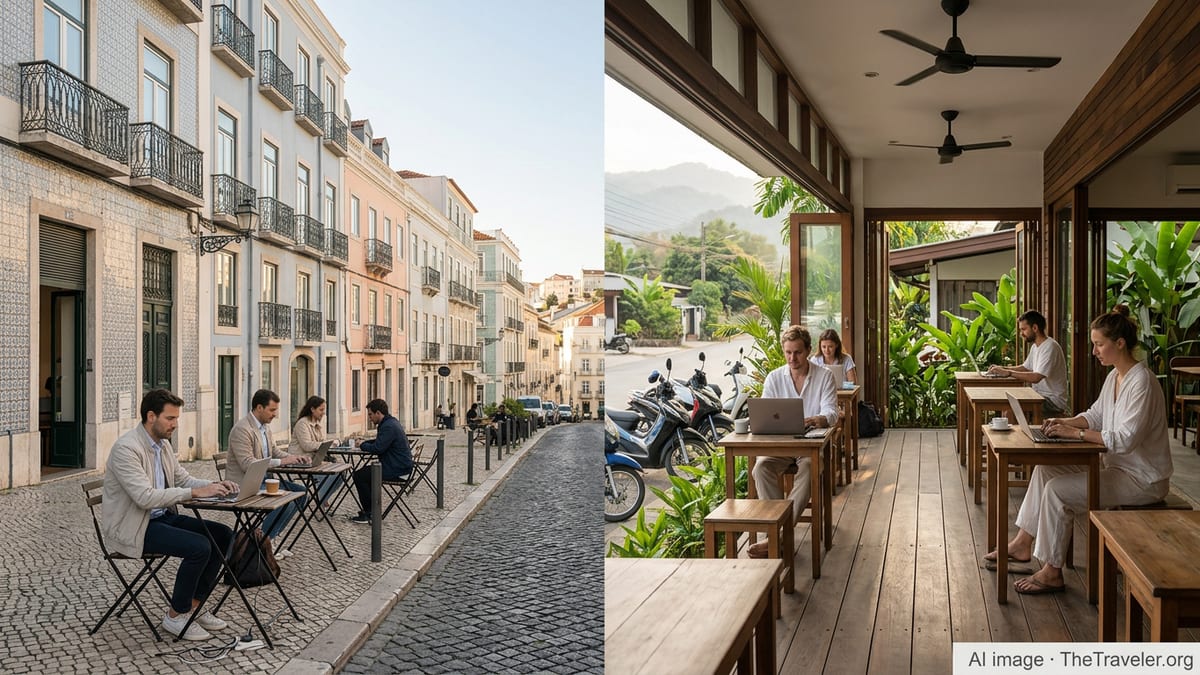
Cost of Living Benchmarks for Remote Workers
Both Portugal and Thailand remain relatively affordable compared with major North American and Western European cities, but they occupy different price points and exhibit different cost structures. As of early 2026, Portugal has seen sustained price and rent inflation in major hubs such as Lisbon and Porto, narrowing the gap with other EU capitals, while Thailand still offers substantially lower day-to-day expenses in most categories, particularly outside Bangkok. Recent comparative datasets and expat-oriented reports indicate that Thailand typically undercuts Portugal on rent, local food, and services, although imported goods and certain international schools or premium services can be priced closer to Western levels.
In Portugal, updated cost of living assessments suggest that a single remote worker living outside Lisbon or Porto can often maintain a comfortable but not extravagant lifestyle on approximately 1,500 to 2,000 euros per month, with 2,000 to 2,500 euros more realistic in Lisbon for a modern one-bedroom in a desirable area. Average national asking rents around the end of 2025 were reported at roughly 16 euros per square metre, translating to around 1,100 to 1,250 euros for a typical mid-size apartment, with Lisbon clearly above and interior cities meaningfully below this figure.([expatica.com](https://www.expatica.com/pt/moving/about/cost-of-living-in-portugal-1167462/?utm_source=openai))
For Thailand, digital nomad and cost-tracking platforms commonly estimate monthly budgets in the range of 1,000 to 1,500 US dollars for a single remote worker in Chiang Mai or secondary cities, and approximately 1,400 to 2,000 US dollars in central Bangkok, including rent for a modern one-bedroom, local transport, and regular dining out. A recent ranking of digital nomad hubs placed Chiang Mai and Bangkok as top-tier locations, reporting average monthly living costs around 1,100 and 1,400 US dollars respectively, confirming Thailand’s continued price advantage despite recent inflation.([thailand.prd.go.th](https://thailand.prd.go.th/en/content/category/detail/id/2078/iid/230447?utm_source=openai))
In practical terms, Thailand tends to be 20 to 40 percent cheaper than Portugal for a similar quality of housing and everyday consumption, especially for remote workers willing to adapt to local consumption patterns. Portugal, however, offers a more predictable pricing environment in euros within the European Union, which can be advantageous for workers earning in that currency or in other strong currencies whose budgets they prefer to frame in euro terms.
Housing and Workspace Costs
Housing and workspace are typically the largest recurring costs for remote workers. In Portugal, rental price pressure is concentrated in coastal metropolitan areas and tourist-intensive regions. Central Lisbon rents for a modern one-bedroom apartment suitable for professional remote work commonly start above 1,300 euros per month and can exceed 1,800 euros in particularly desirable districts, while similar accommodation in Porto often ranges from about 1,000 to 1,500 euros. Outside the main cities, long-term rents in mid-size towns frequently drop to the 600 to 900 euro range for decent quality housing, which can materially change the affordability equation for remote workers who do not require big-city amenities on a daily basis.([getwherenext.com](https://getwherenext.com/blog/cost-of-living-portugal-2026?utm_source=openai))
Co working spaces in Portugal’s urban centres are widely available, with typical monthly hot-desk memberships in Lisbon and Porto often falling in the 120 to 200 euro bracket, and day passes frequently priced between 15 and 25 euros. Fixed desk and private office options scale higher but remain roughly comparable to other Western European mid-tier cities. Many remote workers choose to combine home working with occasional co working usage, especially during peak collaboration periods, in order to control cost while maintaining access to professional infrastructure.
In Thailand, the rental spectrum is broader in absolute terms but remains substantially cheaper at comparable quality levels. In central Bangkok, a modern one-bedroom apartment in a building with good internet and amenities commonly ranges from the equivalent of roughly 500 to 900 US dollars per month depending on proximity to mass transit and the age of the building. In Chiang Mai and many secondary cities, similar units can be found from approximately 350 to 600 US dollars, with significant savings available for longer-term leases and less central locations.([thailand.prd.go.th](https://thailand.prd.go.th/en/content/category/detail/id/2078/iid/230447?utm_source=openai))
Co working in Thailand is also cost competitive. Monthly hot-desk plans in Bangkok and Chiang Mai are typically in the range of 80 to 150 US dollars, and day passes often cost under 15 US dollars. Given the lower baseline cost of housing and workspace, Thailand generally allows remote workers to either reduce overall expenditures significantly or upgrade to more spacious housing and higher-spec offices while keeping monthly costs below or similar to what they might spend in lower-cost Portuguese locations.
Everyday Lifestyle Conditions Relevant to Remote Work
For relocation decisions, “lifestyle” is best framed in terms of conditions that directly affect professional output and daily functioning: climate, infrastructure reliability, language environment, and time zone compatibility. Portugal offers a temperate climate with relatively mild winters and warm summers, which supports year-round outdoor activity and reduces climate-related productivity disruptions for most workers. Air quality in Portuguese cities is generally good by international standards, and infrastructure for water, power, and transport is stable, with rare outages.
Thailand lies in a tropical climate zone, with high humidity, pronounced rainy seasons, and significantly higher average temperatures. While many remote workers adapt well, those sensitive to heat and humidity should factor in the impact on comfort and air conditioning costs. Seasonal air quality issues can arise in parts of northern Thailand during “burning season,” which may be relevant for health-conscious workers considering Chiang Mai or other northern hubs. Urban infrastructure in Bangkok is well developed, particularly public transport and internet connectivity, although flooding and traffic disruptions can occur during heavy rain.([thailand.prd.go.th](https://thailand.prd.go.th/en/content/category/detail/id/2078/iid/230447?utm_source=openai))
From a working language perspective, Portugal benefits from widespread English proficiency in major cities and among younger populations, though Portuguese remains necessary for full integration and certain services. Thailand also has substantial English usage in tourist and business areas, especially in Bangkok, but everyday transactions in smaller cities may require a higher degree of language adaptation for long-term residents. Both countries provide extensive online banking and digital services, but Portugal’s integration into EU financial and regulatory systems can be advantageous for remote workers dealing with European clients or payments.
Time zone alignment is another practical lifestyle variable. Portugal operates in Western European Time, which offers convenient overlap with the rest of Europe and at least partial overlap with North American working hours. Thailand’s time zone is substantially closer to East and Southeast Asia and Australia, making it better suited for remote workers serving clients in those regions. Remote workers coordinating extensively with North American teams will typically find Portugal more compatible from a scheduling perspective, while those with Asia-Pacific clients may find Thailand logistically simpler.
Income Tax Structures for Remote Workers
Both Portugal and Thailand tax residents on their worldwide income under specific conditions, while non-residents are typically taxed only on local-source income. For remote workers who effectively relocate, the key distinction is usually whether they become tax resident and how their foreign-sourced employment or freelance income is treated once resident. In Portugal, tax residency is generally triggered by spending more than 183 days in the country in any 12-month period or maintaining a habitual home with clear intent to reside. Once resident, individuals are subject to progressive personal income tax on worldwide income, with marginal rates running from low double digits at the bottom to a top marginal rate currently in the high forties for higher incomes.([expatica.com](https://www.expatica.com/pt/finance/taxes/self-employment-freelance-and-corporate-tax-in-portugal-1092039/?utm_source=openai))
Updated guidance for 2025 and 2026 confirms that non-residents in Portugal are generally taxed at a flat 25 percent rate on Portuguese-sourced employment and self-employment income, without access to progressive brackets or most deductions. Residents, by contrast, are taxed under progressive IRS brackets, with the highest marginal rates approaching 48 percent on income above a defined threshold, though effective average rates for typical remote worker incomes are lower due to the progressive structure, standard allowances, and specific youth or sectoral reliefs. The historical Non-Habitual Resident regime that once offered favourable flat rates has largely been phased out for new entrants, which means most new remote workers should plan around the standard regime and, where applicable, the “simplified” regime for freelancers.([expatica.com](https://www.expatica.com/pt/finance/taxes/self-employment-freelance-and-corporate-tax-in-portugal-1092039/?utm_source=openai))
Thailand also operates a progressive personal income tax system. Official schedules and recent tax summaries for the 2024 to 2025 tax years show marginal rates starting at 0 percent for low incomes, then increasing through multiple bands to a top marginal rate in the mid-thirties. Some official and international tax references describe seven bands with a tax-free allowance up to a certain threshold, followed by progressive rates typically ranging from 5 to 35 percent.([oecd.org](https://www.oecd.org/content/dam/oecd/en/publications/reports/2025/12/oecd-economic-surveys-thailand-2025_a96fd45e/426b9bc0-en.pdf?utm_source=openai))
Recent reforms materially affect how Thailand taxes foreign-sourced income. For many years, residents were only taxed on foreign income if it was remitted to Thailand in the same year it was earned. Updated guidance from early 2024 indicates that for tax years starting on or after 1 January 2024, Thai tax residents may be taxed on foreign-sourced income that is brought into Thailand in the same or a later year, significantly tightening previous planning options used by some remote workers. This change increases the importance of professional tax advice for long-term residents whose earnings originate from foreign clients or employers.([taxsummaries.pwc.com](https://taxsummaries.pwc.com/thailand/individual/taxes-on-personal-income?utm_source=openai))
Practical Tax Burden for Employees and Freelancers
For salaried remote employees in Portugal, gross salary from a foreign employer is generally subject to Portuguese income tax once tax residency is established, and employers may or may not operate local withholding depending on their structure. Progressive brackets mean that middle-income remote workers often face effective tax rates in the 20 to 30 percent range before social security contributions, rising with higher incomes. Freelancers in Portugal typically register as self-employed and fall under either a simplified regime, where a fixed percentage of turnover is treated as taxable profit, or an organised accounting regime for higher or more complex incomes. Under the simplified approach, common professional service categories apply a coefficient near 0.75, meaning roughly 75 percent of gross receipts are considered taxable income, to which the progressive IRS schedule is applied.([expatica.com](https://www.expatica.com/pt/finance/taxes/self-employment-freelance-and-corporate-tax-in-portugal-1092039/?utm_source=openai))
Social security contributions in Portugal add a material layer to the total burden: self-employed workers generally face contribution rates slightly above 20 percent applied to a portion of their income, though reductions and phased-in rules can apply in early years of activity or for specific categories. For salaried employees, contributions are shared between employer and employee, with the employee-side contribution typically around the high single digits to low teens as a percentage of gross salary. When combined, income tax and social security can push total statutory outflows to levels that feel high relative to Portugal’s cost of living, especially at upper-middle incomes.
In Thailand, employees generally have personal income tax withheld at source, with the progressive rates leading to lower effective tax burdens at moderate incomes than in Portugal, particularly for workers whose annual income falls within the lower and mid-tier bands. Mandatory social security contributions for employees are capped at relatively modest monthly amounts, which helps contain the combined tax and contribution load for many remote workers. This can make Thailand comparatively attractive for those earning modest to upper-middle global salaries who intend to spend extensively in local currency.
For freelancers and independent contractors in Thailand, tax is calculated on net assessable income after allowable expenses and specific deductions. Some categories can use standard expense deductions as a percentage of gross receipts, while others may need to document actual costs. Given the lower top marginal rate and capped social security, many independent professionals find that their combined effective tax and contribution rate remains below what they would expect under an equivalent income level in Portugal, assuming similar compliance levels and no use of special relief regimes in either country.([taxsummaries.pwc.com](https://taxsummaries.pwc.com/thailand/individual/taxes-on-personal-income?utm_source=openai))
The Takeaway
From a cost perspective, Thailand generally offers a lower monthly spend for remote workers than Portugal, especially in housing and everyday consumption, allowing either significant savings or a higher standard of living at the same budget. Portugal remains affordable relative to many Western countries but has seen housing costs in major hubs increase to levels that demand careful budgeting for remote workers relying on moderate incomes.
In terms of lifestyle conditions that directly influence work, Portugal provides a temperate climate, generally high air quality, and a time zone that strongly favours collaboration with European and, partially, North American teams. Thailand offers excellent value, strong connectivity in major hubs, and better alignment with Asia-Pacific clients, but with climatic and seasonal air-quality factors that some workers must weigh carefully.
Taxation is a key differentiator. Portugal applies high marginal rates at upper income levels and pairs them with meaningful social security contributions, especially for freelancers, although the progressive structure keeps effective rates more moderate for lower incomes. Thailand’s progressive system tops out at lower marginal rates and features capped social security, but ongoing reforms to the treatment of foreign-sourced income reduce the scope for informal tax planning and make professional advice advisable for long-term residents.
For remote workers whose priority is minimising living costs and maintaining a relatively moderate formal tax burden, Thailand often presents the stronger financial case, particularly for Asia-focused work. For those seeking integration into the European economic space, euro-denominated stability, and more convenient time-zone alignment with European or transatlantic markets, Portugal can justify its higher costs and heavier tax take. The optimal choice ultimately depends on each remote worker’s income level, client geography, and tolerance for administrative and climatic complexity.
FAQ
Q1. Which country is generally cheaper overall for remote workers, Portugal or Thailand?
Thailand is typically cheaper overall, especially for rent, food, and local services, with many remote workers reporting total monthly budgets 20 to 40 percent below Portugal for comparable lifestyles.
Q2. How do rents for a one-bedroom apartment compare between Lisbon and Bangkok?
Central Lisbon often requires 1,300 to 1,800 euros per month for a modern one-bedroom, while equivalent units in central Bangkok frequently range from roughly 500 to 900 US dollars, depending on area and building quality.
Q3. Are co working spaces significantly cheaper in Thailand than in Portugal?
Yes, co working memberships and day passes in Thailand are usually somewhat cheaper, although both countries offer competitive pricing; Thailand’s lower baseline costs tend to make upgrading to better facilities more affordable.
Q4. Which country offers a more favourable tax regime for typical mid-income remote workers?
For many mid-income remote workers, Thailand’s lower top marginal tax rate and capped social security contributions can result in a lighter effective burden compared with Portugal’s higher progressive brackets and social contributions.
Q5. How does the treatment of foreign-sourced income differ between Portugal and Thailand?
Portugal taxes tax residents on worldwide income, including remote salaries and freelance earnings, while Thailand has tightened rules so that foreign income brought into the country by residents from 2024 onward can be taxed, reducing previous deferral options.
Q6. Which location has lifestyle conditions that are generally more conducive to year-round productivity?
Portugal’s temperate climate and typically good air quality in major cities are conducive to year-round productivity, while Thailand’s tropical climate and occasional regional air-quality issues may require more personal adaptation and mitigation.
Q7. For remote workers serving European clients, which time zone is more practical?
Portugal’s time zone aligns closely with the rest of Europe and offers better overlap with both European and some North American working hours, making it more practical for Europe-focused remote work.
Q8. Do freelancers face heavier compliance and contribution requirements in Portugal than in Thailand?
Freelancers in Portugal often face more complex rules, including simplified regime coefficients and higher social security rates, while Thailand’s system relies on progressive income tax with comparatively modest, capped social security contributions.
Q9. How important is recent tax reform in Thailand for long-term remote workers?
Recent reforms affecting taxation of foreign-sourced income for residents are significant, as they limit common deferral strategies; long-term remote workers in Thailand should assume that foreign income remitted to Thailand may be taxable and plan accordingly.
Q10. If cost is the primary driver, but an EU base is desired, does Portugal still make sense?
Yes, for remote workers needing an EU base and euro stability, Portugal can remain attractive despite higher costs, but budget planning must realistically account for elevated rents in major hubs and a comparatively heavy tax and contribution load.