


For many pilgrims, the Haramain High-Speed Railway is the first real test of logistics after landing at Jeddah’s King Abdulaziz International Airport. Used well, it is fast, comfortable and often less stressful than arranging taxis at the curb. Used poorly, it can mean missed trains, extra costs and unnecessary anxiety at the very start of your Umrah or Hajj journey. This guide explains, in practical terms, how to use the Jeddah Airport Haramain station, connect from Terminal 1, choose the right route to Makkah, Madinah or Jeddah city, buy tickets, handle luggage and avoid common mistakes pilgrims make every day.
Get the latest updates straight to your inbox!
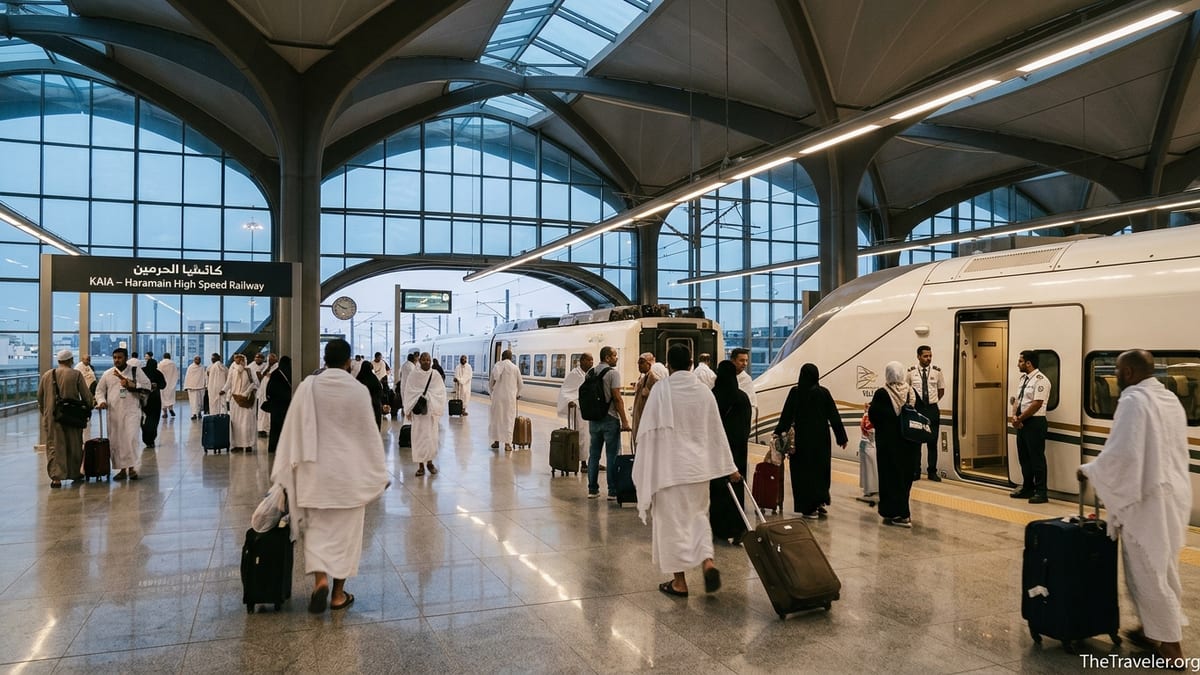
Understanding Jeddah Airport’s Haramain Station and Terminal 1 Connection
The Haramain High-Speed Railway has a dedicated station at King Abdulaziz International Airport in Jeddah, directly connected to the modern Terminal 1. The station is built into the airport transport center, linked to the terminal by walkways, escalators and people-movers. In practical terms, if you land at Terminal 1 on a typical international flight from London, Jakarta or Cairo, you do not need a taxi or shuttle to reach the train. You simply follow the “Train / Haramain Railway” signs after customs, walk through the transport hub and you are inside the station concourse.
The airport station is a full-size rail hub, not a small platform. It spans several levels, with ticket counters, self-service machines, security screening similar to an airport, waiting halls, prayer areas and six platforms for trains towards Makkah, Madinah, Jeddah Al-Sulaymaniyah and King Abdullah Economic City. During Hajj and peak Umrah seasons, the station can feel as busy as a medium-size airport terminal, so allow time to move between levels and expect queues at security and boarding gates.
It is important to distinguish between the “Jeddah Airport” Haramain station and the separate “Jeddah (Al-Sulaymaniyah)” city station. The airport station is physically attached to Terminal 1 and is best for passengers going directly from a flight to the train. The Al-Sulaymaniyah station is in central Jeddah, around 25 to 35 minutes by taxi from the airport in normal traffic, and is more convenient for those already staying in the city or transferring from hotels on the Corniche or in Al-Balad.
Most international pilgrims land at Terminal 1, which hosts the majority of foreign airlines and is purpose-built for seamless access to the Haramain line. However, some Hajj or charter flights may still operate through dedicated pilgrimage or seasonal facilities. If your itinerary mentions a special or north terminal, check with your airline or agent whether you will be bussed to Terminal 1 after arrival before you can use the train, or whether a bus or taxi transfer to Makkah has already been arranged for you.
Routes from Jeddah Airport: Makkah, Madinah and Jeddah City
The Haramain line connects five passenger stations: Makkah, Jeddah Airport, Jeddah Al-Sulaymaniyah (city), King Abdullah Economic City (KAEC) and Madinah. From the airport, the two routes most commonly used by pilgrims are Jeddah Airport to Makkah and Jeddah Airport to Madinah. Some travelers also use the train to reach the Jeddah city station if their hotel or relatives are located in the central city rather than near the airport.
For Umrah pilgrims going straight to Makkah, the airport-to-Makkah journey usually takes around 35 to 45 minutes on a non-stop or limited-stop service. On a typical day outside peak Hajj, you might see multiple direct trains in late afternoon and evening, with off-peak services spaced further apart. For example, a mid-season day can easily offer departures from the airport to Makkah between roughly 10:00 and 23:00, with intervals of 60 to 120 minutes depending on demand. During Ramadan and Hajj, additional night and early-morning services are often added.
For those starting in Madinah, the airport-to-Madinah ride is considerably longer, usually around 2 to 2.5 hours with intermediate stops at Jeddah city and KAEC. Many pilgrims landing at Jeddah in the morning choose to travel first to Madinah, rest and pray at Al-Masjid an-Nabawi for several days, then return to Makkah later via the same line. In this scenario, the full routing over a week might be: Jeddah Airport → Madinah, then Madinah → Makkah, then finally Makkah → Jeddah Airport for departure.
If your first nights are in Jeddah city rather than Makkah or Madinah, you can also take the short Jeddah Airport to Jeddah Al-Sulaymaniyah hop. Travel time is roughly 20 minutes on the train, plus a 20 to 30 minute taxi ride from the city station to common hotel areas like the Corniche or Al-Balad. For example, a business traveler staying in a hotel near the Jeddah waterfront might land in the afternoon, take the Haramain train from the airport to the city station, and then a ride-hailing car such as Uber or Careem to the hotel instead of using an airport taxi for the whole journey.
Buying Haramain Tickets: Platforms, Prices and Practical Tips
Haramain tickets can be purchased through the official online platforms, via the Nusuk app for pilgrims, and via approved third-party agents and travel apps. For most independent pilgrims, booking online in advance is strongly recommended, especially if you are traveling in Ramadan, school holidays or the Hajj season. Same-day tickets at the airport station may be available, but popular time slots often sell out or only have expensive business-class seats remaining.
Prices vary by route, class and how early you book. As an indicative example for a standard off-peak day, a one-way economy ticket from Jeddah Airport to Makkah might appear around 60 to 80 Saudi riyals when booked a few weeks in advance, while business class on the same route might be closer to 100 to 150 riyals. Dynamic pricing means last-minute bookings for busy evening services can be noticeably higher than early-morning or midday trains. For the longer Jeddah Airport to Madinah route, expect economy fares to be several times more than the short Makkah leg, broadly in line with the 400-plus kilometer distance.
The Nusuk platform is increasingly integrated into the pilgrim experience, allowing you to see available trains, choose seats and pay by card in a familiar app environment. A typical Umrah itinerary might involve booking three separate tickets inside Nusuk: Jeddah Airport to Madinah on arrival day, Madinah to Makkah after three nights, and Makkah to Jeddah Airport on the day of departure. By keeping all segments in one app, you reduce the risk of losing reservation emails or mixing up dates and times.
At the airport station itself, you will find staffed ticket counters and self-service machines. These are useful if your flight is delayed and you need to adjust your departure time, or if you arrive without any booking. However, expect queues, particularly in the late afternoon and evening when multiple flights land from South Asia, North Africa and Europe at roughly the same time. A common real-world scenario is a family landing from Istanbul at 16:00, joining the long ticket line at 17:00, and discovering the next available train with four adjacent seats is not until 20:00. Advance booking avoids this trap and lets you plan immigration and baggage time around a specific train.
Luggage, Check-in Process and Onboard Experience
The Haramain High-Speed Railway operates more like a modern intercity train than a domestic airline, but there are still security and luggage rules that matter to pilgrims. Each ticketed passenger is allowed hand luggage and at least one larger suitcase, with typical unofficial guidance in the range of a cabin bag plus a check-in style case around 23 kg. In practice, staff focus on obviously oversized or excessive baggage, such as groups trying to load half a dozen large cartons and multiple suitcases per person onto the train.
When you arrive at the airport station from Terminal 1, you will first pass through a ticket or booking check, then a security screening area with X-ray scanners for bags and metal detectors for passengers. Large suitcases go through the same scanners, and any liquids, Zamzam water containers or boxed items may be inspected. Once through security, you enter the departures hall, which has waiting areas, small shops, prayer rooms and restrooms. Boarding usually opens about 20 to 30 minutes before departure, with gate screens showing train number, destination and platform.
Onboard, economy and business class both offer reserved, numbered seats with air conditioning and overhead racks. Business class typically has wider seats, more legroom and quieter carriages, which can be attractive for older pilgrims or those recovering from a long-haul flight. For example, a group of elderly parents arriving from Kuala Lumpur might choose business class specifically for the first Jeddah to Makkah segment to rest in a calmer environment, while younger relatives book economy seats on later segments to save money.
Food and drink options on the train are limited to a small café counter or trolley service, so it is wise to bring water and light snacks from the airport, especially if you are traveling with children. Zamzam in bulk is not allowed on board, but you can usually carry a small personal bottle for drinking. Remember that you will still need to manage your luggage at the Makkah and Madinah stations and then onto taxis or buses, so pack in a way that you or your group can reasonably carry without relying on porters being immediately available.
Timings, Transfers and How Much Buffer Time You Really Need
One of the most common questions from first-time passengers is how much time to leave between landing at Jeddah and catching the Haramain train. Immigration queues, baggage delays and walking time through the terminal can vary widely by time of day and season. For most international arrivals at Terminal 1, a realistic minimum from aircraft door to train platform is about 90 minutes in light conditions, and 2 to 3 hours during busy periods like Ramadan nights or school holidays.
Real-world experiences from recent travelers suggest that booking a train about 3 to 4 hours after your scheduled landing is a sensible buffer for most situations. For example, a passenger landing at 08:00 on a weekday in an average month might safely aim for a 11:30 or 12:00 train to Makkah, giving time for unexpected queues and a short rest in the station. Another pilgrim landing at 14:00 on a Friday in Ramadan would be wiser to choose a 18:00 or even 19:00 departure, as immigration areas are often full of multiple wide-body flights arriving within a short window.
It is also important to think about what happens after you arrive at the train’s destination. The Makkah Haramain station is located several kilometers from Masjid al-Haram, in an outer district linked by taxis, ride-hailing cars and official shuttle buses. In peak periods, queues for taxis outside the station can add 30 to 60 minutes to your journey. This means that even if your train ride is only 40 minutes, the total station-to-hotel time might still be 90 minutes or more. If you plan to enter ihram and perform Umrah soon after arrival, factor this extra time into your mental schedule.
For return journeys to the airport, be even more conservative. If your international flight leaves Jeddah at 20:00, consider reaching the airport station no later than 17:00. That might mean taking a 15:00 or 15:30 train from Makkah or a midday departure from Madinah. Trains can experience delays, taxis in Makkah can take longer to find than expected, and airport security and exit passport control queues build up significantly in the evenings, especially on weekends and after major prayer times.
Common Pilgrim Mistakes with the Haramain Train and How to Avoid Them
Pilgrims repeat the same avoidable errors season after season, often because they underestimate how structured and time-sensitive the Haramain service is compared with a casual taxi ride. One of the biggest mistakes is booking a train too soon after landing. For instance, a family arriving from Casablanca at 13:30 might, in their enthusiasm, book a 15:00 train to Makkah. A minor delay in deplaning, a long immigration queue and a slow baggage belt later, they reach the station security at 15:10 and watch their train depart without them. Changing to a later train at the counter is possible but is subject to availability and sometimes additional charges.
Another common error is mixing up stations when booking. The online booking pages list both “Jeddah Airport” and “Jeddah” or “Jeddah Al-Sulaymaniyah” as separate options. It is surprisingly easy, especially for non-English speakers, to accidentally buy a ticket from Jeddah city to Makkah when you are actually landing at the airport. In practice, this means arriving at Terminal 1 with a ticket that is only valid from the city station, and then having to purchase a new airport departure on the spot while trying to get a refund later from the original seller.
Many pilgrims also underestimate the distance from the Makkah station to the Haram and the complexity of local transport. Some arrive at night expecting a free shuttle bus that no longer operates in low season, or assume taxi fares will be fixed at a particular number they read in a blog. In reality, taxi and ride-hailing prices fluctuate with demand, time and traffic. A group of four may find that a pre-arranged private transfer from the station to a central hotel is only slightly more expensive per person than negotiating taxis on the spot, and far more relaxing after a long journey.
Finally, some travelers treat the train like a fully flexible bus, assuming they can board any departure with their ticket. Haramain tickets are train-specific, with a set time, date and carriage. Arriving too late at the gate, changing platforms without guidance or sitting in the wrong coach can all lead to confusion and delays. Always check the train number on your ticket against the departure board, and if you are unsure, show your ticket to staff at the station entrance or platform. A quick question in simple English or Arabic can prevent a costly mistake.
Practical Tips for a Smooth Airport-to-Train-to-Hotel Journey
For most pilgrims, the goal is not simply to ride a fast train but to reach a hotel in Makkah or Madinah with minimal stress while respecting the rituals of Ihram and the miqat rules. One practical approach for an Umrah focused on Makkah is to wear Ihram before boarding your outbound flight, declare your intention near the appropriate miqat while in the air, and then treat the entire airport and train transfer as part of the same continuous journey to the Haram. In this scenario, arriving relaxed and unhurried is far more important than shaving 45 minutes off the travel time by taking a risky tight connection.
If your plan is to visit Madinah first, you typically do not enter Ihram on arrival in Jeddah. Instead, you travel normally on the Haramain train to Madinah, spend your days there in regular clothing, then enter Ihram at the miqat when you later travel from Madinah to Makkah, again potentially using the Haramain line. Many pilgrims choose Dhar al-Hulaifah (Masjid Dhul Hulaifah) in Madinah as their miqat point, arranging a taxi from hotel to mosque and then continuing to the train station after declaring intention. Others seek specific scholarly guidance suited to their school of thought and personal circumstances.
Coordinating technology is another real-world issue. Data roaming can be expensive, but relying entirely on airport Wi-Fi has its own risks. Before you travel, consider downloading the Nusuk app, the official Haramain or partner booking app you used, and at least one map application with offline maps of Jeddah, Makkah and Madinah. Upon landing, buying a local SIM card from a reputable operator inside Terminal 1 often pays for itself in a few taxi rides and avoids misunderstandings about pickup points outside the train stations.
Lastly, think about accessibility and family dynamics. Pushing a wheelchair, managing small children and carrying heavy luggage through a busy station while trying to follow signage in a foreign language is demanding. In practice, this might mean splitting tasks: one adult takes charge of tickets, boarding passes and passports; another focuses on children and older parents; a third, if available, handles luggage and makes sure everyone stays together at security. A few minutes of planning on the plane can turn the Haramain transfer from a stressful rush into a calm, purposeful part of your pilgrimage.
FAQ
Q1. How long does it take to walk from Jeddah Airport Terminal 1 to the Haramain station?
In normal conditions it usually takes about 10 to 20 minutes from exiting customs to reaching the train check-in area, including escalators and security, but allow extra time if traveling with elderly relatives or young children.
Q2. How far is the Makkah Haramain station from Masjid al-Haram?
The station is several kilometers from the Haram area, typically a 15 to 30 minute drive by taxi or ride-hailing car in light traffic, although it can take longer during peak prayer times and busy seasons.
Q3. Can I buy Haramain tickets after landing, or must I book in advance?
You can buy tickets at the airport station, but trains during Ramadan, Hajj and busy weekends often sell out or only have expensive seats left, so advance online booking is strongly recommended.
Q4. What happens if my flight is delayed and I miss my train?
If you miss your booked train because of a delay, you generally need to visit the station ticket desk to change to a later service, which depends on availability and may involve a fee or fare difference.
Q5. Are there special luggage rules for pilgrims on the Haramain train?
There is no separate Hajj or Umrah allowance, but each passenger is expected to bring only a reasonable amount of luggage; large cartons, multiple big suitcases or bulk Zamzam containers may be refused or incur extra checks.
Q6. Is the Haramain train suitable for elderly or disabled pilgrims?
Yes, stations and trains have elevators, ramps and priority seating, and many families book business class for extra comfort, but you should still allow generous time for moving between terminal, station and platforms.
Q7. Can I travel in my Ihram clothing on the train from Jeddah to Makkah?
Many pilgrims do exactly this, wearing Ihram from before the miqat and staying in Ihram through the airport and train journey, as long as they can move safely and comfortably while boarding and handling luggage.
Q8. How early should I arrive at the Haramain station before departure?
Arriving about 45 to 60 minutes before your scheduled train time is usually sufficient for ticket checks and security, but during peak seasons or with large groups it is safer to aim for a full hour.
Q9. Is there a difference between Jeddah Airport station and Jeddah Al-Sulaymaniyah station?
Yes, the airport station is directly connected to Terminal 1, while Al-Sulaymaniyah is a separate city station closer to central Jeddah; you must choose the correct one when booking and planning transfers.
Q10. Can I rely on taxis at Makkah and Madinah stations, or should I pre-book transfers?
There are usually taxis and ride-hailing cars available at both stations, but queues and prices can rise sharply at busy times, so pre-booking a station-to-hotel transfer is often more comfortable for families and large groups.