


Landing in Jeddah on the way to Makkah or Medina can be confusing, especially if your ticket mentions Terminal 1, North Terminal or simply “Hajj & Umrah.” In recent years King Abdulaziz International Airport has been rebuilt and reorganized, but older names still appear on tickets, airline websites and even in conversations with travel agents. Understanding which terminal you actually need can save you time, stress and in some cases an expensive last-minute taxi ride across the airfield perimeter.
Get the latest updates straight to your inbox!
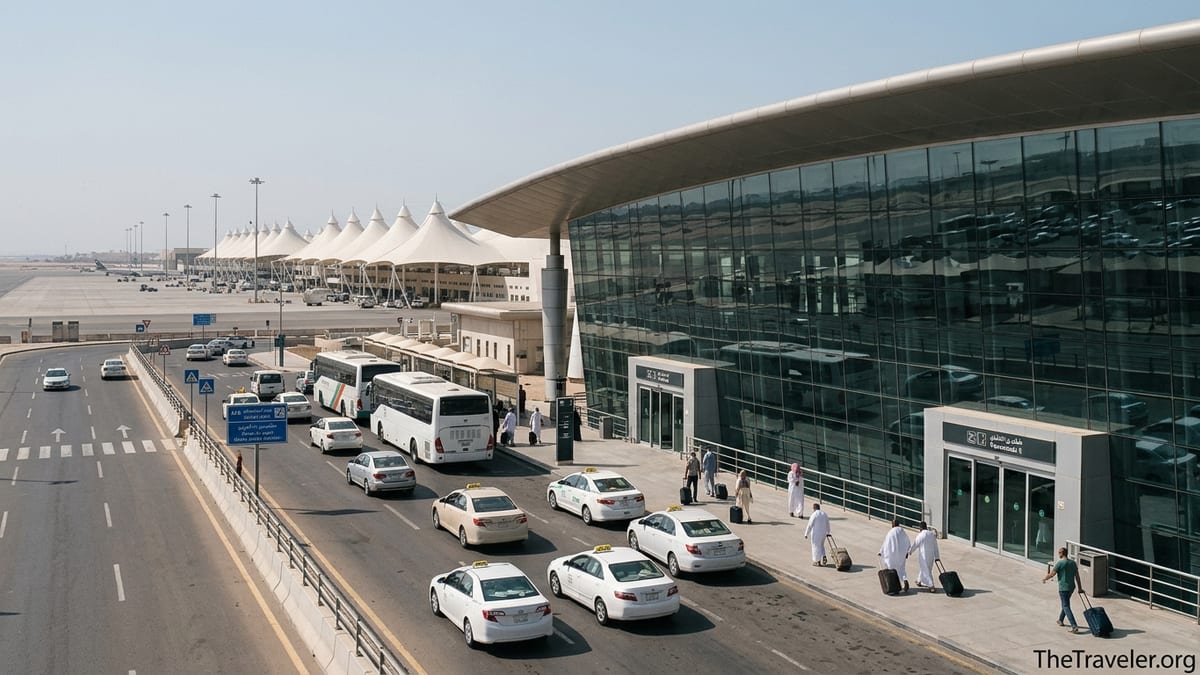
How Jeddah Airport Is Laid Out Today
King Abdulaziz International Airport (JED) in Jeddah now has one main modern building, Terminal 1, plus a separate Hajj & Umrah Terminal complex and a smaller North Terminal area used at busy times. The older South Terminal that many travelers remember has been closed, but the name still appears in some online forums and outdated itineraries, which adds to the confusion. For most regular international and domestic flights that are not part of organized Hajj operations, you will almost certainly use Terminal 1.
Terminal 1 is the glass-and-steel, mall-style terminal with a central indoor garden and a large aquarium. Major carriers such as Emirates, Qatar Airways, Etihad, Turkish Airlines, British Airways and many Asian and African airlines now operate from this terminal for both arrivals and departures. If you are flying in on a typical connection, such as London to Jeddah on British Airways or Dubai to Jeddah on Emirates, and you are visiting Saudi Arabia on a tourist, business or Umrah visa, Terminal 1 is where you should expect to arrive and depart.
Next to Terminal 1, but separated by security and roadway fences, lies the Hajj & Umrah Terminal complex, often simply called the Hajj Terminal. Architecturally it is very different: a vast tent-like roof structure designed in the 1980s to handle hundreds of thousands of pilgrims. Today it mainly operates at full capacity during the official Hajj period and is also used at times for large Umrah groups managed through licensed operators. Individual travelers on e-visas ordinarily have no reason to use the Hajj Terminal unless their Hajj package explicitly says so.
North Terminal is a smaller zone used historically by many foreign airlines before Terminal 1 opened. Some regional carriers and low-cost airlines may still be assigned to it when demand is high, particularly around Ramadan and Umrah peaks. In practice, however, most new bookings after the Terminal 1 consolidation will show either “Terminal 1” or “Hajj Terminal,” and if your ticket only says “JED” with no terminal, you can usually assume Terminal 1 unless your airline, agent or Hajj organizer confirms otherwise.
Who Uses Terminal 1 vs Hajj Terminal in Practice
For the average traveler, the most important question is simple: will my flight arrive and depart from Terminal 1 or from the Hajj Terminal complex? As a rule of thumb, regular scheduled flights that carry a mix of business, leisure and independent Umrah passengers use Terminal 1, while charter-style Hajj flights that are block-booked by official Hajj missions use the Hajj Terminal. This division is not absolute, but it is a reliable starting point when interpreting your itinerary.
Consider two real-world examples. A traveler from Manchester flying on Qatar Airways to Jeddah via Doha on a tourist visa outside the core Hajj weeks will arrive at Terminal 1, clear immigration alongside other visitors, collect baggage and then continue by taxi or pre-booked car to Makkah or Medina. By contrast, a Hajj pilgrim from Indonesia whose package includes a direct Saudia flight labeled “Hajj charter” may land at the Hajj Terminal, be processed through dedicated Hajj immigration counters and then be placed directly on group buses heading to their group’s accommodation.
National carrier Saudia, along with low-cost partners like flyadeal and flynas, predominantly operate from the newer facilities integrated with Terminal 1, especially for domestic legs such as Jeddah to Riyadh or Jeddah to Dammam and for year-round scheduled international flights. During the peak Hajj period, some Saudia flights are reassigned to the Hajj Terminal to separate pilgrims on Hajj visas from other passengers. The detail appears in the internal airline systems and usually on group documentation, so Hajj pilgrims should pay close attention to the terminal listed in their package paperwork rather than relying on a generic mobile app display.
Travelers on smaller or newer airlines sometimes worry that “secondary” carriers may use the old North Terminal instead of Terminal 1. In reality, most of these airlines have already migrated operations into Terminal 1, even if online comments still refer to them as “North Terminal carriers.” If you are flying, for example, from Sharjah on Air Arabia or from Abu Dhabi on Wizz Air Abu Dhabi, recent seasons have shown their flights operating in Terminal 1. The best way to be sure is to check your boarding pass and the departure screens 24 hours before travel, but in practice arriving at the Terminal 1 drop-off is the correct choice for the overwhelming majority of these flights.
Understanding Umrah vs Hajj Operations
Many of the terminal questions arise from confusion between Umrah and Hajj. Umrah is the minor pilgrimage that can be performed year-round and is often done on tourist or dedicated Umrah visas, while Hajj is the major pilgrimage with specific dates in the Islamic lunar month of Dhu al Hijjah. Saudi authorities treat the two very differently when planning airport operations, which directly affects which terminal you will use.
Most independent Umrah travelers, including those on e-visas issued through online portals, will fly in and out of Terminal 1. They use the same immigration halls and baggage belts as tourists visiting Jeddah’s waterfront or business travelers heading to the city’s industrial zones. For example, a family from Cairo performing Umrah during school holidays may fly EgyptAir into Terminal 1, pick up a local SIM card and some snacks in the arrivals area, and then take a metered taxi or a ride-hailing service from the public curb outside.
Hajj, in contrast, is handled through tightly controlled Hajj visas with set quotas for each country and official Hajj offices coordinating flights, buses and accommodation. Pilgrims often arrive in large groups on flights that have been specifically designated as Hajj flights. During the weeks before and after Hajj, these chartered operations are funneled toward the Hajj & Umrah Terminal complex, where large shaded halls, dedicated health desks and group processing lines are set up. A Nigerian or Bangladeshi pilgrim traveling with a government-managed Hajj mission, for instance, may never see Terminal 1 at all; they disembark directly into the Hajj Terminal, clear immigration as a group and board buses waiting on the tarmac.
The timing also matters. Outside the formal Hajj window, what the airport calls the “Hajj & Umrah Terminal” may still handle some large Umrah groups, especially from countries that send charter flights under block agreements. In such cases, travelers often do not choose their terminal at all; the terminal is dictated by the contract between their country’s Hajj or Umrah office and Saudia or another carrier. Individual passengers booking their own tickets, even in Ramadan, are overwhelmingly routed to Terminal 1, so a traveler purchasing an online Saudia ticket from New York to Jeddah for Umrah in March should expect to use Terminal 1 unless their booking explicitly states otherwise.
North, South, Hajj: Clearing Up the Old Names
A lot of the anxiety around Jeddah airport terminals comes from outdated terminology that still appears in online discussions. The “South Terminal” was the primary building used by Saudia for decades but has been officially closed, even though some travelers fondly or not-so-fondly still mention it. If your itinerary or agent refers to the South Terminal today, it almost certainly means they are using old language for the newer Saudia-linked facilities now connected to Terminal 1, not that you should look for a separate public terminal on arrival.
The “North Terminal” historically hosted many foreign airlines, and some mapping apps and older airline schedules still display it. However, practical experience in recent years shows that most mainstream international carriers have been consolidated into Terminal 1. In rare cases during operational peaks, an airline may be temporarily assigned to a gate area labeled “North,” especially for remote-stand operations where passengers are bused to and from aircraft parked away from the main building. For ordinary travelers, there is no distinct landside North Terminal to choose from in the way there was a decade ago; you will still be dropped at the same primary departures façade.
The Hajj Terminal has kept its name and purpose but is part of a larger “Hajj & Umrah” complex that includes arrival and departure halls, rest areas and bus bays. Some airline tools and travel agents abbreviate it as “HJ” or “H Terminal” on internal notes. A Hajj passenger might, for example, see “JED HJ” on a group flight manifest. That does not mean another completely different airport; it simply designates the Hajj Terminal zone within King Abdulaziz International Airport rather than Terminal 1.
For clarity when planning transfers, think in simple pairs: if your document or airline app says “Terminal 1” or gives no terminal at all, assume Terminal 1. If it says “Hajj,” “Hajj & Umrah,” “HJ” or your Hajj organizer explicitly mentions the dedicated Hajj halls, expect to arrive at the Hajj Terminal. If an older document refers to “North” or “South,” treat that as a prompt to reconfirm with your airline for up-to-date wording rather than as a sign that you must find an entirely separate building.
Getting Between Terminals, Shuttles and Taxis
Although King Abdulaziz International Airport is one complex, there is no simple airside walkway between Terminal 1 and the Hajj Terminal. They sit on different sides of the apron with security fencing in between, and each has its own access roads from the highway. If you arrive at the wrong terminal, you must exit landside and use ground transport to reach the correct one, just as if you were moving between two nearby but separate airports.
For travelers needing to move between terminals, the most common option is a licensed airport taxi or a ride-hailing service such as Uber or Careem. The journey by road between Terminal 1 and the Hajj Terminal typically takes 10 to 15 minutes in normal traffic. Fares reported recently for authorized airport taxis on this short hop are around the equivalent of a modest city ride, often in the region of tens rather than hundreds of Saudi riyals, but they can feel like an unnecessary cost if you are already stressed and late. Because these taxis operate from marked ranks, they are usually the quickest solution, especially late at night when shuttle frequencies may be lower.
There is also a basic shuttle bus system connecting the main public transport areas and some airport zones, but schedules may be irregular and can change between seasons. Hajj operators sometimes run their own dedicated buses between the Hajj Terminal and group hotels or meeting points; these are not open to regular passengers and are visible mainly during the peak Hajj weeks when buses line up in clearly marshalled lanes outside the Hajj halls. An independent traveler who arrives at Terminal 1 but discovers their domestic Hajj group flight is leaving from the Hajj Terminal, for example, should not expect to be able to jump on a random Hajj bus. Instead, they must take a taxi or coordinate with their organizer.
When transferring between flights, the key detail is whether your connection is on a single ticket with through-checking or whether you are self-connecting. If both legs are on Saudia on one ticket, for instance, and involve a mix of international and domestic segments in Terminal 1, you will change gates airside without passing immigration. If, however, you are arriving on Air Arabia and then flying onwards on Wizz Air on separate tickets, even if both flights technically use Terminal 1, you should plan to clear immigration, collect bags, exit into arrivals and recheck in at departures. If one of those flights used the Hajj Terminal, a landside terminal transfer by taxi would be essential and could require several extra hours.
Common Wrong-Terminal Mistakes and How to Avoid Them
Wrong-terminal mistakes in Jeddah typically follow a few patterns. One involves outdated information: a traveler reads that “foreign airlines use North Terminal” in a years-old blog, tells their driver to drop them at the North Terminal entrance and then discovers that their airline now departs from Terminal 1. Another involves misinterpreting Hajj-related notes: a pilgrim on a tourist visa sees “Hajj & Umrah complex” mentioned in a generic airport article and assumes that all religious travelers must use the Hajj Terminal, even though their independent Umrah flight ticket clearly lists Terminal 1.
Real situations from recent seasons illustrate the consequences. A European traveler booked an Umrah trip through a small agency that simply wrote “Arrival: JED” on the confirmation without a terminal. Trusting an old online thread, the traveler insisted on being dropped at the Hajj Terminal, only to be refused entry at the door because they were not on a designated Hajj or Umrah group flight. With check-in for their actual Terminal 1 flight closing in less than an hour, they had to scramble into an airport taxi for the short but stressful ride to the correct building, paying extra in cash and arriving just before the counter closed.
Another pattern involves self-transfers. For example, a traveler from Casablanca might arrive on a low-cost carrier using Terminal 1 and then have a separate domestic ticket on Saudia that, during the peak Hajj weeks, has been shifted to depart from the Hajj Terminal. Because the bookings were separate, no one warned them about the terminal change. On arrival they followed “Transfers” signs assuming an easy connection, only to learn at an information desk that they must exit, arrange road transport to the Hajj Terminal and clear outbound security again, adding at least an hour to their minimum connection time.
You can reduce the risk of such mistakes with a few simple checks. First, verify the terminal with your airline 24 to 48 hours before departure using the “manage booking” function or by calling customer service, especially if you are traveling during the Hajj months or Ramadan. Second, read your e-ticket or boarding pass carefully; if it lists “T1,” “Terminal 1” or nothing, plan on Terminal 1. Third, if you are on a Hajj package, rely on your organizer’s written instructions and ask them explicitly whether your flights use the Hajj Terminal or Terminal 1, as different flights within the same package can sometimes use different terminals.
The Takeaway
Jeddah’s King Abdulaziz International Airport has undergone a major transformation, but the mix of old and new terminal names still confuses many travelers, especially those heading for Makkah and Medina. In practical terms, Terminal 1 is now the main hub handling most regular domestic and international flights, including the majority of independent Umrah journeys and all kinds of business and leisure trips. The Hajj & Umrah Terminal complex serves mainly organized Hajj operations and some large chartered Umrah groups whose passengers travel under specific visas and contracts.
If your booking does not explicitly mention the Hajj Terminal or you are not traveling on a dedicated Hajj visa arranged through an official mission or licensed package, you should assume that you will use Terminal 1. Old references to North or South terminals are largely legacy language that should prompt you to double-check, not to search for separate buildings in the middle of the night with luggage in tow. When in doubt, confirm directly with your airline or Hajj organizer shortly before travel and allow enough time in your itinerary for potential landside transfers by taxi if you are self-connecting between flights.
For pilgrims and general travelers alike, a bit of homework about Jeddah’s terminals goes a long way. Knowing in advance whether you belong in Terminal 1 or the Hajj Terminal, understanding that there is no simple walkway between the two, and planning your ground transport and connection times accordingly can turn a potentially chaotic arrival into a smooth first step on your journey to the holy cities or beyond.
FAQ
Q1. How can I tell if my flight uses Terminal 1 or the Hajj Terminal in Jeddah?
Your e-ticket or boarding pass should list the terminal as “Terminal 1,” “T1” or “Hajj Terminal/HJ.” If it is not clear, check your booking on the airline’s website 24 to 48 hours before departure or call customer service, especially if you are traveling in the Hajj period.
Q2. I am going for Umrah on a tourist or Umrah e-visa. Will I arrive at the Hajj Terminal?
Most independent Umrah travelers on regular scheduled flights arrive and depart from Terminal 1, not the Hajj Terminal. The Hajj Terminal is generally reserved for chartered Hajj flights and some large organized groups, so assume Terminal 1 unless your ticket or tour operator explicitly says otherwise.
Q3. What happens if I arrive at the wrong terminal in Jeddah?
If you show up at the wrong terminal, you will usually be turned away at the entrance or at the check-in desks and advised to go to the correct one. You will then need to exit landside and take a licensed taxi or ride-hailing service between terminals, which can add 10 to 15 minutes of driving plus time for new security checks.
Q4. Is there a free shuttle bus between Terminal 1 and the Hajj Terminal?
Shuttle arrangements can vary by season and are not guaranteed for the general public. During Hajj, buses mainly serve organized pilgrim groups and operate under strict access controls. Independent travelers should not rely on free shuttles and should instead plan to use airport taxis or ride-hailing services if a terminal transfer is needed.
Q5. I have two separate tickets in Jeddah, one international and one domestic. How much connection time do I need?
For self-transfers where you must clear immigration, collect baggage, possibly change terminals and recheck in, allowing at least four to five hours is prudent, especially around Ramadan and Hajj. If both flights are on one ticket with a guaranteed connection, the airline’s minimum connection time is usually enough, but extra buffer is always wise.
Q6. Can I access visa-on-arrival or tourist e-visa services at the Hajj Terminal?
Visa-on-arrival and tourist e-visa processing are typically organized in Terminal 1, where general arrivals are handled. Facilities at the Hajj Terminal are focused on pilgrims traveling on dedicated Hajj or group visas. If your travel relies on obtaining a visa on arrival, you should make sure your flight is scheduled to use Terminal 1.
Q7. Do Saudia and low-cost Saudi carriers always use a different terminal from foreign airlines?
No. Saudia, flyadeal and flynas mainly operate from the newer facilities associated with Terminal 1, just as most foreign airlines now do. During Hajj, some dedicated pilgrim flights on Saudia and partners may be moved to the Hajj Terminal, but this will be clearly specified in Hajj package documents rather than left for you to guess.
Q8. What should I tell my taxi or driver when heading to Jeddah airport?
Show your driver your booking and clearly say “Terminal 1” or “Hajj Terminal” according to what is written. Avoid using old terms like “North” or “South” on their own, as these can cause confusion. If your paperwork is unclear, default to Terminal 1, where information desks can confirm your airline’s current check-in area.
Q9. I am a Hajj pilgrim arriving early in Saudi Arabia on a tourist visa and joining my group later. Which terminal will I use?
On your tourist or non-Hajj ticket, you will almost certainly arrive at Terminal 1 like any other visitor. When you later join your Hajj group, the group’s outbound flight may use either Terminal 1 or the Hajj Terminal depending on the organizer’s arrangements, so you must follow the written instructions from your Hajj mission for that specific leg.
Q10. Are there good facilities for rest, food and prayer in both Terminal 1 and the Hajj Terminal?
Yes. Terminal 1 has a modern mall-style layout with international food outlets, shops and multiple prayer rooms. The Hajj Terminal complex is designed to serve large numbers of pilgrims, with shaded waiting areas, basic food services and extensive prayer spaces. The main difference is not comfort but access: most regular travelers will only ever use Terminal 1.