


For many pilgrims, the journey to Masjid al-Haram begins the moment they land at Jeddah’s King Abdulaziz International Airport. Choosing the right route from the airport to your hotel near the Haram can save money, reduce stress, and protect your energy for worship. This guide focuses on real options available in 2026 and is written with first-time pilgrims, families with children, elderly travelers, and group leaders in mind.
Get the latest updates straight to your inbox!
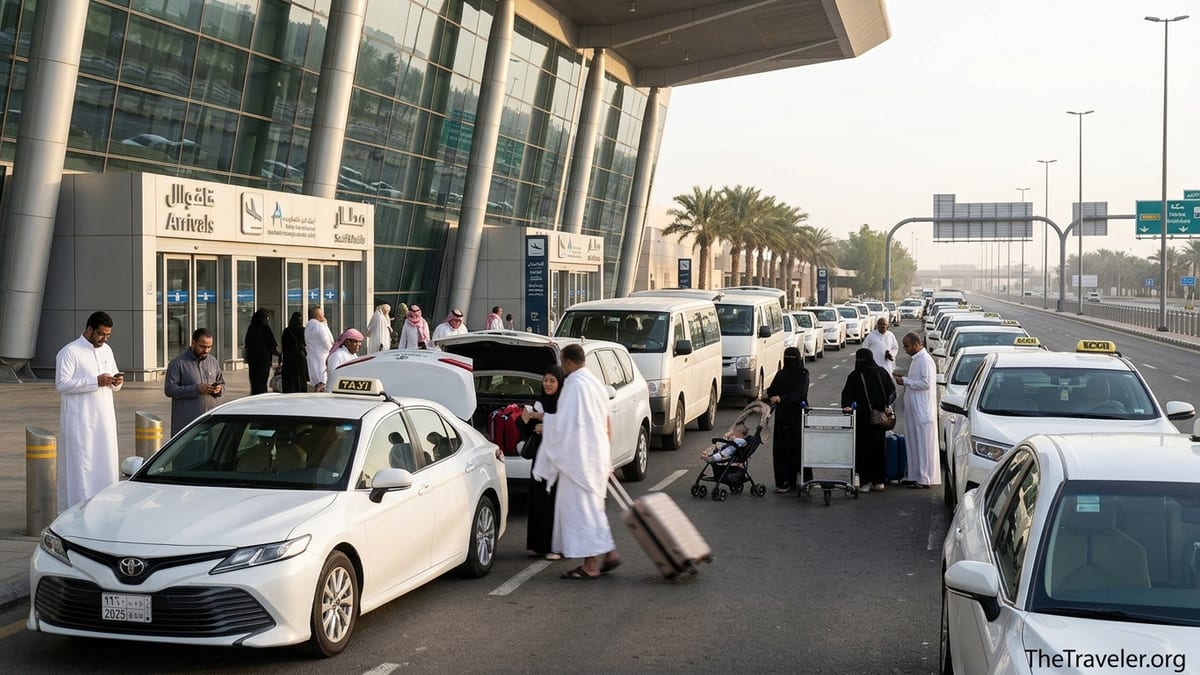
Understanding the Route from Jeddah Airport to Masjid al-Haram
King Abdulaziz International Airport (JED) sits roughly 80 to 90 kilometers from Masjid al-Haram in Makkah, depending on the exact route your driver takes. In normal traffic, the drive takes about 60 to 90 minutes. During peak Umrah and Hajj periods, or on Thursday and Friday evenings, it can stretch to two hours or more as the main highway toward Makkah becomes busier.
Most road journeys follow the Haramain Expressway out of Jeddah and then continue on to Makkah, where vehicles are funneled through checkpoints and into designated access routes around the central Haram zone. If your hotel is in the Ajyad, Ibrahim Al Khalil, or Al Misfalah areas near the Clock Tower, your driver will usually aim for the tunnels and roads that drop you close to King Abdulaziz Gate or the surrounding hotel entrances.
Because the airport is directly connected to the Haramain High Speed Railway, some travelers combine a short internal transfer within the airport with a fast train ride to Makkah’s train station at Rusayfah. From there, they complete the last 6 to 8 kilometers to the Haram area by licensed taxi or ride-hailing app. This can be efficient outside late-night hours, but it adds an extra change of vehicle, which matters if you are elderly or traveling with a lot of luggage.
The key decision is whether you want a single door-to-door transfer from the arrivals curb to your hotel, or you are comfortable changing between train and taxi to potentially save money or avoid traffic. For most families and older pilgrims, a private taxi or pre-booked car from the airport to the hotel is the least complicated option.
Door-to-Door: Taxis, Ride-Hailing Apps and Private Cars
For many pilgrims, the simplest and most common option remains a direct road transfer from Jeddah Airport to their hotel in Makkah. At Terminal 1, you will find an official taxi rank outside arrivals where airport-authorized “green” or white taxis queue. Typical asking prices to central Makkah hotels in 2026 are often in the range of 250 to 350 Saudi riyals for a standard sedan, depending on time of day, demand, and how well you negotiate. Larger vehicles, such as 7-seater SUVs or minivans frequently used by families, will cost more.
Ride-hailing apps such as Uber and Careem operate at Jeddah Airport and along the Jeddah–Makkah corridor. Many recent pilgrims report quoted prices roughly in the 180 to 260 riyal range for an UberX or Careem Comfort from the airport to hotels near the Clock Tower in moderate traffic, with higher surge prices during very busy times. A practical way to avoid overpaying at the curb is to open one of these apps on the airport Wi-Fi, check the estimated fare, and use that figure as a reference when comparing with a taxi quote.
Private car companies and Umrah-focused transport services also sell fixed-price transfers that you can book in advance. These are especially popular with tour groups and large families. A typical 2026 example might be a pre-booked air-conditioned van for 5 to 7 passengers and luggage, meeting you at arrivals with a sign and charging around 350 to 500 riyals for a non-shared ride to a central Makkah hotel. The extra cost often buys you a smoother experience: the driver waits if your flight is delayed, helps with luggage, and knows exactly where to drop you even if you arrive after midnight.
When comparing options, remember that Saudi law requires children under a certain age to use car seats in private vehicles, but in practice, official taxis and many ride-hail drivers may not carry them. Families with toddlers often choose a private transfer company that explicitly offers child seats on request, or bring a compact travel car seat they can quickly install in the back seat before departure from the airport.
Using the Haramain High Speed Train Plus Taxi
The Haramain High Speed Railway links King Abdulaziz International Airport with Makkah, Jeddah city, King Abdullah Economic City, and Madinah. From the airport station, sleek modern trains run to Makkah’s Rusayfah station in roughly 30 to 40 minutes. The trains are air-conditioned, have luggage racks, and offer both economy and business classes with assigned seating. For many travelers arriving in the daytime or early evening with light to medium luggage, this can be a comfortable and scenic way to reach Makkah.
In 2026, economy tickets between Jeddah Airport and Makkah often fall in a ballpark of 60 to 90 riyals per adult when booked in advance, with dynamic pricing depending on demand and time of travel. Families sometimes find that buying several train tickets plus a local taxi ride from Rusayfah station to the Haram area still works out cheaper than a large taxi straight from the airport, especially outside peak Ramadan and Hajj days.
However, the train is not strictly door-to-door. After clearing immigration and customs, you must follow airport signage or staff directions to the Haramain train station within the airport complex, which may involve walking with trolleys or using a shuttle. On arrival at Makkah’s Rusayfah station, you then exit the station building and choose a second-leg transfer. Licensed taxis and ride-hailing drivers are usually waiting in the pick-up zones, and many hotels near the Haram can be reached within 15 to 25 minutes by car, depending on traffic.
The train-plus-taxi combination tends to suit younger couples, solo travelers, and small families with manageable luggage who value speed and cost savings, and who arrive during train operating hours. It is less ideal for very late-night arrivals when train frequencies drop or services pause, or for elderly pilgrims who prefer not to change vehicles. If you are traveling as part of a group package, ask your agent whether a dedicated bus or van from the airport might be easier than navigating the train system individually.
Miqat, Ihram Timing, and Luggage Practicalities
Most international flights heading to Jeddah for Umrah cross one of the designated miqat boundaries before reaching the Red Sea coast. That means male pilgrims intending to perform Umrah on arrival should usually change into ihram clothing and form their intention before the plane crosses the miqat. Airlines often play an announcement 20 to 40 minutes before this point, but it is wise to ask cabin crew early in the flight roughly when you will pass the miqat so that you have enough time to prepare in the aircraft lavatory or a quiet corner.
Some pilgrims, especially those with young children, choose to put on the two white ihram garments on the plane but delay reciting the intention until closer to arrival, to minimize the time they need to maintain ihram restrictions. Others prefer to wear ihram underneath a light abaya or loose clothing and adjust it properly in the airport prayer area before exiting for transport. Women typically wear modest clothing suitable for ihram that they do not need to change mid-flight, though they still must form the intention at or before the miqat according to their school of thought.
Once you land, expect a period of waiting at passport control and baggage claim, especially during peak Umrah months and Hajj season. It is common for families to wait 45 to 90 minutes before they collect all bags and step into the arrivals hall. With this in mind, do not schedule tight train departures or fixed transfer pick-up times that assume you will exit quickly. If you book a private car, choose a provider that tracks your flight and is used to the variability of Jeddah arrivals.
Regarding luggage, standard airport taxis can usually fit two to three large suitcases and smaller cabin bags in the trunk and interior. If you are a group of four adults each with a large suitcase, you might be more comfortable in a minivan or SUV so that bags are not stacked dangerously high. At the Haramain train, official luggage rules may limit very oversized items, but in practice most standard suitcases and small zamzam water boxes purchased in Makkah are accepted. For your outbound trip back to Jeddah, you will usually collect zamzam water in sealed containers at dedicated points in Makkah rather than bringing loose water to the station.
Late-Night Arrivals, Safety, and Scams to Avoid
Many long-haul flights into Jeddah land between 10 p.m. and 4 a.m. At these hours, the Haramain train may have reduced departures or be out of service, while buses run less frequently. The most realistic options then are usually official airport taxis, ride-hailing apps, or pre-booked private transfers. From a safety perspective, Jeddah Airport is generally well patrolled, and families arriving at night will find lighting, cameras, and staff present in the arrivals forecourt.
The main risk at any major airport is not violent crime, but being overcharged or pressured into an unlicensed vehicle. At Jeddah Airport, drivers or middlemen may approach you inside or just outside the terminal offering “special price” rides to Makkah. These cars are often not part of the official taxi queue. To protect yourself, it is best to either join the marked taxi line, use an app like Uber or Careem where the fare is shown on screen, or meet a clearly identified driver from a company you booked in advance.
If you do choose a street taxi, agree the total fare before loading your luggage. For example, if the driver asks for 350 riyals to your Makkah hotel, you can politely respond that ride-hailing apps show around 220 to 250 riyals at that moment and ask whether he can match something close. Many pilgrims successfully negotiate to a more reasonable figure simply by showing the app estimate. If the driver refuses to state a clear price or insists on using a meter without explaining the approximate cost, it is safer to walk away.
Lone travelers and women within a family group commonly use app-based rides without problems, but if you are uneasy, you can wait for a private car driver with a company ID or travel as part of a small group. Keep valuables and passports in a small bag that stays with you on the seat, not in the trunk. Before the car moves, double-check that the driver knows your hotel’s name and near which gate of the Haram it sits; having the Arabic hotel name written on a paper or screenshot helps avoid confusion at 2 a.m.
Families, Elderly Pilgrims, and Group Transfers
Traveling with children, elderly parents, or relatives with mobility issues changes what “best route” means. A solution that saves 80 riyals but requires three changes of vehicle and long walks may not be worth it. Many multigenerational families arriving from countries such as Indonesia, Pakistan, Turkey, or the United Kingdom opt for a pre-arranged minibus that collects the entire group at arrivals and drives straight to their Makkah hotel, even if that means sitting in highway traffic for a while.
For an elderly couple arriving on their own, an airport taxi or ride-hail car is often easier than navigating train stations and lifts with wheelchairs or walking aids. Tell the driver clearly that you need to be dropped as close as possible to your hotel entrance or the nearest Haram gate with wheelchair access. Major hotels such as the Fairmont Makkah Clock Royal Tower, Swissotel Makkah, and Hilton Suites often have well-marked drop-off points that drivers are familiar with.
Parents with small children may prefer to keep routines predictable: feed the kids, visit the restroom, then take a single car while they sleep. Consider packing a compact stroller that folds easily into a taxi trunk and a small backpack with snacks, wipes, and spare ihram belts or pins. In practice, many parents report that the biggest challenge is not the transport itself but keeping tired children calm during the long queues at immigration and the final approach to the Haram during busy prayer times.
For organized groups, such as mosque delegations or community Umrah packages, large coaches or multiple vans may be arranged. These vehicles usually park at designated bus areas on the edge of central Makkah, from which pilgrims either walk or take short shuttle rides to their hotels. Group leaders should confirm with their organizers whether they will see the bus immediately after customs or must wait at a meeting point within the terminal. Clear WhatsApp communication and printed signs with group names help prevent people from getting separated in the crowded arrivals hall.
Choosing the Right Option for Your Budget and Schedule
When deciding between taxi, train, bus, or private car, think in terms of three main factors: time, comfort, and cost. A solo traveler on a tight budget might prioritize the least expensive route, even if it means taking the Haramain train in economy class and then a short shared taxi from Rusayfah station to a budget hotel in the Misfalah or Aziziyah districts. In contrast, a couple on a short three-night Umrah may happily pay extra for a direct private transfer so they can reach their hotel, rest, and begin tawaf as soon as possible.
As a rough guide in 2026, a standard door-to-door taxi or app ride from Jeddah Airport to a hotel within walking distance of Masjid al-Haram might average somewhere between 200 and 300 riyals under normal conditions. A train ticket plus local taxi might land closer to 120 to 180 riyals per person depending on how many are traveling together and what class you choose. Buses operated by major companies are usually the lowest-cost option, but may take longer and involve fixed departure times that do not always align perfectly with your flight arrival.
Consider your arrival time as well. If you land at 11 a.m. on a weekday outside Ramadan, the train is likely running frequently and road traffic is moderate. If you land at 2 a.m. in the last ten nights of Ramadan, the roads toward Makkah may be heavily congested around Fajr and the train schedule may be less convenient. In that scenario, a pre-booked car whose driver knows alternative routes and is comfortable navigating congestion can be worth the premium price.
Finally, factor in your energy levels and spiritual priorities. Many pilgrims want to begin Umrah as soon as possible after arrival. If you know that multiple transfers, price negotiations, and timetable checks will leave you mentally exhausted, spending a bit more for simplicity is a valid and often wise choice. On the other hand, if you enjoy planning and are used to using ride-hailing and train apps at home, combining the Haramain train with local taxis can be both economical and satisfying.
The Takeaway
Travel from Jeddah’s King Abdulaziz International Airport to Masjid al-Haram has improved significantly in recent years, with modern trains, better-regulated taxis, and a growing ecosystem of private transfer services. Yet the best route is still deeply personal. It depends on whether you are alone or with family, arriving at noon or in the middle of the night, carrying a backpack or four large suitcases and a stroller.
For most first-time pilgrims and families, a straightforward taxi or pre-booked private car from the airport to the hotel remains the most practical option. Those comfortable with apps and train stations can save money and sometimes time by using the Haramain High Speed Railway to Makkah and finishing the journey by taxi. In all cases, preparing your ihram early, allowing generous margins for immigration and luggage, and having a clear plan for how you will reach your hotel can transform the airport transfer from a stressful unknown into a smooth first step of your pilgrimage.
Whichever route you choose, remember that the journey itself is part of your ibadah. Patience in queues, courtesy to drivers and fellow travelers, and calm decision-making at the airport set the tone for your days in front of the Kaaba. A little planning before take-off goes a long way in making that first sight of Masjid al-Haram feel as serene and focused as you have imagined.
FAQ
Q1. How long does it usually take to get from Jeddah Airport to Masjid al-Haram?
In normal traffic, expect about 60 to 90 minutes by road from King Abdulaziz International Airport to hotels near the Haram. During busy periods such as Ramadan or Hajj, or weekend evenings, the journey can stretch to two hours or more, especially as you approach central Makkah.
Q2. What is a typical taxi or Uber fare from Jeddah Airport to Makkah in 2026?
Many recent travelers report standard taxis from the official airport rank quoting between roughly 250 and 350 Saudi riyals for a sedan to central Makkah. Ride-hailing apps like Uber and Careem often show estimates in the 180 to 260 riyal range for similar trips, though prices can rise during peak demand or late-night surges.
Q3. Is the Haramain High Speed Train cheaper than a taxi for pilgrims?
For solo travelers or small groups, the Haramain train from Jeddah Airport to Makkah’s Rusayfah station can be cheaper than a private taxi, with economy tickets often falling in a moderate price band per person. However, you must also pay for a taxi from Rusayfah to your hotel. For larger families or groups filling a car or van, a direct road transfer can sometimes work out similar in total cost while being more convenient.
Q4. Should I put on ihram at home, on the plane, or at Jeddah Airport?
Most scholars advise that pilgrims intending Umrah should enter ihram before crossing the designated miqat, which usually happens mid-flight before reaching Jeddah. Many men therefore put on ihram garments on the plane and form their intention when the captain announces approaching the miqat. Some adjust or tidy their ihram in the airport prayer area after landing. Women typically travel in loose, modest clothing suitable for ihram without needing to change at the airport.
Q5. Is it safe to arrive in Jeddah late at night and travel to Makkah?
Jeddah Airport is generally busy and well lit around the clock, and many pilgrims travel to Makkah safely at night. The main concern is not safety but limited public transport options and higher taxi prices. To feel more secure, use official taxis or ride-hailing apps, avoid unmarked cars, and consider pre-booking a private transfer if you are arriving after midnight or with vulnerable family members.
Q6. What is the best option for families with young children and lots of luggage?
For parents with small children or babies, a single door-to-door transfer is usually best. A pre-booked minivan or SUV with enough space for car seats, strollers, and multiple suitcases lets you avoid changing vehicles or lifting bags on and off trains. While slightly more expensive, this option reduces stress and keeps children’s routines as stable as possible after a long flight.
Q7. Can elderly or disabled pilgrims easily use the Haramain train?
The Haramain train and its stations have lifts, escalators, and step-free access, and many elderly pilgrims use it comfortably when assisted by relatives. However, it still involves moving through large stations and changing to a taxi at Makkah’s Rusayfah station. Very frail or wheelchair-bound pilgrims often find a dedicated taxi or private van from the airport to the hotel simpler, especially late at night or during crowded seasons.
Q8. How can I avoid being overcharged by taxi drivers at Jeddah Airport?
To reduce the risk of overpaying, use a ride-hailing app that shows the fare estimate before you confirm, or join the official taxi queue and agree a fixed price before loading your luggage. Checking the current app price on your phone and politely comparing it to any quoted taxi fare gives you a solid basis for negotiation. If a driver refuses to state a clear total cost, it is better to look for another car.
Q9. Are there shared buses directly from Jeddah Airport to Makkah hotels?
Public and private bus companies operate services between Jeddah and Makkah, and some routes stop at or near the airport, especially in peak seasons. However, these buses usually terminate at bus stations or dedicated parking areas in Makkah rather than individual hotels. You will still need a short taxi or shuttle ride from the bus drop-off point to your accommodation near Masjid al-Haram.
Q10. What is the most stress-free option for a first-time Umrah pilgrim?
For a first-time visitor who is unfamiliar with Saudi transport and focused on worship, the most stress-free choice is usually a pre-arranged private transfer from Jeddah Airport directly to the hotel. You share your flight details in advance, meet the driver at arrivals, and travel in one vehicle without negotiating prices or switching between train and taxis. It may cost more than piecing together buses and trains, but it lets you arrive in Makkah calmer, rested, and ready to begin your Umrah.