


Island hopping in the Canary Islands can be one of Europe’s most rewarding short-haul adventures, but planning how to move between seven main islands and several smaller ones takes more than a quick search. Ferries, small propeller planes, resident discounts and car rental rules all shape what your itinerary will actually look like on the ground. This guide breaks down the main routes, typical prices and practical steps so you can connect Tenerife, La Gomera, Lanzarote, La Graciosa, Gran Canaria and beyond with confidence.
Get the latest updates straight to your inbox!
How Island Hopping in the Canaries Really Works
Most travelers base themselves on one of the three big hubs Tenerife, Gran Canaria or Lanzarote and then add one or two “side islands” by ferry or short flight. The bulk of inter-island ferries are operated by Fred. Olsen Express and Naviera Armas, with Baleària Canarias increasingly present on routes from Tenerife to La Gomera and La Palma. Services run year-round, but timetables and frequencies change slightly in winter and summer, so it is worth checking schedules again a few weeks before you travel.
Inter-island flights are dominated by Binter Canarias, a regional airline operating turboprop aircraft that link all eight inhabited islands multiple times per day on core routes such as Gran Canaria to Tenerife, Tenerife to La Palma and Gran Canaria to Fuerteventura. On these short hops, flight times are typically 30 to 45 minutes gate to gate, so you can realistically wake up in Gran Canaria and be having a late breakfast on La Palma without losing a whole day in transit.
Prices vary considerably depending on whether you are a resident of the Canary Islands or mainland Spain. Online search results often show heavily discounted “resident” fares first, which can make a ferry from Tenerife to Gran Canaria look like 15 euros one way when, in reality, a non-resident will often pay closer to 40 to 60 euros per person for a foot passenger and markedly more with a car. When comparing options, always click through to the final stage of the booking to see the real non-resident price before you shape your itinerary around an apparent bargain.
Given the distances involved, ferries are most practical for links between neighboring islands such as Tenerife and La Gomera, Lanzarote and La Graciosa, or Lanzarote and Fuerteventura. Flights make more sense for longer jumps such as Gran Canaria to El Hierro or Tenerife to Lanzarote, especially in winter when the seas can be rough and crossings long. Many travelers combine both, using a flight for the longest leg and then ferries for shorter hops once in a region.
Tenerife to La Gomera: The Classic Short Hop
The Tenerife to La Gomera route is one of the busiest and most convenient island hops in the archipelago. Ferries leave from Los Cristianos, in southern Tenerife, and arrive at San Sebastián de La Gomera, the island’s small capital. Fast ferries generally take around 50 minutes, and on a typical day there are several departures in each direction, which gives you flexibility to choose a morning or afternoon crossing that fits your accommodation check in and check out times.
Fred. Olsen Express and Naviera Armas both operate on this line, while Baleària Canarias has begun reinforcing high speed connectivity between Tenerife, La Gomera and La Palma with catamarans such as the Pepita Castellví. For a non resident booking a return ticket a few weeks in advance, it is common to see prices in the region of 40 to 70 euros per person as a foot passenger, depending on the season and promotions, with higher fares if you take a vehicle. Residents of the Canary Islands, by contrast, can pay less than half of that thanks to government subsidies, which is why online “from” prices can appear misleadingly low for visitors.
For most travelers, walking on as a foot passenger is the simplest option. You can stay in Los Cristianos, take a short taxi to the port with your luggage, and catch a mid-morning sailing that puts you in San Sebastián by lunchtime. Once on La Gomera, local buses fan out from the port toward Valle Gran Rey, Playa Santiago and Hermigua, though services are intermittent, so arranging a hire car in advance through a local company in San Sebastián often makes sense if you plan to explore the island’s mountainous interior and Garajonay National Park.
Rental car rules are an important detail on this route. Many large international agencies based at Tenerife South airport do not allow their vehicles onto ferries, or they void insurance coverage if you do. Local firms such as Cicar and Auto Reisen are often more flexible, but they may still require prior notification if you plan to take the car to La Gomera. Always check the rental contract and, if necessary, send an email asking explicitly whether the vehicle can travel on the Los Cristianos to San Sebastián ferry. If permission is not granted, a common solution is to leave the car in a paid car park in Los Cristianos and rent a separate vehicle upon arrival in La Gomera.
Lanzarote to La Graciosa: Into the Low Key Outpost
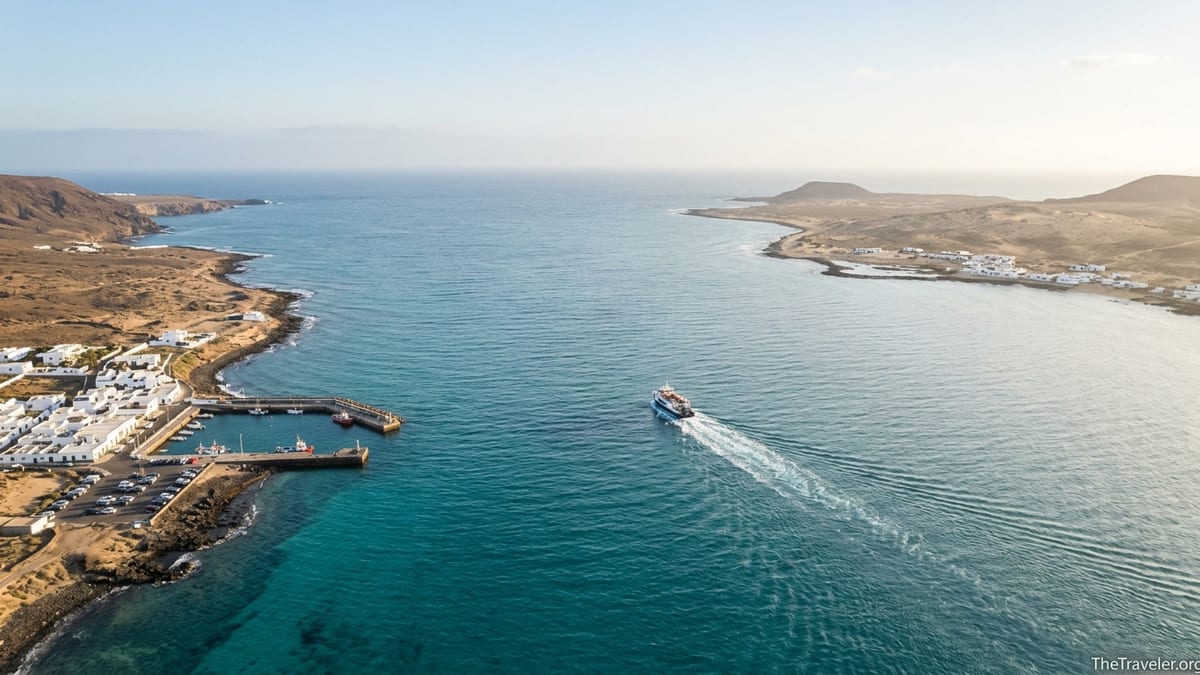
La Graciosa, off the northern tip of Lanzarote, is the smallest inhabited Canary Island and the only one without paved roads or an airport. To get there you must first reach the village of Órzola in Lanzarote’s far north, then take a passenger ferry across the narrow “El Río” strait to Caleta de Sebo on La Graciosa. Crossings typically take around 25 minutes and run many times per day in both directions, with the first boats usually leaving Órzola in the morning and the last returning from La Graciosa late in the afternoon or early evening.
The route is served by a couple of small local ferry companies that maintain ticket booths at the harbor in Órzola. Tickets can be bought on the day unless you are traveling at Easter, during Spanish summer holidays or on a busy weekend, when pre booking online is sensible. A same day return ticket for an adult foot passenger usually runs in the region of 20 to 30 euros, with children’s fares somewhat cheaper. There is no resident discount confusion here for most visitors because La Graciosa does not attract the large commuter traffic seen on routes such as Tenerife to Gran Canaria.
Crucially, you cannot take a car on this route. La Graciosa is largely car free and vehicles remain in dedicated parking areas in or near Órzola, typically just outside the village or next to the ferry terminal access road, with attendants guiding you to day trip or overnight spaces. That means all luggage needs to be carried onto the boat by hand. Pack with soft bags if possible, as you may be lifting your belongings up and down steep boarding ramps. Once in Caleta de Sebo, movement is on foot, by bicycle or via licensed 4x4 taxis that shuttle people along sandy tracks to beaches such as Playa de las Conchas.
In terms of itinerary planning, many Lanzarote based visitors use La Graciosa as a one day excursion, driving up the spine of the island from resort areas like Costa Teguise or Puerto del Carmen, parking at Órzola and catching a mid morning ferry. If you have the time, however, staying one or two nights in a simple apartment in Caleta de Sebo or Casas de Pedro Barba is a very different experience. After the last day trippers leave, the island becomes remarkably quiet. Evening walks along the harbor, with views back to the cliffs of Lanzarote’s Mirador del Río, are a highlight that most day visitors never see.
Gran Canaria Connections and Inter Island Flight Basics
Gran Canaria acts as a central hub connecting the eastern and western Canary Islands. Ferries from Las Palmas de Gran Canaria run to Santa Cruz de Tenerife, Arrecife on Lanzarote, Puerto del Rosario on Fuerteventura and occasionally directly to lesser visited islands. On the busy Gran Canaria to Tenerife route, Fred. Olsen Express and Naviera Armas typically operate multiple daily departures, with high speed catamarans taking about 2.5 hours between the two capitals. Prices for non residents usually start around 35 to 60 euros one way for a foot passenger, increasing significantly if you ship a vehicle.
When distance or sea conditions make ferries less appealing, Binter Canarias flights become the backbone of island hopping. From Gran Canaria’s GCLP airport, you can connect to every other Canary Island, often with several daily frequencies on major routes and at least one daily link on smaller ones such as Gran Canaria to El Hierro. Flight times can be as short as 30 minutes on the Gran Canaria to Tenerife hop and about 55 minutes on longer legs such as Gran Canaria to Lanzarote, which allows you to build complex itineraries without losing excessive travel time.
Binter’s baggage policy is particularly favorable on inter island routes. According to the airline’s own information, even the most economical fares on flights between Canary Island airports currently include one checked bag of up to about 20 kilograms per passenger, in addition to a small cabin bag. That means you rarely need to budget for extra luggage fees when moving between islands, though special items such as surfboards or oversized sports gear may not be accepted on the smaller turboprop aircraft used on many routes and sometimes must travel with cargo companies instead.
For itinerary planning, a useful rule is to reserve ferries for short, visually scenic hops such as Tenerife to La Gomera or Lanzarote to Fuerteventura, and use flights where the sea crossing would exceed three or four hours. As an example, if you want to visit both Gran Canaria and La Palma in one week, flying between them on Binter and then using a fast ferry for a day trip from La Palma to La Gomera often works better than trying to chain several long boat legs together. Booking Binter flights a few months in advance usually yields the best fares.
Luggage, Cars and Practical Rules on Ferries and Flights
Understanding how luggage and vehicles are handled will help you decide whether to move with a car or rely on local rentals and public transport. On the main inter island ferries, foot passengers typically bring one or two suitcases and a daypack on board without additional fees. Larger items such as surfboards or bicycles may incur a small supplement and need to be tagged at check in, but policies differ by company and sometimes even by route, so check your specific sailing during booking if you have bulky gear.
When you travel with a car, you pay by vehicle plus passenger. For example, on a Tenerife to Gran Canaria crossing with a major operator, it is common for a small car and two adults to pay a total fare that is two or three times higher than the price for two foot passengers. Vehicle fares are dynamic and change with demand, but the key point is that bringing a car is a convenience rather than a money saving measure. If you are only moving islands once or twice, it can be cheaper to drop the car where you are, take the ferry or flight as a foot passenger and rent a fresh vehicle on the next island.
Rental contracts are the other piece of the puzzle. Many visitors fly into Tenerife South, pick up a hire car and assume they can drive it onto ferries to La Gomera, La Palma or Gran Canaria without issue. In practice, some of the big international chains explicitly prohibit this and consider it a breach of terms that can void insurance. Regional brands such as Cicar, Payless Canarias or Auto Reisen are known for being more relaxed, but even they often stipulate that you must inform them in advance if you plan to take the car on a ferry. Failing to do this might leave you technically uninsured in case of damage while loading or unloading.
On flights, Binter’s inter island allowance of one checked bag of about 20 kilograms plus cabin luggage covers most normal packing needs, which is one reason many travelers choose planes for legs where ferries would be long and tedious. Security rules align with standard European aviation regulations: liquids in cabin bags must be in small containers, laptops must be screened separately and sharp objects in hand luggage are prohibited. Because inter island flights use small ATR turboprop aircraft, cabin baggage dimensions are more restrictive than on long haul jets, so soft backpacks and compact wheelie cases are easier to manage than large rigid suitcases.
Sample One and Two Week Itineraries
For a seven day trip focused on the western islands, a practical itinerary might start with an international flight into Tenerife South. Spend two or three nights exploring the island’s contrasts between the volcanic landscapes of Teide National Park and the coastal resorts of Costa Adeje or Puerto de la Cruz. Mid trip, take a morning ferry from Los Cristianos to San Sebastián de La Gomera, then continue by bus or pre booked rental car to Valle Gran Rey for laid back hiking and ocean views over two or three nights. On your last full day, return to Tenerife by afternoon ferry, stay near the south coast and fly home the following morning.
A 10 to 12 day eastern islands itinerary could begin with arrival in Lanzarote. After three nights based, for example, in Costa Teguise to explore Timanfaya National Park and the wine region of La Geria, drive north one morning to Órzola. Leave the hire car in the long stay area near the harbor and catch a late morning ferry to La Graciosa for a one or two night stay in Caleta de Sebo. Then return to Lanzarote, collect the car and make your way to Playa Blanca for a short stay before taking the ferry to Corralejo on Fuerteventura, which typically takes less than an hour. From Corralejo, you can continue south by car to El Cotillo or Costa Calma before flying out of Fuerteventura’s FUE airport.
Travelers with two full weeks can combine both regions using a flight as a bridge. One option is to spend the first week between Tenerife and La Gomera, then take a Binter flight from Tenerife North airport to Gran Canaria or Lanzarote. From there, continue your journey by road and ferry to La Graciosa or Fuerteventura. This structure means you never have to rush a connection and you can keep individual travel days to manageable chunks of two or three hours of movement, leaving time for an afternoon swim or village stroll even on transit days.
Whatever the length of your trip, it is wise to avoid booking tight same day chains such as an intercontinental flight landing in Tenerife South in the afternoon and a last ferry to La Gomera the same evening. A delayed inbound flight or slow baggage reclaim can easily cause a missed sailing. Giving yourself at least one overnight buffer on your arrival island before a ferry or inter island flight will reduce stress and allow for the occasional Atlantic swell or schedule change.
Planning, Booking and Seasonal Timing Tips
The Canary Islands are a year round destination, but ferry and flight logistics feel different depending on when you travel. In July and August, as well as around Christmas, New Year and Easter, routes such as Tenerife to Gran Canaria and Lanzarote to Fuerteventura are busy with residents and domestic tourists. At these times, booking both ferries and inter island flights several weeks in advance is advisable, especially if you are traveling with a vehicle or need to stick to a tight schedule. In quieter months such as May or late September, it is often possible to book closer to departure, but last minute price spikes can still occur on peak weekend sailings.
For most visitors, the simplest way to compare ferry options is to use an aggregator site to see rough schedules and journey times, then book directly with the chosen operator to avoid extra booking fees. When looking at prices on any site, double check that you have not accidentally selected a “resident fare” filter. This is a common source of confusion, particularly on Spanish language pages that default to Canarian residents. If a one way crossing between major islands appears to cost less than 10 euros for an adult, it is likely you are seeing a subsidized price that will not apply to you as a tourist.
Inter island flights are usually cheapest when booked as separate point to point segments, even if you are already purchasing a long haul ticket to Spain. For instance, flying into Madrid or Barcelona and then onward to Tenerife or Gran Canaria with a mainline carrier, before buying a standalone Binter ticket for your intra archipelago hops, often gives more flexibility and can be less expensive than trying to fold every movement into a single multi city booking. If your long haul arrival and first Binter sector are on the same day, leave generous connection time because a delay on an inbound international flight will not automatically protect your separate regional ticket.
Finally, think through how much moving you really want to do. The temptation with easy ferries and frequent flights is to string together four or five islands in ten days. In practice, the charm of the Canaries lies as much in slow days on a terrace in Valle Gran Rey or late afternoon swims on La Graciosa as it does in ticking off island names. A well balanced itinerary usually pairs one larger, busier island with one quieter, more rural one and limits total inter island legs to three or four segments at most.
FAQ
Q1. How far in advance should I book ferries between the Canary Islands?
For most of the year, booking ferries one to two weeks in advance is sufficient, but in July, August, at Easter and over Christmas and New Year it is wise to reserve vehicle spaces and peak time crossings three to four weeks ahead, especially on popular routes such as Tenerife to Gran Canaria or Tenerife to La Gomera.
Q2. Is it better to fly or take a ferry between Tenerife and Gran Canaria?
For foot passengers on a flexible schedule, ferries offer a scenic 2.5 to 3 hour crossing and can be competitively priced. If you want to minimize travel time or are prone to seasickness, a 30 to 40 minute Binter flight is usually more comfortable, and checked luggage is typically included in the fare on inter island routes.
Q3. Can I take a rental car from Tenerife to La Gomera on the ferry?
Some local rental companies allow their vehicles on ferries if you inform them in advance, but many international brands prohibit this and may void insurance if you do it anyway. Always check your rental agreement and obtain written confirmation before driving a hire car onto the Los Cristianos to San Sebastián de La Gomera ferry.
Q4. Do I need to book the Lanzarote to La Graciosa ferry in advance?
Outside peak Spanish holidays and busy weekends, it is usually possible to buy tickets for the Órzola to La Graciosa ferry at the harbor on the day of travel. In high season, or if you are traveling in a group or want a specific early or late crossing, pre booking online is recommended for peace of mind.
Q5. Are there any luggage restrictions on ferries between the islands?
Foot passengers can normally bring regular suitcases and a daypack on board without extra fees, but very bulky items such as surfboards or bicycles may require a small supplement or prior notification. Policies vary by company and route, so check the conditions during booking if you are carrying oversized gear.
Q6. What is the baggage allowance on Binter inter island flights?
Binter’s inter island fares currently include one checked bag of about 20 kilograms per passenger plus a small cabin bag, which is generous for short trips. Cabin luggage dimensions are stricter than on long haul flights because the aircraft are smaller, so compact, soft sided bags work best.
Q7. Can I visit La Graciosa as a day trip from Lanzarote without a car?
Yes. Many travelers stay in Lanzarote resorts such as Costa Teguise or Puerto del Carmen, take a taxi or bus to Órzola, and then travel as foot passengers to La Graciosa for the day. Once there, you can explore on foot, rent a bicycle or use licensed 4x4 taxis to reach beaches.
Q8. Are ferries in the Canary Islands affected much by bad weather?
Ferries operate year round, but in winter Atlantic swells and high winds can cause choppy conditions or occasional cancellations, particularly on longer open sea crossings. Shorter routes, such as Tenerife to La Gomera or Lanzarote to La Graciosa, are more sheltered but can still be bumpy, so seasick travelers may prefer flights when forecasts are poor.
Q9. How many islands can I realistically visit in one week?
Most visitors find that one larger island plus one smaller, quieter island is ideal for a seven day trip. Adding a third island is possible if distances are short, but more than that often turns the holiday into a sequence of travel days with little time to relax and explore.
Q10. Do ferry tickets in the Canary Islands include resident discounts automatically?
Booking platforms often display subsidized fares for Canary Islands residents by default, which can look surprisingly cheap. As a non resident you will need to deselect any resident discount option and expect your final price to be noticeably higher than the first figure you see on screen.