


The JetBlue Plus Card has a devoted following among frequent JetBlue flyers, but on paper its benefits can look like a jumble of points, tiles, and fine print. To understand what this card is really like to live with, it helps to move beyond marketing bullets and into real trips, real fares, and real baggage fees. After comparing its perks against actual JetBlue prices and rival cards, a clearer picture emerges of who this card serves brilliantly, and who is better off elsewhere.
Get the latest updates straight to your inbox!
The Core Deal: Fees, Earning Rates and Welcome Bonus
The JetBlue Plus Card, issued by Barclays, is a mid-tier airline card with an annual fee of about 99 dollars. That places it in the same ballpark as cards like the Southwest Rapid Rewards Plus or mid-level Delta and United cards. What sets it apart is how heavily it leans into JetBlue-specific value: points on JetBlue purchases, a recurring anniversary bonus, and perks that can erase baggage charges quickly for anyone loyal to the airline.
On spending, the JetBlue Plus Card typically earns 6 TrueBlue points per dollar on eligible JetBlue purchases, 2 points per dollar at restaurants and eligible grocery stores, and 1 point per dollar on everything else. In practice, that means a 400 dollar round-trip to Orlando for a family vacation can earn around 2,400 points if paid with the card directly through JetBlue. A 150 dollar week of groceries or a dinner out at a mid-range restaurant might yield 300 points. While that will not replace a dedicated high-earning grocery card, it does ensure you are steadily feeding your JetBlue balance between flights.
The welcome bonus on the JetBlue Plus Card changes, but recent public offers have hovered in the range of roughly 60,000 to 75,000 TrueBlue points for relatively modest minimum spend in the first few months. For many travelers, that can mean covering two or three domestic round-trips on routes like New York to Fort Lauderdale or Boston to Chicago, depending on dates and demand. For a traveler planning a couple of JetBlue trips in the next year, that initial windfall is often the single biggest burst of value they will get from the card.
Critically, the base earning on non-bonus categories is only 1 point per dollar, so the card is not a universal workhorse for every purchase. When compared with general travel cards that earn 2 points or more per dollar everywhere, the JetBlue Plus Card makes sense primarily as a “JetBlue-first” tool rather than your only card.
Free Checked Bags in Real Life: How Fast They Erase the Annual Fee
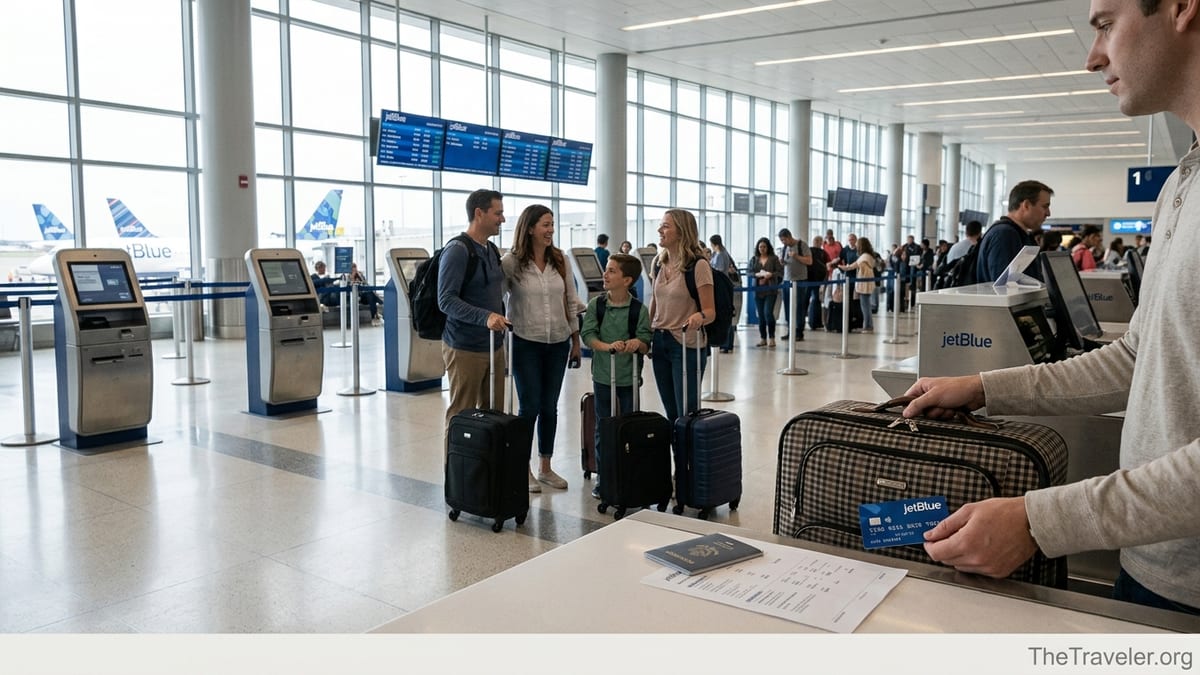
One of the most tangible perks of the JetBlue Plus Card is the free first checked bag on JetBlue-operated flights for the cardholder and up to three companions on the same reservation. This benefit applies regardless of the fare type in many cases, including lower-cost fares that would otherwise charge for bags. For a family or small group, this is where the card starts to feel very real, very quickly.
At the time of writing, JetBlue’s first checked bag on many domestic routes often falls in the range of about 35 to 45 dollars each way when not included in the fare. Imagine a couple flying from Boston to San Diego round-trip on basic Blue fares. Without the JetBlue Plus Card, each leg could mean 70 to 90 dollars in checked-bag fees per person for the round-trip, or 140 to 180 dollars total for two travelers. With the card properly linked to the TrueBlue account, both travelers can check a bag free, instantly offsetting the 99 dollar annual fee and then some on just that one trip.
Consider another example: a family of four flying from New York JFK to Orlando for a week at theme parks with one checked bag per person. With standard bag pricing, the round-trip cost for four checked bags can easily reach 280 dollars or more. If one adult holds the JetBlue Plus Card and is on the same reservation, those four checked bags can be free, turning what could have been a painful add-on fee into a straightforward win. For families who fly JetBlue once or twice a year with luggage, this perk alone can justify keeping the card.
The key limiting detail is that the cardholder typically must be on the reservation and have the card linked to the TrueBlue account at check-in. You cannot simply book flights for relatives and stay home while still expecting the free bag benefit to trigger for them. Travelers who mostly buy carry-on-only fares, or who frequently fly on other airlines, will not see as much value here, but for bag-checkers on JetBlue the math is unusually clear.
Anniversary Bonus, Inflight Savings and JetBlue Vacations Credit
Beyond baggage, several quieter perks smooth out the annual fee over time. Each year you renew the JetBlue Plus Card, you receive a 5,000-point anniversary bonus deposited into your TrueBlue account. Depending on the going value of TrueBlue points, many analysts place that at something like 60 to 80 dollars of flight value. In real-world terms, that might cover more than half the cost of a one-way ticket from New York to Savannah on an off-peak date, or serve as a substantial discount on a transcontinental economy fare if you are flexible with dates.
The card also typically offers 50 percent savings on eligible inflight purchases on JetBlue-operated flights when paid with the card. Picture a family of three on a five-hour JFK to Los Angeles flight, ordering a few snack boxes and drinks that might total around 40 dollars. With the card, that inflight bill can drop to about 20 dollars. For frequent flyers who regularly buy food or drinks onboard, that steady trickle of small discounts can feel surprisingly pleasant across a year of trips.
Another underappreciated perk is a statement credit for JetBlue Vacations when you book a qualifying package. Current terms often include around a 100 dollar annual statement credit after purchasing a JetBlue Vacations package of at least 100 dollars with the card. In practice, that could mean booking a weekend package to Fort Lauderdale that bundles flights and a basic beachfront hotel. If you were planning to book through JetBlue Vacations anyway, this perk effectively erases the card’s annual fee in a single stroke.
When you combine the anniversary bonus points, inflight savings, and potential JetBlue Vacations credit, many cardholders who take even one JetBlue trip per year find the card shifting from “break even” to “profitable” fairly easily, as long as they stay within the JetBlue ecosystem.
JetBlue Plus and the New TrueBlue Mosaic System
JetBlue’s revamped TrueBlue program introduced a tile-based path to Mosaic elite status, and the JetBlue Plus Card plays a direct supporting role. Cardholders earn tiles for credit card spending, generally at a rate of 1 tile per 1,000 dollars spent on JetBlue co-branded cards. Mosaic 1 status typically starts at 50 tiles in a calendar year, which corresponds to about 50,000 dollars in credit card spend if earned entirely through the card, though most travelers mix flying and card spend.
What does this look like for a real traveler? Suppose you are a Boston-based consultant who flies JetBlue regularly between Boston and Washington, D.C., with annual JetBlue ticket purchases around 5,000 dollars and another 20,000 dollars each year charged on the JetBlue Plus Card for dining, groceries, and other expenses. Those 20,000 dollars of card spend would earn about 20 tiles, while flight spending could earn additional tiles under JetBlue’s rules, potentially putting Mosaic 1 within reach when combined.
Mosaic 1 itself brings valuable benefits such as at least one free checked bag, same-day switches on many fares, priority boarding, and extra points on JetBlue flights. Higher Mosaic tiers add perks like complimentary Even More Space seats when available and occasional certificates for upgrades to Mint, JetBlue’s premium cabin. The card alone will not make you an elite flier, but it smooths the path and can provide those extra tiles needed to cross a threshold late in the year.
However, there is a reality check: spending 50,000 dollars on a single co-branded card just to earn entry-level Mosaic through spend alone is a heavy lift. For many travelers, especially those who split spending across multiple cards with higher everyday rewards, Mosaic is more realistically attained through a combination of frequent travel and targeted card use, not card spend alone.
How the JetBlue Plus Card Compares to Other JetBlue and General Travel Cards
Comparing the JetBlue Plus Card with other options is where its strengths and weaknesses really show up. Within the JetBlue lineup, the primary alternative is the no-annual-fee JetBlue Card. That free card earns points on JetBlue purchases but lacks the free checked bag, anniversary bonus, and JetBlue Vacations credit. For a traveler who flies JetBlue once a year with at least one checked bag, the 99 dollar JetBlue Plus Card usually comes out ahead. A single round-trip with bags can recoup the fee, while a basic card without an annual fee cannot offset those baggage charges at all.
Then there are general travel cards like the Chase Sapphire Preferred, Capital One Venture, or Citi Premier. These often earn 2 or more points per dollar on a broad range of categories and are not tied to a single airline. If you fly JetBlue only occasionally, those cards can provide far more flexible value. For example, a traveler based in Chicago who sometimes flies JetBlue to New York but frequently takes American or United flights will usually find a general travel card more rewarding over time.
In a realistic scenario, a New York family that flies JetBlue to Florida twice a year, always checks bags, and books the occasional JetBlue Vacations package stands to save hundreds of dollars annually with the JetBlue Plus Card. A solo traveler in Denver who might fly JetBlue once every couple of years on a sale fare but mostly flies other airlines will likely get better value from a flexible travel card that is not airline-specific.
When comparing to premium airline cards with higher fees, like some flagship cards from Delta or United, the JetBlue Plus Card feels leaner but more focused. It does not include airport lounge access or a long list of travel protections at the same level, but it also does not cost 250 to 650 dollars per year. For travelers who want a targeted, bag-focused card without venturing into premium territory, it hits a middle ground.
Redemption Experience: Using TrueBlue Points from the Card
TrueBlue points earned on the JetBlue Plus Card feed into a redemption system that is generally tied to the cash price of a ticket. While redemption values can vary, JetBlue does not have rigid blackout dates on award flights in the way some traditional award charts used to. That means if there is a seat for sale, you can often book it with points plus cash at a transparent rate.
In practice, this could look like using 14,000 to 18,000 points for a one-way transcontinental flight from Los Angeles to New York on a shoulder-season date, or around 6,000 to 9,000 points for a shorter hop such as Fort Lauderdale to San Juan, depending on demand. If you earned a 60,000-point welcome bonus from the JetBlue Plus Card, you might realistically cover a full cross-country round-trip and a shorter Caribbean hop, especially if you watch for fare sales.
Cardholders also benefit from having all of their JetBlue spending consolidated into a single pool of points. Booking a family trip to Turks and Caicos, for example, can be easier when both your flight purchases and your weekly grocery runs have been feeding the same TrueBlue balance throughout the year. Rather than juggling points in a flexible bank portal, your redemptions are simply focused on one airline, which can be appealing for travelers based in JetBlue hubs such as New York, Boston, Fort Lauderdale, Orlando, or Los Angeles.
That said, limiting yourself to one airline is not always ideal. Travelers who frequently need last-minute tickets on carriers other than JetBlue may find the redemption flexibility of bank points more valuable than the airline-specific ease of TrueBlue. In other words, the redemption experience is smooth if you already plan to fly JetBlue often, but it can feel restrictive if your travel patterns regularly pull you toward other airlines or smaller regional carriers.
Who the JetBlue Plus Card Is Really For
After comparing the JetBlue Plus Card’s benefits against real-world travel patterns, a clear profile emerges of the traveler who gains the most from it. This card is strongest for people who live in JetBlue focus cities, regularly fly JetBlue for vacations or family visits, and reliably check baggage. These travelers are often families heading from Northeast cities to Florida, Caribbean-bound vacationers, and coastal flyers who appreciate JetBlue’s generally comfortable cabins and free Wi-Fi.
Imagine a Boston-based family that visits grandparents in Fort Myers every spring and takes a fall trip to the Caribbean. They book JetBlue flights, check bags on every trip, sometimes buy inflight snacks, and might use JetBlue Vacations for the Caribbean portion. For them, the free checked bags alone can easily outweigh the annual fee. Add in a 5,000-point anniversary bonus worth a portion of a future flight and occasional inflight discounts, and the card feels almost like a loyalty subscription that pays them back several times a year.
By contrast, a digital nomad who splits their time between Europe and Asia and only occasionally hops on a JetBlue flight when back in the United States will not see the same payoff. That traveler may find a global general travel card with lounge access, broad transfer partners, and high base earning rates more appropriate, even if it comes with a higher annual fee. For them, the JetBlue Plus Card would feel like a niche tool that rarely comes out of the wallet.
There is also a middle group: travelers who fly JetBlue a few times a year but mostly carry on. If they do not check bags or use JetBlue Vacations packages, then the anniversary points and inflight discounts have to do most of the work to justify the fee. In these cases, it is worth running a simple one-year experiment: keep track of how often you check bags, what you save, and how much flight value you extract from the anniversary points and any welcome bonus. The card either proves its worth or it does not, and that decision can then guide whether to keep, downgrade, or cancel.
The Takeaway
Viewed through real trips rather than glossy marketing, the JetBlue Plus Card comes into focus as a practical, mid-tier airline card with unusually strong baggage and anniversary perks for those who fly JetBlue consistently. The 99 dollar annual fee can be offset quickly through free checked bags for the cardholder and up to three companions, especially on popular family routes where everyone packs a suitcase. The 5,000-point anniversary bonus, inflight discounts, and JetBlue Vacations credit deepen the value for travelers who stay inside the JetBlue ecosystem.
Where the card falls short is in its narrow focus and modest everyday earning outside JetBlue, restaurants, and groceries. Travelers who crave flexibility across many airlines, or who rarely check bags, may be better served by a general travel card that earns more broadly and redeems with multiple partners. And while the card can help with the tile chase toward Mosaic elite status, it is rarely the only tool needed to get there.
Ultimately, the JetBlue Plus Card is not trying to be everything to everyone. For JetBlue loyalists in cities like New York, Boston, Fort Lauderdale, Orlando, or Los Angeles, it can be a workhorse that quietly saves money year after year. For occasional JetBlue flyers or those anchored to other airlines, it is worth admiring from afar while choosing a more flexible option. As with any travel card, the key is honest self-assessment: match the card to the way you actually travel, not the way you wish you traveled.
FAQ
Q1. Does the JetBlue Plus Card always give me a free checked bag?
The card typically provides the first checked bag free for you and up to three companions on the same JetBlue-operated reservation, as long as your card is active and properly linked to your TrueBlue account at check-in. The cardholder generally must be traveling on that reservation for the benefit to apply.
Q2. How many flights do I need each year to make the annual fee worth it?
For many travelers, a single round-trip for two people with checked bags can offset the annual fee, because standard JetBlue bag fees on a round-trip often exceed 100 dollars. If you fly JetBlue with checked bags more than once a year, you are likely to come out ahead.
Q3. Do I have to buy my ticket with the JetBlue Plus Card to get the bag benefit?
Terms emphasize using the card for the purchase, but in practice what matters most is that the active card is linked to your TrueBlue account and that you are traveling on the reservation. To be safe and aligned with official terms, it is best to use the card for your JetBlue ticket purchases whenever possible.
Q4. Can the JetBlue Plus Card help me earn Mosaic elite status?
Yes. You earn tiles from card spend, generally at a rate of 1 tile per 1,000 dollars charged. Those tiles count toward Mosaic status levels under JetBlue’s TrueBlue program. However, reaching Mosaic purely through card spend alone usually requires very high annual spending, so most travelers combine flying with card use.
Q5. What happens to my points if I cancel the JetBlue Plus Card?
TrueBlue points live in your JetBlue loyalty account, not on the card itself. If you cancel the card, you typically keep your points as long as your TrueBlue account remains active, though you will lose ongoing card benefits such as the free checked bag and anniversary bonus.
Q6. Is the JetBlue Plus Card good for non-JetBlue travel purchases?
The card earns 2 points per dollar at restaurants and eligible grocery stores and 1 point per dollar on most other purchases. While that is decent, many general travel cards earn 2 or more points everywhere and provide flexible redemptions, so the JetBlue Plus Card is usually best used when you are focused on building JetBlue points rather than maximizing non-airline spending.
Q7. How valuable are the 5,000 anniversary points in practice?
The 5,000-point anniversary bonus can often be worth roughly 60 to 80 dollars in JetBlue flight value, depending on the route and timing. For example, it might cover most of a one-way ticket on a shorter domestic route or act as a significant discount on a longer flight when fares are reasonable.
Q8. Will the JetBlue Plus Card get me into airport lounges?
No. The JetBlue Plus Card does not come with airport lounge access. If you value lounges, especially when connecting through major hubs, you may need a separate premium credit card or airline membership that specifically includes that benefit.
Q9. Is the JetBlue Plus Card a good choice if I live in a city with limited JetBlue service?
Probably not. If JetBlue operates only a few routes from your home airport and you often fly other carriers, a more flexible travel rewards card with broad airline coverage is likely a better fit. The JetBlue Plus Card is most rewarding for travelers based in JetBlue focus cities who regularly choose the airline.
Q10. Can I downgrade the JetBlue Plus Card if I decide it is not right for me?
In many cases, you can request a product change to a no-annual-fee JetBlue credit card from the same issuer, which lets you preserve your account history while dropping the annual fee. Your TrueBlue points remain in your loyalty account, though you will lose Plus-level perks like the free checked bag and anniversary bonus.