


More news on this day
Severe disruption at New York’s John F. Kennedy International Airport has triggered a ripple effect of cancellations and delays across global airline networks, with JetBlue and Delta among the hardest hit carriers as thousands of travelers face mounting chaos on some of the world’s busiest routes.
Get the latest news straight to your inbox!
Operational Breakdown at a Critical Global Hub
John F. Kennedy International Airport is one of the primary gateways for transatlantic and long-haul traffic, handling tens of millions of passengers a year and serving as a key base for both JetBlue and Delta. When normal operations are disrupted, the knock-on effects quickly extend far beyond New York, touching airports across North America, Europe, the Caribbean and the Middle East.
Recent reporting indicates that a mix of weather constraints, air traffic flow restrictions and infrastructure strain converged to sharply reduce available capacity at JFK. Airlines responded with large-scale schedule cuts and rolling delays, concentrating cancellations on highly connected banks of flights that feed international services.
Data compiled from flight-tracking and airline schedule services shows that on peak days of the disruption, JFK recorded clusters of cancellations and more than one hundred delays, undermining on-time performance across dozens of destinations. The heavy concentration of affected services at a single hub turned a local operational problem into a global connectivity crisis.
Because JFK functions as both an origin and transfer point, the meltdown stranded point-to-point travelers and disrupted carefully timed connections for passengers heading onward to cities in Europe, the Gulf region, Canada, and Latin America. Rebooking backlogs at airline call centers and airport counters compounded the strain.
JetBlue and Delta Bear the Brunt
JetBlue and Delta, two of the dominant operators at JFK, experienced particularly acute disruption. Publicly available operational data and industry coverage point to elevated cancellation counts for both carriers, along with extensive delays on services that did operate.
JetBlue relies heavily on JFK as a core hub, feeding both domestic routes and international services to the Caribbean, Latin America and Europe. When JFK movements stalled, outbound aircraft and inbound connections fell out of sequence, leaving crews and aircraft out of position across the network. Observers noted that even flights far from New York began to push back late or were scrubbed altogether as scheduling teams attempted to rebuild viable rotations.
Delta, which operates a major transcontinental and transatlantic portfolio from JFK, also faced waves of cancellations. Industry analysis drew parallels with the airline’s prior technology-related meltdowns, emphasizing how a sudden capacity squeeze at a primary hub can reverberate through an interconnected system for days. As long-haul aircraft miss departure windows or arrive late, subsequent flights must be retimed, often leading to further cancellations to restore balance.
Operational notices and exception policies issued in recent months for New York services highlight how both airlines have been forced to adjust schedules repeatedly in response to storms, airspace restrictions and infrastructure limitations. The latest episode at JFK underscores the limited margin for error when multiple stress factors converge at the same time.
Global Shockwaves Across Long-Haul Networks
Because JFK sits at the heart of many international networks, the meltdown produced disruption far beyond the United States. Flight data reviewed by travel industry analysts shows cancellations and long delays on services linking New York to major European hubs, Canadian cities and popular leisure destinations in the Caribbean.
Some JetBlue flights to Caribbean gateways were diverted or forced to return to JFK during recent periods of instability, while both JetBlue and Delta have previously canceled services to island destinations when regional airspace restrictions or weather made reliable operations difficult. The latest turmoil amplified these challenges, cutting off or reducing frequencies on already constrained routes.
Transatlantic operations also absorbed significant strain. Reduced departure slots from JFK meant that evening banks to Europe, which are finely calibrated to arrive for morning connections abroad, often left late or were consolidated. Travelers reported misaligned connections, extended layovers and missed onward flights as partner and codeshare airlines attempted to accommodate disrupted passengers on limited remaining capacity.
In Canada and the United Kingdom, aviation monitoring services recorded elevated delays on flights linked to JFK throughout the disruption window, illustrating how a single troubled hub can degrade reliability across multiple national networks within hours.
Stranded Passengers and Mounting Economic Costs
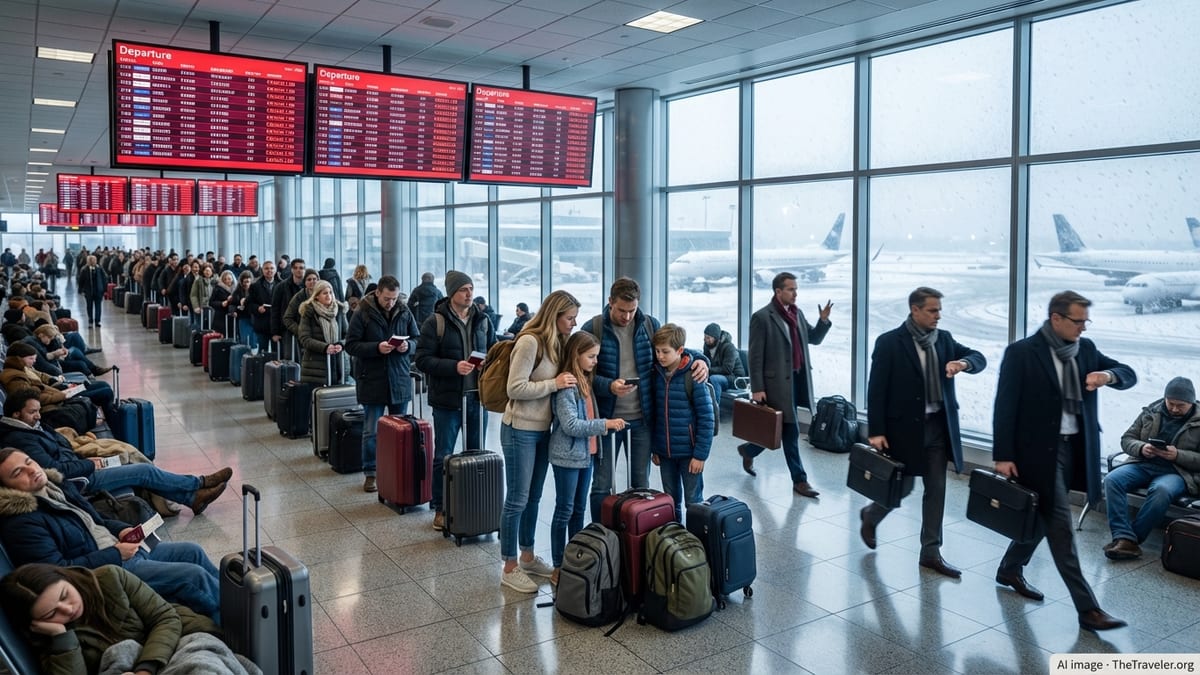
The immediate human impact at JFK has been visible in crowded terminals, long rebooking lines and extensive baggage backlogs. Social media posts and local coverage describe departure boards filled with delayed or canceled flights, along with passengers attempting to reroute via Boston, Newark, Washington and other alternative gateways.
Airlines have relied heavily on digital tools, encouraging customers to rebook via mobile apps and websites where possible. Industry guidance on JetBlue and Delta policies indicates that in major disruption events, carriers may offer fee waivers, travel credits or hotel and meal support depending on whether the cause of the disruption is considered within their control. However, the scale of the latest meltdown has strained these mechanisms, with limited spare seats available during peak travel days.
Aviation economists note that large-scale operational failures at a hub like JFK carry substantial financial consequences. Prior technology-related disruptions at major US carriers have generated losses estimated in the hundreds of millions of dollars, driven by compensation, repositioning of aircraft and crews, overtime, and lost future bookings. While final figures for the present episode are not yet available, analysts expect a material impact on quarterly results for the most affected airlines.
Beyond airline balance sheets, the disruption has significant spillover effects on hotels, ground transportation, cargo operations and tourism-dependent destinations that rely on predictable air links from New York. Late-arriving flights compress turnaround times and complicate staffing plans across the entire travel ecosystem.
Growing Scrutiny of Airline and Infrastructure Resilience
The JFK meltdown is intensifying scrutiny of how prepared airlines and airports are for compound disruptions. In recent years, US regulators and consumer advocates have paid closer attention to large-scale cancellation events, particularly when they are linked to issues considered controllable by carriers, such as IT failures or staffing shortfalls.
Commentary in major US and international outlets points to a pattern in which individual weather events or localized infrastructure problems trigger disproportionately large schedule collapses. Analysts argue that tightly wound networks, lean staffing and aging technology leave limited buffer to absorb shocks at key nodes like New York.
JFK itself is in the midst of a multi-year redevelopment program aimed at modernizing terminals and improving airfield efficiency. While these projects are designed to enhance long-term resilience, the construction period has introduced additional complexity, with temporary gate changes, constrained taxiways and shifting passenger flows.
For travelers, the latest chaos serves as a stark reminder of the fragility of global air connectivity. Industry experts suggest building in additional buffer time for connections through New York, monitoring flight status frequently, and considering alternative routings when storms, system outages or infrastructure issues begin to affect JFK. As airlines and airport operators assess what went wrong, attention is likely to focus on how to prevent a repeat of the kind of cascading failure that turned a single-hub disruption into a worldwide travel ordeal.