


Driving under the midnight sun in northern Norway is one of Europe’s most surreal road trip experiences. By June 2027 the Arctic is in full summer mode, with snow lingering on high ridges while fishing villages, white beaches and mountain passes glow in a low golden light through the night. To make the most of this unique season, you need to understand where the sun truly stays above the horizon, how far you can drive in comfort each day, and what rules apply to camping, ferries and roads across Lofoten, Vesterålen, Senja, Tromsø, Alta and the North Cape.
Get the latest updates straight to your inbox!
Understanding the true midnight sun in June 2027
The true midnight sun, in the strict astronomical sense, is when the entire sun remains above the horizon for 24 hours or more. This only happens north of the Arctic Circle, roughly 66 degrees north, and for a limited period in late spring and early summer. Around the exact Arctic Circle line, the continuous daylight window is only a few days around the June solstice, which in 2027 falls on 21 June. As you travel further north, the number of days with the sun above the horizon grows significantly.
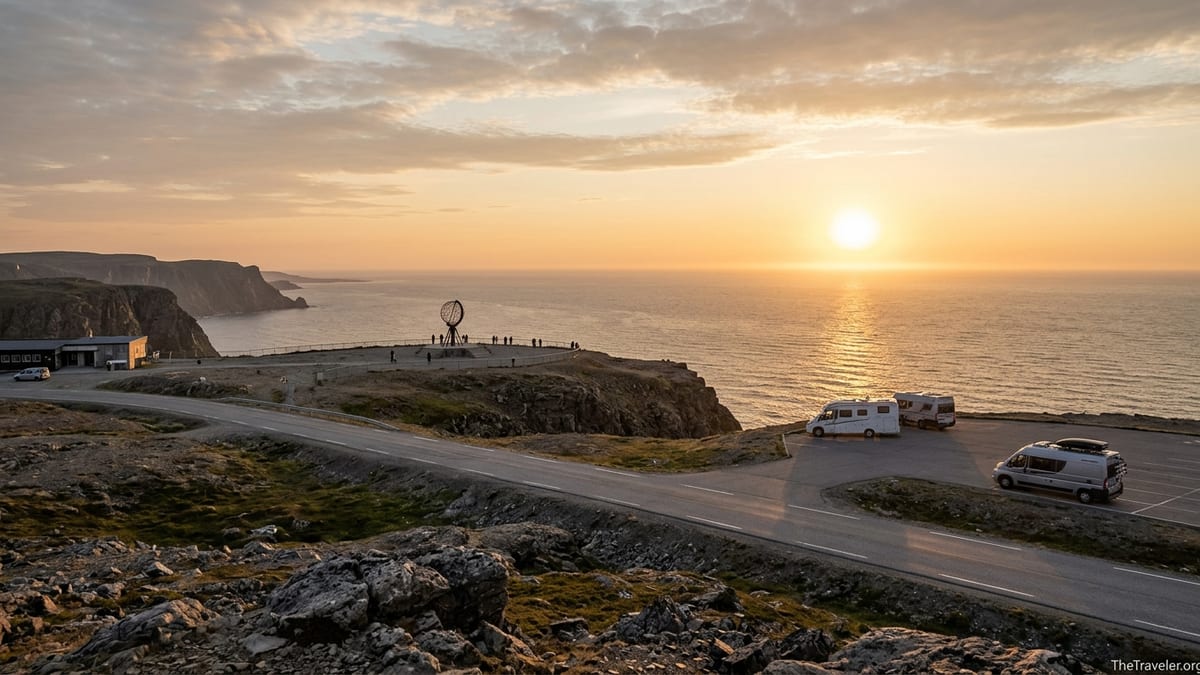
At North Cape (Nordkapp), one of the most famous viewing points, the official midnight sun season runs approximately from 14 May to 29 July, a span of more than ten weeks when the whole solar disc remains above a flat sea horizon at midnight. This long window means that by late June 2027 you can be almost certain of continuous daylight at the North Cape, even if clouds or sea mist occasionally hide the sun itself.
Farther south, many well-known destinations such as Lofoten and coastal areas near Bodø sit just inside or just south of the Arctic Circle, so the distinction becomes more subtle. In places like Svolvær in Lofoten, local tourism authorities list a midnight sun season from late May to around mid July, but these dates assume an open horizon and normal atmospheric refraction. In practice, the steep Lofoten mountains can obscure the low sun, turning "midnight sun" into very bright night twilight rather than an uninterrupted view of the sun itself.
South of the Arctic Circle, including much of coastal Nordland county, you will not see the astronomical midnight sun at all, but you still experience extremely long days. In late June 2027 civil twilight can last all night as far south as Trondheim, meaning it never gets fully dark. For road trippers, that practical effect is similar: you can drive and hike through the night without using headlights, even though by strict definition the sun does dip below the horizon.
Comparing key regions: Lofoten, Vesterålen, Senja, Tromsø, Alta and North Cape
Each major region in northern Norway offers a different combination of midnight sun visibility, scenery and driving demands. The Lofoten Islands are perhaps the most iconic, with a designated Norwegian Scenic Route that runs about 230 kilometres between Å and Raftsundet, including detours to villages such as Nusfjord, Henningsvær, Unstad and Eggum. The chain’s serrated granite peaks, white-sand beaches and rorbu fishing cabins make Lofoten a dream for photographers. However, the mountains also block the horizon in many places, so even during the theoretical midnight sun period you may need to seek west-facing beaches like Uttakleiv, Haukland or Eggum to see the sun touch the sea at night.
Vesterålen, directly north of Lofoten and reachable by bridge and ferry, is lower and more rolling, especially along the Norwegian Scenic Route Andøya on the west side of Andøya Island. Here, the road follows a flatter coastline past long beaches and small fishing communities, which gives clearer views of the horizon and the sun. Vesterålen is also a strong centre for whale watching, especially around Andenes, where late June tours often depart close to midnight to sail under the sun-lit sky.
Senja, further north and east, is another official Norwegian Scenic Route, about 102 kilometres between Gryllefjord and Botnhamn with side trips to tiny island communities. Senja is often called "Norway in miniature" because you get steep peaks, fjords, sandy coves and open ocean in a compact area. The west coast, including Ersfjordstranda and Tungeneset, offers some of the finest midnight sun viewpoints reachable directly from the road, while the interior has short hikes to ridges and summit plateaus.
Tromsø, Alta and the North Cape form a more expansive arc across northern Norway. Tromsø is the largest city in the high north and has direct flights from Oslo and several European cities. The region experiences continuous daylight from roughly mid May to late July, with mountains and islands all around. Alta offers sculpted canyons, river valleys and access to high plateaus, while the North Cape plateau itself is a barren, wind-exposed cliff above the Barents Sea. Here the horizon is completely open, which, combined with the long season of continuous daylight, makes it one of the most reliable places to see the sun hovering above the ocean at midnight in June 2027.
Flying in and renting a car: Bodø, Evenes, Tromsø and Alta
Most international visitors will reach northern Norway on a combination of international and domestic flights. Bodø Airport serves as a major hub for the coastal Nordland region, with frequent domestic services from Oslo and several Widerøe connections up and down the coast. From Bodø you can pick up a rental car within walking distance of the terminal and either board the car ferry to Moskenes in Lofoten or drive north on the coastal highway toward Narvik.
Harstad/Narvik Airport at Evenes lies between Lofoten and Tromsø and offers direct flights to Oslo with carriers such as Norwegian and SAS, along with regional services on Widerøe to Bodø and Tromsø. The terminal has desks for big international rental brands alongside Norwegian companies, and Evenes is a practical starting point for road trips that loop through Lofoten and Vesterålen without a long backtrack to Bodø. Renting here also gives you quick access to the E10 highway, which forms the spine of both Lofoten and Vesterålen routes.
Tromsø Airport is the main aviation gateway to northern Norway, with domestic flights connecting to Oslo, Bergen and Trondheim, plus seasonal services on European airlines from cities such as London, Paris, Amsterdam and Milan. Inside the terminal you will find counters for firms like Avis, Hertz, Sixt, Budget and Europcar, typically with cars parked a short walk from arrivals. Alta Airport is smaller but still offers frequent flights to Tromsø and Oslo, and also hosts several car rental agencies located just outside the tiny terminal building. For a longer one way journey, many travellers fly into Tromsø, pick up a car there and drop it in Alta or even Honningsvåg near the North Cape.
One way rentals within Norway are common but can carry substantial drop fees. Travellers arranging an Oslo to Tromsø or Bodø to Alta rental report that the basic daily rate can be reasonable, but one way charges often add several thousand Norwegian kroner to the total. Large brands such as Avis and Hertz state that any one way fee will be included in the price shown at booking, so it is crucial to compare options using your intended pick up and drop off points rather than assuming a flat daily rate. Booking well ahead for June 2027 is wise, especially for automatic transmission or campervan categories.
Norwegian Scenic Routes, ferries, tunnels and road information
Driving in northern Norway in June 2027 means using a mix of National Tourist Routes, undersea tunnels, bridges and coastal ferries. The official Norwegian Scenic Route Lofoten runs roughly 230 kilometres between Å at the far southwest of Lofoten and Raftsundet in the northeast, including optional detours to iconic side roads like the one out to Henningsvær. The Andøya Scenic Route in Vesterålen covers around 50 kilometres along the exposed west coast of Andøya Island, while the Senja Scenic Route runs 102 kilometres along the outer and northern coast of Senja. Together, these routes stitch into the E10 and smaller county roads, creating varied circuits without excessive daily mileage.
Ferries act as vital shortcuts. The summertime route between Gryllefjord on Senja and Andenes on Andøya connects the Senja and Andøya Scenic Routes. Another car ferry normally sails between Melbu in Vesterålen and Fiskebøl in Lofoten, avoiding a long inland detour through Sortland. In peak season car queues can be long, so June travellers should check the latest timetables, consider making reservations where available, and arrive at the quay with a time buffer. Many ferries charge by vehicle length and passenger count, and a typical crossing with a small rental car and two people can cost several hundred kroner.
Modern road tunnels and bridges make it far easier to drive Lofoten and the Tromsø region than in the past. Undersea tunnels such as the ones connecting Tromsøya to the mainland and Kvaløya are lit and well maintained, but gradients can be steep and speed limits strictly enforced. Road tolls on key link roads are increasingly collected through the AutoPASS system, where cameras register your licence plate as you pass. Rental agencies usually subscribe to an electronic toll service; the toll charges are then invoiced to you after the trip, sometimes with a small administration fee. Before you set off, ask the rental company how tolls are handled and whether any toll passes are already installed in the vehicle.
To monitor roadworks, landslides or temporary closures, use the information services of the Norwegian Public Roads Administration. The agency publishes up to date notices of planned works and unexpected incidents, and information is available in Norwegian and partially in English. Before setting out each day, it is wise to check for any restrictions on your planned route, especially on secondary roads in Lofoten, Senja and the Finnmark plateau, where rockfall or maintenance closures can force detours or delays.
Camping rules, motorhome areas and the right to roam
Norway’s outdoor culture is built on the principle of the right to roam, known locally as allemannsretten, which is anchored in national law. This gives everyone the right to walk and camp on uncultivated land such as mountains, forests and much of the shoreline, as long as they behave considerately. You can usually pitch a tent for up to two nights at least 150 metres from the nearest occupied house or cabin, and you must avoid cultivated land, gardens and fenced pastures. Local campaign materials produced for Lofoten’s camping visitors emphasise that campers should move quietly, leave no trace and respect bird nesting areas and grazing animals.
However, the right to roam does not grant unlimited vehicle access. Driving or parking vehicles off road on open land is generally prohibited. With motorhomes and campervans you are allowed to park and spend the night where roadside parking is legal and there are no signs against camping, but you cannot simply drive out onto meadows or dunes. In heavily visited areas such as Lofoten this distinction is crucial. Local authorities and outdoor councils have published flyers and maps highlighting no camping zones near especially pressured beaches and viewpoints, as well as recommended motorhome parking areas with toilets and waste facilities.
For a June 2027 road trip, building your nights around official campsites, designated motorhome pitches and a few carefully chosen wild-tent spots is the most sustainable approach. Many campsites now require payment via card or mobile app and offer electric hook ups, showers and kitchen sheds. In busy beach areas like Haukland and Uttakleiv in Lofoten, car parks have clear signs about parking hours, overnight stays and fees. Enforcement has become stricter in recent years, and ignoring signs can lead to fines or being asked to move during the night.
If you prefer hotels and cabins, you will find a growing range of small rorbu complexes, guesthouses and branded hotels in hubs like Svolvær, Leknes, Andenes, Senja’s outer coast, Tromsø and Alta. These often offer late check in options to suit midnight sun schedules, and some provide blackout curtains to help guests sleep despite the 24 hour brightness. Booking ahead for June 2027 is especially important in Lofoten, where beds regularly sell out weeks or months in advance.
Weather realities, visibility and photography in continuous daylight
Continuous daylight does not guarantee clear skies. Along the Norwegian coast June is often one of the mildest and driest months, but low cloud, drizzle and coastal fog are common, especially when warm air passes over colder sea water. In Lofoten and Senja the mountains can create local weather, with sea mist hugging one side of a peninsula while the other enjoys clear sun. Even at the North Cape, where the horizon is entirely open, grey cloud on the northern horizon can hide the sun itself at midnight, even though it never actually sets during the season.
Snow can linger on higher passes and mountain plateaus through June. While roads like the E10 in Lofoten and the E6 north to Alta and the North Cape are kept open, short hikes to ridges, such as easy summit walks above Henningsvær or viewpoint trails on Senja, may still cross wet snow patches. Waterproof hiking shoes, a warm layer and windproof shell are essential even in what appears to be high summer. Wind on exposed headlands can be brisk, and temperatures at midnight, even under a glowing sun, may feel close to single digits Celsius.
For photography, the midnight sun often produces softer and warmer light than midday, with long shadows and pastel skies. On beaches like Uttakleiv, Haukland or Skagsanden in Lofoten, or at Tungeneset on Senja, you can position yourself so that the sun moves slowly across the northern horizon behind jagged peaks or open sea. Filters are generally less necessary than in strong midday contrast, but lens hoods and cloths help with flare from low-angle light. Carry a spare battery, as long exposures during the night and chilly temperatures can drain power faster than you might expect.
Continuous daylight also changes your daily rhythm. Many visitors find it easiest to shift their main sightseeing into late evening when traffic and crowds thin out, then sleep late the following morning. Blackout masks or eye shades, which are rarely provided in more basic cabins or campsites, can make a huge difference, as can agreeing realistic wake up times so that long daylight does not tempt you into constant activity and eventual exhaustion.
A realistic seven day Lofoten and Vesterålen road trip
A compact but satisfying seven day itinerary for June 2027 can focus on Lofoten and Vesterålen without rushing. A common approach is to fly into Evenes, pick up a rental car at the airport and drive about three hours along the E10 to Svolvær, using this harbour town as a first base. The following day you can explore the eastern Lofoten coastline, including short drives to Henningsvær for harbour views and galleries, and to Gimsøya’s flat shores for your first taste of late-night light.
Mid trip, base yourself further west around Leknes or Reine. Daily drives need not exceed 80 to 120 kilometres round trip, which leaves time for moderate hikes such as the trail above Offersøykammen or lower viewpoints near Reine without tackling serious mountaineering. Late on a clear night, drive to Haukland or Uttakleiv beaches, park where allowed and watch the sun slide along the sea between roughly 23:00 and 01:00 before it climbs again.
On day five or six, cross to Vesterålen using the Melbu to Fiskebøl ferry and then head north through Sortland toward Andøya. Overnighting near Andenes lets you join a late evening whale watching tour, where some operators time departures to combine sperm whale or orca sightings with the midnight sun above the horizon. On the final day, drive back to Evenes in around four to five hours, returning your car and flying south.
This seven day loop keeps daily driving stages manageable, usually between two and four hours behind the wheel, which still allows generous time for roadside photo stops. It uses widely available accommodation in Svolvær, the Reine or Leknes area, and Andenes, with a mix of small hotels, fishermens cabins and campsites. For tent campers and motorhomes, the same structure works if you anchor nights at established camping grounds near Svolvær, around Leknes or Flakstad, and near Andenes, taking care to comply with Lofoten’s stricter parking and camping rules.
A ten to fourteen day itinerary from Lofoten to the North Cape
Travellers with 10 to 14 days in June 2027 can expand their horizon from Lofoten all the way to the North Cape without marathon drives. One option is to fly into Bodø, spend a night to adjust and collect provisions, then take the car ferry to Moskenes in Lofoten. After three or four days following the Scenic Route Lofoten between Å and Svolvær, including time for short hikes and beach evenings, cross to Vesterålen via Melbu and continue to Andenes for a night or two.
From Andenes, take the summer ferry to Gryllefjord and join the Scenic Route Senja for two or three days, lingering at photogenic spots like Bergsbotn viewpoint or Ersfjord’s golden beach. Short hikes on Senja deliver big rewards for modest effort, with several signed trails under three hours that climb to balcony-like viewpoints over fjords and open sea. The next stage is a four to five hour drive via Finnsnes and the E6 to Tromsø, where two nights give you time to enjoy city life under the midnight sun, including a cable car ride up Storsteinen or a quiet midnight stroll over the bridge.
From Tromsø you can drive northeast along the E8 and E6 towards Alta in about six to seven hours, or break the journey with a night in a smaller coastal community. Around Alta, spend a day exploring canyon viewpoints, river valleys or local rock art sites. The final push to the North Cape via Olderfjord and Honningsvåg takes around three to four hours along exposed coastal roads and through modern subsea tunnels. Plan at least one, preferably two, nights in or near Honningsvåg so you have multiple chances to visit the North Cape plateau in different weather windows.
For the return, you can either drive back to Alta and drop your rental car there, flying out south, or, with more days available, meander back towards Tromsø via different inland valleys. Throughout this longer itinerary daily driving blocks rarely exceed five to six hours and often remain closer to three or four, which significantly reduces fatigue. The extra days also allow for rest periods during poor weather so that you are not under pressure to drive long distances in wind or persistent rain.
Costs, daily budgets and responsible travel in the midnight sun
Travel costs in northern Norway are high by many visitors’ standards, and a midnight sun road trip in June 2027 will reflect that. As a rough planning guide, a couple renting a compact car, sleeping mostly in hotels or cabins, and eating a mix of supermarket meals and one restaurant meal a day should expect a daily budget somewhere in the mid thousands of Norwegian kroner. Car rental for a week or two in high season, including compulsory insurance, tolls and any one way fee, can amount to several hundred kroner per day on top of accommodation and fuel.
Campers using tents or a modest motorhome can save significantly on accommodation. Campsites in northern Norway commonly charge per vehicle and per person; for a couple in a small campervan with access to electricity, showers and kitchen facilities, daily campsite costs may fall into the lower hundreds of kroner range, depending on location and services. Self catering with groceries from chains such as Coop, Rema 1000 or Kiwi and only occasional restaurant treats keeps food costs more predictable than daily dining in harbour-front restaurants in places like Svolvær, Henningsvær or Tromsø.
Fuel is a major line item because distances, while not extreme, accumulate over a week or two of exploring, and petrol and diesel prices in Norway are relatively high compared with many European countries. A full circuit from Bodø through Lofoten, Vesterålen, Senja, Tromsø, Alta and the North Cape and back to Alta or Tromsø can easily exceed 2,000 kilometres. Small, fuel-efficient cars or hybrid models will make a noticeable difference to the total fuel bill. Ferries and toll roads add another layer of cost; a single long car ferry crossing for a couple and compact car can approach or exceed one thousand kroner when distance-based tariffs apply.
Continuous daylight can tempt drivers into long days on the road. Even if visibility is excellent at midnight, your body still needs rest. Fatigue is one of the most significant safety risks for midnight sun visitors, especially on narrow roads without central barriers and with oncoming campervan traffic. Schedule regular breaks, share driving duties if possible, and avoid planning more than four to five hours of actual wheel time per day over sustained periods. Wildlife such as reindeer and sheep often wander along or across roads during quiet night hours, so moderate speed and alert observation are essential, particularly on inland stretches of the E6 and regional roads in Finnmark.
Final recommendations for photographers, families and first time visitors
Photographers planning a June 2027 midnight sun trip should build in flexibility. Aim for at least two nights in each key area, such as western Lofoten, Senja’s west coast, Tromsø and the North Cape region, so that if one night is cloudy you have another chance. Scout compositions during the afternoon, noting parking spots, foreground elements and any access restrictions, then return late at night with plenty of time before midnight. A sturdy tripod, remote release, spare batteries and lens cloths are more useful than a large lens collection.
Families with children will benefit from a gentler pace. Choose two or three bases rather than moving every day and look for accommodation with kitchen facilities and access to simple outdoor play areas such as beaches or small playgrounds. Try to maintain a consistent sleep routine by covering windows with portable blackout fabric or aluminium foil (removing it respectfully when you leave) and using eye masks. Many short family friendly hikes, like coastal paths near Eggum or boardwalk sections around viewpoints such as Bergsbotn on Senja, provide big views without technical terrain.
For first time Arctic road trippers, the priority should be balancing ambition and realism. It can be tempting to include everywhere from Lofoten to the North Cape in one short visit, but focusing on one or two regions often delivers a richer experience. A week devoted entirely to Lofoten and Vesterålen or ten to twelve days between Senja, Tromsø and Alta will still provide abundant midnight sun moments and a strong sense of Arctic landscapes. Invest time before departure to understand camping rules, parking restrictions, road toll arrangements and ferry booking routines, so that when you arrive under the midnight sun you can spend your energy on coastal drives, seaside picnics and long, glowing nights rather than logistics.
Whatever itinerary you choose for June 2027, approaching northern Norway with respect for local communities, nature and your own limits will ensure the midnight sun enhances your journey rather than exhausting it. With clear expectations about daylight, weather, driving distances and costs, your road trip through Lofoten, Vesterålen, Senja, Tromsø, Alta and the North Cape can become a highlight of Arctic travel, filled with memories of pastel skies that never fully darken.