


Landing at Kahului Airport on Maui can feel like stepping straight into a vacation postcard, but it also comes with the usual practical questions: Where do I find baggage claim? How do I get to my rental car? Where is rideshare pickup, and where can I grab a quick bite or a lei greeting? This guide walks you through the real-world layout of Kahului Airport, from the moment you step off the plane to the moment you drive or ride away, so you can start your Maui trip relaxed instead of frazzled.
Get the latest updates straight to your inbox!
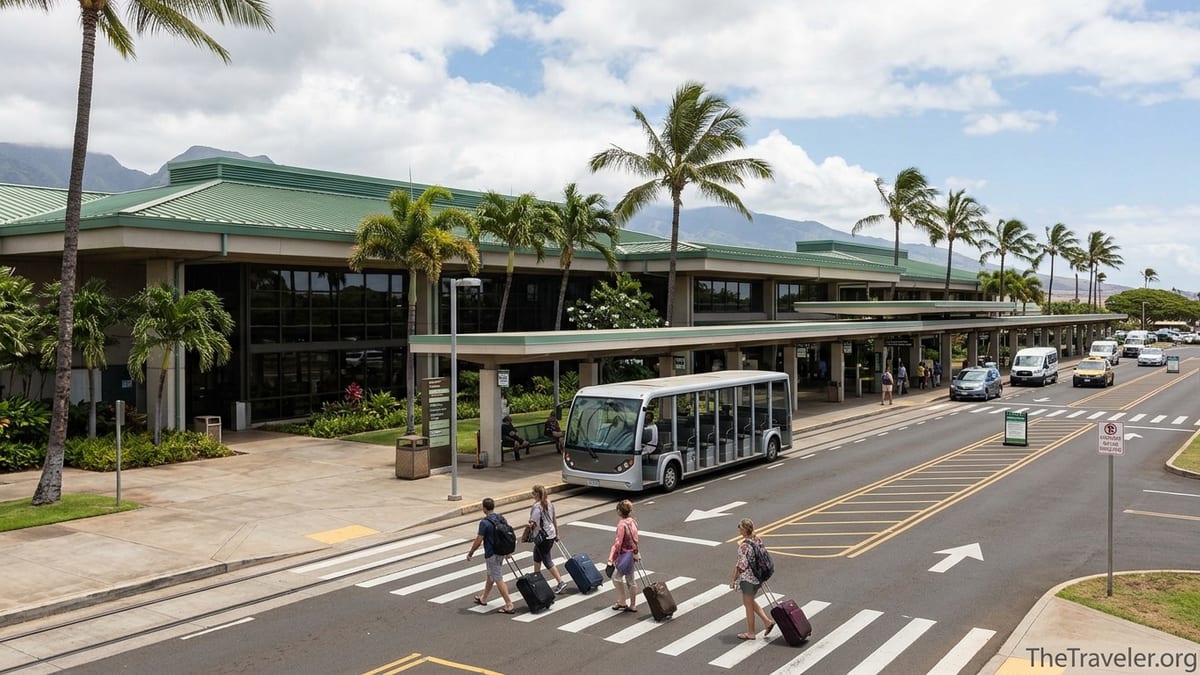
Understanding the Layout of Kahului Airport
Kahului Airport (OGG) is relatively compact compared with large mainland hubs, but its open-air design and split levels can be confusing to first-time visitors. The airport effectively functions as a single main terminal with three concourse arms plus a small separate commuter terminal used by regional carriers like Mokulele for interisland hops. Most visitors arriving from the U.S. mainland or Canada will use the main terminal, which has gate areas on the upper level and check-in and baggage claim on the ground level.
When you land on a typical mainland-to-Maui flight, you disembark onto the second level and walk through partially open-air walkways toward the central concourse. From there, escalators, elevators, and stairways bring you down to the first level, where you will find baggage claim running along the north end of the building and ticketing toward the south end. A covered roadway runs in front of the terminal for private cars, hotel shuttles, tour buses, and taxis, while the tram station for the consolidated rental car facility sits just across from the terminal, reached by short crosswalks.
The commuter terminal sits farther north along the airport ring road, in a small stand-alone building. It is used mainly for smaller aircraft serving routes such as Maui to Molokai or Lanai. You can drive, take a taxi, or ride a shuttle there, but most visitors never need to enter it unless specifically booked on a commuter airline. Transfer between the main and commuter terminals is simple by road and takes only a few minutes, though it is not typically done on foot with luggage.
Because of the breezy, semi-open design, much of the terminal feels more like a series of pavilions than an enclosed airport building. This is charming but can make it harder to understand where one area ends and another begins. Think of the airport lengthwise: ticketing and check-in at one end, security and concourses in the center, and baggage claim at the opposite end, with ground transportation and the rental car tram fronting the entire structure along the curb.
Arrivals, Baggage Claim, and Agriculture Inspection
After deplaning, follow the overhead signs for "Baggage Claim" and "Ground Transportation." These will quickly funnel you toward escalators and elevators down to the first level. Visitors coming from the mainland will have already passed U.S. agriculture screening at their departure airport, where checked bags are scanned for prohibited items like fresh fruits and plants. On arrival in Maui, there is no passport control for domestic flights, so your only formalities are picking up your bags and exiting into the public hall.
Baggage claim carousels are lined up in a long hall on the ground level, typically numbered and marked by arriving flight on overhead monitors. In busy periods, such as Saturday afternoons in winter or summer holidays, the hall can feel crowded and baggage delivery can be slow, sometimes taking 30 to 45 minutes after arrival for all bags to appear. A common real-world strategy for couples or families is for one person to wait at the carousel while another heads toward the rental car tram or ground transport counters to get a head start on any potential lines.
Visitor information booths are usually staffed near the baggage claim hall. These desks can help with basic questions such as which carousel your flight is using, where to meet a prearranged shuttle, or how to find the public bus stop. They may also have printed island maps and brochures for local attractions, which can be genuinely handy if your phone battery is low after a long flight.
Before leaving the baggage claim area, double-check that you are not carrying raw produce, live plants, or other items that might cause difficulty when you eventually depart Hawaii. While outbound agriculture inspections occur when you fly out of Maui, not when you arrive, it is easier to avoid packing restricted items in the first place. Many visitors are surprised to learn that taking certain flowers or fruits back to the mainland is restricted or requires specific certification, so it is wise to ask at the information booth or your airline desk if you are unsure.
Rental Cars and the Electric Tram
Most visitors to Maui rent a car, and Kahului Airport now serves these rentals from a consolidated multi-story facility set slightly away from the terminal. Instead of separate company shuttles, an electric tram on a short rail line connects the main terminal to the rental car center. The ride is typically just a few minutes and is free of charge. The tram station sits directly across from the terminal entrance; from baggage claim, you walk out to the curb, cross the roadway at the marked crosswalks, and follow the signs for the tram.
Inside the rental car facility you will find major brands such as Enterprise, Alamo, National, Budget, Avis, Dollar, Thrifty, and others, often spread across several floors of a large parking structure. Desks or kiosks are located near the entrance where the tram arrives, and the actual vehicles are parked nearby in clearly labeled sections. At peak arrival times like midafternoon on Saturdays, visitors sometimes report waits of 30 minutes or more to reach the counter if they have not enrolled in an express program, so it is worth using online check-in, joining a loyalty program, or adding your flight number to your reservation so the car can be prepared in advance when possible.
Some experienced travelers choose to walk to the rental car center instead of waiting for the tram, especially if they are traveling light. The walk is roughly a quarter to half a mile, primarily on sidewalks along the internal airport roadways. In the middle of a sunny Maui day, however, it can feel longer, so most visitors prefer the tram, particularly with children or wheeled suitcases. Returning your car at the end of your trip simply reverses the process: you follow signs for "Rental Car Return," drop the vehicle in your company’s section, complete any check-in with the attendant or kiosk, then board the tram back to the terminal.
For travelers not renting a car immediately, it is still useful to know where the tram station is located. If you are meeting friends or family who have flown in earlier and already collected a car, they may arrange to pick you up near the rental facility’s curb to avoid congestion at the main terminal. In that case, you would simply take the tram over and meet them there, which can be less stressful during busy afternoon arrival banks.
Ground Transportation: Taxis, Rideshare, Shuttles, and Buses
If you are not renting a car, Kahului Airport offers several ground transportation options. Immediately outside baggage claim, the curb is divided into zones for taxis, hotel and resort shuttles, tour buses, and private vehicles. Signs overhead indicate each zone. Taxis line up curbside at a designated taxi stand; as of recent traveler reports, a standard metered taxi from the airport to popular resort areas like Ka’anapali or Wailea often costs in the range of a substantial flat fare plus tip, depending on traffic and exact destination, so it is wise to ask the driver for an approximate cost before departing.
Rideshare services such as Uber and Lyft operate at Kahului Airport, but they use specific pickup zones separate from the standard taxi line. After collecting your baggage, you open the app, confirm your terminal, and follow in-app instructions to the assigned pickup area, which is usually a short walk from the main doors along the ground transportation curb. For a family of four traveling to a condo in Kihei, for instance, many visitors find that a rideshare can often be more economical than a per-person shuttle, especially late in the evening when scheduled shuttles are less frequent.
Several shuttle companies serve major resort areas with either shared or private transfers. Hotel-branded shuttles sometimes run to larger resorts in Wailea or near Lahaina, while independent companies offer seats on shared vans that make multiple stops. Because shuttle fares are typically charged per person, a solo traveler might find a shared shuttle to West Maui resorts appealing, while a group of three or more may find a taxi or rideshare cheaper on a per-person basis. Prearranged shuttle drivers usually meet guests near or just outside baggage claim, often holding signs with company logos or guest names.
Budget-conscious travelers can also use the Maui public bus system, which operates from a stop near the airport. The bus does not pick up directly at the terminal doors; instead, you follow signs or local directions to a nearby bus stop that is reachable on foot. The bus offers a low fixed fare per ride, typically in small bills or exact change only, and connects to Kahului, Wailuku, and transfer points for routes to Kihei or Lahaina. This option works best for travelers with light luggage and flexible schedules, as buses can be infrequent in the evenings or on weekends.
Commuter and Interisland Flights
While the majority of Maui visitors arrive on nonstop or direct flights from the mainland, some travelers connect through Honolulu or other islands and use interisland flights to reach Kahului. Hawaiian Airlines operates interisland flights into the main terminal, using the same check-in and gate areas as its mainland services. This means that if you are flying, for example, Los Angeles to Honolulu and then Honolulu to Kahului on Hawaiian, your arrival and departure experience on Maui will feel no different from someone arriving straight from the mainland.
The separate commuter terminal comes into play for smaller carriers flying turboprop or light aircraft on shorter routes, such as Mokulele flights linking Maui with Lanai or Molokai, or occasional flights to smaller Maui-area airports. The commuter terminal has its own small parking area and is typically far less busy than the main building, with simple check-in desks and compact waiting areas. Passengers walk short distances out to their aircraft on the ramp, adding a more old-fashioned island-air travel feel to the experience.
If you are connecting between a commuter airline and a major carrier at Kahului, you will usually need to reclaim your baggage and change terminals, since the tickets are often on separate itineraries. For example, if you arrive from Lanai on a Mokulele flight into the commuter terminal and connect to a mainland flight on Alaska or United from the main terminal, you would collect your bag, take a short taxi or prearranged shuttle along the airport ring road, and then check in again at the main terminal. Leaving plenty of connection time, such as two to three hours, is recommended in these cases.
Interisland passengers also need to observe the same agriculture rules as mainland travelers. Even when moving only between islands, carrying certain plants, fruits, or live animals may require permits, and oversized surfboards or sports gear may have to be checked at special counters. Checking baggage dimension and weight limits for regional aircraft is particularly important, as smaller planes may have tighter restrictions compared with widebody jets serving the mainland.
Food, Shops, and Services in the Terminal
Food and beverage options at Kahului Airport are more limited than at large mainland hubs but have improved in recent years. On the concourse level, you will find staples such as a Starbucks-style coffee outlet, snack bars serving sandwiches and plate lunches, fast-casual counters offering items like teriyaki chicken bowls or burgers, and several grab-and-go coolers with salads, musubi, yogurt, and drinks. Prices are typically higher than off-airport options, so many travelers choose to eat a meal in Kahului or at a resort before heading to the airport for departure, while using the terminal options for lighter snacks and coffee.
In and around the baggage claim and ticketing areas, you will find convenience stands and news-style shops that sell bottled water, chips, sunscreen, reef-safe sunblock, and last-minute travel accessories such as neck pillows, charging cables, and earphones. These are handy if your checked bags were delayed and you need basics for the first night, or if you realize at the last minute that you forgot reef-safe sunscreen, which is strongly encouraged to protect Maui’s coral reefs.
Several gift shops, both pre- and post-security, stock local souvenirs, macadamia nuts, chocolate-covered candies, Maui-branded apparel, and small items like hula dancer dashboard figures. While serious shoppers might prefer visiting local markets in Lahaina, Paia, or Kihei for better prices and selection, the airport’s shops can be ideal for a quick last-minute gift, such as a box of chocolate macadamias to take to family on the mainland or a small ukulele toy for children.
Other services within the terminal include ATMs, a few basic currency exchange options for international visitors, and small kiosks for activities and tours. At these stands, you can browse brochures and speak with staff about booking snorkeling excursions to Molokini, Haleakala sunrise tours, or luau tickets. While you can often find better deals by booking online beforehand, the kiosks can be useful if your original plans change due to weather or if you prefer to discuss options face-to-face after landing.
Lei Greetings and First Impressions of Maui
For many travelers, a flower lei greeting on arrival is one of the most iconic images of Hawaii. At Kahului Airport, lei greetings are usually arranged in advance through tour operators or specialty companies rather than by spontaneously purchasing leis in the terminal arrivals hall. When you prebook a lei greeting, a host typically waits just outside the secured area as you exit from the escalators near baggage claim, holding a sign with your name and draping fresh flower leis around your neck as they welcome you to Maui.
The leis used for these greetings often feature fragrant plumeria, orchid, or pikake blossoms, though the exact flowers vary with season and availability. Many visitors choose standard single-strand orchid leis, which hold up well to travel and are less fragile. Premium packages may include fuller double-strand leis or special kukui nut leis that last longer and can be kept as souvenirs. Prices range widely depending on complexity and vendor, so it is worth comparing options before booking, especially for larger groups arriving for weddings or family reunions.
Even if you do not book a formal greeting, you can often purchase leis from stands or shops in Kahului town not far from the airport, including small flower shops or grocery stores that sell pre-made orchid leis. Some travelers prefer to buy leis in town and greet their friends or relatives themselves at the airport curb when they arrive on a later flight. This can be a more budget-friendly way to keep the tradition alive while still enjoying that moment of island welcome.
As you step out of the terminal with or without a lei, the first impressions of Maui are immediate: warm air, trade winds, and views of the West Maui Mountains in the distance. Building a little buffer into your arrival plans, such as avoiding a tightly scheduled dinner reservation in your first hours on island, allows you to enjoy that transition instead of worrying about racing through baggage claim or traffic. Many experienced visitors simply plan to pick up a casual meal in Kahului, check into their lodging, and take a walk on the beach, letting the first evening unfold at a relaxed island pace.
First-Time Navigation Tips for a Smooth Arrival
For first-time visitors, navigating a new airport right after a long flight can feel overwhelming, but a few simple strategies go a long way at Kahului. Before you land, review the basic sequence: deplane on the second level, walk to the central concourse, descend to baggage claim, collect bags, step outside to the curb, and then either head to the rental car tram across the roadway or move to the taxi, shuttle, or rideshare zones. Having this mental map makes the abundance of signs and open-air walkways much easier to interpret.
Travelers arriving with small children or elderly relatives should consider assigning roles in advance. One adult can be responsible for keeping passports, phones, and boarding passes together, while another focuses on supervising children and managing carry-on bags. On reaching baggage claim, the group can choose a clear rendezvous point, such as a specific pillar near a certain carousel or the entrance to the rental tram path, in case anyone is briefly separated in the crowd.
Timing also matters. Flights from the mainland often cluster at similar times of day, especially late mornings and afternoons. In those windows, lines for rental cars and taxis can be long, while the terminal feels noticeably quieter in the late evening. If you have flexibility when booking, arriving later in the day can sometimes mean faster ground handling, though it may also limit evening bus and shuttle options. Checking recent traveler comments about wait times for TSA or rental car pickup just before your trip can help you set realistic expectations.
Finally, remember that Kahului is smaller and more laid-back than many mainland airports. Airport staff are generally used to helping disoriented first-timers, and asking for directions is straightforward. Whether you are trying to find the nearest restroom after a long flight, locate a specific airline check-in desk, or work out where a prearranged tour bus will meet you, it is faster to ask a staff member or at an information booth than to wander in circles. A few friendly questions at the start of your trip can save you half an hour of confusion and get you out into Maui’s sunshine that much sooner.
The Takeaway
Navigating Kahului Airport is less about wrestling with a giant maze and more about understanding a few key zones: gates and concourses upstairs, baggage claim and ticketing downstairs, the rental car tram across the street, and ground transportation lines along the curb. Once you visualize that layout, every step from deplaning to driving away becomes much easier.
For most travelers, the smoothest arrival routine looks like this: follow signs to baggage claim, send one member of your group ahead to the rental car tram if lines look long, meet at the rental center or curb, and head toward your lodging without rushing. Along the way, you can pause for a quick coffee, pick up a lei, or grab a brochure for tomorrow’s snorkel trip.
By planning these simple details in advance and knowing roughly where everything is, you transform Kahului Airport from an unknown variable into a predictable first chapter of your Maui story. Then, instead of remembering your arrival as a blur of bags and lines, you can look back on it as the moment your vacation truly began.
FAQ
Q1. How long does it usually take to get from the gate to my rental car at Kahului Airport?
For most visitors, expect about 30 to 60 minutes from deplaning to reaching your rental car, including walking from the gate, waiting for baggage, riding the tram, and completing check-in. At peak times such as Saturday afternoons, it can take longer if rental car lines are busy.
Q2. Where exactly is baggage claim located at Kahului Airport?
Baggage claim is on the ground level at the north end of the main terminal. After leaving your gate on the second level, you follow signs for "Baggage Claim," then take escalators or elevators down to the first level, where carousels line a long hall.
Q3. Do rideshares like Uber and Lyft pick up directly outside baggage claim?
Rideshares use designated pickup zones along the ground transportation curb, not the same spot as the standard taxi line. After collecting your bags, you follow app instructions and airport signs to walk a short distance to the marked rideshare area.
Q4. Is the rental car facility within walking distance, or do I have to take the tram?
The consolidated rental car center is close enough to walk in roughly 10 to 15 minutes, but most travelers prefer the electric tram, which is free, shaded, and designed to handle luggage. Walking can be hot and tiring in midday sun, especially with bags or children.
Q5. How early should I arrive at Kahului Airport before my departing flight?
For mainland flights, many airlines recommend arriving about 2 to 3 hours before departure to allow time for rental car return, check-in, agriculture inspection, and security. For interisland flights, 90 minutes is usually sufficient, but more time is wise during holiday peaks.
Q6. Are there good food options if I arrive hungry or have time before departure?
Yes, but choices are limited compared with big mainland airports. You will find coffee outlets, snack bars, and fast-casual counters serving sandwiches, plate lunches, and grab-and-go items. For a fuller meal at better prices, many travelers eat in Kahului town before arriving at the airport.
Q7. Can I arrange a traditional lei greeting at Kahului Airport?
Yes. Lei greetings are typically arranged ahead of time through tour operators or lei greeting companies. A host meets you near the exit to baggage claim with fresh flower leis. You can also buy leis at nearby shops in Kahului if you want to greet arriving friends or family yourself.
Q8. What is the difference between the main terminal and the commuter terminal?
The main terminal serves all major airlines and most interisland flights, with full check-in, baggage claim, and concourses. The commuter terminal is a small separate building used by regional carriers with smaller aircraft, mainly for short routes such as Maui to Lanai or Molokai.
Q9. Is there public transportation from Kahului Airport to resort areas?
The Maui public bus serves the airport area and offers low fixed fares, but routes may require transfers and are best for travelers with light luggage. Many resort areas are also served by shuttles, taxis, and rideshares, which offer more direct but more expensive options.
Q10. What should first-time visitors watch out for when arriving at Kahului Airport?
Plan for potentially slow baggage delivery and rental car lines at busy times, know where the tram and ground transportation zones are, and avoid tight dinner or tour reservations immediately after arrival. Giving yourself extra time helps you adjust to the island pace and reduces stress.