


Choosing the right eSIM service can easily save you hundreds of dollars on roaming, but the real challenge is finding a provider that fits how you actually travel. Keepgo and BNESIM are two popular names promising low-cost global data without physical SIM cards. They work in very different ways, though, and the better choice will depend on whether you are a once-a-year vacationer, a frequent flyer, or a digital nomad chasing deals around the world.
Get the latest updates straight to your inbox!
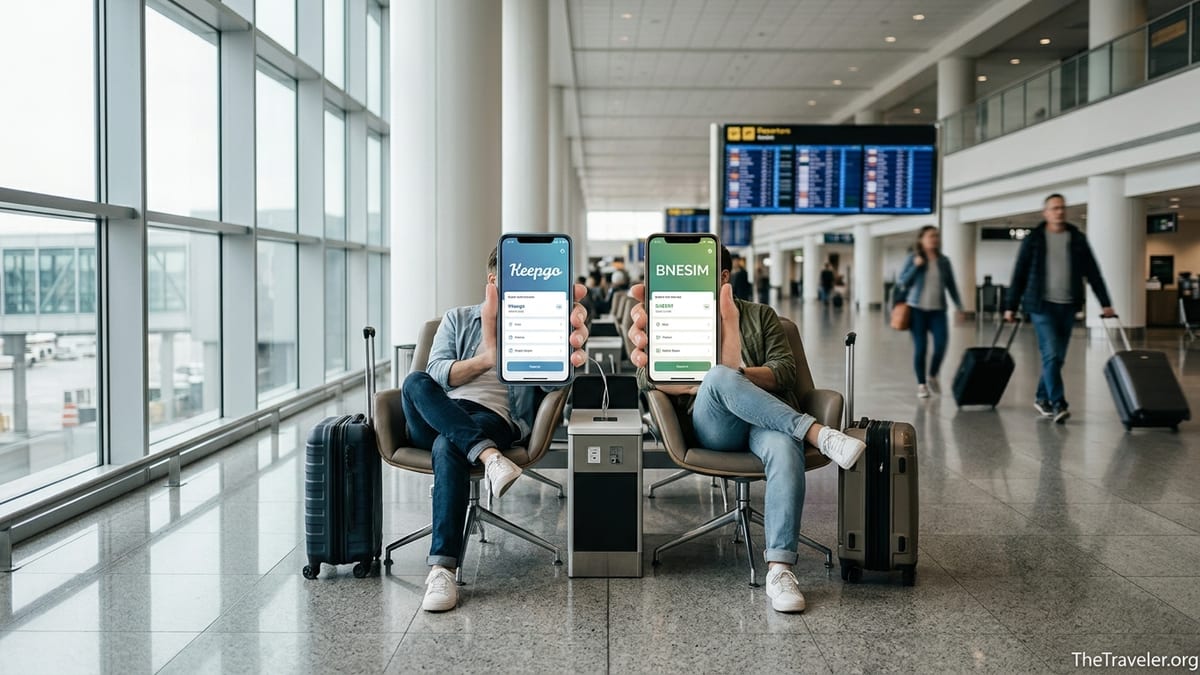
Keepgo and BNESIM in a nutshell
Both Keepgo and BNESIM sell data-only eSIMs for travelers who want to avoid traditional roaming. You scan a QR code, install an eSIM profile, and then buy data for the countries you visit. Neither is meant to replace your home carrier completely; instead, they sit alongside your main SIM so you can keep your number active for calls and texts while routing data over the travel eSIM.
Keepgo focuses heavily on long-lasting prepaid data. Several of its consumer eSIM bundles are promoted as “lifetime” or no-expiry as long as you top up at least once a year with a small purchase, typically from around 3 US dollars. This appeals to travelers who want a backup connection they can keep on their phone year-round for occasional trips or emergencies.
BNESIM, by contrast, behaves more like a classic travel operator with a wide range of short- and medium-term plans. It offers country, regional, and global eSIMs starting from a few euros, many of them valid for 7 to 30 days. BNESIM also mixes in voice and SMS options, and markets itself as a full connectivity solution across roughly 230-plus destinations.
On a practical level, you could think of Keepgo as a long-term data wallet that you slowly draw from, while BNESIM feels more like buying a specific pass for a particular trip or region, with more options but more time-limited validity.
Coverage and network quality on real trips
Coverage is where the two services begin to diverge in how they feel in day-to-day use. Both rely on roaming agreements with local carriers instead of owning networks. That means performance depends on which partner they use in each country and how traffic is routed back to their core network.
Keepgo markets coverage in well over 100 countries and emphasizes multi-network access in key markets. For example, many of its global or regional eSIMs in Europe let your phone switch between large incumbents such as Vodafone, Orange, or Telefonica, rather than locking you to a single operator. Travelers in recent reviews note that this is particularly helpful in places like rural Spain or mountainous Austria, where one network may suddenly fade but another remains usable.
BNESIM typically lists even broader coverage, into the 200-plus country range, including smaller island nations and parts of Africa that some competitors skip. Its own price list shows multi-country regional offers such as a Europe bundle covering most EU states plus countries like the UK, Turkey, and several microstates, or a North America bundle spanning the United States, Canada, and Mexico. In practice, this means you can land in New York, connect on a US carrier such as AT&T, then cross into Montreal and stay on Canadian partners like Bell or Telus without changing eSIMs.
However, some experienced users have noted that BNESIM sometimes routes data traffic back through European gateways even when you are in North America, which can add latency for things like gaming or video calls. This rarely affects basic tasks such as maps and messaging, but if you rely on time-sensitive apps, Keepgo’s more conservative routing and multi-network approach can feel snappier in some countries.
Pricing models: lifetime data vs flexible bundles
The way Keepgo and BNESIM charge for data is one of the most important differences for travelers. Keepgo is known for plans where your prepaid data does not expire as long as you keep the account active with a small yearly top-up. For example, a traveler might buy a modest global eSIM bundle once, then add around 3 dollars of credit each year to keep that pool of data alive. If you only fly abroad once or twice a year and use a few hundred megabytes for maps and email, this structure can be cheaper than repeatedly buying time-limited packages.
BNESIM leans into a menu of short- to medium-term packages. Its official price lists show typical regional offers like around 25 to 30 euros for 10 GB valid for roughly 10 days in a Europe multi-country zone, or just under 35 euros for 10 GB to use across the United States, Canada, and Mexico over several days. There are also smaller entry-level packages for solo destinations that start well under 10 euros if you only need a couple of gigabytes for a long weekend city break.
For a real-world comparison, imagine you are spending 5 days in Italy and then 4 days in Greece. With BNESIM, you might pick a 10 GB Europe bundle lasting 10 days. You use 6 GB in Rome and Florence and another 3 GB on the Greek islands for social media, restaurant searches, and offline map downloads. Once those 10 days are over, the plan simply expires. With Keepgo, you could instead maintain a global data balance year-round, nibbling away a few hundred megabytes on this trip and saving the rest for your next journey to Mexico or Japan.
For frequent travelers doing several international trips a year, the math can flip. Buying targeted BNESIM bundles for each region, sometimes taking advantage of promo codes or seasonal sales, may give a lower effective price per gigabyte than slowly consuming a more expensive global no-expiry pool. If you routinely stream video and upload large photo batches, BNESIM’s higher-capacity plans often make more sense.
User experience: apps, setup and reliability
Both providers support standard eSIM installation: after purchase you receive a QR code or activation link, add the eSIM in your phone’s settings, and enable it for mobile data. Installation typically takes a few minutes on recent iPhone and Android models. In practice, the difference lies in how smooth their apps feel and how predictable activation is when you actually land in a new country.
Keepgo’s app and dashboard are relatively simple. You see your current data balance, the countries covered by your bundle, and the last top-up. This minimalism works well if you only manage one or two eSIMs for yourself or a partner. Some travelers use Keepgo as a permanent “travel profile” labeled clearly in their phone settings, so each time they reach an airport they just toggle it on without thinking about which plan to buy.
BNESIM offers a more feature-packed app. Beyond data plans, it adds options such as virtual numbers in selected countries, pay-as-you-go calling credit, and the ability to manage several separate eSIMs for different regions. For a remote worker or a consultant who wants both data and a secondary phone number for Europe, this extra complexity can be a major advantage. The trade-off is that there are more settings to get wrong, such as accidentally scheduling activation at the wrong time or picking a country-specific plan instead of a regional one.
In recent user reports, both services receive broadly mixed but manageable feedback: many customers describe straightforward activation and stable connections, while a minority report issues such as delayed activation, difficulty contacting support, or confusion around data consumption. This is typical in the travel eSIM market. The key is to install and test the eSIM before your trip if possible, and to keep your home SIM active for calls and SMS while routing only data through the travel eSIM, to avoid getting locked out of important two-factor authentication messages.
Who each service is best for
The most useful way to choose between Keepgo and BNESIM is to look at how you travel over an entire year rather than focusing on one flight. Different traveler profiles naturally align with one service or the other.
If you are an occasional traveler who likes predictability and hates the idea of buying a new plan every time, Keepgo is often a better psychological fit. Consider a US-based family who vacation in Mexico this summer, visit London over New Year, and perhaps take a long weekend to Montreal in between. A single global Keepgo eSIM with a few gigabytes and yearly top-ups can quietly serve all of those trips with minimal app fiddling. Parents appreciate that the same data wallet will still be there next year without worrying about expiry timers.
If you are a budget-conscious backpacker or digital nomad hopping between regions, BNESIM’s pick-and-choose structure may work better. A traveler spending a month in Southeast Asia, for example, could buy a regional 30-day plan that covers Thailand, Vietnam, and Cambodia with enough data for heavy map use, hostel searches, and video calls home. When they later move on to a working stint in Berlin, they could swap to a Europe bundle with more generous gigabyte allowances instead of paying global prices.
Finally, if you rely on voice service, BNESIM currently has the edge with optional calling and SMS packages plus virtual numbers in selected destinations. Keepgo, by design, focuses on data only, which is enough for most travelers who are comfortable with internet calling apps but can be limiting if you need to receive traditional phone calls from local businesses or government offices.
Comparing specific trip scenarios
To make the comparison more concrete, it helps to walk through a few realistic itineraries and see how Keepgo and BNESIM would play out in practice. These examples use approximate pricing levels seen in 2026; exact figures change frequently, so always check the current rates before you buy.
Scenario 1: A 10-day Europe city hop out of New York, covering Paris, Amsterdam, and Berlin. With BNESIM you might choose a Europe multi-country eSIM around the 10 GB for 10 days mark at roughly the mid-20s in euros. You install it before departure, and as you cross borders on trains and low-cost flights, the eSIM automatically roams onto French, Dutch, and German partner networks. With Keepgo, you would draw data from a global bundle. If you only use maps, messaging, and light browsing, you might consume 3 to 4 GB total, leaving the rest of your data for future trips, but your cost per gigabyte is usually higher.
Scenario 2: A once-a-year two-week resort break in Cancun from the United States. A casual traveler who only needs their phone for ride-hailing, restaurant reviews, and photo sharing might prefer Keepgo. They can keep the same global eSIM active from last year, top up with a small purchase to maintain lifetime validity, and enjoy seamless data when they land in Mexico. A heavier user who plans constant social media streaming or remote work calls may find a BNESIM North America bundle for the specific dates of their stay offers more generous data for a similar or slightly higher budget.
Scenario 3: A digital nomad spending three months rotating through Bangkok, Da Nang, and Bali. Here BNESIM tends to shine with regional Southeast Asia plans or stacked 30-day packages that cater to substantial data consumption in multiple countries. Keepgo can still work, but burning through large amounts of global data quickly can be more expensive than buying region-specific blocks designed for intensive usage.
These scenarios show that there is no absolute winner. Instead, the smart move is to map your travel style to each provider’s strengths and to think realistically about how much data you will actually use each day. Many experienced travelers even maintain both a long-term wallet-style eSIM like Keepgo and a more aggressive regional service like BNESIM, switching depending on the trip.
Hidden costs, customer support and fine print
As with any travel connectivity product, the attractive headline price is only part of the story. You should also pay attention to how each provider handles throttling, plan expiration, and support if something goes wrong while you are standing in an airport with no signal.
Keepgo’s data-only focus keeps things relatively simple. When you hit your data limit, the connection stops rather than silently charging you at a higher pay-as-you-go rate. Since the core pitch is no-expiry data, most of the important fine print centers on the minimum annual top-up needed to keep your balance alive. If you forget to add a small amount of credit each year, the remaining data can eventually be forfeited, which is an unwelcome surprise for infrequent travelers.
BNESIM’s bundles are more complex. Some plans slow your speed once you hit a particular limit instead of cutting you off completely, especially on “unlimited” offers where the high-speed portion is capped before dropping to much slower speeds for the rest of the day or month. Others simply stop when the quota or validity period is exhausted. You should read the description of each plan carefully, especially if you rely on video calls or large file uploads for work. A cheap day pass that throttles heavily after 1 GB might be fine for a city walking tour but frustrating for remote work.
On support, both Keepgo and BNESIM primarily use online channels, such as in-app chat and email. Response times can vary depending on time zone and demand. Many travelers report resolving issues such as failed activations or incorrect plan selections, but you should not expect the same instant response as a major domestic carrier with physical stores. A good habit is to install the eSIM and confirm that it can register on at least one network before your trip begins, giving you room to contact support from the comfort of home Wi-Fi if needed.
The Takeaway
For most travelers, the real question is not whether Keepgo or BNESIM is objectively better, but which one aligns with how, where, and how often you travel. Both are mature players in the eSIM space with broad coverage and competitive prices compared to traditional roaming. The difference comes down to pricing structure, feature set, and how you prefer to manage your connectivity.
Keepgo is generally the stronger choice if you want a simple, long-lasting data solution. Its no-expiry style bundles, kept alive with small yearly top-ups, make sense for occasional travelers and families who take a couple of trips a year and want to know that their travel eSIM will still work next time without re-shopping the entire market.
BNESIM suits travelers who like to optimize each trip, especially digital nomads and frequent flyers who pass through many regions. Its granular mix of country, regional, and global plans, plus optional voice and SMS features, offers more control and often better value for heavy data users, as long as you are willing to spend a little more time picking the right bundle.
If you are unsure which way to go, a pragmatic compromise is to start with a modest Keepgo global eSIM as a permanent backup and then experiment with BNESIM regional plans on specific trips where you expect higher usage. Over a year or two of travel, your own experience with speeds, coverage, and support will be more useful than any theoretical comparison.
FAQ
Q1. Will Keepgo or BNESIM replace my regular mobile carrier?
Neither service is designed to fully replace your home carrier. They are best used as travel data companions while you keep your primary SIM or eSIM active for calls, texts, and authentication codes.
Q2. Which provider is cheaper for a short city break?
For a 3 to 5 day trip where you use a few gigabytes, BNESIM usually works out cheaper because you can buy a small country or regional bundle with a short validity period tailored to your stay.
Q3. Which is better for once-a-year travelers?
Keepgo tends to be better for occasional travelers since its data can remain valid from year to year with a small annual top-up, avoiding the need to buy a new plan every trip.
Q4. Do these eSIMs support phone calls and SMS?
Keepgo focuses on data only, so you would use apps like WhatsApp or FaceTime for calls. BNESIM offers additional paid options for traditional voice and SMS in selected destinations.
Q5. Can I use Keepgo or BNESIM for remote work?
Yes, but you should choose a plan with enough data and be aware that speeds and latency depend on local networks. Many remote workers prefer larger BNESIM regional plans for heavy daily usage.
Q6. How do I avoid bill shock with either provider?
Both services are prepaid, so you cannot rack up traditional roaming bills. To avoid surprises, keep an eye on your data balance in the app and understand whether your plan stops or throttles after the allowance is used.
Q7. Is it safe to rely solely on a travel eSIM?
Travel eSIMs are generally reliable, but it is safer to keep your primary SIM active as a backup, especially for receiving important SMS messages from banks, airlines, or government services.
Q8. Can I share data via hotspot with these eSIMs?
On most phones and in most countries, personal hotspot works normally with both Keepgo and BNESIM, although some specific plans or local carriers may restrict tethering, so results can vary.
Q9. What happens if my phone is not eSIM compatible?
If your device does not support eSIM, you may still be able to use physical SIM versions from similar travel providers, or consider renting a portable Wi-Fi hotspot instead of these specific services.
Q10. Should I keep multiple travel eSIMs on my phone?
Many frequent travelers keep more than one eSIM installed, such as a long-term Keepgo profile plus a BNESIM regional plan. This gives you flexibility to switch if coverage or pricing is better with one provider in a particular country.