


Kotor and Budva sit less than an hour apart on Montenegro’s Adriatic coast, yet they deliver very different holidays. Kotor wraps around a fjord-like UNESCO-listed bay, its compact medieval Old Town pressed between stone walls and steep mountains. Budva, by contrast, stretches along a series of beaches and headlands, combining a small walled town with modern resorts, clubs and summer entertainment. Choosing where to stay comes down to the kind of coastline, crowds and nightlife you want, plus how you plan to move around.
Get the latest updates straight to your inbox!
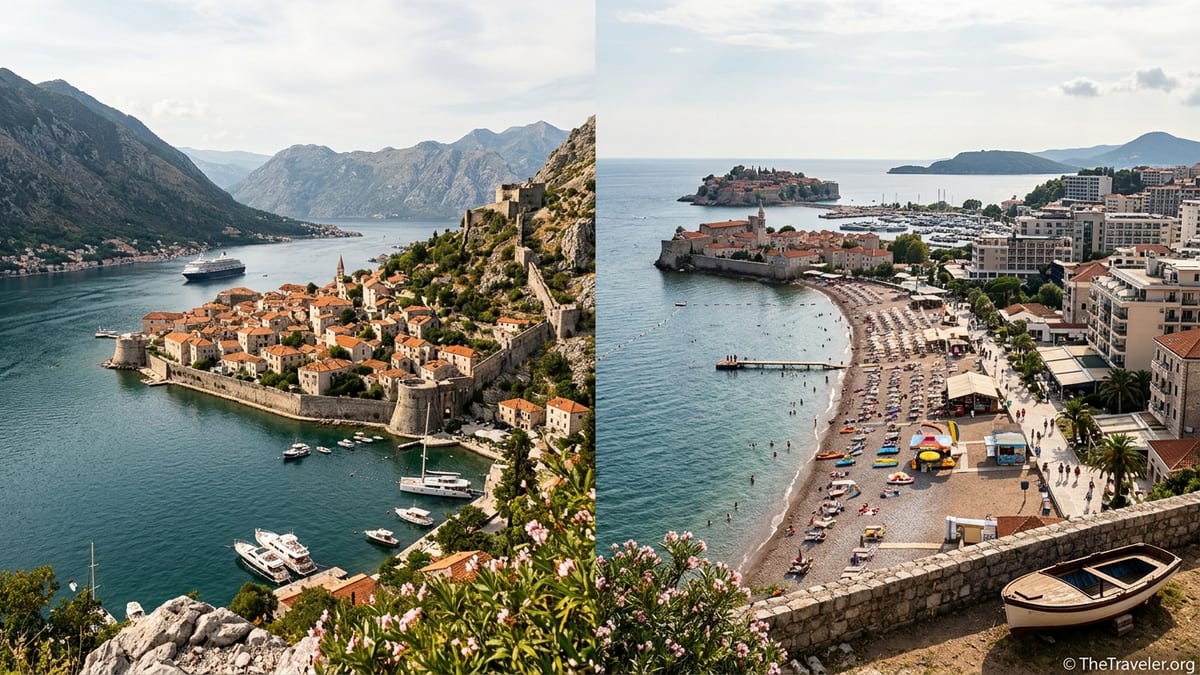
Overall character: bay drama vs beach resort energy
Kotor’s setting is its defining feature. The town curves around the inner corner of the Bay of Kotor, with steep grey mountains falling almost straight into the water and cruise ships sometimes appearing almost within arm’s reach of the Old Town walls. The historic core is tiny and pedestrian, with churches, small squares and cats around every corner. You come here for atmosphere, stone architecture and views across the bay rather than a conventional beach holiday.
Budva feels immediately more like a classic Mediterranean resort. Behind its small Old Town, the modern city spreads along Slovenska Plaža and further towards Bečići, lined with hotels, apartments, beach bars and water-sports kiosks. Music from open-air clubs drifts across the seafront well into the night in July and August, and the main promenade fills with families, groups of friends and seasonal workers heading to and from shifts in hotels and bars.
If you picture mornings of coffee under old stone loggias and evenings wandering quiet alleys after cruise passengers depart, Kotor fits that image. If you want to step out of your apartment and be on a long strip of beach within a few minutes, with multiple restaurant options and late-night clubs, Budva is the better match.
Beaches and waterfront: sandy, pebbly and rocky
Budva’s biggest practical advantage is access to beaches. Slovenska Plaža, directly in front of the main town, is a long belt of small pebbles and grit with concrete sections, lined with paid sunbed sets and a few free areas. A 10 to 20 minute walk from the Old Town brings you to Mogren Beach, a pair of coves reached via a coastal path and tunnel through the rock; the sand and fine shingle here feel more natural and the cliffs provide a dramatic backdrop for sunset swims.
East of town, Bečići Beach offers one of the more spacious stretches of sand and fine pebbles on this part of the coast, backed by large resort hotels and apartment blocks. Further on, the view towards the Sveti Stefan peninsula, now largely occupied by a high-end resort complex, gives Budva one of its most iconic postcard scenes, even if the islet itself functions more as a viewpoint and photo stop than a public beach destination.
Kotor’s waterfront is different in kind. Along the bay you find narrow strips of gravel or concrete bathing areas, staircases and jetties between Dobrota and Ljuta, with ladders into deep, very clear water. These spots are excellent for straight-in-the-water swimming and feel serene outside peak season, but there is almost no true sandy or wide pebbly beach in the immediate Kotor area. A row of sunbeds on a private concrete platform in Dobrota is not the same experience as a half-kilometre of shore in Budva.
This is why Kotor’s central waterfront should not be treated as a beach resort. Travellers sometimes book a hotel “on the bay” expecting a strip of sand, only to find a road, a narrow terrace and a ladder into deep water. If a week of sandcastles, shallow paddling and beach bars is central to your plan, Budva or Bečići is the more straightforward base, and Kotor works better as a day trip or shorter stay.
Old towns, viewpoints and day trips
Kotor’s Old Town is a dense network of alleys, squares and stone houses inside well-preserved walls. Climbing the path to the San Giovanni Fortress above town remains one of the most popular activities, with a steep stepped route that rewards early starts to avoid heat and cruise crowds. From the higher viewpoints, you look over the “Boka” with its folded inlets and small villages looping around the water.
The bay itself is a major part of a Kotor stay. Small-group boat trips typically combine the island church of Our Lady of the Rocks near Perast with a short stop in Perast’s waterfront lanes and sometimes a visit to a blue cave closer to the open sea. Prices for shared excursions in 2026 often fall in the roughly 25 to 40 euro per person range depending on route and duration, with private boats costing more per hour. This makes Kotor an easy base for low-effort scenic days that still feel varied.
Budva offers its own compact walled town on a peninsula, rebuilt after the 1979 earthquake and now wrapped by beaches and a yacht harbour. Walking the Old Town walls and narrow lanes fills part of a day, but most visitors combine it with beach time at Slovenska Plaža or Mogren and sunset views towards Sveti Nikola island and the Sveti Stefan headland from the promenade or roadside lookouts above the coast road.
For travellers without a car, both towns provide simple day-trip opportunities: from Kotor, regular buses and organised tours run to Perast, Tivat and Cetinje; from Budva, buses and tours connect to Kotor, Sveti Stefan viewpoints, Petrovac and inland excursions. In both places, hotel and apartment receptionists can point you towards locally run agencies selling day tours to Lake Skadar or the Lovćen National Park area.
Getting between Kotor and Budva, and arriving via Tivat or Podgorica
The coastal highway and connecting roads mean Kotor and Budva are close in distance, but real travel times depend heavily on traffic. Published bus timetables and current operator schedules show tickets between the two towns in the region of 4 to 7 euros per person for standard coaches, with journeys listed at roughly 30 to 50 minutes in light traffic. In practice, recent traveller reports from peak summer mention runs stretching to 90 minutes or more when congestion builds along the Budva field and around the Bay of Kotor.
Several companies operate buses on the Kotor Budva route throughout the day, often at intervals of about 30 to 60 minutes in summer and slightly less frequently in shoulder seasons. Tickets can usually be bought at the bus stations or online through regional booking platforms, though stations may add small service and platform fees on top of the base fare. In busy periods, leaving earlier in the day and allowing generous margins before flights or tours is strongly recommended.
Tivat Airport is the closest gateway to both resorts. It lies roughly 8 to 10 kilometres from Kotor and just over 20 kilometres from Budva. In 2026, official and app-based taxi price lists indicate one-way fares from Tivat Airport of around 30 to 45 euros per car to Kotor and similar or slightly lower figures to Budva, depending on operator, time of day and prebooking. Travel time can be around 20 to 30 minutes to Kotor and 30 to 40 minutes to Budva in favourable conditions, extending during July and August afternoon peaks.
Podgorica Airport stands inland, around 60 to 70 kilometres from Budva and further from Kotor. There is no direct coastal bus from the airport terminal to Budva or Kotor; travellers either take a taxi into Podgorica city and then a bus to the coast, or book an intercity taxi or transfer directly from the terminal. Recent guides and transfer operators in 2026 quote ranges of about 50 to 90 euros per car from Podgorica Airport to Budva and higher figures to Kotor, with a total driving time usually between 60 and 90 minutes to Budva depending on route. For Kotor, routing via Budva or via the inland roads can add extra time, especially if traffic is heavy near the coast.
Cruise ships, crowd patterns and evening atmosphere
Kotor is one of the primary cruise ports on the Adriatic, and this shapes its daily rhythm. On days when one or two mid-sized cruise ships anchor in the bay, thousands of passengers funnel through the Old Town between roughly 9:00 and 16:00. At those times, queues form at the San Giovanni Fortress entrance, boat trip stands are busy and popular squares can feel packed, particularly in high summer and shoulder-season weekends when multiple vessels call.
When several large ships schedule calls on the same day, local operators report that crowding intensifies across the entire bay, with Perast’s narrow waterfront and the small island church feeling especially strained during late-morning peak excursions. Walking the Old Town walls or taking photos at key viewpoints can become slow, and café prices on main squares can appear noticeably higher than equivalent spots just outside the gates or in Dobrota.
After about 17:00, once cruise passengers reboard and most tour groups depart, Kotor shifts character. Streets become significantly quieter, restaurant terraces around less central squares fill with a mix of overnight visitors and local residents, and the town feels more like a small community again. Nightlife here is relatively modest, with a handful of bars staying open late but little in the way of large-scale clubs or beach parties, especially compared with Budva.
Budva does receive occasional cruise and excursion groups, but its crowds are driven more by land-based tourism. July and August evenings bring high energy along the seafront promenades, with live music stages, open-air clubs near the Old Town and beach bars in Bečići creating a resort atmosphere. Travellers seeking quiet nights may need to choose accommodation away from the central waterfront or look to smaller nearby villages instead.
Where to stay: Old Towns, Dobrota, central Budva and Bečići
Staying inside Kotor Old Town is atmospheric but not practical for everyone. Many guesthouses and small hotels are tucked up narrow alleys with several flights of stone steps and no lifts. Rolling suitcases across cobbles, carrying luggage upstairs and navigating irregular stairwells can be difficult for travellers with mobility issues or families with strollers. Noise can also be a factor, particularly in peak season when bars and restaurants in courtyards stay busy until late.
Dobrota, which stretches northwest along the bay from Kotor, offers a quieter alternative. Here, waterfront apartments and small hotels often sit directly on or across a narrow road from the shore, with jetties and terraces for swimming. Parking is generally easier than in the Old Town, and properties can be more spacious. The trade-off is that you may be 20 to 40 minutes on foot from the Old Town gates, or reliant on short taxi rides or local buses.
In Budva, central neighbourhoods around Slovenska Plaža and the bus station place you within a short walk of the main beach, promenade and Old Town. However, chronic summer parking shortages and traffic jams in and out of the centre make on-site parking an important filter if you are driving. Buildings can be packed closely together, and some apartments sit above bars, bakeries or late-opening shops, which affects noise levels for light sleepers.
Bečići, a few kilometres east, feels slightly more resort-like and somewhat calmer at night than the very centre of Budva. Large hotels and modern apartment buildings line the main beach, often with their own sunbed sections and family-friendly facilities. Walking to Budva Old Town from Bečići can take around 30 to 40 minutes along the coastal path and promenade, although frequent local buses and taxis shorten the journey. For families who want easy beach access but are happy to travel into Budva for an evening or two, Bečići strikes a useful compromise.
Sample prices and total vacation costs
Accommodation prices on Montenegro’s coast fluctuate strongly by month. Checking mainstream booking platforms and price comparisons for 2026 shows that in May and late September, mid-range doubles in both Kotor and Budva can often be found in the broad range of roughly 60 to 110 euros per night for central but not luxury properties. Two-night stays for a couple at this level in either town may therefore run between about 120 and 220 euros in shoulder season, excluding tourist taxes.
In July, the same class of accommodation climbs noticeably. In central Budva and Bečići, seven-night stays for two people in well-rated mid-range hotels or apartments in 2026 often price out between roughly 800 and 1,400 euros depending on proximity to the beach, facilities and cancellation terms. Kotor Old Town rooms and Dobrota waterfront apartments of comparable standard can fall into similar or slightly lower ranges, though specific dates around festivals and peak cruise activity can push prices higher.
Tourist taxes in Montenegro are typically charged per person per night and collected by accommodation providers; for budgeting purposes, couples can roughly estimate an extra few euros per person per night on top of room rates. Eating out ranges widely: a couple might pay around 18 to 30 euros for a casual dinner with local seafood or grilled meat and non-alcoholic drinks in less touristy streets, while waterfront restaurants in prime positions can be higher. Self-catering in apartments with supermarket shopping and occasional restaurant meals can significantly reduce costs for families.
Local buses between Kotor and Budva cost in the mid single digits per journey for adults, and taxis on the coastal stretch can quickly reach 25 to 40 euros per car each way at 2026 flat rates when traffic is heavy. Renting two sunbeds and an umbrella on central beaches in Budva or Bečići might cost in the broad range of 10 to 25 euros per day in main season, with cheaper or free space further from the busiest sections. Families should add daily beach equipment and occasional organised excursions or boat trips into their budget, which can add several dozen euros per day in high season.
Itineraries without a car and when to avoid changing bases
For a two-day Kotor-focused stay without a car, one practical plan is to spend the first day exploring the Old Town, walking part or all of the San Giovanni Fortress path early in the morning, then cooling off with a swim from a Dobrota jetty in the afternoon. On the second day, join a shared boat excursion around the bay, including Perast and Our Lady of the Rocks, and finish with dinner at a waterfront restaurant slightly outside the main gate to escape the most touristy pricing.
A two-day Budva stay without a car might pair day one on Slovenska Plaža and Mogren Beach with a stroll through Budva Old Town and a sunset drink overlooking the sea. Day two could focus on Bečići Beach, walking or taking a short bus ride there, then heading to roadside viewpoints overlooking Sveti Stefan for photographs before returning to Budva for an evening in the Old Town or one of the open-air clubs, depending on your interests.
For travellers wanting both towns in a three-day trip, it is usually more efficient and economical to choose a single base and make a day trip rather than changing hotels. For example, base in Budva if beach time is the priority: spend one full day at Mogren and Slovenska Plaža, another day in Bečići or on a boat trip along the coast, and devote a third day to an early bus or taxi run to Kotor and the bay, returning in the evening. Conversely, base in Kotor if scenery and excursions are your focus, and dedicate one day to a bus trip over to Budva for swimming and Old Town exploration.
Each hotel change introduces extra taxi rides, time packing and unpacking, and sometimes higher nightly prices for very short stays. Unless you have at least four or five nights to play with, the marginal benefit of sleeping in both towns is often outweighed by the friction and additional expense. Basing in one location and using buses or taxis for one or two long day trips keeps the logistics simpler, especially in peak summer when traffic makes check-in and check-out days more stressful.
Which destination wins for different types of traveller
For classic beaches, Budva and its neighbouring areas come out ahead. Slovenska Plaža, Mogren and Bečići provide shallower entries into the sea, more sand and fine pebble, and a dense strip of rentals, cafés and water sports. Kotor’s charm lies in rocky swimming spots and jetties along a deep bay rather than in traditional beach arcs, which makes it better for confident swimmers than for small children who need gently shelving sand.
In terms of scenery and historic atmosphere, Kotor is the clear winner. The combination of fortified Old Town, steep limestone mountains and the winding bay creates one of the most memorable visual settings on the Adriatic coast. Budva has attractive views, particularly towards Sveti Stefan and from the Old Town walls, but much of its backdrop is modern development.
Nightlife and summer entertainment tilt strongly towards Budva, especially in July and August, when beach clubs, open-air stages and bars fill the nights. Couples seeking quiet cobbled evenings, and families wanting early bedtimes without heavy music outside the window, often prefer Kotor or the calmer parts of Dobrota. Budget travel can go either way: Budva offers more competition among apartments and eateries, which can help prices, but Kotor allows travellers to spend more of their time on low-cost pleasures such as wandering the Old Town and taking bus-based excursions rather than high-priced beach clubs.
For couples, Kotor suits those prioritising romance, views and slower evenings, while Budva works better for pairs who want a mix of beach days and nightlife. For families with young children, Bečići and parts of Budva provide easier beach access and family-friendly hotels, though traffic and noise should be weighed carefully when choosing a street. Quiet accommodation is easier to find in Dobrota around Kotor or in less central Budva and Bečići side streets set back from the main road. Travellers without cars will find both towns workable, but Kotor demands fewer decisions about parking and traffic, while Budva demands more thought about how close you want to be to the noise. In the end, many visitors find that pairing a beach base in Budva or Bečići with a full-day or overnight visit to Kotor delivers the best of both worlds.