


More news on this day
Kuwait International Airport has again become a flashpoint in the escalating Iran conflict, with fresh Iranian attacks triggering renewed suspensions, sharply reduced schedules and a wave of urgent warnings to travelers across the Gulf and beyond.
Get the latest news straight to your inbox!
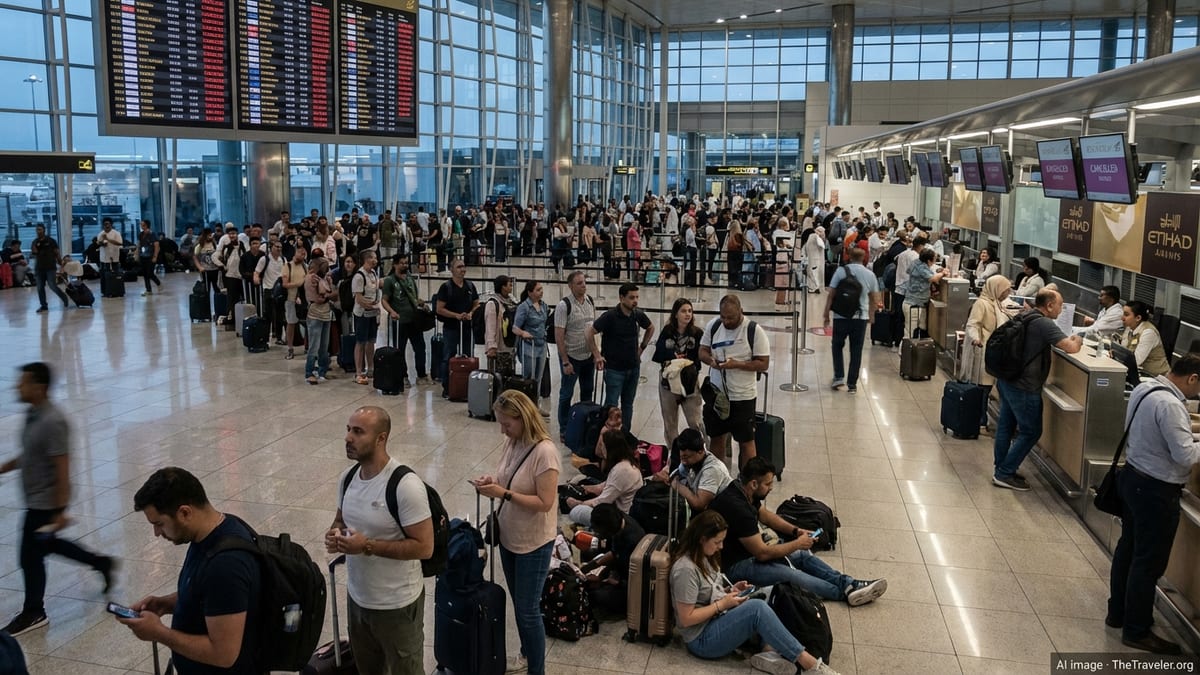
New Strikes Revive Fears Over Kuwait’s Main Gateway
Publicly available information from Kuwait and international media on July 18 indicates that incoming Iranian attacks have led to a temporary halt in takeoffs and landings at Kuwait International Airport. The national carrier, Kuwait Airways, has reported that most flights have been rescheduled after the latest suspension, describing the move as a direct consequence of what it called ongoing Iranian aggression in the region.
The disruption marks another chapter in a year of repeated strikes on Kuwaiti infrastructure linked to the broader Iran conflict. Previous attacks since late February damaged airport facilities and nearby sites, prompting intermittent closures and forcing aviation authorities to repeatedly reassess the safety of operations at the country’s primary air hub.
While some flights continue on reduced or adjusted schedules, the pattern of stop-start operations has created an atmosphere of uncertainty for travelers, airlines and airport workers. Terminals have at times shifted activity between Kuwait Airways and low-cost carriers such as Jazeera Airways, as damage assessments and repair work continue on parts of the complex.
Gulf Aviation Network Feels the Shockwaves
The latest turbulence in Kuwait comes as Gulf aviation as a whole faces mounting pressure from the Iran war. Regional and international outlets have documented a rolling series of diversions, delays and cancellations on routes touching Iran, Iraq and Kuwait, with carriers rerouting aircraft away from high-risk airspace and accepting longer flight times and higher fuel costs.
Reports from regional travel and business media show that airlines including carriers based in the United Arab Emirates, Europe and Asia have either suspended services to Kuwait at various points this year or adjusted routings to minimize exposure to potential missile and drone trajectories. Flight-tracking snapshots in recent days display sparse traffic over segments of the northern Gulf compared with pre-crisis patterns.
For travelers, the effect can be felt well beyond the immediate conflict zone. Passengers connecting through major hubs such as Dubai, Doha, Abu Dhabi and Istanbul face last-minute gate changes and extended layovers as airlines juggle network schedules to absorb the instability radiating out from Kuwait and neighboring states.
Travel Advisories and Passenger Warnings Intensify
Government travel advisories have grown steadily more explicit as the crisis has unfolded. Recent updates from Western governments highlight the risk of further Iranian strikes on Kuwait at short notice and note that Kuwait International Airport is operating at reduced capacity, with some terminals closed and flight schedules constrained.
These advisories typically urge passengers to monitor airline communications closely, verify flight status repeatedly in the 24 hours before departure, and prepare for sudden delays or overnight stays. Travelers are increasingly advised to keep flexible itineraries, carry essential medication and valuables in hand luggage, and obtain comprehensive travel insurance that covers conflict-related disruption.
Publicly available consular information also points to knock-on security concerns in districts near the airport, underscoring that the crisis is not purely an aviation scheduling problem but part of a wider risk environment for visitors and residents alike.
Operational Strain on Airlines and Airports
The operational challenges for airlines serving Kuwait have intensified with each new wave of attacks. Carriers are contending with shifting no-fly zones, last-minute airspace bulletins and the practical difficulty of protecting aircraft and passengers in an environment where ballistic missiles and drones have previously struck civilian infrastructure.
Industry coverage indicates that Kuwait’s Public Authority of Civil Aviation has repeatedly closed and reopened airspace after conducting damage surveys at the airport, including inspections of runways, taxiways and terminal structures. Even when airspace has reopened, flight schedules have tended to restart gradually, leaving airlines to rebook passengers and consolidate services where possible.
For airport operators, the need to maintain security while processing passengers through a partially damaged and heavily surveilled facility presents its own logistical test. Contingency measures have included concentrating operations in a smaller number of terminals, coordinating closely with ground handlers, and preparing for rapid shutdowns if new threats emerge.
What Travelers Should Expect in the Coming Days
Given the fluid military situation between Iran, the United States and regional states, aviation analysts and risk consultancies quoted in open reports caution that further turbulence for Kuwait-bound and Gulf-transiting passengers is likely. Repeated references to “short notice” changeability in official advice underline that today’s timetable can shift dramatically within hours.
Travelers with upcoming itineraries touching Kuwait are being encouraged to treat all plans as provisional. This includes allowing generous connection times, checking in online as early as systems permit, and monitoring both airline channels and airport announcements right up to departure time. Those with nonessential trips are being asked by some employers and institutions to consider postponement until the frequency and intensity of attacks diminish.
For now, Kuwait International Airport remains a symbol of how quickly a modern aviation hub can be thrust into crisis by regional conflict. Its repeated suspensions and partial reopenings are sending ripples through airline networks on three continents, underscoring the vulnerability of global travel to geopolitical shock and the need for passengers to stay informed and flexible when flying through the Gulf.