


More news on this day
Flights between the United Arab Emirates and Kuwait continue to face large-scale disruption in mid-July 2026, as regional airspace restrictions and security concerns force Gulf carriers to cancel, reroute and consolidate services on one of the region’s busiest short-haul corridors.
Get the latest news straight to your inbox!
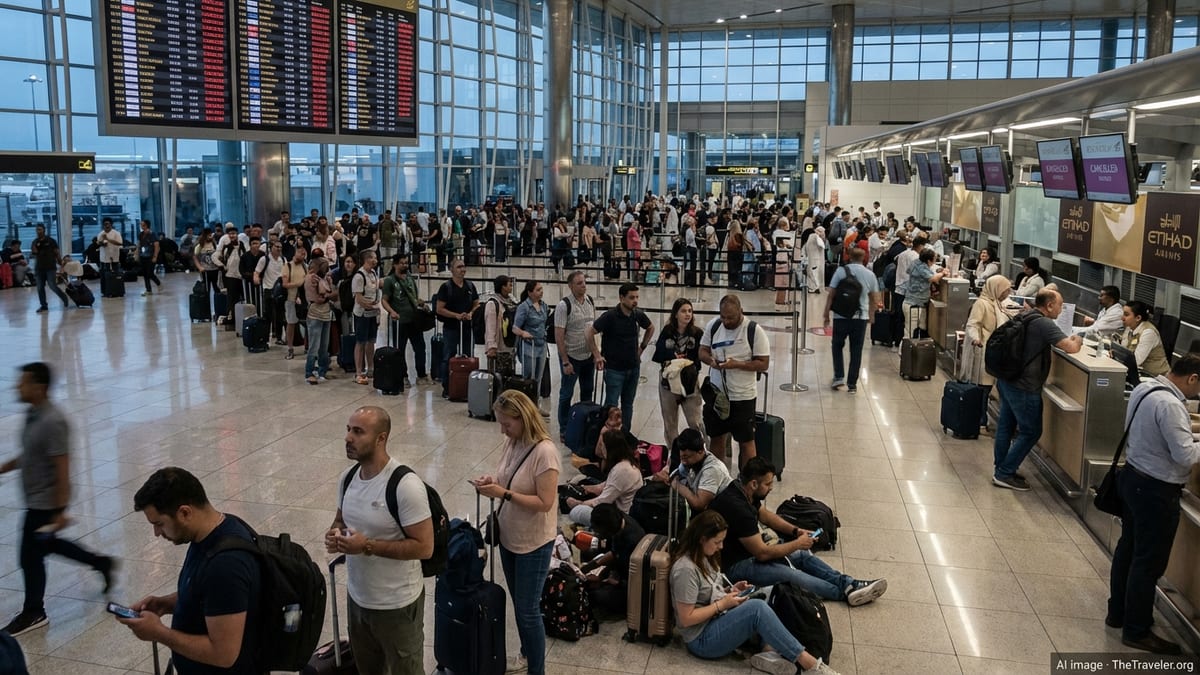
Regional security fallout keeps pressure on Gulf air links
Publicly available information shows that commercial traffic between the UAE and Kuwait has been heavily affected since late February 2026, when a wave of attacks and subsequent military operations triggered widespread airspace closures across the Gulf. Aviation analyses of the 2026 Iran conflict indicate that airports in Dubai, Abu Dhabi and Kuwait all sustained disruption, with authorities in multiple states imposing tight controls on overflight and scheduled passenger movements.
Industry summaries of the crisis report that key Middle Eastern hubs, which typically handle a significant share of global traffic, have operated with limited capacity for months. Flights that previously crossed congested Gulf corridors have been rerouted along longer arcs to avoid restricted zones, adding time and cost for airlines and travelers. Within this broader pattern, point-to-point services on the UAE–Kuwait route have been particularly exposed, given Kuwait City’s proximity to recent military activity.
Operational updates from travel-management bulletins and airline notices highlight that restrictions have tended to be imposed or eased in stages, often at short notice. As a result, passengers traveling between the UAE and Kuwait have faced a mix of outright cancellations, rolling delays and last-minute aircraft swaps, even when airports were technically open.
While some carriers in the wider region have begun restoring frequencies to other Gulf and Middle Eastern destinations, the situation between the UAE and Kuwait remains fragile. Schedules that were briefly reinstated earlier in the summer have in several cases been cut back again when security assessments changed.
Emirates trims Kuwait schedule and focuses on rebooking
Dubai-based Emirates has long marketed Kuwait City as a core short-haul destination from its main hub, feeding both point-to-point demand and onward connections to Europe, Asia and the Americas. However, accounts shared by passengers and travel agents, as well as previous notices carried in regional media, indicate that the airline’s Kuwait operations have been repeatedly curtailed since the onset of the Gulf airspace crisis.
In recent months, customer reports circulating on public forums suggest that Emirates has at times suspended Kuwait flights entirely for defined periods, while keeping services to other destinations running on reduced timetables. Travelers have described scenarios in which flights to and from Kuwait were cancelled even as long-haul sectors on the same ticket remained active, forcing last-minute rebookings or alternative routings through other Gulf gateways.
General guidance on Emirates’ flight-status channels reiterates that customers should monitor their bookings closely, as existing itineraries may be subject to further change. The airline’s publicly available information emphasizes flexibility policies, under which eligible passengers on cancelled flights may seek refunds or rebooking on the next available service, subject to space and prevailing conditions.
For now, observers note that Emirates appears to be prioritizing network stability on longer-haul routes while keeping a cautious stance on short sectors into Kuwait. Prospective passengers are being advised by travel intermediaries to treat any reintroduced Dubai–Kuwait frequencies as potentially fluid until regional security conditions show a sustained improvement.
Etihad’s Abu Dhabi–Kuwait link hampered by rolling suspensions
Etihad Airways, based in Abu Dhabi, has faced similar challenges. During the peak of the airspace closures earlier in the year, official statements carried by local media and corporate bulletins confirmed that Etihad’s departures from Abu Dhabi were temporarily suspended for several days, affecting all destinations. Subsequent recovery plans have seen the carrier rebuild its network in phases, with priority given to key long-haul markets and select regional cities.
Community updates shared by travelers in Kuwait and the UAE over recent weeks indicate that flights between Abu Dhabi and Kuwait have gone through several cycles of suspension and partial restoration. Passengers recount being informed that Abu Dhabi–Kuwait services were halted until mid-June, with some flights reportedly returning to the schedule afterward, only to be adjusted again amid renewed uncertainty.
Etihad’s own booking channels continue to list Kuwait as part of its destination network, underscoring the airline’s longer-term commitment to the route. However, live timetables and flight-status tools show that individual frequencies can still be delayed, retimed or cancelled at short notice, depending on operational assessments and any changes to airspace availability.
Travel advisers monitoring the situation suggest that passengers flying from or via Abu Dhabi to Kuwait should build in additional contingency time and remain alert to same-day schedule changes. Many recommend using airline apps and real-time trackers on the day of travel, rather than relying solely on printed or earlier-confirmed itineraries.
Air Arabia and other low-cost operators adjust Sharjah–Kuwait flows
Sharjah-based Air Arabia, which serves Kuwait from its main hub, has also been caught in the turbulence. Schedule data compiled by flight-information platforms shows that the carrier has continued to list Sharjah–Kuwait services through July 2026, reflecting an effort to preserve connectivity on this high-demand corridor where feasible.
At the same time, records of recent operations into and out of Sharjah indicate that flights linked to Kuwait have not always run as planned. Historic logs and compensation-tracking services show Kuwait–Sharjah sectors among services disrupted in mid-July, pointing to the knock-on effects of regional airspace restrictions and the operational complexity of running a low-cost model in an unstable environment.
Travel search engines tracking schedules between Sharjah and Kuwait note that seat availability and timings remain in flux, with frequency adjustments occurring as conditions evolve. For budget-conscious travelers who traditionally rely on Air Arabia and other low-cost operators on this route, the uncertainty has complicated planning for both leisure and short-notice business trips.
Analysts following Gulf aviation say that low-cost carriers in particular must constantly balance yield management, aircraft utilization and crew planning against the risk of sudden closures or new prohibitions affecting Kuwait-bound flights. This has led to a cautious approach, with capacity often added or removed in smaller increments than before the crisis.
What travelers between the UAE and Kuwait should expect now
For passengers moving between Kuwait City and the main UAE hubs of Dubai, Abu Dhabi and Sharjah, the prevailing picture in mid-July 2026 is one of partial but unstable connectivity. Schedules from Emirates, Etihad and Air Arabia collectively provide some direct options, although frequencies are lower than pre-crisis levels and more vulnerable to disruption.
Regional travel advisories and aviation alerts consistently recommend that passengers avoid assuming that any particular flight will operate as originally planned. Instead, travelers are urged to check departure and arrival information repeatedly in the 24 hours before flying, and again on the day of travel. Many also choose to build in longer connection times or overnight stops when linking through the UAE to further destinations.
Specialists in corporate travel management report that companies with regular traffic between the UAE and Kuwait are increasingly using flexible tickets, maintaining backup routings via alternative Gulf or Saudi airports, or in some cases turning to virtual meetings to reduce exposure to last-minute cancellations. Individual leisure travelers, meanwhile, are being encouraged to consider comprehensive travel insurance that explicitly covers disruption resulting from airspace closures and security events.
While there are tentative signs of gradual normalization on some Middle East routes, the UAE–Kuwait corridor remains closely tied to broader geopolitical developments in the region. Until airspace restrictions are fully lifted and infrastructure in Kuwait and key UAE airports is considered secure over an extended period, airlines such as Emirates, Etihad and Air Arabia are likely to keep schedules under constant review, leaving passengers to navigate a more unpredictable travel landscape.