


More news on this day
UK holidaymakers are being urged to prepare for a radically different arrival experience in Europe as Spain, France, Italy, Greece, Germany and other Schengen destinations roll out a new digital border regime with biometric checks and tighter passport requirements.
Get the latest news straight to your inbox!
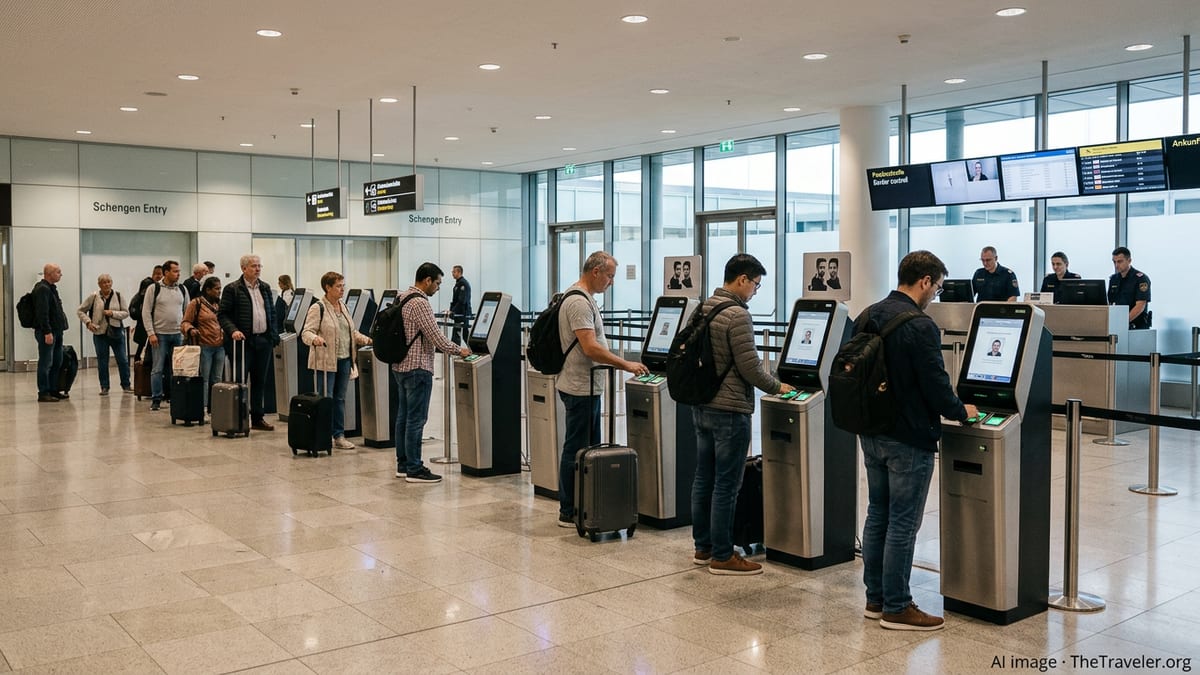
Entry/Exit System Transforms Europe’s External Borders
The European Union’s new Entry/Exit System, now fully operational, has replaced traditional passport stamping for most non-EU visitors with a centralised digital record. Publicly available information from EU institutions describes it as an automated IT system that records each entry and exit at the external borders of 29 participating European countries, covering the Schengen Area and associated states.
For British travellers, who are now treated as third-country nationals, the system creates an electronic file every time they cross an external Schengen border for a short stay. Passport details, the date and place of entry or exit, and biometric identifiers such as a facial image and fingerprints are captured, usually on a first trip after the system becomes active at a given crossing point.
Officials in Brussels have promoted the shift as a way to speed up border checks in the long term by automating processes that were previously manual. The system also underpins enforcement of the well-known “90 days in any 180-day period” rule by providing real-time calculations of how long a non-EU visitor has already spent in the Schengen zone.
However, the transition period, which began in October 2025 and concluded with full operation in April 2026, has involved a patchwork rollout across airports, seaports and land crossings. That has created uncertainty for UK visitors about exactly what procedures to expect on specific routes and at different times.
Biometric Checks and Longer Queues for UK Holidaymakers
The most visible change for many British tourists is the introduction of biometric checks on arrival in Europe. According to information released by the European Commission and national governments, non-EU passengers are now routinely required to provide fingerprints and a live facial image when first registered in the system. Once recorded, these biometrics can be re-used for future trips, typically for up to three years, although fresh verification may still be required at the border.
Travel industry reports indicate that implementing these procedures has been especially challenging at busy holiday gateways serving Spain, France, Italy and Greece, as well as at major hubs in Germany. Border posts need additional space for enrolment kiosks and staffed booths, and flows of passengers must be reorganised so that biometric capture does not block departure gates or arrival halls.
In the early months of operation, there have been recurring warnings about potential bottlenecks at peak times. UK government briefings have told travellers to expect extra checks and to allow more time when using the Eurostar terminal at London St Pancras, the Eurotunnel terminal at Folkestone and the Port of Dover, where French border officers carry out Schengen controls before departure from Britain. Similar advice has been echoed by airlines and ferry companies serving Mediterranean hotspots.
Experience has varied widely between locations. Larger continental airports, including those serving Spanish and Italian resorts, have invested in extra staff and equipment, offsetting some delays. Smaller regional airports and certain ferry ports have faced more acute pressures, particularly on summer Saturdays when UK holiday traffic peaks.
Tougher Passport Rules and the 90/180-Day Limit
Alongside digitised border checks, UK citizens travelling to Schengen countries must navigate stricter passport rules that are now being enforced more systematically. Passports generally need to be less than 10 years old on the date of entry and valid for at least three months after the intended date of departure from the Schengen area. These conditions are not new, but the increased automation and data sharing mean they are more consistently applied.
The 90-days-in-180-days rule has also moved into sharper focus. Under the new system, every entry and exit by a UK national is logged electronically, allowing border systems to calculate remaining visa-free allowance immediately. Travellers who string together frequent city breaks or extended stays in countries such as Spain, France or Greece may find their previous movements scrutinised more closely than when frontier staff relied solely on passport stamps.
Travel advisers are encouraging UK visitors planning multiple European trips to keep their own record of days spent in the Schengen zone and to check against official calculators made available by European institutions. Failure to comply with the 90/180 limit can result in refused entry or potential future difficulties when re-entering the area.
There are separate rules for UK nationals who are resident in EU states or who hold local residence permits, as well as for those travelling on long-stay visas that fall outside the scope of short-stay rules. Even so, the coexistence of different legal categories at the same airport or border crossing can cause occasional confusion for both travellers and carriers.
Impact on Key Routes to Spain, France, Italy, Greece and Germany
The impact of Europe’s digital border revolution is being felt most strongly on the busiest leisure corridors from the UK. Spain, which remains the top destination for British holidaymakers, has rolled out the Entry/Exit System at major airports and key ferry and land crossings, capturing biometrics for UK tourists heading to the Costa del Sol, the Balearics and the Canary Islands. Reports from Spanish tourism and airport bodies highlight a focus on expanding self-service kiosks to relieve pressure during peak arrivals.
France, a critical gateway for UK travellers using Eurostar, ferries and the Channel Tunnel, has attracted particular attention. Because French controls for Schengen entry are conducted on British soil at several ports and terminals, queues linked to biometric processing can build up on the UK side of the border, affecting road traffic and station operations. Local authorities in Kent have repeatedly raised concerns about the prospect of multi-hour waits on busy holiday getaway days.
Italy, Greece and Germany are also adapting their border infrastructure. Large airports in Rome, Athens, Milan, Frankfurt and Munich have installed enrolment kiosks in departure and arrival halls, while some islands and regional gateways with strong UK demand are introducing mobile or shared facilities. National media coverage in these countries has pointed to a learning curve for both front-line staff and travellers as the technology beds in.
In parallel, the inclusion of newer Schengen members, such as Bulgaria and Romania, means UK travellers heading to the Black Sea coast or Carpathian ski resorts may now encounter the same biometric and digital procedures as in longer-established Schengen destinations. That reinforces the sense that the changes are EU-wide rather than confined to a handful of major tourism markets.
What UK Travellers Should Do Before Heading to Europe
Public information campaigns from the European Commission, the EU’s border agency and national governments stress that the new systems are designed to make travel more secure and efficient in the long run. Nevertheless, prospective UK holidaymakers are being advised to adjust their habits ahead of trips to Spain, France, Italy, Greece, Germany and other Schengen states.
Key recommendations emerging from official guidance and travel industry commentary include checking passport validity at the time of booking, rather than waiting until just before departure, and reviewing the accumulated number of days already spent in the Schengen Area during the previous 180 days. Travellers are also encouraged to follow updates from transport operators, who may request passengers to arrive earlier than previously required, especially at ports and rail terminals where pre-departure registration takes place.
Where available, use of self-service kiosks or mobile pre-registration tools can speed up the process at the border, although eligibility and functionality differ between countries and individual crossing points. Families with children, travellers with reduced mobility and those who anticipate difficulties providing fingerprints or facial scans are urged in public materials to seek assistance from border staff as early as possible in the journey.
For now, the message to UK holidaymakers is that Europe’s borders are entering a new, more digital era. The promise is quicker crossings and clearer rules once systems and staffing settle, but in the short term, the combination of biometric checks and tougher passport enforcement means that extra planning and patience are likely to be essential parts of any summer trip.