


More news on this day
Bombing and missile fire continued to ripple across the Gulf on Friday night as United States forces struck targets in Iran for the seventh consecutive evening, while Iranian forces expanded retaliatory attacks on military and infrastructure sites in several neighboring Gulf states.
Get the latest news straight to your inbox!
Escalating air campaign enters a second week
Publicly available military updates and regional media reports indicate that US forces carried out another wave of air and naval strikes across southern Iran late Friday, targeting surveillance facilities, logistics hubs, underground weapons depots and maritime assets linked to the country’s Gulf operations. The latest attacks marked a full week of nightly strikes since the collapse of a short-lived ceasefire in mid July.
Coverage from international outlets describes strikes concentrated in Hormozgan province and along Iran’s Gulf of Oman coastline, including attacks on bridges, port infrastructure and a tower identified as part of a maritime surveillance network. Iranian state media reports three deaths and multiple injuries from recent strikes in the south, along with damage to transport links that serve both local communities and wider regional trade.
Statements published by US Central Command, cited in open reporting, frame the campaign as an effort to degrade Iran’s ability to target commercial shipping and regional bases, while enforcing a renewed naval blockade on Iranian ports. Analysts quoted across several outlets note that the tempo and depth of the strikes suggest a broader effort to pressure Tehran to reopen the Strait of Hormuz to international traffic.
The renewed offensive forms part of a wider conflict that began in late February with coordinated US and Israeli attacks on Iranian territory. Since then, the confrontation has expanded into a grinding air and maritime campaign centered on the world’s most strategically sensitive energy corridor.
Iranian missiles and drones hit across the Gulf
As US strikes intensified, Iranian forces widened their own operations across the region, launching missiles and armed drones toward what Tehran describes as US military sites and infrastructure in neighboring countries. Reporting from Gulf and international media indicates that Bahrain, Kuwait, Jordan, Oman, Qatar and parts of Iraq and Syria have all come under fire during the latest escalation.
Authorities in Kuwait and Bahrain, according to published coverage, have acknowledged impacts on military facilities, power infrastructure and industrial sites after waves of Iranian drones and missiles. Local reports in Kuwait describe injuries among army personnel and firefighters, as well as fires and power outages linked to falling debris and strikes on critical facilities.
Regional outlets further note Iranian claims of targeting radar systems, weapons depots and helicopters at bases hosting US forces, portraying the cross-border attacks as retaliation for nightly bombing runs on Iranian territory. At the same time, civilian populations across the northern Gulf have experienced air raid sirens, temporary blackouts and visible explosions on the horizon as the confrontation spills over national borders.
Analysts cited in international media warn that Iran’s decision to hit multiple Gulf states risks hardening regional governments’ positions after earlier efforts to contain the conflict. Some Gulf capitals, which initially pushed for de-escalation, are now reported to be pressing Washington to maintain or even expand operations until Iran’s missile and drone capabilities are significantly reduced.
Strait of Hormuz crisis squeezes shipping and aviation
The latest strikes are unfolding against the backdrop of an intensifying crisis in the Strait of Hormuz, where Iran has curtailed tanker movements and threatened to halt shipping entirely. Travel and maritime industry reports describe a sharp reduction in commercial traffic through the narrow chokepoint, with some vessels rerouting or anchoring in safer waters while they assess the security situation.
Oil and gas tankers, bulk carriers and container ships have all faced heightened risk from missiles, drones and small-boat activity in and around the Strait. Media tracking services and maritime analysts note delays, detentions and inspections, as well as reported harassment of ships seen as linked to the United States or its partners. Insurance premiums for vessels transiting the corridor have risen, adding further cost pressure to global trade flows.
The disruption at sea is reverberating through regional aviation networks. Open-source flight data and news coverage show that several airlines have adjusted flight paths to avoid affected airspace over the Gulf and southern Iran, in some cases adding time and fuel costs to long-haul routes between Europe, Asia and the Americas. Previous rounds of missile fire earlier in the conflict had already prompted temporary airport closures and diversions, and operators remain wary of renewed crossfire.
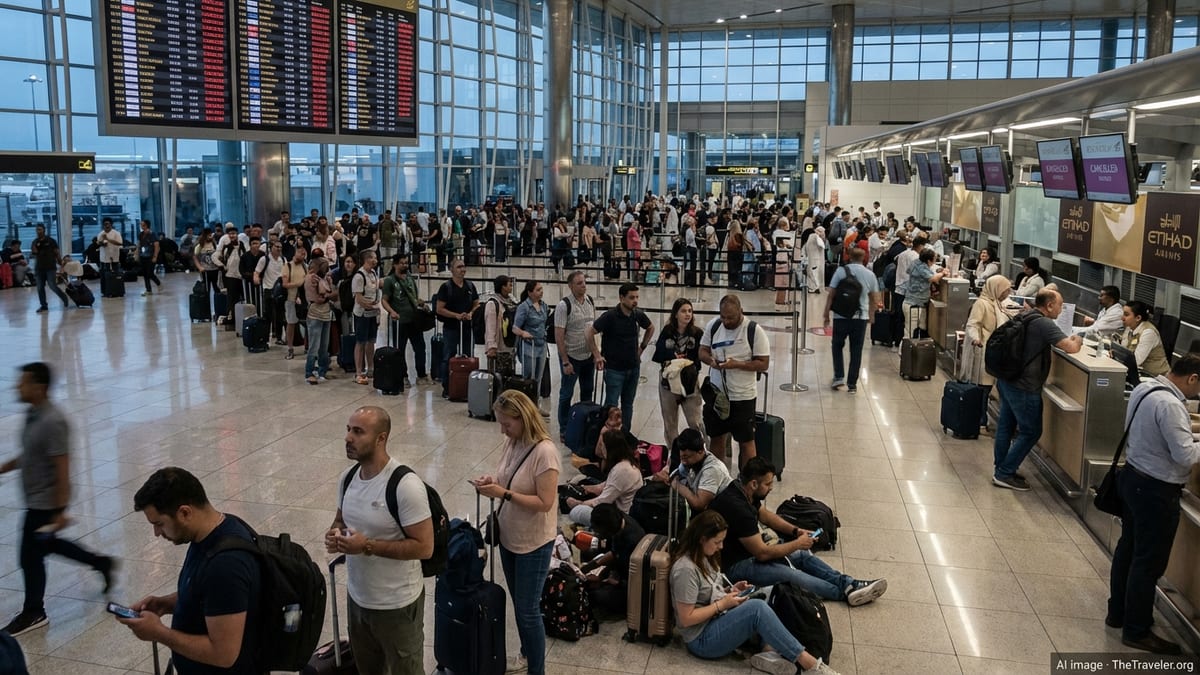
For travelers, the combination of airspace restrictions, shifting maritime routes and periodic security alerts has introduced new layers of uncertainty around itineraries involving Gulf hubs. Many governments continue to advise citizens to reconsider non-essential travel to areas near Iran and the Strait of Hormuz, reflecting the heightened risk of sudden escalations.
Regional infrastructure and tourism under strain
Beyond immediate military targets, the exchange of strikes is putting sustained pressure on critical infrastructure that underpins daily life and tourism across the Gulf. Reporting from regional outlets highlights damage to bridges, power lines and water facilities in Iran and neighboring states, including desalination plants that provide drinking water to desert cities.
In Kuwait, local media describe attacks that triggered fires at industrial facilities and strain on emergency services. In Bahrain and Qatar, warning sirens, intercepted projectiles and the activation of air defense systems have become a recurring feature of life in recent days, affecting the sense of security that supports tourism, expatriate communities and international events.
The Gulf’s major airline and airport hubs, from Doha and Dubai to Manama and Kuwait City, remain operational but are operating in a more volatile security climate. Even where direct damage is limited, the perception of risk can influence traveler choices, conference planning and investment decisions in sectors that depend heavily on the region’s reputation for stability and connectivity.
Travel industry analysts cited in open reporting suggest that sustained uncertainty could dampen visitor numbers and transit traffic if the confrontation continues, particularly among leisure travelers who may opt for alternative routes and destinations until the security outlook becomes clearer.
Outlook for travelers and global trade
With US strikes now running for seven consecutive nights and Iranian responses extending across multiple borders, observers see few immediate signs of durable de-escalation. Diplomatic discussions have struggled to gain traction amid competing military objectives, and public statements from both sides signal a willingness to continue operations as long as attacks and blockades persist.
For international travelers and businesses, published advisories stress the importance of monitoring airline notices, rerouting plans and government guidance, especially for itineraries that pass through or near the northern Gulf. Companies with supply chains tied to Gulf ports and the Strait of Hormuz are reassessing shipping schedules, stockpiles and alternative corridors to manage potential delays.
Energy markets remain sensitive to any additional disruption, given that a significant share of the world’s traded oil and gas typically moves through the Strait. Analysts note that even partial closures or sporadic attacks can have outsized effects on prices and logistics, particularly when they coincide with broader geopolitical uncertainty.
How long the current cycle of nightly strikes and cross-Gulf attacks continues will shape not only the trajectory of the conflict, but also the travel, trade and tourism landscape for one of the world’s most interconnected regions.