


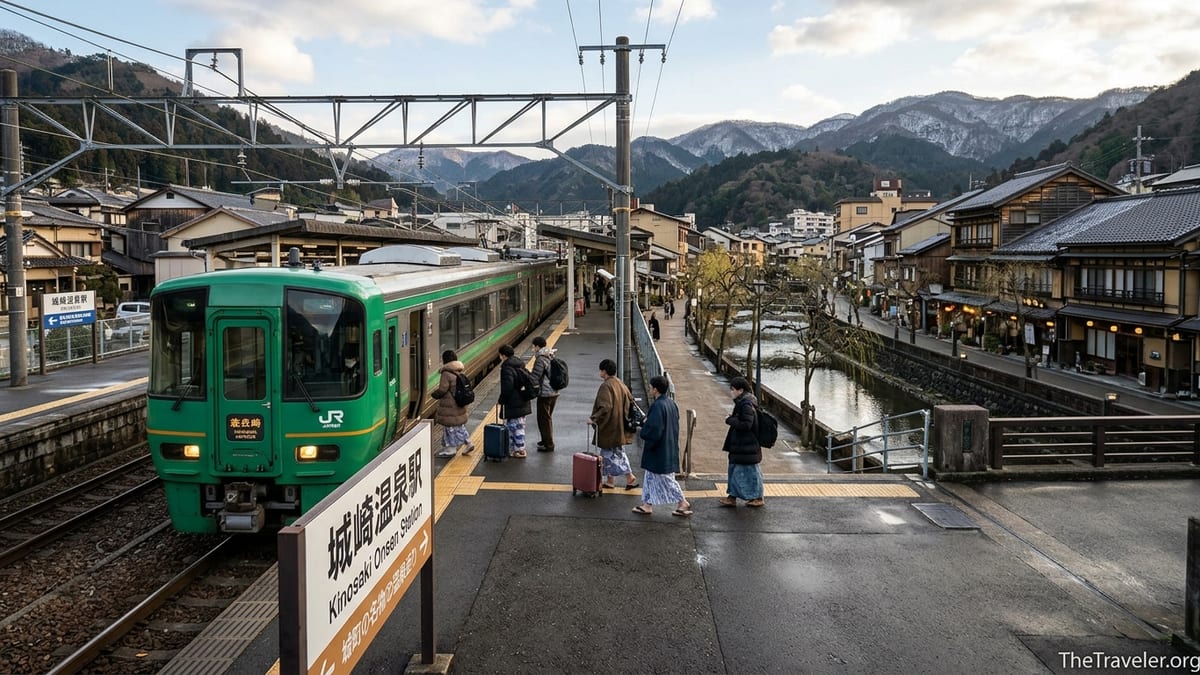
JR West’s Limited Express Kinosaki trains link Kyoto Station with Kinosaki Onsen in about two and a half hours, providing the most convenient rail route into one of Japan’s most atmospheric hot spring towns. As of autumn 2026, several direct Kinosaki services operate daily between Kyoto and Kinosaki Onsen, while other journeys require a simple transfer, typically at Fukuchiyama. Because most ryokan in Kinosaki Onsen still serve elaborate multi-course dinners at fixed times in the early evening, the choice of train from Kyoto is not just a transport decision but one that can determine whether you sit down to steaming crab and Tajima beef, or arrive after the kitchen has closed.
Get the latest updates straight to your inbox!
Understanding the Kyoto to Kinosaki Onsen Train Route
The Limited Express Kinosaki is a named JR West service that runs between Kyoto Station and Kinosaki Onsen Station via the Sanin Main Line. Current timetables published in July 2026 show four direct Kinosaki trains a day in each direction, with morning, late-morning, early-afternoon and mid-afternoon departures from Kyoto. Recent examples include Kinosaki 1 leaving Kyoto around 7:30 and arriving just before 10:00, and midday or early afternoon services that reach Kinosaki Onsen between roughly 13:45 and 18:00. Journey times fall in the range of about 2 hours 20 minutes to 2 hours 35 minutes depending on the run.
When direct trains do not fit your schedule, it is straightforward to travel with one connection. A common pattern is to take a JR limited express such as Kinosaki or Maizuru from Kyoto to Fukuchiyama, then transfer to another limited express or local train bound for Kinosaki Onsen. JR West’s official timetables, last updated in October 2026 for this corridor, indicate that total travel time with a transfer is usually around 3 hours. This is slightly longer than the direct run but can give you more flexibility around lunch or check in.
All Kinosaki limited express services are fully reserved seat trains. This means you must hold both a valid base fare ticket and a reserved seat ticket before boarding. Ordinary Cars and Green Cars are generally available on these trains, with Green Car cars concentrated in the middle of the formation. Ordinary Cars offer standard 2+2 seating, while Green Car seats are wider with more legroom and recline, which some travelers appreciate on winter evenings returning from the onsen.
One important detail in 2026 is that timetable adjustments can occur with seasonal changes and during winter periods when snow conditions may require speed restrictions. JR West explicitly advises passengers to check the latest Kinosaki timetable close to their travel date via official route search tools or station information boards. Treat any printed or third-party timetable as a guide and confirm your selected departure on the day.
Tickets, Reservations, Fares and Rail Pass Coverage
On JR conventional lines such as the Kyoto to Kinosaki Onsen route, long-distance fares consist of two parts: the base fare and, for faster trains, a limited express supplement. Traveling from Kyoto to Kinosaki Onsen in an Ordinary reserved seat currently costs in the range of 6,000 to 7,000 yen one way for an adult when these two components are combined, based on 2026 examples from Kyoto tourist information and JR fare calculators. A Green Car seat pushes the price higher, usually by around a few thousand yen per person for the same distance.
Seat reservations are mandatory on Limited Express Kinosaki trains, and there are several ways to secure them. Travelers can use JR West’s online reservation system, accessible in English, to search for Kyoto to Kinosaki Onsen, choose a departure, and reserve an Ordinary or Green Car seat. After purchase, you collect the physical ticket at a green ticket machine or a staffed Midori-no-Madoguchi counter in Japan using the credit card and reservation number you registered. Alternatively, you can buy both the base fare and the limited express ticket in person at Kyoto Station, either at ticket counters or at multilingual ticket machines that allow you to select “Limited Express,” then choose your train and car. The machines typically show car layouts and note if Green Car is available.
Several JR West passes cover this journey in full. The Kansai Wide Area Pass, promoted by JR West as valid to outlying destinations such as Kinosaki Onsen, allows unlimited rides on local, rapid and selected limited express trains in the region within its validity, including Limited Express Kinosaki between Kyoto and Kinosaki Onsen. In this case, the pass covers both the base fare and the express supplement within the pass area, although pass holders still need to obtain seat reservations for limited express trains at no additional cost. Larger products such as the Sanyo Sanin Area Pass and Kansai Hiroshima Area Pass also include Kyoto and Kinosaki Onsen inside their coverage, making them useful for longer itineraries that combine Kinosaki with Himeji, Hiroshima or the Sanin coast.
From a budgeting perspective, a simple round trip from Kyoto to Kinosaki Onsen on limited express trains without a pass might cost roughly 12,000 to 14,000 yen per adult in 2026, depending on seasonal adjustments. If your entire plan is just that round trip plus local Kyoto buses and subways, individual tickets are usually more economical. The Kansai Wide Area Pass, typically priced around the mid-tens of thousands of yen for five consecutive days as of 2026, pays off when you add further long-distance trips such as Kyoto to Okayama, Osaka to Shirahama, or side excursions to Amanohashidate. For a traveler doing only Kyoto–Kinosaki round trip and nothing else, buying standard limited express tickets is often the simpler and cheaper option.
Luggage, Accessibility and Station-to-Ryokan Transfers
JR West limited express trains running between Kyoto and Kinosaki Onsen are designed to handle typical travel luggage. Overhead racks are suitable for medium suitcases and backpacks, while the vestibule areas at the ends of some cars can accommodate a few larger cases. Unlike shinkansen lines that now have strict oversize baggage rules, there is currently no surcharge on this route for common suitcase sizes, although travelers with very large items are encouraged to use non-peak services or alternative transport. Strollers can be brought on board and usually fit in the vestibule or between seats when folded; parents are asked to set the brakes and avoid blocking aisles.
For wheelchair users, recent JR West barrier-free documentation for the Sagano and Sanin lines indicates that Kinosaki limited express trains have designated wheelchair spaces and accessible toilets in at least one car. It is advisable to contact JR West in advance, either by phone or at a major station, so staff can arrange boarding ramps at Kyoto and Kinosaki Onsen Stations. Both stations feature elevators and slopes between ticket gates and platforms, and Kinosaki Onsen Station has a relatively compact forecourt that makes transfers to ryokan shuttles straightforward for passengers with limited mobility.
Because Kinosaki Onsen is a compact river valley town, many ryokan are within a 5 to 15 minute walk of the station. The main onsen street lined with willow trees and wooden inns begins almost immediately outside the station area and runs along the Otani River. However, with luggage or on rainy winter days it is worth using the Ryokan Service Center and shuttle bus. The Kinosaki Onsen Ryokan Service Center, located close to the station, offers luggage delivery to participating inns earlier in the day so guests can stroll hands free. A complementary shuttle bus also circulates between the station and groups of ryokan, usually in the afternoon around check in time and in the morning after check out, operated in partnership with the local inn association.
Travelers who prefer not to move bulky suitcases at all can use Japan’s nation-wide luggage delivery services operated by major couriers. Kyoto hotels and convenience stores frequently accept takkyubin shipments to Kinosaki Onsen ryokan, where bags are held until check in. In 2026 the typical cost for sending a medium suitcase within the Kansai region is roughly 2,000 yen per piece. This can be particularly attractive in winter when snow and slush make wheeling a large case through Kinosaki’s narrow streets less enjoyable.
Ryokan Check In, Dinner Times and Why Train Choice Matters
Kinosaki Onsen’s traditional ryokan culture is closely tied to meal times. Many full-service inns serve kaiseki dinners featuring seasonal ingredients such as Tajima beef and, in winter, Matsuba crab. Because these dishes require lengthy preparation and are best eaten fresh, ryokan typically schedule dinner at fixed times, often around 18:00 or 18:30, with the latest seating sometimes at 19:00. Reservation confirmations and English-language FAQ pages for ryokan such as Shinzan and Akaishiya explicitly ask guests to arrive by about 17:00 if dinner is included, and note that late arrivals may forfeit meals without a refund.
This schedule has direct implications for your train choice from Kyoto. For example, taking a mid-afternoon Limited Express Kinosaki that arrives close to 18:00 leaves little margin for delays, walking to your ryokan, checking in, changing into a yukata and sitting down to dinner. A more relaxed plan is to choose a late-morning or early-afternoon departure from Kyoto, arriving in Kinosaki Onsen between roughly 13:45 and 15:45. That gives time to check in after the usual start of check in hours around 15:00, enjoy tea in your room, perhaps visit an onsen bathhouse, and be back at the ryokan comfortably before dinner.
Concrete timings help illustrate the point. A common pattern is to leave Kyoto on a late-morning Kinosaki train, arriving in town around 13:50. After a 10 minute walk or a short shuttle ride to your ryokan, you can store luggage if your room is not yet ready, slip into the provided yukata and wooden geta, then head out to explore the streets and maybe try one public bath in mid afternoon. You return to your room well before 18:00 for kaiseki dinner served either in-room or in a private dining space. In contrast, booking a Kinosaki departure that only reaches town after 18:00 risks arriving to find your dinner largely plated and waiting or, in the strictest cases, cancelled.
When making reservations, always confirm your estimated arrival time and whether your chosen plan includes dinner and breakfast. Some inns offer “room only” or “breakfast only” plans, which provide more flexibility for travelers who cannot reach Kinosaki until the evening. In those cases you might intentionally select a later limited express from Kyoto, eat a light meal from Kyoto Station’s bento shops on board, and focus on night-time bath hopping after you check in.
Onsen Etiquette, Public Baths, Tattoos and Private Options
Kinosaki Onsen is best known for its seven public bathhouses, each with its own character, architecture and bathing pools. Guests staying in most ryokan receive a public bath pass known as a yumepa at check in, which allows unlimited entry to the open bathhouses from mid afternoon until late evening on the days of their stay. Official tourism brochures state that the yumepa remains valid until checkout time and that all inns in Kinosaki offer some form of bath access, though the exact arrangement can vary. Walk-in visitors not staying in local accommodation can pay per-use admission at each bathhouse or purchase a day pass when available at the information center.
Basic onsen etiquette in Kinosaki follows national norms. Inside each bathhouse you remove your shoes and store them in lockers, then undress completely in gender-segregated changing rooms, placing clothes and large towels in baskets or lockers. In the washing area you must sit on a stool and thoroughly wash and rinse your body and hair using the provided showers and soap before entering any shared tub. Bath water is not for washing; it is for soaking quietly. Modesty towels can be carried to the edge of the bath but should not be dipped into the water. Photography is prohibited in bathing areas. Many visitors wear their ryokan’s yukata and geta as they stroll between bathhouses, which is considered part of the local charm rather than strange attire.
One notable feature of Kinosaki in 2026 is its tattoo-friendly policy. The town’s official tourism materials and independent onsen guides confirm that all public bathhouses in Kinosaki Onsen currently accept tattoos of any size without requiring them to be covered, a rare exception in Japan. Individual ryokan baths may set their own rules about tattoos, so tattooed guests who plan to use only in-house onsen should confirm policies when booking. Mixed-gender bathing is not a feature of Kinosaki’s main public baths; they operate with separate men’s and women’s areas, sometimes switching sides at different times of day.
For travelers uncomfortable with communal nudity, or families wanting more privacy, several ryokan offer private baths that can be reserved by the hour, sometimes free of charge for staying guests or for a small additional fee. An example is a Kinosaki inn that opens its indoor onsen as gender-segregated baths in the morning and converts them into bookable private baths in the afternoon and evening. Other properties advertise rooms with attached open-air onsen on balconies, which allow couples or families to bathe together in a private setting while still enjoying natural hot spring water. These private facilities are distinct from the town’s seven public bathhouses and may or may not be included in the base room rate.
Sample Itineraries and Nearby Coastal Excursions
A relaxed two-day itinerary from Kyoto allows you to experience both the ryokan culture and the rhythm of bath-hopping that makes Kinosaki special. On day one, take a late-morning Limited Express Kinosaki from Kyoto, aiming to arrive in Kinosaki Onsen early to mid afternoon. Check your bags at the Ryokan Service Center if your inn’s check in has not started, then change into yukata after you reach your ryokan. Spend the late afternoon visiting one or two public baths using your yumepa pass, followed by an elaborate kaiseki dinner back at the inn. After dinner, head out again under the lanterns to try another bathhouse or simply wander along the river, where you will see many other guests strolling in yukata even in winter, often pausing for soft-serve ice cream or a drink at small bars.
On day two, enjoy breakfast at your ryokan, typically served between about 7:30 and 9:00. After checking out around 10:00, you can continue to use the yumepa until your departure time if you leave luggage at your inn or the service center. Spend the morning visiting remaining bathhouses that appeal to you, shopping for local sweets and crab crackers, or riding the Kinosaki Ropeway up to a viewpoint above town when it is running. In the afternoon, collect your bags and board a mid- or late-afternoon limited express back to Kyoto or onward to Osaka using the Kinosaki or Kounotori services. This pattern offers two full rounds of bathing and one sumptuous dinner without feeling rushed.
For travelers with a third day to spare, Kinosaki Onsen can serve as a base for nearby coastal attractions along the Sea of Japan. Toyooka’s coastal area includes scenic coves and small fishing harbors reachable by local trains and buses, though service frequency can be limited outside peak seasons. One popular half-day trip from Kinosaki is to Genbudo Park, known for its striking basalt column formations. Access involves a short ride on the JR Sanin Main Line from Kinosaki Onsen to Genbudo Station, followed by a walk and short ferry or footbridge crossing depending on the season. Including waiting and walking time, visiting Genbudo typically takes at least three to four hours door to door from your ryokan, so it works best as a third-day option before returning to Kyoto in the evening.
Those interested in combining Kinosaki with other regional highlights might stitch together an itinerary that links Kyoto, Kinosaki Onsen, Amanohashidate, and Okayama using a Kansai Wide Area Pass. For instance, you might travel Kyoto to Kinosaki for one night, then continue along the coast or return via Fukuchiyama to transfer toward Amanohashidate before looping back to Kyoto or Osaka. Because regional train lines on the Sea of Japan side run less frequently than urban routes, always build in margin around connections and cross-check timetables, particularly in winter when snowfall can affect speeds.
Budgeting for Trains, Ryokan Stays, Meals and Bathing
As of late 2026, a representative budget for a one-night visit from Kyoto to Kinosaki Onsen can be sketched using current price ranges. Transport on the Limited Express Kinosaki between Kyoto and Kinosaki Onsen in an Ordinary reserved seat tends to range around 6,000 to 7,000 yen one way per adult, giving 12,000 to 14,000 yen for a simple round trip. Children in elementary school generally travel for about half the adult base fare and a reduced limited express fee, slightly lowering the total for family groups.
Ryokan prices vary widely by season and menu, especially in winter crab season from around November to March. Recent traveler reports and ryokan rate tables show that a mid-range ryokan plan including dinner and breakfast for one night often falls in the 25,000 to 40,000 yen per person range in 2026, based on double occupancy. High-end ryokan with premium crab kaiseki courses or Michelin-noted service can easily exceed 50,000 yen per person per night. Simpler inns and small hotels that do not include dinner might offer rooms from about 10,000 to 15,000 yen per person with breakfast only, appealing to budget travelers who are happy to dine at casual restaurants.
Bathing costs depend on whether you stay overnight. Guests at most ryokan receive a free yumepa public bath pass, which means you pay nothing extra for visiting multiple bathhouses after check in until checkout. Day-trippers or visitors staying outside the main inn network pay individual entrance fees at each bathhouse. In 2026, single-entry prices reported by tourism information are typically in the low thousands of yen per adult, with children’s entries cheaper, so visiting several bathhouses as a day tripper can add up. Food outside your ryokan might include simple noodle lunches for around 1,000 to 1,500 yen, seafood rice bowls in the 2,000 to 3,000 yen range, and snacks and drinks between 300 and 800 yen each.
Putting these numbers together, a typical couple coming from Kyoto for one night with kaiseki dinner and breakfast at a mid-range ryokan might reasonably budget around 70,000 to 90,000 yen in total for transport, accommodation, meals and incidental spending in late 2026. Solo travelers can sometimes book single occupancy rooms, although some ryokan either charge a supplement or restrict their most elaborate meal plans to parties of two or more. Families often find value in child-rate plans that include smaller course dinners and shared rooms, but it is important to read the details, as some family plans assume co-sleeping children and may not include full access to all menu items.
Seasonal Considerations, Families and Alternatives to Communal Bathing
Winter brings both beauty and complications to Kinosaki Onsen. From roughly December through February, the town often receives snowfall, blanketing willow trees and wooden bridges with white and creating a particularly romantic atmosphere at night. JR West trains along the Sanin Main Line are built to operate in such conditions, but heavy snow can cause speed reductions and occasional delays. Travelers heading from Kyoto to Kinosaki during this period should favor earlier trains in the day, leave ample connection time if they are catching a flight after their return, and pack appropriate footwear for walking on icy streets in geta or boots.
For travelers with limited mobility, Kinosaki has been investing in barrier-free infrastructure, as reflected in a dedicated accessibility guide published in 2026. Several public bathhouses now provide ramps, handrails and lifts, and some ryokan have rooms on lower floors or with minimal steps. That said, historic buildings and narrow streets do mean there are still uneven surfaces and steep internal stairs in older inns. Communicating your mobility needs in advance allows ryokan to advise whether they can accommodate you in a specific room type or suggest nearby properties that are easier to navigate.
Families with children are a common sight in Kinosaki’s bathhouses. Young children can enter the baths with a parent of the same gender, and toddlers often accompany mothers or fathers into the appropriate side. Parents should take extra care that children understand the need to wash thoroughly before entering the bath and to keep voices and splashing at a considerate level. Some families choose accommodation with private family baths so children can practice bathing etiquette in a more relaxed environment before venturing into public pools.
Not every traveler feels comfortable with communal nude bathing, even in gender-separated spaces. For these visitors, rooms with private hot spring baths or ryokan that rent out private onsen by the hour provide an excellent compromise. You still benefit from Kinosaki’s mineral-rich waters and ryokan hospitality while bathing either alone or only with your partner or family. Combining private bathing with walks through the town in yukata, enjoying the river scenery, shops and restaurants, can deliver much of the Kinosaki experience without ever entering a large shared bath.
Day Trip or Overnight: Which Is Better for Kinosaki Onsen?
From a pure rail perspective, a day trip from Kyoto to Kinosaki Onsen is possible. You could, for instance, take the first morning Limited Express Kinosaki around 7:30, arrive shortly before 10:00, spend the midday hours visiting a few public baths and strolling the town, then board a mid or late afternoon return train reaching Kyoto in the early evening. Recent bathhouse timetables confirm that several of the seven public onsen open from morning or late morning, making a daytime visit feasible. A day trip is most appealing for travelers on tight schedules or those unsure whether they will enjoy onsen culture enough to devote a night.
However, almost every aspect of Kinosaki Onsen is designed around staying at least one night. The magical atmosphere of guests in yukata crossing stone bridges under lantern light, the unhurried rhythm of multiple baths punctuated by an elaborate kaiseki dinner, and the pleasure of a slow breakfast followed by one last soak before checkout are all hard to replicate on a quick there-and-back excursion. Because most ryokan include bath passes with overnight stays and bundle meals in a set price, the relative value of a one-night visit is higher than what you can piece together with separate day-use bath fees and restaurant meals.
For travelers who enjoy hot springs, traditional Japanese accommodation and regional cuisine, Kinosaki Onsen is best experienced as at least an overnight stay, and many would argue that two nights allows you to fully relax without watching timetables. A day trip can still be worthwhile for those based in Kyoto with no flexibility in their lodging schedule or for travelers who simply want to sample one or two baths and the townscape before returning to urban comforts. In either case, the key to a successful visit is aligning your Limited Express Kinosaki train choices from Kyoto with ryokan check in windows, dinner arrangements and your personal comfort with onsen bathing so that the journey, meals and hot springs all work together.