


Perugia does not shout like Florence or glow with Franciscan legends like Assisi. Instead, this hilltop capital of Umbria works quietly as a lived-in university city, a place where medieval streets, student bars and serious museums all share the same piazzas. For travelers, it offers something important: enough history and culture to fill a weekend, yet a relaxed atmosphere and good transport links that make it a practical base for exploring central Italy.
Get the latest updates straight to your inbox!
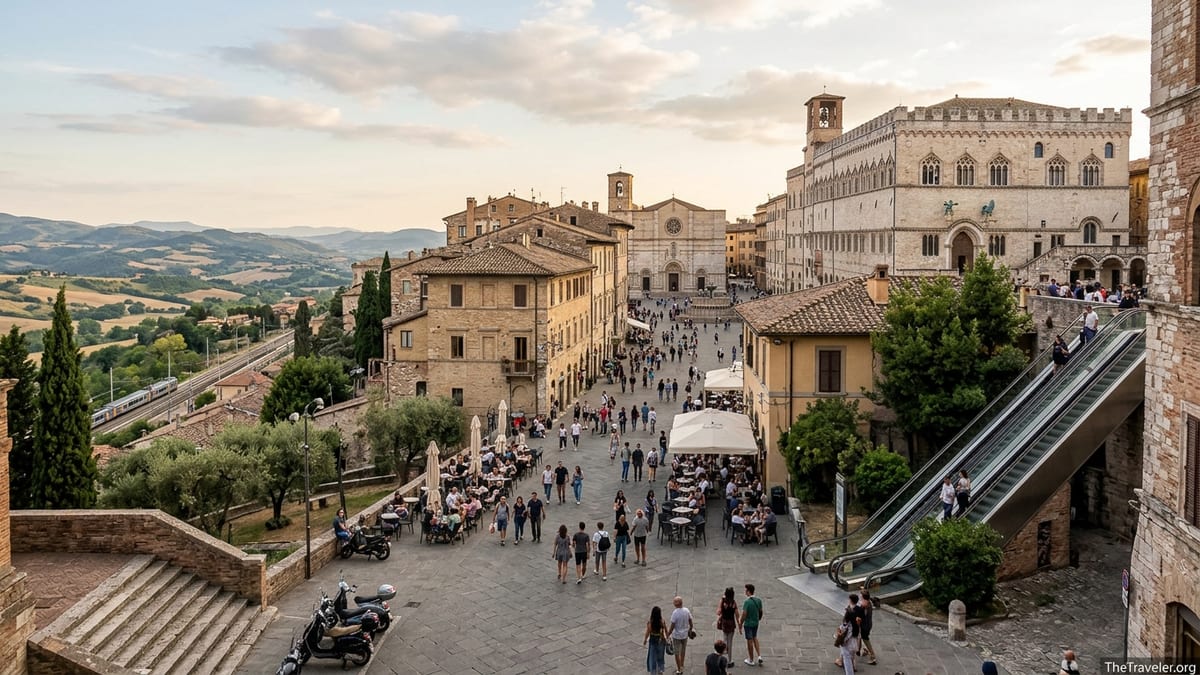
Why Perugia Works as a Weekend Base
Perugia sits roughly halfway between Florence and Rome in central Italy, on a high ridge above the Tiber valley. Trains from Rome usually take between two and three hours with a change at Foligno or Terontola, and Florence is generally around two hours away on regional trains. The city is smaller and less monumental than Florence, with no single must-see masterpiece that everyone queues for, but it has a compact historic center, major Umbrian art collections and a daily rhythm shaped by students from the University of Perugia and the Università per Stranieri language school.
Compared with Assisi, which is heavily focused on Saint Francis and pilgrimage, Perugia feels broader in scope. Here the story runs from Etruscan gates and Roman walls to medieval bankers, Renaissance fresco painters and modern jazz fans. There are churches and monasteries, but also contemporary galleries, bars offering aperitivo to students, and events like Umbria Jazz and Eurochocolate that take over the streets. Many visitors who base in Assisi or Orvieto come to Perugia as a day trip and say afterward they could happily have stayed here instead.
One full day in Perugia lets you walk the main historic spine between Rocca Paolina and Piazza IV Novembre, visit one or two key sights and linger over a long lunch. Two days give time for museums such as the Galleria Nazionale dell’Umbria and a deeper wander through side streets and viewpoints. With three nights you can treat Perugia as a hub for a day trip to Assisi, Spello or Lake Trasimeno while still having an evening back in a city that stays alive after dark.
Because Perugia is a functioning regional capital and university town, visiting outside major festivals usually means less of a pure tourist economy and more ordinary life. Cafes cater to local office workers in the morning and students in the afternoon. Supermarkets and neighborhood bakeries are easy to find, and rental apartments in residential streets sit a short walk from major monuments. This mix can be a clear advantage if you want to balance sightseeing with slower, more local routines.
Historic Core in a Day: Piazza IV Novembre to Rocca Paolina
A logical first-day walking route starts at Rocca Paolina, the 16th century fortress that now serves as one of Perugia’s main gateways from the lower city. If you arrive by bus or park in one of the large car parks below the center, escalators carry you up through the remains of the fortress. Inside, you walk through atmospheric brick-vaulted passages that feel like an underground town, with fragments of old streets and houses incorporated into the papal stronghold. The route finally emerges near Piazza Italia on the southern edge of the historic core.
From Piazza Italia it is a gentle walk along Corso Vannucci, Perugia’s main promenade, toward Piazza IV Novembre. This stretch is mostly level and lined with cafes, gelaterie and shops that range from chain clothing stores to small artisan boutiques selling Umbrian textiles and ceramics. Corso Vannucci is the city’s natural meeting point, especially in late afternoon when students and families come out for a stroll. You can plan coffee stops here at bars such as Caffè Sandri, an old patisserie known for cakes and chocolate.
At the northern end of Corso Vannucci you reach Piazza IV Novembre, the main square. Here the white and pink Fontana Maggiore stands between the Duomo and the Gothic Palazzo dei Priori. The fountain, carved in the 13th century, is more than decoration; its sculpted panels show months of the year, zodiac signs and biblical scenes, a stone encyclopedia of medieval life. Behind it, the Perugia Cathedral has an asymmetrical facade and a simple interior where you can pause briefly before moving on to the civic buildings.
Palazzo dei Priori houses two of Perugia’s most important interiors: the Collegio del Cambio, decorated with Renaissance frescoes by Perugino, and the Galleria Nazionale dell’Umbria, a regional art museum. The Collegio del Cambio is compact and can be visited in under an hour, with tickets sold at the entrance and combined options often available for related sights. The Galleria Nazionale occupies several floors and is best approached selectively; you might focus on a few periods such as late medieval panels and works by Perugino and Pinturicchio. Together, these sites anchor a full morning without needing to cross large distances.
Medieval Streets, Viewpoints and Everyday Perugia
After lunch, you can explore the warren of medieval streets that spread behind the main piazza. One rewarding loop heads toward the Etruscan Arch, also called Arco Etrusco, a monumental stone gate built by the Etruscans and later modified by the Romans and medieval rulers. The arch sits at the northern end of the old city and gives a sense of how long Perugia has controlled this hilltop. Along the way you pass stretches of the ancient city walls and narrow lanes with overhanging buildings, some with steps so steep they almost function as exterior staircases.
Nearby streets hide small artisan workshops and independent boutiques. You might find a tiny leather shop producing belts and bags, a studio selling hand-painted majolica from nearby Deruta, or bakeries offering local specialties like torcolo, an Umbrian ring cake. Exploring these areas means frequent short climbs and descents; although distances are small, elevation changes can make a 15-minute walk feel more strenuous, especially if you are carrying shopping or traveling with young children.
For views, several points around the historic center look out across the valley and surrounding hills. The terraces near the Giardini Carducci by Piazza Italia give panoramic views toward the south and west, especially atmospheric at sunset. On the opposite side, areas around the Etruscan Arch and Via delle Prome open toward the Tiber valley and, on clear days, distant hill towns. Unlike Florence’s crowded Piazzale Michelangelo, these viewpoints often have space to sit on a bench and watch evening light without heavy tour bus traffic.
Later in the day, you can return along different backstreets to Corso Vannucci and Rocca Paolina, stopping for an aperitivo at a bar with outdoor tables. Student-focused spots might offer inexpensive spritzes and snacks, while more upscale wine bars showcase Umbrian labels by the glass. This combination of older stone alleys and a lived-in evening scene is where Perugia feels most distinct from more museum-like hill towns.
Escalators, Minimetrò and Managing the Hills
Perugia’s dramatic setting on a ridge is part of its appeal, but it creates real practical challenges. Streets between the railway station in the valley and the upper town are steep, and some historic lanes within the center climb sharply in short bursts. For visitors with mobility issues or parents pushing strollers, planning routes is essential. What looks like a few hundred meters on a map may involve multiple flights of stairs and slopes that feel punishing in summer heat.
To mitigate this, the city has invested in escalator systems and the Minimetrò, a small automated light rail line. Escalators connect several car parks and lower districts to the historic core, including the route through Rocca Paolina from the Piazza Partigiani parking area and the Pellini escalators that link the Cupa Minimetrò stop and the Pellini car park with Via dei Priori. These escalators are free to use and run most of the day, effectively providing vertical public transport directly into the medieval streets.
The Minimetrò runs from the railway station area at Pian di Massiano up toward Pincetto near the old town. It uses small driverless cabins that arrive every few minutes during service hours, allowing travelers arriving by train to avoid a strenuous uphill walk. Tickets are integrated with the local bus system and can be bought at machines at stations. From the Pincetto terminus, a short escalator ride and brief walk bring you to the edge of the historic center; this is one of the easiest ways to reach central hotels with luggage.
Despite these aids, it is still wise to pack with the terrain in mind. Wheeled suitcases that cope well with cobblestones, comfortable walking shoes with good grip and realistic expectations about walking times will all improve your stay. If you have limited mobility, contacting your accommodation in advance to ask about the nearest escalator or Minimetrò stop, and whether taxis can approach the front door, can prevent unpleasant surprises on arrival.
Umbrian History in Context Without the Lecture
Perugia’s story begins long before its medieval palaces. The city grew from an important Etruscan settlement known as Perusia, one of the twelve major cities of Etruria. The massive stone blocks of the Arco Etrusco and segments of Etruscan walls that still surface around the center give a physical sense of this early power. Unlike some archaeological sites that sit apart from daily life, here the remains are stitched directly into the living city, with modern traffic and university buildings not far away.
Under Roman rule Perugia retained importance, then entered a turbulent medieval period marked by conflicts with neighboring cities and internal factions. Many of the buildings you see today date from the 13th to 15th centuries, when wealthy merchant families and civic institutions funded churches, guild halls and the Fontana Maggiore. Inside the Collegio del Cambio, for example, the frescoes of Perugino reflect both religious themes and the pride of the money changers who commissioned them.
Later, papal control reshaped Perugia. Rocca Paolina was built in the 16th century as a fortress to dominate the city after an uprising. Its construction involved demolishing part of an entire neighborhood, whose remains you now walk through in the underground passages. Rather than treating these spaces as a detached museum, Perugia uses them as pedestrian routes and occasional exhibition areas, which makes the history feel more like a layer under your feet than a separate attraction.
This background helps frame what you see on a weekend visit without requiring deep academic study. Knowing that an Etruscan gate became a Roman and then a medieval symbol of power, or that a seemingly charming fortress once served as a tool of control, can add texture to your walks while leaving plenty of time for coffee, markets and conversation.
Eating and Drinking: Umbrian Flavors in a Student City
Perugia is a useful place to explore Umbrian cuisine because it combines traditional trattorie with student-friendly options and a famous local chocolate industry. Typical street-level foods include torta al testo, a flatbread cooked on a griddle and split to hold fillings such as sausage, greens or cheese, and strangozzi or strangozzi-like fresh pasta with simple sauces like tomato, truffle or wild boar. Local cheeses from the surrounding countryside and cured meats from Norcia and Valnerina often appear on mixed boards flown to tables as antipasti.
Prices vary by location. Near Piazza IV Novembre and Corso Vannucci, menus often cater to short-stay visitors, with pasta dishes sometimes priced higher and more English-language signage. A few streets away, in lanes closer to the university, you may find more straightforward osterie offering fixed-price lunch menus or generous aperitivo spreads aimed at students. Asking your accommodation for one or two places where they themselves would eat is often more productive than following only online rankings.
Chocolate is woven into Perugia’s identity. The city is associated with brands like Perugina, and throughout the center you find patisseries and chocolate shops selling pralines, bars and seasonal specialties. In November, Eurochocolate takes over squares and streets with stalls from large companies and small artisans, as well as workshops and tastings. Upcoming editions are scheduled in mid to late November 2025 over roughly ten days, so checking current year dates before planning a trip is essential, particularly because accommodation prices tend to rise sharply during the festival and central streets become very crowded.
Umbrian wines, including reds based on Sangiovese and Sagrantino grapes and whites from Orvieto and the hills around Lake Trasimeno, appear widely by the glass. Wine bars and enoteche in the center offer tasting flights at moderate prices, sometimes paired with local cheeses and salumi. This is a good way to get a feel for the region’s production without visiting vineyards, especially if you are staying only a couple of days and relying on trains or buses rather than a car.
Where to Stay and How to Handle ZTL and Parking
Choosing where to stay in Perugia has a significant impact on how convenient your trip feels. Staying in the historic center places you within a few minutes’ walk of major sights, cafes and viewpoints. However, much of the center is inside a ZTL, a restricted traffic zone monitored by cameras. Drivers without permission who cross these borders receive fines, so anyone arriving by car should contact their hotel in advance to ask about access and short-term authorization for loading and unloading luggage. Some hotels can register your license plate with local authorities, while others may direct you to nearby car parks instead.
Parking garages such as those near Piazza Partigiani or at the base of major escalators provide paid long-term spaces outside the tightest part of the ZTL. Daily rates can add a noticeable cost to your stay, but they spare you from navigating narrow streets and worrying about tickets. From these garages, escalators carry you directly into the old town, so the extra walking time is often modest. Drivers should watch for ZTL signs and cameras and avoid following navigation apps blindly into the center, since software sometimes suggests routes that cross restricted points.
Staying near Perugia railway station at Fontivegge can work if you are focusing on day trips by train or bus and want easier access with luggage. Accommodation prices here are sometimes lower than in the historic core, and you avoid the ZTL entirely. However, the area feels more functional and less atmospheric and you need to factor in the ride up to the historic center using the Minimetrò or buses. In the evening, some travelers prefer to spend nights in the upper town rather than repeatedly commuting back and forth.
Other districts on the slopes around the center, including neighborhoods just outside the old walls, can offer a good compromise, especially for travelers with a car. Here you might find guesthouses with on-site parking or easier street parking and still be within a ten to twenty minute walk or short bus ride of Corso Vannucci. When booking, study the accommodation’s precise location, ask directly about parking arrangements and confirm whether any part of your access route crosses a ZTL entry point.
Practical Transport, Day Trips and Multi-Day Extensions
Perugia is connected to Rome, Florence and Bologna by regional and InterCity trains, usually involving at least one change. Routes from Rome often run via Foligno, with typical journeys taking roughly two to three hours depending on connections. Florence connections usually operate via Terontola or Arezzo with similar travel times. From Bologna, the fastest itineraries combine high-speed trains between Bologna and Florence or Rome with regional lines to Perugia, so total journeys can extend to three or more hours. Buses also link Perugia with some cities and airports, though schedules and operators change, so checking current timetables shortly before travel is crucial.
From Perugia, several Umbrian destinations work very well as day trips without a car. Assisi is among the easiest, with frequent regional trains and a short bus ride or uphill walk from the station to the historic center. Spello lies on the same rail line and rewards a half-day or longer with walks through flower-decorated streets and Roman remains. Trains and buses reach some Lake Trasimeno towns such as Passignano or Castiglione del Lago, where you can combine lakeside walks with boat trips in season.
Other classic Umbrian sights are more practical with a car. Gubbio, an impressive medieval town terraced up a hillside, is reachable by bus but with schedules that may not suit short stays. Deruta, famous for ceramics, sits near major roads and has some public transport links, yet visiting multiple workshops or combining the town with rural stops is considerably smoother if you are driving. Hill villages, agriturismi and wineries scattered in the countryside around Perugia also generally require a car or private transfer.
For a three-day stay in Perugia, one pattern is to spend two full days on the city itself and one day on an easy rail trip to Assisi or Spello. With five days, you could add Lake Trasimeno and one car-based excursion, or use buses and trains to string together Assisi, Spello and a lakeside town while still leaving evenings in Perugia. Travel times between these Umbrian destinations are usually under an hour each way, but operational details, from Sunday service reductions to strike days, mean it is always wise to confirm current schedules rather than relying on old notes or word of mouth.
Seasons, Events, Budgets and Practical Considerations
Weather plays a real role in how Perugia’s hills feel. Spring and autumn are often the most comfortable periods for walking, with mild temperatures and clearer light for valley views. Summer can be hot, and climbing steep streets in afternoon sun requires hydration and more shade breaks. Winter brings quieter streets, shorter days and a different atmosphere; fog can fill the valleys below, creating striking views from the city walls, while occasional cold snaps call for layers and good footwear on potentially damp stones.
Major events change the city’s rhythm and prices. Umbria Jazz, scheduled for 11 to 20 July 2025, fills venues from the Arena Santa Giuliana stadium to squares in the historic center and draws large crowds of music fans. Hotels often increase rates during these dates, and central streets stay lively late into the night. In November, Eurochocolate brings a different kind of crowd, focused on food stands and tastings, with upcoming 2025 dates confirmed for a long stretch in mid to late November. For some travelers, these festivals are a highlight; others prefer to visit in shoulder periods when accommodation is more affordable and the historic streets are less congested.
Budget-wise, Perugia can be more forgiving than some larger Italian cities. In normal periods outside major events, modest hotel rooms or simple guesthouses may be available at prices notably below those in Florence’s center, and meals in local-oriented trattorie remain within reach of budget and midrange travelers. However, it is important to account for extras such as museum tickets, transport up and down the hill, parking if you have a car and festival surcharges if your dates overlap big events. Families should factor in the cost and effort of moving luggage on slopes or up stairs, which can sometimes make a centrally located, slightly more expensive hotel better value than a cheaper option with a long uphill walk.
Accessibility in Perugia is mixed. Escalators and the Minimetrò help flatten some of the vertical challenge, yet many historic streets have uneven paving, steps and narrow sidewalks. Some museums and larger churches have adapted entrances or lifts, but not all historic buildings can be fully modernized. Sunday and Monday closures can affect smaller museums and shops, so checking opening days and planning a flexible schedule is useful, especially for short stays. If a particular sight such as the Collegio del Cambio or part of the Galleria Nazionale is a priority, verifying its current opening hours before your visit reduces the risk of disappointment.
When comparing Perugia with other Umbrian bases like Assisi or Orvieto, patterns emerge. Assisi suits travelers whose main focus is religious history, pilgrimage and a quieter evening environment, though it can be very busy with day trippers. Orvieto, perched on its tufa plateau with a famous cathedral, works well for shorter stays along the Florence to Rome rail line. Perugia, by contrast, offers a broader urban experience, a student-driven nightlife and easier access to multiple corners of Umbria and beyond, at the cost of steeper streets, somewhat more complex transport from high-speed rail lines and occasional festival-driven price surges.
Is Perugia the Right Base for You?
Perugia rewards travelers who enjoy walking through lived-in streets, appreciate history without needing every detail and do not mind climbing a few slopes in exchange for views. As a weekend destination, its combination of Etruscan gates, medieval fountains, Renaissance frescoes and everyday university life delivers enough variety to keep both first-time visitors to Italy and repeat travelers engaged. Those who want to use it as a base for exploring Umbria will find workable connections to Assisi, Spello and Lake Trasimeno by public transport, with the option of renting a car for deeper countryside exploration.
At the same time, Perugia is not ideal for everyone. Travelers with severe mobility issues may find the gradients challenging despite escalators. Those who prioritize seamless high-speed train access might lean toward Orvieto or a city directly on the high-speed line. Visitors highly sensitive to crowds or price spikes may prefer to avoid Umbria Jazz and Eurochocolate periods, or at least book far in advance and choose accommodation on quieter side streets.
For many, however, Perugia strikes a useful balance. Its role as regional capital and student city keeps it active year-round, while its historic layers provide the sense of place people look for in central Italy. With two or three days, a thoughtful walking itinerary between Rocca Paolina, Piazza IV Novembre and the Etruscan Arch, and one eye on the hills and timetables, you can experience both the depth of Umbrian culture and the convenience of a well-connected base.
Whether you come for art, food, events or simply to wander, Perugia offers a grounded alternative to Italy’s most crowded destinations. Approached with realistic expectations about terrain, transport and festival dynamics, it can become both a memorable weekend stop and a strategic hub for exploring the green heart of the country.