


Few travel debates in Barcelona are as enduring as La Rambla versus Passeig de Gràcia. One is the city’s most famous promenade, lined with flower stalls, street performers, and crowds at nearly every hour. The other is an elegant artery of Modernista architecture and flagship boutiques that feels like a catalogue of Catalan style. Both are central, both are iconic, and both will almost certainly appear on your map. The question is which of these two very different boulevards will leave the deeper impression on you.
Get the latest updates straight to your inbox!
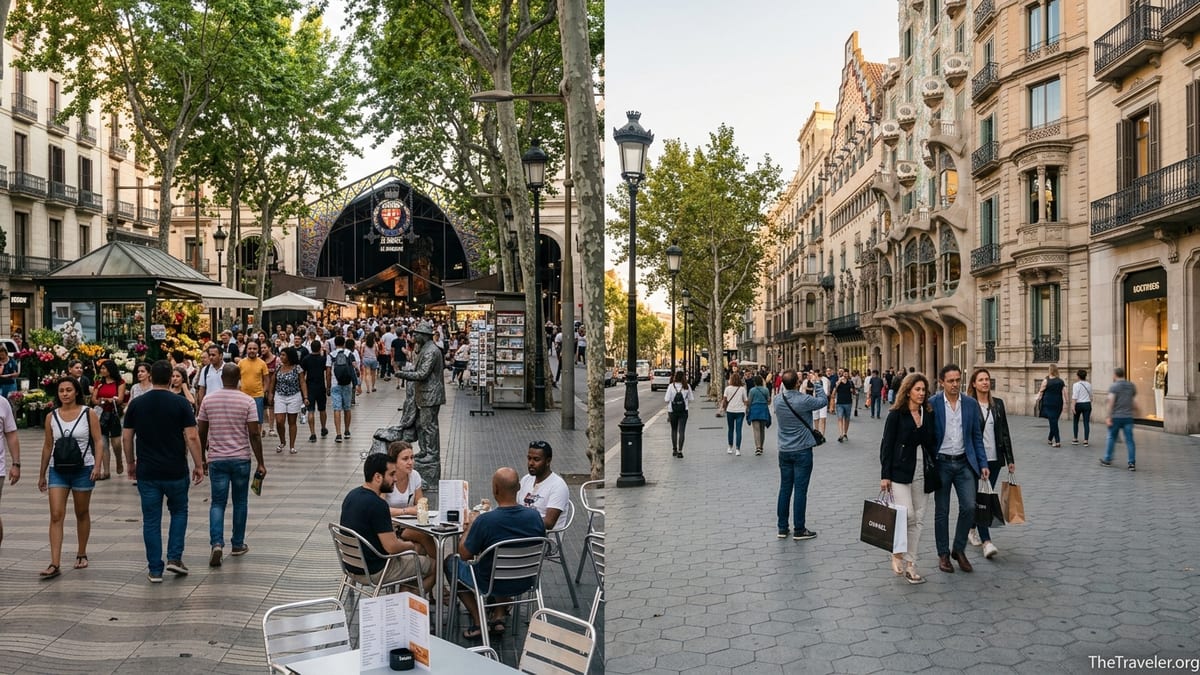
First Impressions: Carnival Energy or Composed Elegance
Walk out of Liceu metro station onto La Rambla and the first thing you notice is movement. Vendors hustle around their kiosks, visitors stop short to photograph human statues, and the constant murmur of different languages rises above the plane trees. Cafés spill onto the pavement near the Gran Teatre del Liceu opera house, and the entrance to La Boqueria market pulls you into a tunnel of hanging jamón, bright fruit smoothies, and seafood counters. La Rambla feels like a permanent festival, and for first time visitors that energy can be intoxicating.
By contrast, emerging from Passeig de Gràcia or Diagonal metro stations onto Passeig de Gràcia feels almost serene. The sidewalks here are broad, clean, and paved with Gaudí-designed hexagonal tiles. Traffic is busy but ordered, and the boulevard is framed by some of the most striking façades in Europe. Instead of souvenir kiosks, you see polished window displays from international brands and local designers. Even at peak times, the atmosphere is more measured. It is not that Passeig de Gràcia is empty, but the people here are mostly heading somewhere specific rather than roaming without a plan.
That initial contrast often sets the tone for how travelers remember each street. La Rambla tends to lodge in memory as chaotic, sometimes overwhelming, and very obviously tourist oriented. Passeig de Gràcia often leaves a quieter impression that grows stronger as you realize how much of Barcelona’s story is written into its architecture. The choice between them begins with asking yourself whether you are more drawn to the carnival or the gallery.
Architecture and Urban Drama: Gaudí vs the Gothic Edge
If you are visiting Barcelona for its architecture, Passeig de Gràcia almost always leaves the stronger mark. Two of Antoni Gaudí’s most celebrated works, Casa Batlló and Casa Milà (La Pedrera), sit just a short walk apart along this boulevard. Both offer interior visits that many travelers regard as highlights of their trip, with standard adult tickets for Casa Batlló typically in the low to mid 30 euro range depending on the time slot and extras, and La Pedrera a little lower. Standing on the sidewalk beneath Casa Batlló’s bone like balconies as the sun hits the iridescent tiles is one of those moments where Barcelona’s Modernista reputation makes immediate sense.
Passeig de Gràcia is not only about Gaudí. The so-called “Block of Discord” places Casa Batlló next to works by rivals Josep Puig i Cadafalch and Lluís Domènech i Montaner, creating a visual argument in stone and tile about whose version of Catalan modernity should win. Further up the avenue, elegant turn of the twentieth century apartment blocks mix ornate wrought iron balconies with carved stone doorways. The street lights, benches, and even the ventilation grilles for car parks are designed objects here, making a simple stroll feel like walking through an open air design museum.
La Rambla’s drama is less about façades and more about what spills onto the street. Architecturally, the most notable building along the main stretch is the Liceu opera house, whose interior can be visited on guided tours when performances are not scheduled. The mosaic by Joan Miró set into the pavement near the Liceu metro entrance adds a flash of modern art under your feet. But the most atmospheric settings tend to appear when you step off the main drag: the shadowy side streets of the Gothic Quarter on one side, and the Raval district’s tighter, livelier alleys on the other. As a result, many travelers remember La Rambla as a gateway corridor rather than an architectural destination in its own right.
Street Life, Markets, and Food Experiences
La Rambla’s most compelling real world experience is arguably Mercat de Sant Josep de la Boqueria, whose main entrance opens directly onto the boulevard. By late morning, locals with rolling carts weave around groups of visitors crowding the central aisle, where some stalls sell fresh produce by the kilo while others specialize in ready to eat options such as paper cones of fried calamari or cups of freshly cut mango. Prices here vary widely: a coffee at a bar tucked deep inside the market might still feel reasonable, while pre squeezed juices and fruit cups at the front lines often cost noticeably more than in neighborhood markets elsewhere in the city.
Food on La Rambla itself is hit or miss. Many of the terrace cafés lining the main strip advertise large jugs of sangria and multi language menus with paella photographs. A typical lunch of paella and a drink on the main drag can easily reach 20 to 25 euros per person, with quality that experienced travelers frequently describe as average at best. The smarter play is often to use La Rambla as a landmark, then slip a few streets east or west into the Gothic Quarter, Raval, or El Raval’s Sant Antoni edge, where you can still find menú del día lunches in the 14 to 18 euro range at restaurants catering more to locals and office workers than passing foot traffic.
Passeig de Gràcia’s food scene leans more upscale. Along the boulevard and its side streets, you will find sleek brasseries where a main course can easily cost 22 to 30 euros, cocktail bars attached to boutique hotels, and a scattering of Michelin starred restaurants within a fifteen minute walk. That said, you can still graze affordably around here by grabbing a pastry and coffee at a corner bakery on nearby Carrer de Provença or dipping into a tapas bar just off the main avenue. The mood is very different from the grab and go energy at La Boqueria, but for travelers interested in modern Catalan cuisine and design focused interiors, Passeig de Gràcia’s surroundings tend to resonate more deeply.
Shopping, Budgets, and Practical Costs
For many visitors, Passeig de Gràcia is synonymous with shopping. The boulevard hosts flagship stores from international luxury brands alongside midrange labels and prominent Spanish chains. Window shopping is free and often delightful, especially in the early evening when displays are lit and locals stroll home from work. If you are planning to invest in a statement piece, such as a designer handbag or a tailored outfit, this is where you will likely find it. Even if your budget is modest, browsing Spanish brands at midrange prices offers a tangible sense of the city’s fashion culture that you simply do not get from La Rambla’s souvenir kiosks.
La Rambla’s commerce is of a different kind. Newspaper stands, flower stalls, and tourist shops dominate the central stretch, selling everything from FC Barcelona scarves to fridge magnets. Prices for small souvenirs such as keychains and magnets can be a few euros more here than in side streets deeper into the Gothic Quarter, where fixed price souvenir shops often advertise lower rates. Street artists operating near Plaça de Catalunya or around the Columbus monument also sell portraits and caricatures, with prices negotiated on the spot. You are unlikely to make a major purchase on La Rambla, but you may come away with a handful of small mementos and a lighter wallet than you expected.
In terms of day to day practical costs, both boulevards are well connected to the city’s public transport network. A T casual transit ticket loaded on Barcelona’s smartcard system offers ten integrated journeys across metro, bus, and some commuter trains within zone 1 for around 13 euros in 2026, and a single metro ticket sits just under 3 euros. That means most visitors staying in central neighborhoods can reach La Rambla or Passeig de Gràcia for just over 1 euro per person per ride when using a multi trip card, keeping transit costs relatively low compared with food and attraction spending.
Safety, Scams, and Crowds
When you speak with Barcelona residents or frequent visitors, one of the first caveats they mention about La Rambla is pickpocketing. The combination of heavy foot traffic, distracted tourists, and frequent stops to take photos creates ideal conditions for opportunistic theft. Real world scenarios often involve crowded spots near metro entrances, street performances, or café terraces where bags are left on chairs or the ground. Wallets taken from open backpacks, phones lifted from back pockets, and small bags snatched from chair backs are recurring themes in anecdotal reports.
This does not mean you should avoid La Rambla altogether, but it does mean you should treat it like a large festival crowd. Keep valuables zipped inside a front worn bag, avoid placing phones or wallets on café tables, and be especially alert in clumps of people where your movement is restricted. Some travelers leave the boulevard feeling more stressed than enchanted simply because they spent so much time guarding their belongings.
Passeig de Gràcia feels noticeably calmer. The wide sidewalks and more evenly distributed foot traffic reduce the sense of compression, and many of the people around you are office workers, shoppers, and residents. Pickpocketing can occur anywhere that visitors gather, but on Passeig de Gràcia it tends to be less concentrated and often linked to classic distractions on metro platforms or near busy crossings. In practice, many visitors report feeling safer and more relaxed here, able to look up at façades and browse shop windows without constantly scanning for potential problems.
Which Street for Which Traveler
The real answer to which of these two Barcelona experiences leaves a bigger impression often depends on your travel personality. If you love high energy street life, do not mind crowds, and enjoy observing humanity in all its forms, La Rambla may well be unforgettable. For example, a traveler arriving on a weekend afternoon might watch a spontaneous crowd form around a busker outside Liceu, then duck into La Boqueria for oysters at a standing bar before heading down toward the Columbus monument. The colors, sounds, and constant motion will likely dominate that day’s travel diary.
On the other hand, a visitor fascinated by architecture and design may find Passeig de Gràcia far more powerful. Picture starting the morning with timed tickets for Casa Batlló, then wandering slowly up the boulevard, coffee in hand, noticing the variations in wrought iron balconies and carved stone doorways. After a leisurely lunch on a side street, you might visit La Pedrera in the late afternoon, watching the city’s grid unfold from its sculptural rooftop as the light softens. That sequence of experiences often becomes the emotional anchor of a Barcelona stay.
Families with young children sometimes lean toward Passeig de Gràcia simply because the pavements are easier to navigate with strollers and there is less sensory overload. Solo travelers on a tight budget may gravitate toward La Rambla as a free show, provided they are comfortable with the crowds and take basic precautions. Short stay city break visitors often find that combining both in a single day, perhaps with a siesta in between, offers an efficient way to understand two sides of central Barcelona’s personality.
How to Experience Both in One Day
For travelers with limited time, experiencing both La Rambla and Passeig de Gràcia in a thoughtful way can help decide which one leaves the stronger impression. A practical route starts in the late morning at Passeig de Gràcia. Book a mid morning Casa Batlló or La Pedrera visit so that you are inside during the brighter light, then take a slow stroll along the boulevard, crossing to whichever side has more shade. Stop for a coffee on a side street such as Carrer de Mallorca or Rosselló, where prices are often lower than directly on the main drag.
From the top of Passeig de Gràcia it is a direct walk downhill toward Plaça de Catalunya, which acts as a natural hinge between the two worlds. After a break on a bench or a quick detour into nearby streets of the Eixample for lunch, you can continue from the plaza straight onto La Rambla. Walking south, you will notice the demographics shift gradually from office workers and shoppers to tour groups and souvenir browsers.
Plan your La Rambla time with intention. For example, you might decide to head directly to La Boqueria for a short spin through the market, choosing one bar to sample a tapa and a glass of cava, then exiting through a side door into the Raval or Gothic Quarter rather than circling back out onto the main drag. If you want to see the street performers and kiosks more fully, loop back up La Rambla in the early evening, staying alert to your belongings as twilight brings even denser crowds.
The Takeaway
If you judged only by global name recognition, La Rambla might seem like the obvious answer to which Barcelona street leaves a bigger impression. In reality, many seasoned travelers and locals regard Passeig de Gràcia as the more deeply rewarding experience. Its combination of world class Modernista architecture, refined urban design, and layered local life often lingers longer in memory than La Rambla’s dense strip of tourist commerce.
That said, La Rambla still plays an important role in understanding Barcelona. It is the stage where the city presents itself most overtly to visitors and a convenient spine from which to access both the Gothic Quarter and Raval. Experiencing it with realistic expectations, firm grip on your valuables, and a willingness to detour into side streets can transform it from “tourist trap” to living theater.
In the end, the bigger impression may come from how you choose to use each boulevard. Treat Passeig de Gràcia as your open air museum and design corridor, and La Rambla as your noisy foyer to older, more textured neighborhoods. Approach them intentionally rather than reflexively and you will likely leave Barcelona not asking which is “better,” but appreciating how each one illuminates a different side of the same city.
FAQ
Q1. Is La Rambla still worth visiting if it is so touristy?
Yes, La Rambla is worth a visit if you treat it as a short experience rather than an all day destination. Walk a section of it, step into La Boqueria or the side streets, and then move on to nearby neighborhoods where prices and atmosphere feel more local.
Q2. Which is better for first time visitors, La Rambla or Passeig de Gràcia?
Most first time visitors benefit from seeing both, but if time is tight, Passeig de Gràcia often offers more lasting value thanks to Gaudí landmarks, elegant architecture, and calmer sidewalks.
Q3. Where should I stay if I want to be near both La Rambla and Passeig de Gràcia?
Areas around Plaça de Catalunya and the upper Gothic Quarter sit between the two boulevards, giving you an easy walk to both while also providing quick access to the metro and airport buses.
Q4. Is Passeig de Gràcia only for luxury travelers?
No. While it hosts many high end boutiques and hotels, the boulevard also includes midrange shops, cafés, and public architecture that can be enjoyed on any budget, even if you are only window shopping.
Q5. How much time should I budget for each street?
If you are only walking and people watching, 45 to 60 minutes is enough for each. If you plan to visit Casa Batlló or La Pedrera on Passeig de Gràcia, add at least 1.5 to 2 hours per building.
Q6. Which area feels safer for evening strolls?
Passeig de Gràcia generally feels more relaxed and less crowded at night, with many locals heading home or out to dinner. La Rambla remains busy and safe in terms of violent crime but requires extra care with belongings due to pickpockets.
Q7. Are there good budget food options near Passeig de Gràcia?
Yes. Step one or two blocks off the main boulevard onto streets like Carrer de Provença, Rosselló, or Diputació and you will find bakeries, tapas bars, and simple restaurants with prices closer to local norms.
Q8. Can I walk between Passeig de Gràcia and La Rambla easily?
Yes. It is roughly a ten to fifteen minute downhill walk from the heart of Passeig de Gràcia to Plaça de Catalunya and then directly onto La Rambla, making it simple to include both in one outing.
Q9. Which street is better for families with children?
Passeig de Gràcia usually suits families better because of its wider sidewalks, smoother surfaces for strollers, and lower level of crowding compared with La Rambla, especially in high season.
Q10. If I have to choose just one, which offers the more “authentic” Barcelona experience?
Authenticity is subjective, but many locals would point you to Passeig de Gràcia and its surrounding Eixample streets for a sense of everyday city life, while suggesting you treat La Rambla as a quick snapshot of Barcelona’s more theatrical side.