


Most people experience La Rambla as a single overcrowded ribbon of pavement: flower stalls, souvenir stands, pickpocket warnings, a quick photo at the mosaic and then on to the next sight. Stay on the central strip and you will confirm every cliché about Barcelona’s most famous street. Step just 30 seconds to either side, though, and a different city appears. This is where locals actually drink coffee, where Gaudí built a townhouse for a friend, where chocolate has been poured thick into ceramic cups for almost a century. The secret to enjoying La Rambla is not leaving it behind, but learning how to slip off it.
Get the latest updates straight to your inbox!
Why La Rambla’s Side Streets Matter More Than the Main Walk
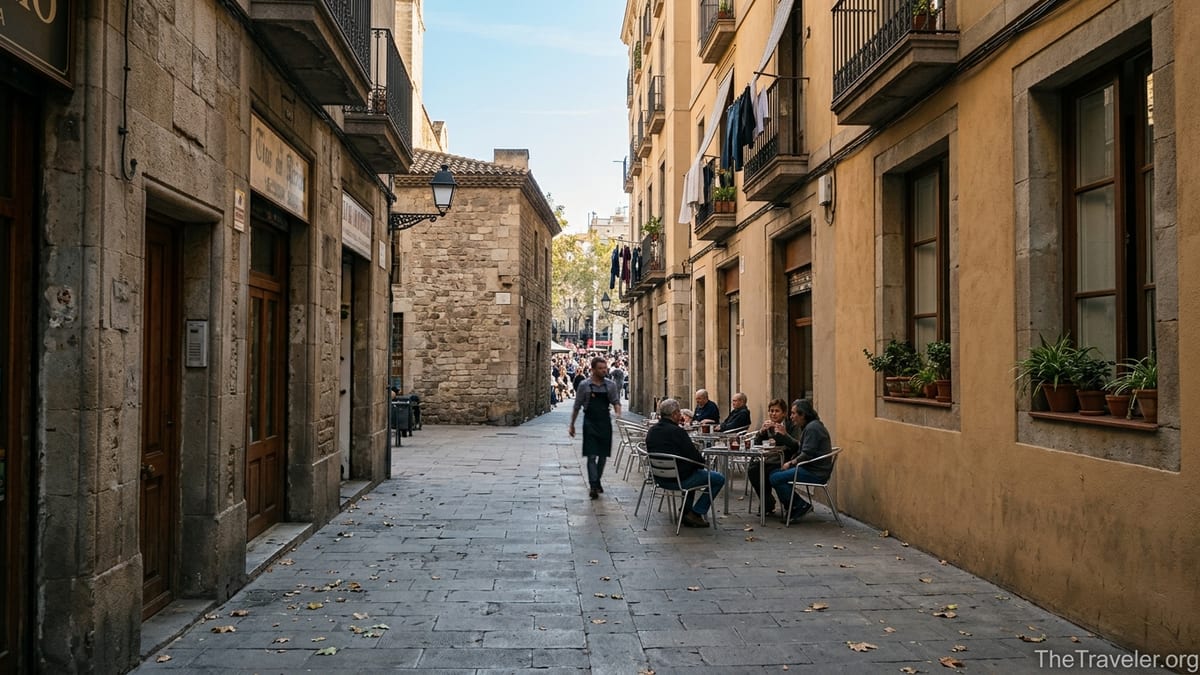
The modern reputation of La Rambla is mixed. It remains a must-see boulevard, but it is also one of Barcelona’s most touristy strips, lined with expensive terraces and menus translated into half a dozen languages. What many visitors do not realize is that La Rambla is also the seam between two very different historic districts: the Gothic Quarter to the east and El Raval to the west. Each side is a maze of short streets, passages and little squares that most people never explore. In practice, this means that by walking just a minute or two away from the central promenade, you can trade inflated terrace prices for normal local cafés, swap chain souvenir shops for small businesses, and hear Catalan and Spanish instead of a constant buzz of visitor languages.
From Plaça de Catalunya at the top to the Columbus monument at the bottom, dozens of narrow streets radiate away from La Rambla like the teeth of a comb. These side streets are short, often less than a block long, and many look unremarkable at first glance. Yet behind the first row of souvenir shops you find small bookstores, long-established pastry shops, neighborhood bars where a glass of vermut still costs roughly what a soft drink costs on the main drag, and residential buildings whose balconies are draped with laundry instead of flags of FC Barcelona for sale. Treat La Rambla as the spine of a neighborhood walk, not the destination itself, and the experience shifts completely.
The practical payoff is significant. A coffee at a table directly on La Rambla can easily cost double what you pay one or two streets back from the promenade. Dinner for two at a restaurant on a side street in El Raval or the Gothic Quarter can come in at a reasonable neighborhood price, compared with the set menus pitched aggressively to passersby on the central strip. For budget-conscious travelers, using the main walkway simply as an orientation line, and planning actual stops a block or two away, is one of the simplest ways to keep daily costs under control.
Slip Into Plaça Reial and Its Hidden Passages
One of the easiest side steps off La Rambla is also one of the most overlooked: Plaça Reial. Many visitors notice an archway near the Liceu opera house and keep walking, unaware that it opens into a full 19th century square lined with palm trees. Enter through one of the short passages, such as the elegant Passatge de Bacardí, and the atmosphere changes immediately. Instead of the continuous flow of pedestrians, you find an enclosed plaza with colonnades, decorative lampposts designed in Gaudí’s early career, and a ring of bars and restaurants that come alive at night.
Plaça Reial is not exactly a secret to Barcelonans. It is a meeting point, especially for night owls, thanks to venues like Sidecar and Jamboree around the square. Yet visitors often treat it as an incidental detour rather than a place to linger. Arrive late in the afternoon, when the sun drops behind the surrounding buildings, and order a drink under the arcades. Prices here can still be higher than in residential neighborhoods, but they tend to be more reasonable than the top tier terraces directly on La Rambla. On weekend mornings, small markets and collectors’ gatherings add another layer of local life, with traders swapping stamps or coins under the palm fronds.
If you walk through Passatge de Bacardí itself, take a moment to look up. This mid-19th century passage was built to connect La Rambla with the then-new square and still preserves its decorative ironwork, glass, and period detailing. It is a snapshot of an era when covered passages were fashionable urban shortcuts. Many pass straight through with their eyes on their phones. If you pause mid-passage, you can frame a photograph that captures the contrast between the bustle of La Rambla at one end and the calm geometry of the square at the other.
West into El Raval: Rambla del Raval, Botero’s Cat and Real-World Barcelona
On the western side of La Rambla, El Raval has long carried a reputation as the rougher, edgier neighbor. Today it is a densely populated, multicultural district that still feels far more like a real working neighborhood than a curated historic set. From the main La Rambla, you can cut in via streets like Carrer de Sant Pau or Carrer del Carme and quickly reach Rambla del Raval, a broad boulevard that functions almost like a local version of the famous promenade. Here, café terraces are filled with residents, students and workers rather than tour groups. Prices for a simple menú del día at local eateries are usually noticeably lower than along the central strip.
Rambla del Raval is also home to one of Barcelona’s most photographed pieces of modern public art, the massive bronze cat by Colombian artist Fernando Botero. Families use its paws as a climbing frame; locals arrange to meet “next to the cat” almost as often as visitors pose on it. Standing beside the sculpture provides an instructive comparison with the main La Rambla: while both spaces are lined with palm trees, Rambla del Raval has a slower, more neighborly rhythm, with kids riding scooters and elderly residents parked on benches discussing local politics or football results.
El Raval’s food scene rewards curiosity. A short walk from La Rambla takes you to informal tapas bars like Bar Mendizábal, an old-fashioned stand-up counter on the edge of the neighborhood, or to small international eateries reflecting the area’s South Asian and Middle Eastern communities. Around the Boqueria market, which technically sits on the Raval side of La Rambla, side streets such as Carrer de Jerusalem and Carrer del Carme hide places where chefs stop in for a quick lunch after the morning market run. Some of these kitchens have attracted attention in recent years for quality and value, but they still feel grounded in everyday city life rather than in the tourist economy.
As in any dense urban neighborhood, especially one that has undergone rapid change, it pays to use common sense. Pickpocketing and petty theft are more common around the main tourist arteries than deeper into the residential grid, but you should keep an eye on your bag when sitting at outdoor tables and avoid drifting into unlit alleys very late at night. Visit during the day to get a feel for the streets, then decide where you might want to come back for dinner or drinks. For many travelers, El Raval ends up being the place where the clichés about La Rambla dissolve into a much more complex and interesting picture of Barcelona.
Gaudí in the Shadows: Discovering Palau Güell on Nou de la Rambla
While visitors queue across town for Park Güell and gaze up at the façades of Casa Batlló, one of Antoni Gaudí’s most intriguing works sits almost unnoticed a few minutes from La Rambla. Palau Güell stands on Carrer Nou de la Rambla, just off the lower section of the main boulevard. From the street, its heavy stone façade and twin parabolic archways look almost severe, especially compared with Gaudí’s later, more colorful works. Step inside, however, and you enter the private city palace that industrialist Eusebi Güell commissioned from the architect in the late 19th century, now recognized as a World Heritage site.
The palace was carefully restored and today operates as a museum, with timed entry slots and a route that winds from the ground-floor carriage space up to the rooftop chimneys. Standard tickets are typically priced competitively compared with Gaudí’s more famous sites. Audio guides are available in multiple languages, and there are often discounts for younger visitors, seniors or combined family tickets. Because Palau Güell is slightly off the standard Gaudí circuit, visiting earlier in the day or later in the afternoon can mean far fewer crowds than at the major houses along Passeig de Gràcia.
The interior is a showcase of early Gaudí experimentation: a lofty central hall pierced with tiny openings to create the effect of a starry night when lit from above, an intricate blend of stone, wood and wrought iron, and a rooftop forest of chimneys clad in colored tiles. From the terraces you can look back toward La Rambla, hearing its noise at a distance while standing in a space that feels deliberately introspective. For travelers already planning to walk La Rambla, adding Palau Güell to the route is one of the simplest ways to take the day beyond the obvious and engage directly with Catalan modernisme without crossing half the city.
Even if you choose not to tour the interior, the walk along Nou de la Rambla itself is instructive. This side street shows a cross-section of the area: a mix of residential buildings, small shops, simple bars where you can order a coffee for a fraction of La Rambla’s prices, and the occasional hotel lobby. It is a reminder that the famous promenade is also a real address for thousands of people, and that architectural masterpieces can hide in plain sight on what looks from the main drag like just another narrow street.
East into the Gothic Quarter: Quiet Plaças and Literary Corners
On the eastern side of La Rambla, the Gothic Quarter folds around the old Roman and medieval core of the city. At first glance this can feel just as touristed as the main boulevard, especially along streets that lead directly to the cathedral. Yet here too, stepping off the obvious routes brings you into quieter squares and corners where the city’s daily rhythms still show. Beginning from La Rambla, streets like Carrer del Cardenal Casañas and Carrer del Pi funnel you toward a cluster of small plazas dominated by stone churches and lined with cafés more likely to be frequented by residents of the district than by excursion groups.
Plaça del Pi, for example, opens unexpectedly after one of these side streets, anchored by the church of Santa Maria del Pi and a towering pine tree that gives the square its name. In the mornings, you may find small artisan or food markets set up under simple tents; in the evenings, neighbors linger at café tables around the square’s perimeter. The atmosphere is very different from the constant movement on La Rambla. Instead of street performers and organized human statues, the entertainment might simply be children playing around the church steps while parents talk over glasses of wine.
Another often overlooked institution just a short walk off La Rambla is the Ateneu Barcelonès, a historic private cultural center tucked behind a relatively plain entrance near Carrer de Canuda. Non-members can sometimes access its ground-floor spaces during cultural events or exhibitions, while the building’s courtyard and interior library remain a quiet world away from the bustle outside. Even if you do not go inside, noticing the entrance and the stream of locals disappearing through its doors is a reminder that the Gothic Quarter is still a living intellectual and residential district, not just a historic backdrop.
Between these sites, keep an eye on the ground and the walls. Small plaques, street-level sculptural details and old shop signs record episodes of literary and political history that rarely make it into quick visitor briefings. Guided literary walks organized by local groups sometimes trace paths that begin on La Rambla and then weave through this part of the Gothic Quarter, illustrating how writers have used the boulevard as both setting and symbol while actually situating much of their action in the denser side streets where real life unfolds.
Sweet Detours: Carrer de Petritxol and the World of Granges
For many Barcelona residents, the words “La Rambla” and “chocolate” are linked not to any stall on the main boulevard, but to Carrer de Petritxol, a narrow pedestrian lane a few minutes’ walk into the Gothic Quarter. This short street has long been associated with small art galleries and with granges, traditional dairies turned chocolate cafés. In cooler months, locals slip away from the crowds, choose a table in places like Granja Dulcinea or La Pallaresa, and order a cup of thick hot chocolate with churros or melindros, the light Catalan sponge fingers meant for dipping.
Prices here reflect the street’s popularity, especially on weekends, but a classic hot chocolate with churros still tends to cost less than many of the elaborate desserts marketed along the main La Rambla terraces. More importantly, the experience feels rooted in local habit rather than in passing trade. Elderly regulars share tables with families and students; the walls are often lined with old photographs and tiled inscriptions that tell bits of the street’s story. For visitors, this offers not just a sweet break but a small window into Barcelona’s café culture beyond fashionable espresso bars.
Carrer de Petritxol is also a reminder that some of the city’s most atmospheric streets are not wide, grand avenues but narrow corridors where two people can almost touch hands from opposite balconies. Noise from La Rambla fades quickly here, replaced by the clink of cups and the muffled sounds of televisions from upstairs apartments. Many tourists walk within a block of this lane without ever turning the corner. Making the deliberate choice to seek it out transforms a standard Gothic Quarter stroll into a more intimate encounter with local routines.
If you are concerned about timing, consider visiting either in the late morning, when queues for tables are often short, or in the late afternoon before the early evening rush. During the peak of the day in high season, waits for a table can form outside the most famous granges. Even then, stepping into the street and watching locals greet each other or examine gallery windows can be more rewarding than yet another photo of the central promenade.
Everyday Life Behind the Market: Beyond La Boqueria’s Front Stalls
Mercat de Sant Josep de la Boqueria, universally known as La Boqueria, is one of La Rambla’s unavoidable magnets. Many visitors stop at the colorful fruit juice stands and photo-perfect displays directly inside the main entrance, then leave convinced they have seen the market. In reality, what you encounter in those first few meters is only the most photogenic band of a functioning wholesale and retail space that serves both restaurants and households across the city. To see something closer to everyday market life, you need to step past the initial corridor and explore the interior aisles.
Here you find permanent stalls specializing in fresh fish, offal, seasonal vegetables and dried fruits, as well as small counters where locals stop for a quick breakfast or mid-morning snack. Prices for produce and cured meats deeper inside the market tend to be more aligned with what residents pay in other municipal markets, while the front displays often target one-off purchases from tourists. Early morning, when chefs are doing their rounds and the market is still waking up, offers the sharpest contrast with the more theatrical atmosphere later in the day.
Walk out of the back or side exits and you are immediately in ordinary streets of El Raval or the lower Gothic Quarter, where grocery shops, butchers and bakeries continue the supply chain in a quieter key. On Carrer del Carme or Carrer de l’Hospital, you might stop in a small bakery for a simple sandwich or ensaïmada at a price that would barely cover a bottled drink on La Rambla. For travelers staying in apartments rather than hotels, buying ingredients here and cooking at home can be both economical and a way to participate modestly in local rhythms.
It is worth remembering that La Boqueria is not a theme park, even if it can feel like one at peak hours. Vendors rely on local trade as well as visitors, and the municipal authorities have in recent years encouraged a balance between tourism and daily use. Being aware of this, avoiding blocking narrow aisles for photos when people are shopping, and choosing to spend money at stalls that clearly serve regulars are simple ways to turn a quick market visit into a more respectful and enriching experience.
The Takeaway
Experiencing La Rambla only along its central strip is like reading the first page of a novel and stopping there. The boulevard’s global fame rests as much on the dense neighborhoods that press in on either side as on the plane trees and flower stalls themselves. Within a five-minute walk of any point on La Rambla you can reach a Gaudí palace, a grange that has been serving chocolate for generations, a local rambla where a bronze cat is part of the city’s everyday vocabulary, and quiet squares where the soundtrack is church bells rather than buskers’ amplifiers.
For travelers, the practical strategy is simple. Use La Rambla as your guide rope, not your goal. Plan your coffee breaks, meals and cultural visits on the side streets that branch away from it. Notice passages like Bacardí, squares like Plaça Reial and Plaça del Pi, markets beyond their photogenic entrances, and side lanes like Carrer de Petritxol that condense more local habit into a hundred meters than the entire central strip manages in a kilometer. In doing so, you not only spend more time and money in places that sustain the city’s everyday life, you also discover a Barcelona that feels infinitely more textured than the clichés suggest.
FAQ
Q1. Is it safe to explore the side streets off La Rambla?
Yes, in daytime and early evening the main side streets into El Raval and the Gothic Quarter are generally safe, provided you use normal big-city awareness. Keep valuables secure, avoid very dark or deserted alleys late at night, and follow your instincts if a street feels uncomfortable.
Q2. How far do I need to walk from La Rambla to find less touristy areas?
Often no more than a minute or two. Squares like Plaça Reial, Plaça del Pi and boulevards like Rambla del Raval are all only a short walk from the main promenade, but feel noticeably calmer and more local.
Q3. Are prices really cheaper just off the main walkway?
In most cases, yes. A coffee or drink at a side-street café or bar is usually significantly cheaper than on La Rambla’s front-row terraces, and fixed-price lunch menus away from the main strip tend to offer better value.
Q4. When is the best time to visit Palau Güell near La Rambla?
Visiting in the late morning or mid-afternoon often means fewer crowds than at peak opening or just after lunch. Booking a timed ticket in advance can help you avoid waiting at the entrance, especially in high season.
Q5. How can I experience La Boqueria market beyond the tourist stalls?
Arrive early in the morning, walk past the first row of colorful juice and fruit stands, and explore the interior aisles where locals shop. Look for small counters with mostly Spanish or Catalan being spoken; these are often the places serving everyday breakfasts to regulars.
Q6. What is special about Carrer de Petritxol near La Rambla?
Carrer de Petritxol is a narrow lane known for its traditional chocolate cafés, or granges, and small galleries. It offers a classic local experience: thick hot chocolate with churros in century-old interiors only a short walk from the main boulevard.
Q7. Is El Raval suitable for an evening out if I am staying near La Rambla?
Yes, many travelers enjoy evenings in El Raval, especially around Rambla del Raval and the streets near the Boqueria. Stick to well-lit routes, keep an eye on your belongings, and consider taking a taxi or rideshare back to your accommodation if you are returning very late.
Q8. Can I see interesting architecture off La Rambla without leaving the area?
Absolutely. Beyond the central walkway you have Gaudí’s Palau Güell on Nou de la Rambla, the arcades and lampposts of Plaça Reial, and Gothic churches like Santa Maria del Pi, all reachable within a few minutes on foot.
Q9. Are there good budget food options near La Rambla that locals actually use?
Yes. Streets in El Raval and the lower Gothic Quarter, especially around La Boqueria and Rambla del Raval, have small tapas bars, bakeries and international eateries where prices and menus cater primarily to residents rather than visitors.
Q10. How can I avoid the worst of the crowds on La Rambla itself?
Walk early in the morning or later in the evening, use the side lanes running roughly parallel to the main strip, and treat La Rambla as a crossing point rather than a place to linger. Duck into nearby squares and streets whenever the flow of people feels overwhelming.