


I landed in Barcelona with a picture in my head of La Rambla as a leafy boulevard where locals lingered over cortados and street performers added a touch of whimsy to an elegant historic avenue. What I actually found was something louder, more crowded, more commercial, and yet, in fleeting moments, surprisingly human. My visit to La Rambla was very different from what I expected, and that gap between dream and reality is worth unpacking for anyone planning a first stroll down Barcelona’s most famous street.
Get the latest updates straight to your inbox!
Expecting Movie-Set Europe, Meeting a Real, Messy Artery
On paper, La Rambla promised a postcard. A 1.2 kilometre pedestrian boulevard between Plaça de Catalunya and the Columbus Monument, lined with plane trees and historic buildings, it is often described as the city’s “living room.” I imagined relaxed crowds, discreet cafes with hand-written menus in Catalan, and a soft Mediterranean breeze drifting across polished stone. Walking out of the metro at Catalunya and stepping onto the top of La Rambla, the first thing that hit me was not the architecture but the noise. Rolling suitcase wheels, clinking terrace glasses, buskers’ speakers, flower sellers calling out, and the constant murmur of multiple languages layered into a single roar.
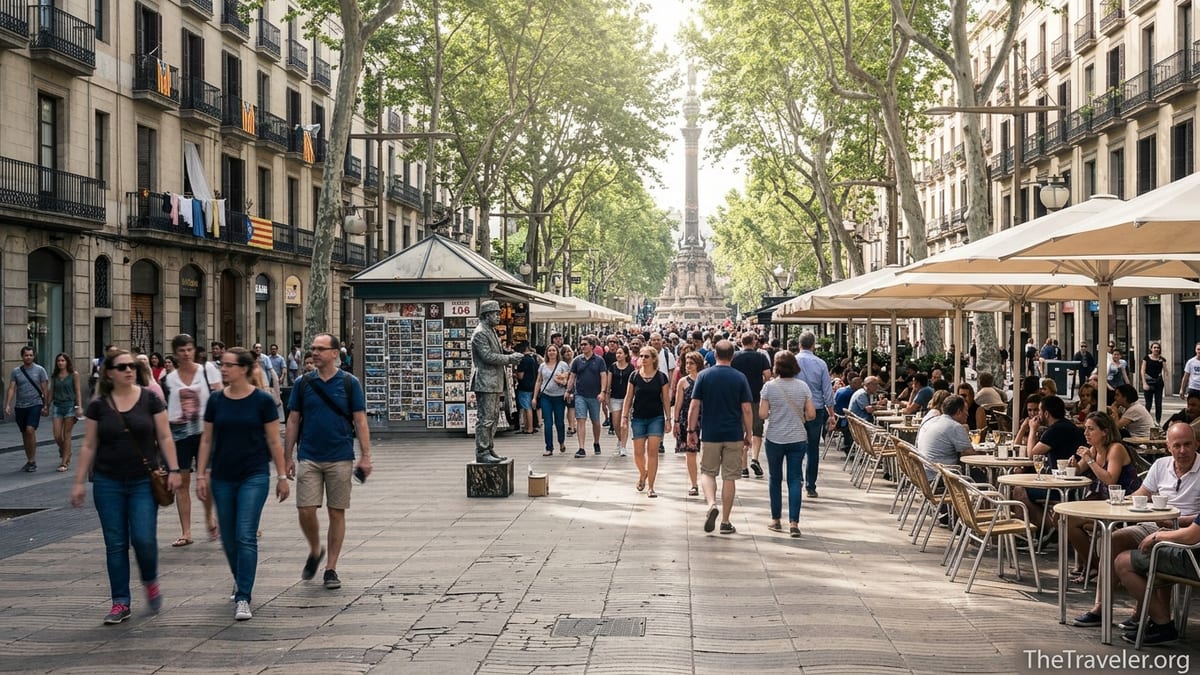
The density was the second shock. On a late spring afternoon, the central promenade felt more like the queue for a music festival than a casual promenade. Families stopped abruptly to take photos of human statues, TikTokers filmed in the middle of the walkway, and tour groups bunched around raised umbrellas. Rather than strolling, everyone seemed to be negotiating space. I had expected charm; I got crowd management. It was not unpleasant exactly, but it was a far cry from the slow, romantic “ramble” I had pictured.
Only when I stepped to the edges, towards the curb and the side streets, did the bones of the street start to appear. Glimpses of tiled entrance halls, old-fashioned newspaper kiosks, and balconies with laundry and Catalan flags reminded me that this was still a real city artery. La Rambla was not a museum piece or a film set; it was a space where tourism, commerce, and everyday life collided, sometimes gracefully and sometimes awkwardly.
The Terrace Culture I Imagined vs the One I Found
Before arriving, I was convinced that the ultimate La Rambla experience would be to sit at a terrace café, order a coffee or a glass of cava, and watch the city go by. In my mind, these terraces were the domain of locals who had “their” tables and waiters who knew regulars by name. In reality, almost every terrace I saw on the main stretch seemed calibrated for short-stay visitors. Multilingual menus featured laminated photographs of paella, sangria by the litre, and “English breakfast” plates, with prices that would make most Barcelonians wince.
In April 2026, Barcelona’s city council announced a new design code that standardises La Rambla’s terraces, setting caps on the number of tables and requiring cream and neutral-toned parasols to give the boulevard a more coherent, higher-quality look. The day I visited, you could already see this shift taking shape: rows of similar-looking beige umbrellas, neatly aligned chairs, and fewer large advertising boards than older photos of La Rambla might suggest. Aesthetically, it did make the street feel tidier and more intentional. Financially, however, it was still very much a tourist economy. A simple cortado could run around 3 euros or more, a glass of sangria 8 euros or higher, and “menu del día” signs hovered in the mid-teens to low twenties per person, noticeably above what you might pay a ten-minute walk away in Sant Antoni or Poble-sec.
When I did decide to sit for a drink, it was less for the culinary value and more for the view. My waiter switched easily between English, French, and Italian within a single minute as he moved from table to table. At one point he laughed and told me bluntly that most locals did not use these terraces except to meet visiting friends. He pointed across La Rambla towards a narrow street in the Gothic Quarter and suggested I wander there later if I wanted somewhere “where people argue in Catalan about the football.” His honesty was refreshing and underscored a key truth: the terraces on La Rambla are part of the spectacle. If you accept that you are paying for a front-row seat to the show rather than an authentic slice of everyday Barcelona, the shock softens.
The Tourist Traps I Expected, and the Ones I Did Not See Coming
Guidebooks and blogs warn repeatedly that La Rambla is packed with tourist traps, and they are right. I thought I knew what that meant: overpriced paella frozen in the middle, aggressively coloured cocktails, souvenir shops selling identical magnets and flamenco dresses. All of that is there, and it is easy enough to spot. Restaurants tout paella “for two” at prices that would easily feed three people elsewhere, and many menus lean heavily on imagery rather than ingredients. Several local guides actively recommend skipping paella on La Rambla altogether and heading to neighbourhoods like Barceloneta or Poblenou if you want rice cooked in proper stock and served with some pride.
What surprised me more were the subtle traps, the ones that did not feel like scams but still left a sour taste. For example, I watched several people sit for what they thought would be a quick drink only to discover a 2 or 3 euro “terrace supplement” per person added to the bill. Others ordered the cheaper house sangria listed on the menu and received a larger, more expensive version automatically poured into a more dramatic glass. None of this was illegal or shocking by big-city standards, but it reinforced that along La Rambla you need to read menus carefully and ask specifically for what you want.
Then there are the experiences that seem novel at first glance but are more about separating tourists from their money than showcasing anything uniquely Barcelonian. Wax museums, small “experiences” lit in neon, and a well-known erotic museum all advertise themselves loudly along the street. Many locals I later spoke with dismissed these as pure tourist bait, rarely visited by residents. Even La Boqueria market, just off La Rambla, divides opinion: for some it is a must-visit food hall; for others it has become a stage-managed spectacle of colourful fruit cups and smoothie stands that mask a steady displacement of everyday grocery stalls.
The Reality of Crowds and Safety on La Rambla
Before my trip, I kept reading that Barcelona is one of the pickpocket capitals of Europe and that La Rambla is a focal point. Online forums are filled with stories of stolen phones and wallets, but also with locals and repeat visitors insisting that the reputation is exaggerated, provided you take basic precautions. Walking the boulevard myself, I found a middle ground between those extremes. At peak times, especially in the late afternoon and early evening, the crowd density makes opportunistic theft a realistic risk. People stop impulsively to watch living statues or buskers, backpacks dangle unzipped, and phones appear constantly for selfies.
During one twenty-minute stretch near the Liceu metro entrance, I saw three separate clusters of people arguing with each other and gesturing at bags and pockets. Whether these were actual theft attempts or just misunderstandings is impossible to know, but the nervous energy was visible. At the same time, I noticed a steady presence of uniformed and plainclothes police watching the central promenade and occasionally speaking with groups that seemed to be lingering without purpose. Several long-time residents in online discussions mention that regular civic patrols and a wave of social media exposure of pickpockets have slightly changed how thieves operate, pushing some further into the metro system and side streets while still keeping La Rambla high on their list of targets.
For me, simple measures turned concern into awareness rather than anxiety. I kept my wallet and phone in front pockets, wore a crossbody bag clipped in front, and avoided walking the boulevard late at night after bars closed. I did not bring my passport, wore no flashy watch, and rarely checked maps in the middle of the sidewalk. As a result, I never felt unsafe, just alert. The most uncomfortable moment came not from crime but from aggressive street vendors who tried repeatedly to drape bracelets over my wrist as a “gift” and then insisted on payment. It is an old trick in many European cities, but it catches tired travellers off guard. Saying a firm no and continuing to walk was enough to disengage.
Moments of Authenticity Hidden Between the Souvenir Stands
With so much attention focused on the worst of La Rambla, it is easy to miss the quieter, more authentic layers that survive between the tourist-focused storefronts. One of the most unexpected pleasures of my visit was wandering into the side passages and small squares that branch off the main boulevard. A few metres away from the buskers and souvenir stalls, the sound shifts noticeably. You start to hear the clatter of plates from traditional bars, snippets of Catalan conversations, and the low rumble of delivery vans.
Near the Liceu opera house, I ducked into a narrow side street almost at random and found a tiny bakery where the day’s special was a warm coca de recapte, a savoury flatbread topped with roasted peppers and anchovies. The total for a generous slice and a coffee was roughly what a bottled soft drink would have cost at one of the main La Rambla kiosks. At another corner, a small stationery shop with old wooden drawers and dusty postcards looked like it had survived multiple cycles of gentrification through sheer stubbornness. The owner chatted fondly about how La Rambla once hosted more everyday businesses before souvenir kiosks multiplied to match visitor numbers.
Even along the central strip, there were moments when the street felt less like a theme park and more like a civic stage. A group of older locals debated politics at the edge of a terrace, barely glancing up at the passing tourist river. A busker played Catalan folk songs rather than the global playlist of Despacito and Ed Sheeran covers. A child chased pigeons across the tiled pavement near a famous mosaic by Joan Miró, oblivious to the smartphones documenting everything. These flashes did not erase the commercialisation but they complicated the simple narrative of La Rambla as “only” a tourist trap.
How the City Is Trying to Recalibrate La Rambla
One of the things that shifted my perception was learning more about how seriously Barcelona is trying to manage La Rambla’s future. After years of complaints from residents about overcrowding and the street feeling like a “theme park,” the city approved a comprehensive redevelopment project aiming to make the promenade more walkable, greener, and more oriented towards locals as well as visitors. The plan, being implemented in phases, includes widening sidewalks, adding trees and benches, reconfiguring traffic, and tightening regulations on which kinds of businesses can operate at street level.
Recent measures around terraces are part of this larger push. By limiting the number of tables, recapturing some of the central space for pedestrians, and standardising furniture and parasols, the council hopes to reduce visual clutter and create a calmer, less chaotic landscape. The idea is that a coherent aesthetic, combined with stricter licensing rules, will attract higher-quality establishments over time rather than rows of interchangeable “same menu, different sign” restaurants. Whether that happens will depend on how enforcement plays out and how economic pressures influence landlords, but the ambition is clearly to move away from a purely mass-tourism model.
Locals remain divided on whether these efforts go far enough. Some celebrate any move that reins in what they see as an uncontrolled tourism machine. Others worry that regulations focused on appearances do little to address deeper issues like rising rents, the closure of long-standing independent shops, and the loss of neighbourhood identity. As a visitor, I sensed both hope and fatigue. Taxi drivers, baristas, and guides spoke of wanting tourists who were more curious and respectful, who might step off La Rambla to discover other districts instead of spending their entire stay on a single axis between the port and Plaça de Catalunya.
The Takeaway
Walking La Rambla for the first time was disorienting precisely because of how deeply I had absorbed its romantic image before arrival. I expected an elegant promenade and found a crowded funnel of global tourism, complete with inflated prices, hard-selling waiters, and a constant low-level worry about my pockets. I expected casual authenticity and found that the most visible layers of the street are engineered around short-term visitors like me. Yet the story did not end there. When I stepped sideways into quieter alleys, looked up at balconies rather than only at menus, and listened to the mix of languages around me, a more complex La Rambla emerged.
If you visit Barcelona, I would not tell you to avoid La Rambla entirely. It still serves as a spine connecting key parts of the historic centre, and its energy, for better and worse, says a lot about how modern cities grapple with mass tourism. My advice would be to walk it once with clear eyes: accept that terrace prices will be higher, that some attractions are pure tourist bait, and that you must keep an eye on your belongings. Use the boulevard as a gateway rather than a destination. Duck into local bakeries, explore the Raval and Gothic Quarter backstreets, and seek out markets and plazas where life unfolds at a less choreographed pace.
Most of all, do not feel disappointed if your visit is very different from what you expected. In that gap between fantasy and reality lies a valuable lesson about travel: cities are not built to fulfill our postcards. They are living, changing places with tensions, compromises, and the push and pull of residents’ needs against global demand. La Rambla may not be the dreamy European boulevard of your imagination, but it is a revealing mirror of our time, and walking it with intention can teach you as much about yourself as it does about Barcelona.
FAQ
Q1. Is La Rambla still worth visiting on a first trip to Barcelona?
Yes, La Rambla is worth walking at least once because it connects key parts of the historic centre and gives you a sense of Barcelona’s scale, energy, and current tourism reality. Treat it as a starting point rather than the main focus of your itinerary, and plan to spend more time exploring nearby neighbourhoods like El Raval, the Gothic Quarter, and El Born.
Q2. How bad is pickpocketing on La Rambla, really?
Pickpocketing on La Rambla is a genuine risk, especially in crowded areas near metro stations, buskers, and terraces, but it is not inevitable. If you keep valuables in front pockets or a crossbody bag, avoid displaying expensive watches or large cameras carelessly, and stay alert in dense crowds and on the metro, your chances of being targeted drop sharply.
Q3. Are the restaurants on La Rambla a total tourist trap?
Many La Rambla restaurants cater almost exclusively to tourists, with higher prices and average quality, so you should be selective. It is fine to sit for a drink if you accept the premium for the view, but for better food and value, step a few streets back into El Raval, the Gothic Quarter, or other neighbourhoods where locals actually eat.
Q4. What time of day is best for walking La Rambla?
Late morning on a weekday usually offers a better balance between atmosphere and space, before the peak afternoon and evening crowds arrive. Early evening can be lively and photogenic, but expect tighter crowds and more street performers, which may increase the risk of petty theft and make the walk feel more hectic.
Q5. Is La Rambla safe at night?
La Rambla is generally busy and well-lit in the evening, but late at night, especially after bars close, the mood can change with more intoxicated crowds and occasional petty crime. If you want to walk it after dark, stay on the main promenade, avoid deserted side streets, keep valuables secured, and consider using a taxi or rideshare rather than walking long distances very late.
Q6. How expensive are drinks and meals on La Rambla compared to the rest of Barcelona?
Prices on La Rambla are typically higher than in more local areas, with coffee, soft drinks, and sangria often costing noticeably more than a few blocks away. A basic sit-down meal on the boulevard can easily cost several euros more per person than in neighbourhoods like Sant Antoni or Gràcia, where you will usually find better quality for the price.
Q7. Where can I find a more local atmosphere near La Rambla?
If you step just a few minutes off the main boulevard, you can quickly reach streets in El Raval and the Gothic Quarter that feel more local. Look for small bakeries, traditional bars, and family-run shops on side streets rather than the heavily branded terraces facing La Rambla itself, and you will hear more Catalan and Spanish and fewer megaphone tour guides.
Q8. Has the city done anything to improve La Rambla in recent years?
Yes, Barcelona has launched a multi-year redevelopment of La Rambla aimed at widening sidewalks, adding greenery, and regulating terraces and street furniture more strictly. The goal is to recover some public space for pedestrians, improve the visual quality of terraces, and gradually shift the street away from a purely mass-tourism model toward a more balanced mix of residents and visitors.
Q9. How long does it take to walk the full length of La Rambla?
The main stretch of La Rambla is about 1.2 kilometres long, so walking it without stops takes roughly 15 to 20 minutes at a relaxed pace. In practice, you will likely spend 30 to 60 minutes or more if you pause for photos, visit side streets, or stop at a café, especially during busier times of day.
Q10. What is the best way to enjoy La Rambla without feeling overwhelmed?
Approach La Rambla with clear expectations: it is busy, commercial, and geared toward tourists, but it also offers snapshots of real city life if you look beyond the surface. Walk it once, keep your belongings secure, avoid making it your main dining destination, and use it as a jumping-off point to discover nearby markets, plazas, and neighbourhoods where Barcelona’s daily rhythm is easier to feel.