


More news on this day
New York’s LaGuardia Airport is warning travelers to expect significant delays and cancellations after a sinkhole discovered near one of its two runways forced an abrupt shutdown and prompted emergency repair work on Wednesday.
Get the latest news straight to your inbox!
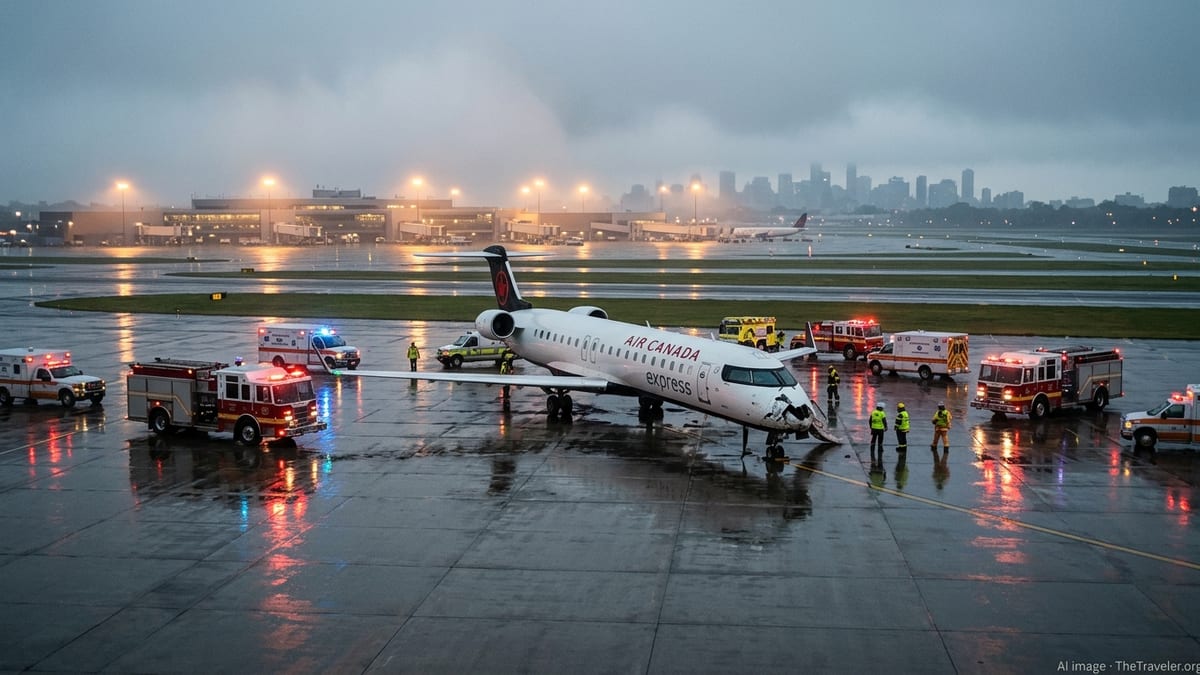
Runway 4/22 Closed After Morning Inspection
Publicly available information indicates that airfield crews identified the sinkhole late Wednesday morning during a routine inspection of LaGuardia’s operating surfaces. The affected area is located near Runway 4/22, one of only two runways at the Queens airport, which means even a partial closure has an immediate impact on capacity.
Reports from multiple outlets describe the closure as taking effect shortly after the sinkhole was spotted, with the runway removed from service while engineers and construction teams moved in to assess and stabilize the ground. Images circulated by local media show crews working around a roughly circular depression in the pavement, surrounded by heavy machinery and safety barriers.
Runway 4/22 is a key piece of infrastructure at LaGuardia, handling a large share of arrivals and departures in coordination with the airport’s other primary runway. With that asset unavailable, airlines and air traffic managers have fewer options for sequencing takeoffs and landings, which quickly translates into backlogs during peak periods.
Early indications from flight-tracking dashboards and operational summaries suggest that the sinkhole was not the result of a single dramatic incident, but rather emerged as a localized failure in the pavement and underlying material that became visible during the inspection.
Flights Slowed as Weather Compounds Disruption
National airspace system updates show that the Federal Aviation Administration has implemented a ground delay program for LaGuardia, reducing the rate of incoming flights while the runway remains closed and summer-style thunderstorms build in the region. This type of traffic management initiative typically spaces out arrivals and can cause departures to be held at their origin airports for extended periods.
According to published coverage from Reuters and broadcast outlets, the combination of the sinkhole and unsettled weather has pushed average departure delays close to or above the hour-and-a-half mark at various points on Wednesday afternoon. Flight status boards and tracking sites highlight a rolling pattern of holds, gate changes and late turnarounds as airlines attempt to keep at least part of their schedules moving.
Publicly available data from FlightAware cited in news reports points to roughly 200 cancellations and a similar number of delays into and out of LaGuardia, representing about one in six scheduled flights on the day. The figures have been fluctuating as airlines trim frequencies, consolidate passengers onto remaining services and position aircraft through other New York area airports.
With a constrained runway configuration and storm cells periodically moving across the metropolitan area, operational planners have limited room to recover lost time, making ripple effects likely to extend well into the evening travel window.
Travelers Urged to Check Flights and Expect Crowds
Statements posted by the Port Authority of New York and New Jersey and summarized in media coverage strongly encourage passengers to check directly with their airlines before heading to the airport. Carriers are updating departure times, aircraft assignments and rebooking options throughout the day as the situation evolves.
Terminal photos and on-the-ground accounts shared through local outlets and social media depict crowded check in areas, long customer service lines and passengers clustered around departure boards waiting for updates. Travelers connecting through LaGuardia on tight itineraries appear to be particularly affected by misaligned inbound and outbound flights.
Industry practice in comparable disruptions suggests that airlines may offer fee waivers for same carrier rebooking, and in some cases the possibility of routing via John F. Kennedy International Airport or Newark Liberty International Airport when space permits. However, those options depend heavily on available seats and aircraft and can vary widely by airline, route and fare type.
Public travel guidance emphasizes that anyone with a flight scheduled into or out of LaGuardia on Wednesday and potentially into Thursday should monitor mobile apps and email alerts closely, allow additional time for security and airport transfers, and be prepared for last minute gate or schedule changes as runway repair timelines become clearer.
Emergency Repairs Underway, Timeline Still Unclear
Photographs from the airfield show heavy equipment and work crews concentrating on the damaged section near Runway 4/22, with temporary lighting and safety cordons indicating that round the clock activity is possible if conditions allow. Port Authority updates summarized in local news coverage describe the response as an emergency repair operation aimed at restoring safe service on the runway as quickly as feasible.
While no detailed timeline has been publicly confirmed, the nature of runway pavement work typically requires staged steps, including excavation of compromised material, stabilization of the subgrade and placement of new asphalt or concrete, followed by curing, inspection and testing. Even under accelerated procedures, that sequence can limit how quickly a surface is returned to full-load operations.
Recent Federal Aviation Administration construction impact reports for LaGuardia highlight ongoing runway and taxiway maintenance programs during the warm weather season, underscoring that the airfield has been under periodic strain from both scheduled work and heavy use. Industry observers note that localized ground failures such as sinkholes, though relatively rare, can emerge where drainage, soil conditions and aging infrastructure intersect.
Until more specific information on the extent of the subsurface damage is released, airlines and travelers are planning on the assumption that runway capacity at LaGuardia will remain constrained at least through the remainder of the day, with further adjustments possible if repairs extend longer.
Impact on Airlines and Broader New York Air Network
According to Reuters and other outlets, Delta Air Lines currently operates the largest share of flights at LaGuardia, accounting for roughly 40 percent of the airport’s traffic. That concentration means the sinkhole shutdown has a particularly visible effect on Delta’s schedule, though all carriers serving the airport are experiencing knock on disruption.
Operational data reviewed by aviation analysts shows a pattern of rolling delays on short haul domestic routes that rely heavily on LaGuardia for business travel, including services to major hubs such as Atlanta, Chicago, Detroit and Washington. Regional partners operating under major airline brands are also contending with aircraft and crew rotations affected by the ground delay program.
Because New York’s three major commercial airports share overlapping airspace, a disruption at LaGuardia can also influence flows into John F. Kennedy and Newark as traffic managers rebalance arrival and departure rates to maintain safety margins. Some flights are reportedly being rerouted or slowed en route to ease congestion around the constrained runway configuration at LaGuardia.
For travelers across the country, the effects may be felt even if their itineraries do not pass through New York. Aircraft and crews scheduled to operate later segments from LaGuardia can end up arriving late into other cities, creating secondary delays that appear on departure boards far from the original sinkhole incident.