


More news on this day
A sinkhole discovered on one of LaGuardia Airport’s main runways on Wednesday has forced emergency repairs and prompted the Federal Aviation Administration to slow flights into the busy New York hub, leading to mounting delays and cancellations for travelers along the Eastern Seaboard.
Get the latest news straight to your inbox!
Morning Inspection Uncovers Runway Damage
According to published coverage, the sinkhole was identified late Wednesday morning during a routine inspection of LaGuardia’s airfield. Airport crews spotted the damage near Runway 4/22, one of the airport’s two primary runways and a critical artery for both domestic and short-haul international traffic.
Reports indicate that the damaged section was immediately taken out of service once the hole was confirmed, with Port Authority engineering and construction teams dispatched to assess the extent of the subsurface failure. Images shared by local outlets show repair crews clustered around a cordoned-off area of pavement near the runway threshold.
Runway 4/22 had already been the focus of recent maintenance planning, including pavement rehabilitation work documented in Port Authority and Federal Aviation Administration materials. The emergence of a sinkhole in this area has raised fresh questions about how aging infrastructure and intense traffic volumes may be interacting at LaGuardia, one of the nation’s most congested airports.
As of late Wednesday afternoon, publicly available information showed that the cause of the sinkhole had not yet been determined, and officials had not provided a timeline for when the full runway surface might safely reopen.
FAA Slows Arrivals as Delays Ripple Through Network
The Federal Aviation Administration’s real-time advisories indicated that flights into LaGuardia were being slowed because of a combination of the runway issue and unsettled weather in the New York region. The arrival rate into the airport was reduced, effectively spacing out inbound flights and limiting how many aircraft could land each hour.
Flight-tracking data cited in multiple news reports showed that roughly 200 flights into and out of LaGuardia were canceled and close to that number delayed by midafternoon. That represented a significant portion of the airport’s daily schedule, with disruptions affecting travelers connecting through other major hubs such as Atlanta, Chicago and Dallas.
Travel monitoring sites that aggregate FAA status information already describe LaGuardia as an airport prone to delays, with average late departures frequently approaching or exceeding an hour under normal strain. The added impact of operating with only one full-length runway for an extended period amplified that pressure almost immediately.
Publicly available guidance from airport and airline channels urged travelers to check their flight status frequently, arrive early, and be prepared for extended waits both at the gate and on board aircraft awaiting takeoff slots.
Emergency Repairs Underway on Runway 4/22
Reports from local television outlets showed construction vehicles, heavy equipment and work crews positioned along the affected portion of Runway 4/22, as emergency repairs continued into the afternoon and early evening. The priority, according to published coverage, has been to stabilize the underlying ground, prevent the sinkhole from expanding and restore a safe operating surface.
Standard airport engineering practice in similar incidents involves excavating the compromised pavement, inspecting utility corridors and drainage structures beneath the runway, and backfilling with compacted material before laying new asphalt or concrete. The process must meet strict FAA design and safety criteria before the runway can reopen, even on a limited basis.
Recent Federal Aviation Administration construction impact reports show LaGuardia engaged in multiple runway and taxiway rehabilitation projects over the past year, including interim pavement repairs on its other main runway, 13/31. The new sinkhole-related work adds another layer of complexity to an already busy airfield construction schedule.
Given the airport’s status as a slot-controlled facility with limited capacity to reroute aircraft, even temporary runway closures can produce outsized operational impacts compared with larger, more spacious fields.
Travelers Face Cancellations, Missed Connections and Crowded Terminals
By late afternoon, the knock-on effects of the runway closure were increasingly visible inside LaGuardia’s terminals. According to flight data cited in national and local coverage, hundreds of passengers faced outright cancellations, with many others rebooked on later flights or rerouted through alternative airports such as John F. Kennedy International and Newark Liberty.
Airlines with a heavy presence at LaGuardia, including Delta Air Lines and other major carriers, adjusted schedules and swapped aircraft where possible, but seat availability quickly tightened on popular late-day and evening departures. Travelers reported longer lines at customer service desks, crowded gate areas and limited seating in hold rooms as they waited out rolling delays.
Standard consumer travel guidance in such situations emphasizes staying in close contact with airlines through official mobile apps and alerts, exploring same-day itinerary changes, and clarifying rebooking and hotel policies when cancellations stretch into overnight disruptions. With thunderstorms also in the regional forecast, passengers faced the prospect of weather-related restrictions compounding the infrastructure-driven slowdown.
For some New York-area travelers with flexible plans, publicly available advice pointed to considering ground options, including intercity rail and bus services, particularly for trips along the Northeast Corridor where travel times can be competitive with short-haul flights during prolonged airport disruptions.
Safety Scrutiny Grows After Recent LGA Incidents
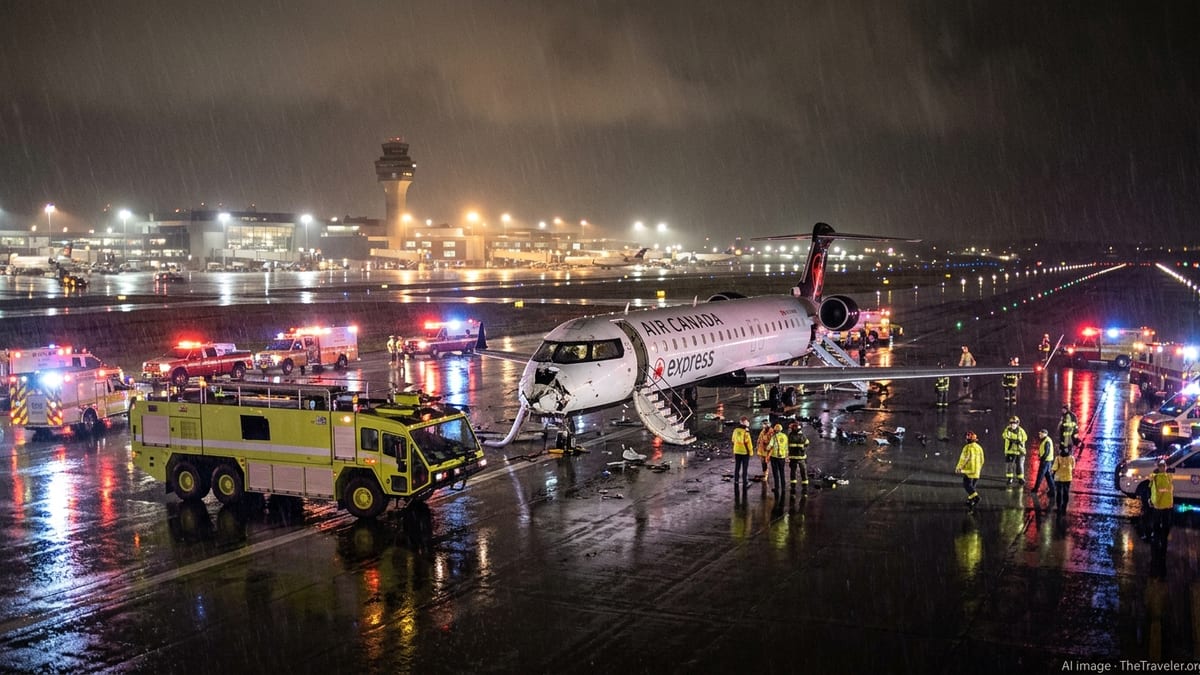
The runway sinkhole arrives at a sensitive moment for LaGuardia, which has already been under heightened scrutiny in 2026 following a deadly collision in March between an Air Canada Express regional jet and an airport firefighting vehicle on Runway 4/22. Preliminary information from federal accident investigators, summarized in recent media reports, highlighted the complexity of ground operations and the importance of clear surface movement tracking.
The Federal Aviation Administration has recently detailed broader safety initiatives across the national airport system, from expanding runway incursion mitigation programs to upgrading lighting, signage and vehicle tracking technologies. These efforts are designed to reduce the risk of both runway incursions and excursions, and to ensure that airfield layouts and infrastructure can withstand heavy use.
Although sinkholes are relatively rare events on major commercial runways, previous cases at other U.S. airports have triggered multi-day closures, extensive engineering reviews and, in some instances, long-term reconstruction of affected pavement sections. Aviation safety advocates often point to such events as reminders of how weather, aging infrastructure and complex utility networks beneath airports can combine to create sudden operational hazards.
In the coming days, attention is expected to focus on the findings of engineering assessments at LaGuardia, the speed at which normal runway operations can safely resume, and the broader implications for an airport that remains a vital gateway for business and leisure travel into New York City.