


More news on this day
Memorial Day holiday travel across the United States has been thrown into disarray after a sinkhole discovered near a key runway at New York’s LaGuardia Airport forced a multi day closure, triggering hundreds of flight cancellations, mounting delays, and knock on disruptions at major hubs including Chicago, Atlanta, and Miami.
Get the latest news straight to your inbox!
Runway 4/22 Closure Turns Local Issue Into National Disruption
Publicly available information shows that the sinkhole was identified late Wednesday morning, May 20, during a routine airfield inspection near Runway 4/22, one of LaGuardia’s two main strips for domestic operations. The runway was taken out of service immediately so construction and engineering teams could stabilize the area and determine the cause, sharply constraining the airport’s capacity heading into one of the busiest travel weekends of the year.
Reports from aviation trackers and airline operations summaries indicate that LaGuardia was pushed into a prolonged ground delay program as traffic was funneled onto a single remaining runway. Airlines cancelled dozens of departures outright and trimmed schedules on May 20 and May 21, while many remaining flights faced extended tarmac waits and holding patterns. Some carriers issued flexible travel waivers allowing passengers to rebook off peak flights or shift to nearby airports.
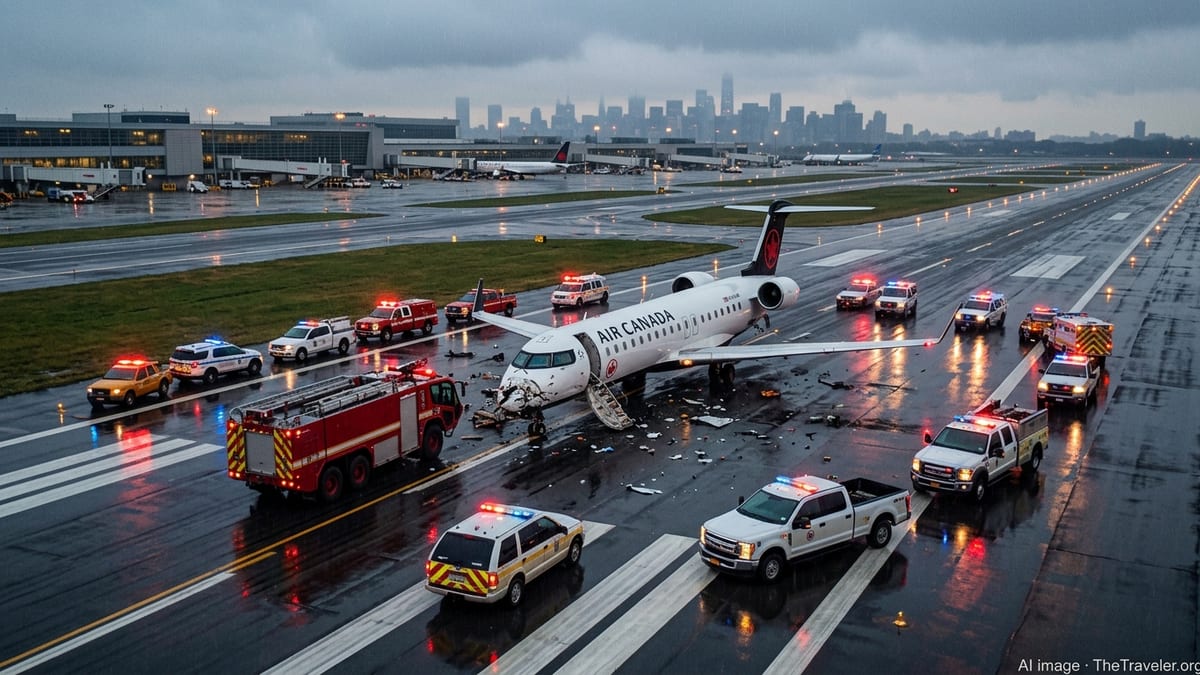
Coverage from multiple outlets notes that Runway 4/22 has already been under scrutiny this spring after a fatal collision in March involving an Air Canada regional jet and a Port Authority fire truck. The sinkhole incident has renewed attention on LaGuardia’s aging infrastructure and the geotechnical challenges of operating a high intensity airfield built on former shoreline fill and marsh.
According to travel industry analyses, the timing of the closure could hardly be worse. Federal forecasts had pointed to record setting Memorial Day passenger volumes for the New York region, with LaGuardia expected to handle a heavy share of short haul domestic traffic. With one runway offline for nearly three days, normal throughput was simply not possible, and the backlog quickly rippled far beyond Queens.
Hundreds of Cancellations Ripple to Chicago, Atlanta, and Miami
Operational data compiled by flight tracking services and airline schedule updates show that the initial wave of cancellations and diversions concentrated on LaGuardia departures to major hubs such as Chicago O’Hare, Atlanta Hartsfield Jackson, and Miami International. As aircraft and crews were stranded out of position, downstream legs from those hubs to secondary cities also began to fall apart, converting a local infrastructure problem into a nationwide network disruption.
On Thursday and Friday, carriers trimmed frequencies on some of the most heavily trafficked business and leisure routes, including shuttle style services between New York and Chicago and multiple daily links between LaGuardia and Atlanta. Public dashboards tracking day of performance recorded spikes in both cancellations and arrival delays of an hour or more at O’Hare and Hartsfield Jackson that coincided with the tightest constraints at LaGuardia.
Miami, a key gateway for Caribbean and Latin American routes, also felt the strain as flights that typically originate or feed from LaGuardia were cancelled or significantly delayed. Airline updates indicate that some passengers bound for South Florida from the Northeast were rebooked through alternative New York area airports or via detours through other hubs, lengthening total travel times well beyond original itineraries.
Aviation analysts cited in recent coverage describe this pattern as a classic example of hub and spoke vulnerability. When a critical spoke like LaGuardia experiences a sudden loss of runway capacity, hub schedules several states away become more fragile, especially during peak holiday periods when spare aircraft and open seats are in short supply.
Memorial Day Travel Chaos Compounded by Weather and Tight Schedules
Memorial Day weekend traditionally marks the unofficial start of the summer travel season in the United States, and planning documents from federal transportation agencies had already warned of tight margins at major airports. With LaGuardia’s runway restriction reducing available slots just as demand peaks, even moderate weather disruptions translated into outsized delays.
Flight status boards over the past 48 hours showed long strings of delayed departures from LaGuardia, many citing both “runway work” and “traffic management” as contributing factors. Thunderstorms sweeping through the Northeast on Thursday evening further limited arrival rates, forcing air traffic controllers to extend spacing between aircraft and deepening the queue of planes waiting to depart.
Travel advisers and consumer advocates, drawing on recent airline performance statistics, note that holiday periods leave little room to recover from a shock of this kind. Crews quickly bump up against duty time limits, aircraft rotations are tightly choreographed, and spare capacity is minimal. As a result, a sinkhole measured in a few meters has effectively added hours to journeys for thousands of passengers and, in many cases, wiped out entire travel days.
Some carriers responded by proactively cancelling later flights in order to preserve morning operations and reduce the likelihood of passengers being stranded overnight. While such preemptive cuts can minimize same day chaos at the airport, they have left many travelers scrambling to salvage vacation plans or important family visits scheduled around the long weekend.
Runway Repairs, Reopening Efforts, and Infrastructure Questions
By Saturday, May 23, publicly available statements from the airport and regional news coverage indicated that emergency repairs on the affected area had been completed and the runway had undergone inspection and testing before being returned to service. Construction crews reportedly filled and stabilized the sinkhole, then resurfaced the impacted pavement to restore safe load bearing capacity for commercial jets.
Even with the reopening, airlines have warned through schedule alerts that residual delays and scattered cancellations are likely to persist into the remainder of the holiday period. Aircraft and crew rotations require time to rebalance, and some long haul and late night services cannot be easily reinstated once they have been dropped from the operating plan.
Engineering assessments referenced in recent reporting highlight the broader challenge of maintaining legacy airfields built on complex subsurfaces. LaGuardia’s location along the northern shore of Queens has long required substantial use of fill, drainage infrastructure, and layered pavement, and experts note that heavy rainfall, tidal influences, and aging underground utilities can all contribute to soil voids that eventually surface as sinkholes or depressions.
The incident is expected to feed into ongoing debates about airport resilience and capital investment priorities in the New York region. Policy discussions already under way around runway safety improvements, ground vehicle tracking, and storm hardening measures are now being joined by fresh scrutiny of subsurface monitoring and maintenance, particularly at high traffic facilities that operate near or at capacity for much of the year.
New Airline Responses and What Passengers Can Expect Next
Airlines serving LaGuardia have rolled out a mix of operational and customer facing measures in response to the disruption. Several large carriers issued temporary change fee waivers for affected dates, allowing travelers booked through LaGuardia to move flights at no additional charge within limited windows. Some also expanded the option to reroute to and from nearby airports in the New York metropolitan area when seats were available.
Network adjustments are also emerging as carriers reoptimize around the event. Industry publications report that some airlines are upgauging aircraft on select LaGuardia routes in the short term, substituting larger jets for regional planes in order to move more passengers per slot as the runway returns to normal use. Others are trimming late night and fringe hour operations to create more breathing room for schedule recovery over the remainder of the weekend.
Consumer advocates recommend that travelers with upcoming itineraries involving New York, Chicago, Atlanta, or Miami continue to monitor flight status closely, even if their departure is scheduled several days after the initial incident. Experience from past infrastructure related disruptions suggests that mispositioned crews and aircraft can leave an imprint on on time performance well after the physical problem is resolved.
For now, Memorial Day passengers are contending with the reality that a small section of compromised pavement at LaGuardia has reshaped travel plans across multiple time zones. As airlines and airport operators digest the lessons from this week’s turmoil, the sinkhole has become an unexpected test case in how quickly the nation’s aviation system can adapt when one of its busiest urban airports suddenly loses a critical piece of its runway network.