


More news on this day
Czech private operator Leo Express has launched a new daily overnight train linking Frankfurt am Main with the Polish border city of Przemyśl, creating one of Europe’s longest continuous rail services and a new night-time corridor to the Ukrainian frontier.
Get the latest news straight to your inbox!
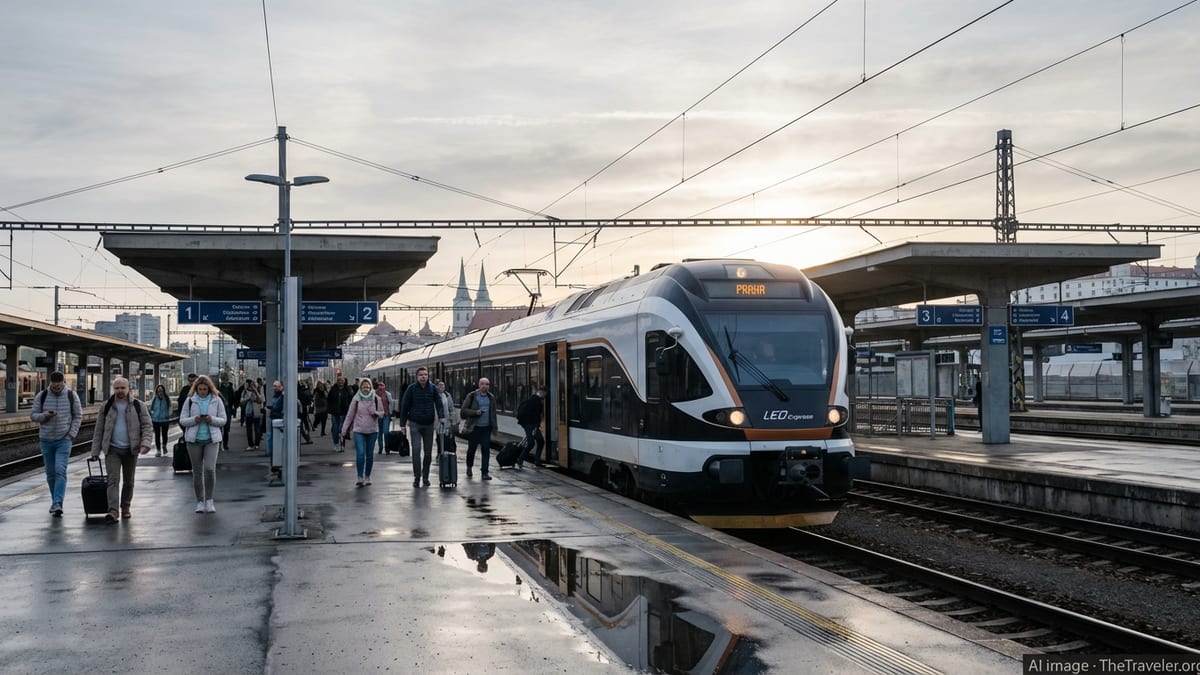
New cross-border route spans more than 1,300 kilometers
The new service, which began operations on 25 June 2026 according to published timetables and media coverage, connects Frankfurt and Frankfurt Airport with Przemyśl in southeastern Poland, close to the Ukrainian border. The end-to-end journey covers more than 1,300 kilometers and runs once a day in each direction, overnight for the core German and Czech sections.
Publicly available information indicates that the train operates via major intermediate hubs including Erfurt, Leipzig, Dresden, Prague, Ostrava and Kraków. By stitching together these established rail cities, Leo Express is positioning the route as both a long-distance trunk line and a chain of shorter, regional links that can feed local demand.
Timetabling data shows that departures from Frankfurt are scheduled in the evening, with arrivals in Przemyśl near the following day’s midday period. In the opposite direction, the train leaves the Polish border city in the late afternoon or evening and reaches Frankfurt the next morning, giving travelers a full overnight segment on board.
The new service joins Leo Express’s existing long-distance operations across the Czech Republic, Slovakia and Poland, but significantly extends the network’s reach into western Germany and to one of the key rail gateways to Ukraine.
Strategic link to the Ukrainian border
Przemyśl has become a crucial interchange point for travel between the European Union and western Ukraine, particularly since 2022. Trains from Lviv and other Ukrainian cities regularly connect there with Polish and cross-border European services, making the station a de facto rail bridge between the two systems.
By terminating in Przemyśl, the Leo Express route does not cross into Ukraine but effectively brings western Germany’s rail network to the edge of the Ukrainian system. According to route descriptions and operator information, passengers headed onward to Lviv or Kyiv can transfer to Ukrainian Railways trains or cross-border buses scheduled around arrivals and departures at the station.
The new overnight connection adds another option for travelers, aid workers and diaspora passengers who currently rely on a patchwork of daytime trains and buses between Germany, Poland and Ukraine. Observers note that the extended corridor also supports freight and logistics flows, as operators explore ways to move humanitarian goods and commercial cargo along similar paths.
Reports indicate that, unlike some emergency “humanitarian” trains introduced earlier in the conflict, the Frankfurt to Przemyśl service is structured as a regular commercial operation. However, the geography of the route means it is likely to play a role in wider mobility to and from Ukraine, especially during peak periods and holidays.
Onboard comfort and night-train positioning
Leo Express has marketed itself as a higher-comfort alternative to conventional regional services on its core Prague corridors, and early descriptions of the Frankfurt to Przemyśl train suggest a similar positioning. Seating cars form the backbone of the consist, with a focus on power outlets, Wi-Fi and upgraded interiors compared with many legacy fleets on the route.
While the operator has emphasized overnight convenience, publicly available details indicate that the service is not a traditional sleeper train with widespread couchettes and private berths. Instead, the night-time positioning comes from the timetable, which allows passengers to board in the evening and arrive at distant destinations by morning without a hotel stay.
Travel advocates suggest that this hybrid model reflects a broader European trend, where new entrants and some incumbent operators are reintroducing or extending overnight services but often with modern seated rolling stock rather than classic sleeping cars. The approach reduces operating costs and simplifies maintenance, while still capturing part of the revived interest in night trains.
Journey times on the full route are competitive with air travel once airport transfers and security queues are included, particularly for passengers whose origins or destinations lie along the line between Frankfurt and Kraków or Prague. For those segments, the overnight schedule can make rail an attractive alternative to early-morning flights.
Fares, ticketing and potential competition
According to Leo Express fare tables and booking information, tickets on the Frankfurt to Przemyśl service are sold in several price tiers, with advance-purchase discounts for early bookings and higher last-minute fares closer to departure. The operator also participates in pan-European rail passes on selected stretches, although not all ticket types cover the entire journey.
Published commentary from transport analysts notes that the new route enters a competitive space already served in parts by state-owned operators such as Deutsche Bahn and PKP Intercity, especially on the German and Polish sections. Some of these incumbents run their own long-distance and overnight trains, while others provide connecting services that feed into Leo Express’s timetable.
Regulatory documents in Poland have drawn attention to the possible impact of the new train on publicly funded services, with the national regulator asked to assess whether the commercial operation could affect the “economic equilibrium” of subsidized routes. Those proceedings are framed as technical evaluations under open-access rail rules rather than political disputes.
For passengers, the immediate effect is a wider choice of departure times and operators on key legs, particularly between Kraków, Prague and Germany. Industry observers suggest that price competition could intensify on some segments, although long cross-border journeys remain a niche compared with domestic flows.
Operational challenges and future prospects
Running a more than 1,300 kilometer train across multiple countries, infrastructure managers and signaling systems presents notable operational challenges. Timetable reliability must account for varying track conditions, potential congestion near major hubs and cross-border coordination between German, Czech and Polish networks.
Railway forums and passenger reports about earlier Leo Express expansions describe occasional disruptions and rolling stock issues on other routes, illustrating the difficulty of maintaining punctuality and consistent service quality over long open-access lines. The company has previously adjusted schedules and equipment as it responded to demand and infrastructure constraints.
Transport commentators point out that the Frankfurt to Przemyśl train will serve as a test case for how smaller private operators can sustain very long international routes over time. Strong seasonal peaks are expected, particularly around summer holidays and major religious festivals, while shoulder seasons may see lighter loads and greater pressure on profitability.
If the new overnight connection proves successful, it could encourage further expansion of cross-border night trains linking western Europe with central and eastern hubs. Observers highlight potential future combinations with services deeper into Ukraine, pending security and infrastructure conditions, that would enable through-ticketing from German cities to destinations such as Lviv and Kyiv using timed transfers in Przemyśl.