


Landing at Los Cabos International Airport and heading straight to Nobu Hotel Los Cabos is one of the great luxury arrivals in Mexico, but it also involves one of the longest and most expensive transfers in the destination. With the resort set on the quiet Pacific side beyond Cabo San Lucas, choosing the right transport can make the difference between a seamless, champagne-smooth arrival and a stressful start. This guide focuses on private SUVs, taxi availability, road access, luggage considerations, and why pre-booking matters specifically for the Pacific-side resorts such as Nobu.
Get the latest updates straight to your inbox!
Understanding the Route: From SJD to the Pacific-side Resorts
Los Cabos International Airport (SJD) sits near San José del Cabo on the Sea of Cortez side, while Nobu Hotel Los Cabos is tucked inside the Diamante community on the Pacific coast, past Cabo San Lucas. The resort is roughly 34 miles or about 55 kilometers from the airport, with a typical driving time of 45 minutes to just over an hour depending on time of day, traffic, and whether your driver uses the toll road or the slower free roads. In practice, many travelers report closer to 50 to 60 minutes door to door when traffic around Cabo San Lucas builds in the afternoon or during peak holiday periods.
The main route starts on the airport road before connecting to the toll road known locally as the cuota, a modern highway that bypasses local traffic as it heads toward Cabo San Lucas. Near town, drivers connect with Federal Highway 19, which runs up the Pacific side toward the Diamante development where Nobu and the nearby Hard Rock Hotel sit. This last stretch gives the first real glimpse of the Pacific Ocean before the road bends toward the gated community entrance and the resort’s stone-lined driveway.
Because the Pacific-side resorts are outside the main hotel corridor, most shared shuttles make multiple stops in San José del Cabo and the Tourist Corridor before continuing toward Cabo San Lucas. That can add considerable time to the journey. Travelers who have tried shared vans often describe over 90 minutes in transit compared with under an hour in a private SUV heading directly to Nobu. For guests arriving after a long-haul flight, paying more for a direct private transfer often feels justified once they see how far the resort is from the rest of the destination.
The route also has practical implications for motion-sensitive travelers. The toll road portion is smooth and well maintained, with long straight sections. The final approach along Highway 19 and into the Diamante compound includes a few curves and some speed bumps near the gate, but is not particularly winding. If anyone in your group is prone to car sickness, request a front seat and consider asking your driver to keep the air conditioning moderate and the windows slightly cracked for fresh air during the last 20 minutes.
Why Private SUVs Are the Gold Standard for Nobu Transfers
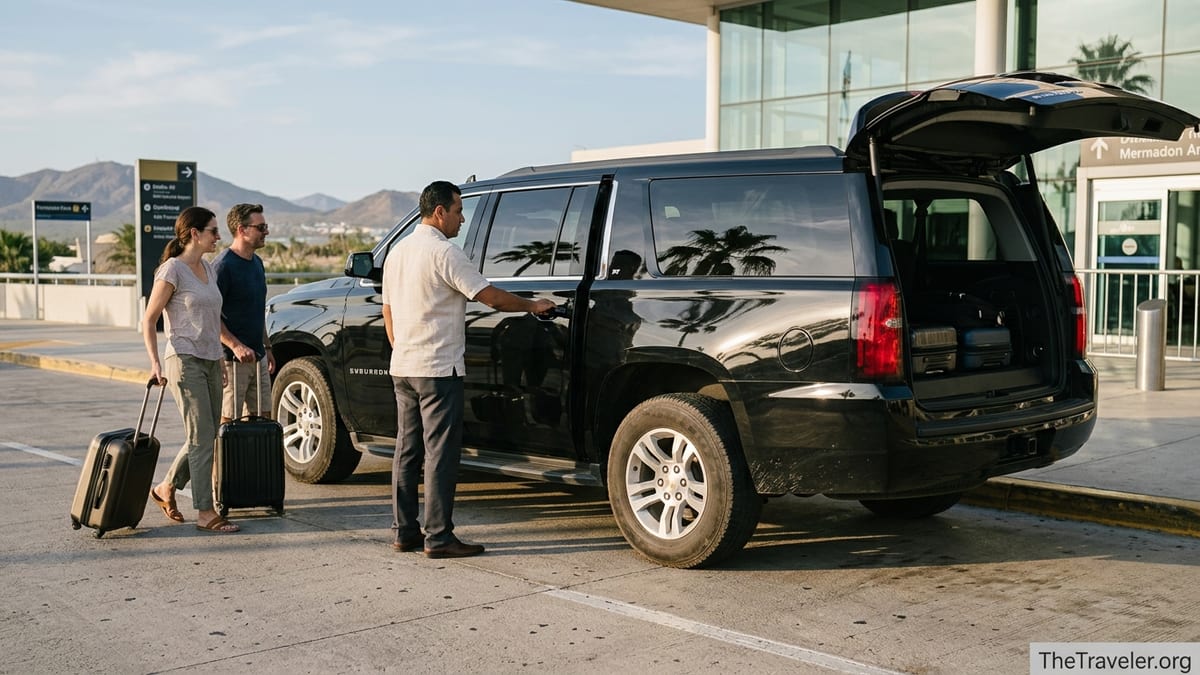
For guests staying at Nobu and other high-end Pacific-side resorts, private SUVs have become the default transfer choice. Several local operators specialize in airport-to-hotel service using late-model Chevrolet Suburbans, Cadillac Escalades, or similar full-size SUVs. A typical private SUV transfer from SJD to Nobu for up to five passengers with luggage often starts in the range of about 110 to 150 US dollars one way, though rates vary by season, time of day, and inclusions such as bottled water or beer. Some companies offer a step-up “luxury” category using higher-spec vehicles or Escalades at slightly higher prices.
Travelers who have used companies such as Los Cabos Airport Transportation, SJD Taxi’s private SUV service, or boutique local operators report consistent experiences: a representative meets them just outside the terminal doors, walks them to a clearly marked vehicle, and departs within minutes of luggage pickup. For a typical family of four arriving on a Saturday afternoon, that means being on the road to Nobu within 15 to 20 minutes of clearing customs, instead of waiting in a long taxi line during peak arrival times.
From a comfort perspective, full-size SUVs are well suited to the demands of the route. The drive involves highway speeds on the toll road and then a longer coastal stretch, so the combination of legroom, strong air conditioning, and high ground clearance feels noticeably more comfortable than squeezing into a compact sedan. Vehicles tend to have generous cargo space for large checked suitcases, golf bags for guests playing at Diamante’s courses, and strollers or baby gear. Many operators will also pre-arrange child seats at no extra or low additional cost if you request them ahead of time.
For groups or multigenerational families, private SUVs also provide privacy and control. You can adjust the music, ask for photo stops if road conditions allow, or request a quick detour via a supermarket in Cabo San Lucas to pick up supplies before continuing to the resort. Some services openly advertise that they are happy to stop at Costco or a local grocery store for 15 to 20 minutes, so guests can stock rooms with snacks and drinks before settling in at Nobu.
Taxis, Ride-share, and On-the-Spot Options
Official airport taxis are another option, but for Nobu and the Pacific-side resorts they are generally less popular than pre-booked SUVs. Airport taxis at SJD operate under fixed-zone pricing agreed with local authorities and hotel associations. Because Nobu sits beyond Cabo San Lucas, in one of the farthest zones from the airport, walk-up taxi fares are among the highest in the region. Travelers occasionally report paying amounts comparable to or even higher than pre-booked SUVs, but without the guarantee of a full-size vehicle or additional services like child seats.
Ride-share services like Uber do operate in parts of Los Cabos, but the airport itself remains tightly controlled by local taxi unions and authorities. In practice, it is often difficult or impossible to arrange a legal Uber pick-up directly from the arrivals curb at SJD. Some visitors attempt to walk outside the terminal area to request a ride, but this can be confusing after a flight and is not officially recommended. Additionally, Nobu’s location inside a gated community and its partnership with local taxi providers can restrict ride-share vehicles from picking up at the resort itself, even if they can drop guests off at or near the entrance.
Once you are at Nobu or visiting Cabo San Lucas for dinner or shopping, hotel staff can easily call a licensed taxi back to the resort. Typical one-way taxi fares from the marina area or downtown Cabo San Lucas to Nobu are often reported in the range of 30 to 40 US dollars, depending on time of day and negotiation. These are arranged through hotel concierges or restaurant hosts rather than hailed on the street. For airport runs, however, relying on taxis at the last minute is a higher-risk strategy due to availability, fixed pricing, and the longer distance to the Pacific side.
Shuttle desks inside the airport sometimes sell last-minute shared transfers, but very few run regularly all the way to Nobu without multiple en route stops. Guests who have tried these services describe sitting in a van that stops at several Corridor resorts and at least one Cabo San Lucas hotel before continuing to the Pacific-side properties. What looks like a cost-saving choice at the counter can easily translate into more than 90 minutes in a full van after a long travel day. That trade-off is especially noticeable if you have children, elderly relatives, or simply want to get into the pool at Nobu as quickly as possible.
Road Access, Tolls, and What to Expect on the Drive
The drive from SJD to Nobu uses a combination of modern toll highway and standard federal roads. The toll road is officially part of Highway 1D, a controlled-access road linking the airport with San José del Cabo and Cabo San Lucas. This section is well paved, with guardrails and proper lighting in key segments, and is considered the fastest and most comfortable way to cross the region. Your private transfer company or taxi pays the tolls, which are built into your quoted fare, so you will usually not handle cash at the toll booths.
Near Cabo San Lucas, drivers leave the toll road and connect with Highway 19, which runs along the Pacific coast toward Todos Santos. Compared with the toll road, this stretch feels more like a standard coastal highway: two lanes in each direction near Cabo, narrowing further out, and with occasional junctions for residential developments and resorts. The scenery opens as you climb slightly above the coastline, offering views of desert hills, the blue Pacific, and the emerging silhouettes of large resorts near the shoreline.
Road conditions overall are good, but there are a few practical details worth knowing. At night, some stretches beyond Cabo San Lucas can feel quite dark, with limited street lighting. Private transfer drivers accustomed to the route are comfortable with this, but if you are renting a car it requires more attention, especially when local drivers move at high speed. Occasional livestock sightings have been reported along Pacific-side roads further north, although this is less common near the developed resort area around Nobu. Seat belts and a cautious approach are advisable, even in a luxury SUV.
For guests who rent a car, the drive is straightforward but requires clear navigation. Car rental desks at the airport will often mark Nobu and Diamante on printed maps, and major navigation apps successfully route drivers via the toll road and Highway 19. The main surprise for first-time drivers is fuel. Some gas stations close to the airport have a reputation among visitors for aggressive upselling or confusion around card charges, so many repeat travelers prefer to refuel near Cabo San Lucas or at well-known brand stations they recognize. Parking at Nobu is typically handled by valet staff at the main entrance, adding an extra layer of convenience if you decide to self-drive.
Luggage, Groups, and Traveling in Style
Nobu’s guest profile often includes couples celebrating special occasions, destination wedding groups, golfers heading for Diamante’s courses, and families escaping for school holidays. This mix complicates luggage needs. A couple on a long weekend might arrive with two large checked bags and hand luggage, easily handled by a standard SUV. A golf group of four could arrive with four large suitcases and four full-size golf bags, which can quickly overwhelm smaller vehicles. In these scenarios, reserving an SUV or even a larger van is not just about luxury, but about basic practicality.
Most reputable private transfer companies specify maximum passenger numbers and recommended luggage limits on their booking pages. A common guideline for a Chevy Suburban is up to five passengers with around five large suitcases and carry-on items. If you exceed this, operators may recommend a larger vehicle such as a passenger van, which can handle eight to ten guests and golf or surf gear. For wedding parties, it is common to book multiple SUVs to move guests in waves from SJD to Nobu on arrival day, coordinated with the hotel’s events team and the wedding planner.
Traveling with young children brings additional considerations. Mexican law requires proper child restraint systems for young passengers, and while enforcement can vary, luxury properties and serious transfer providers take this seriously. Many companies now offer infant seats or booster seats by request, sometimes included in the rate and sometimes with a small supplemental fee. It is important to reserve these early rather than assuming they will be available at the last minute. Ask your provider to confirm in writing that the seat will be installed before pickup, and consider bringing a compact, travel-friendly booster if you have specific safety preferences.
Because Nobu positions itself as a design-forward, celebrity-favorite property, some guests choose to extend that feeling of style to the transfer itself. Upgraded options can include black-on-black Escalades, vehicles with in-car Wi-Fi, and stocked coolers with sparkling water or local beer. These touches rarely change the basic function of the ride but can set the tone for a milestone trip, whether it is a honeymoon, anniversary, or major birthday celebration.
Why Pre-booking Matters for Nobu and the Pacific Side
Unlike resorts clustered near San José del Cabo or along the main Tourist Corridor, Nobu’s Pacific-side location magnifies the advantages of pre-booking. One key reason is availability. High-season weekends, major US holidays, and school breaks see intense demand for SUVs and vans. Operators allocate vehicles to confirmed reservation windows, and walk-up travelers at the airport may find limited options, especially if they need a larger vehicle or specific amenities like child seats. By reserving at least a week or two in advance, you secure both a vehicle category and a firm pickup plan that aligns with your flight arrival.
Cost transparency is another strong argument for pre-booking. Private transfer websites typically present clear one-way and round-trip prices for Nobu and other Pacific-side resorts. Booking in advance lets you compare quotes between companies and decide whether to pay slightly more for a higher-end vehicle or added services. In contrast, taxi pricing at the airport is tied to zone charts and can be harder to decode. Travelers often report paying roughly similar amounts to pre-booked SUVs, but without knowing the exact figure until they reach the front of the taxi stand.
Pre-booking also simplifies communication in a destination where language barriers can add stress after a long day of travel. Confirmed transfers send you written instructions about where to meet your driver, often specifying a particular exit door and placard displaying your name or the company logo. That clarity reduces the chance of getting diverted by aggressive timeshare salespeople in the arrivals hall or wandering between different transportation desks. For return transfers, having a pre-set pickup time from Nobu’s lobby means you can enjoy your final morning by the pool rather than negotiating taxi timing and rates on the spot.
Finally, pre-booking is a form of travel insurance against delays and disruptions. Many operators monitor incoming flights and adjust pickup times automatically when airlines run late, something an airport taxi queuing system cannot do. If your flight is significantly delayed into the evening, a pre-booked driver still waits for you. In contrast, relying purely on casual options can mean dealing with limited taxis at off-peak hours or navigating unfamiliar streets in a rental car after dark, which is not ideal when you are trying to reach an outlying resort on the Pacific side.
Practical Booking Tips and Realistic Budgeting
When planning your transfer from SJD to Nobu, it helps to work backward from your flight schedule. For arrivals, consider the typical pattern: immigration and customs can take 20 to 45 minutes depending on how many flights land at the same time, followed by 10 to 15 minutes to exit the terminal and meet your driver. Most private transfer companies ask for your flight number, airline, and scheduled arrival time, then build in a standard waiting window. If you are flying internationally and concerned about long immigration lines, choosing a provider with flexible waiting policies can be worth a small premium.
For departures, the general advice is to leave Nobu around three hours before your scheduled flight time for international departures and slightly less for domestic flights, adding extra buffer in peak holiday periods. The drive itself typically takes 45 to 60 minutes, but hitting traffic near Cabo San Lucas or at toll booths adds risk. A common schedule for a midday departure is a hotel pickup around 8:30 or 9:00 in the morning, which gives you time to check out, settle incidental charges, and still reach the airport with time for security and a quick snack.
In terms of budgeting, it is reasonable for a couple or family staying at Nobu to allocate a low three-figure amount in US dollars for round-trip transfers in a private SUV. Solo travelers may find the per-person cost high but appreciate the comfort and safety, while larger groups can bring the per-person cost down by sharing an SUV or van. If you are already investing in a high-end resort stay, most guests find that cutting transfer costs by shifting to a crowded shared van is a false economy given the extra time and reduced comfort.
Payment methods vary. Many transfer companies allow prepayment by credit card online, sometimes with discounts for round-trip bookings or for paying in advance. Others accept cash in US dollars or Mexican pesos on arrival. If you choose to pay on the day, it is sensible to carry some smaller bills for tipping. Drivers in Los Cabos commonly receive tips in the range of 10 to 20 percent of the fare, depending on service level, luggage assistance, and whether they made any additional stops at your request.
The Takeaway
Getting from Los Cabos International Airport to Nobu Hotel Los Cabos is not a simple airport-hop; it is a substantial coastal transfer from the Sea of Cortez side to the Pacific, and that distance makes your choice of transport more important. For most travelers heading to Nobu or other Pacific-side resorts, a pre-booked private SUV offers the best combination of comfort, reliability, and value compared with walk-up taxis, patchwork shuttles, or improvised ride-share plans.
By understanding the route, planning for realistic travel times, and choosing a vehicle that fits your group size and luggage, you can turn the journey into an extension of the luxury experience rather than a logistical hassle. Confirm details in advance, communicate any special needs such as child seats or golf bags, and allow enough time for both arrival and departure transfers. With those simple steps, the drive from SJD to Nobu becomes exactly what it should be: a smooth, scenic introduction to one of Baja California Sur’s most sought-after coastal retreats.
FAQ
Q1. How long does the drive from Los Cabos Airport to Nobu Hotel usually take?
Most travelers should plan on about 45 to 60 minutes by car, depending on traffic, time of day, and whether the toll road is used for most of the route.
Q2. What is the approximate distance from SJD to Nobu Hotel Los Cabos?
The distance is roughly 34 miles or about 55 kilometers, making Nobu one of the farther major resorts from Los Cabos International Airport.
Q3. How much should I budget for a private SUV transfer to Nobu?
Private SUV transfers from SJD to Nobu commonly start around the low 100s in US dollars one way for up to four or five passengers, with prices varying by season and operator.
Q4. Are taxis from the airport cheaper than pre-booked private transfers?
Not usually for Nobu. Because it is in a distant zone, official airport taxi fares are relatively high and often comparable to pre-booked private SUVs, which usually offer more comfort and predictability.
Q5. Can I use Uber or other ride-share services from Los Cabos Airport to Nobu?
Ride-share apps may work in parts of Los Cabos, but legal pick-ups at the airport are restricted and can be unreliable, so they are not a dependable option for direct transfers to Nobu.
Q6. Is it necessary to pre-book my transfer, or can I arrange it on arrival?
You can sometimes arrange transport on arrival, but for Nobu and other Pacific-side resorts it is strongly recommended to pre-book so you secure a suitable vehicle and know the price in advance.
Q7. What vehicle type is best for families or golf groups staying at Nobu?
A full-size SUV such as a Suburban or Escalade is ideal for most families and small golf groups, while larger parties or those with extensive gear may be more comfortable in a passenger van.
Q8. Are child seats available in private transfer vehicles?
Many reputable companies provide infant seats or boosters on request, but you should reserve them in advance and have written confirmation to ensure availability when you arrive.
Q9. Is the road from SJD to the Pacific-side resorts safe to drive?
The main route is a modern toll road combined with well-maintained highways that most visitors find safe, especially with experienced local drivers, though night driving requires extra attention.
Q10. Should I rent a car instead of booking a transfer to Nobu?
Renting a car can be convenient if you plan to explore widely around Los Cabos, Todos Santos, or La Paz, but for guests focused on relaxing at Nobu a pre-booked private transfer is usually simpler and less stressful.