


More news on this day
Motorists across central and northern England are facing significant disruption this weekend, with major delays reported on the M6, M42, A42 and key stretches of the M1 following a new highways warning about closures, lane restrictions and ongoing construction works.
Get the latest news straight to your inbox!
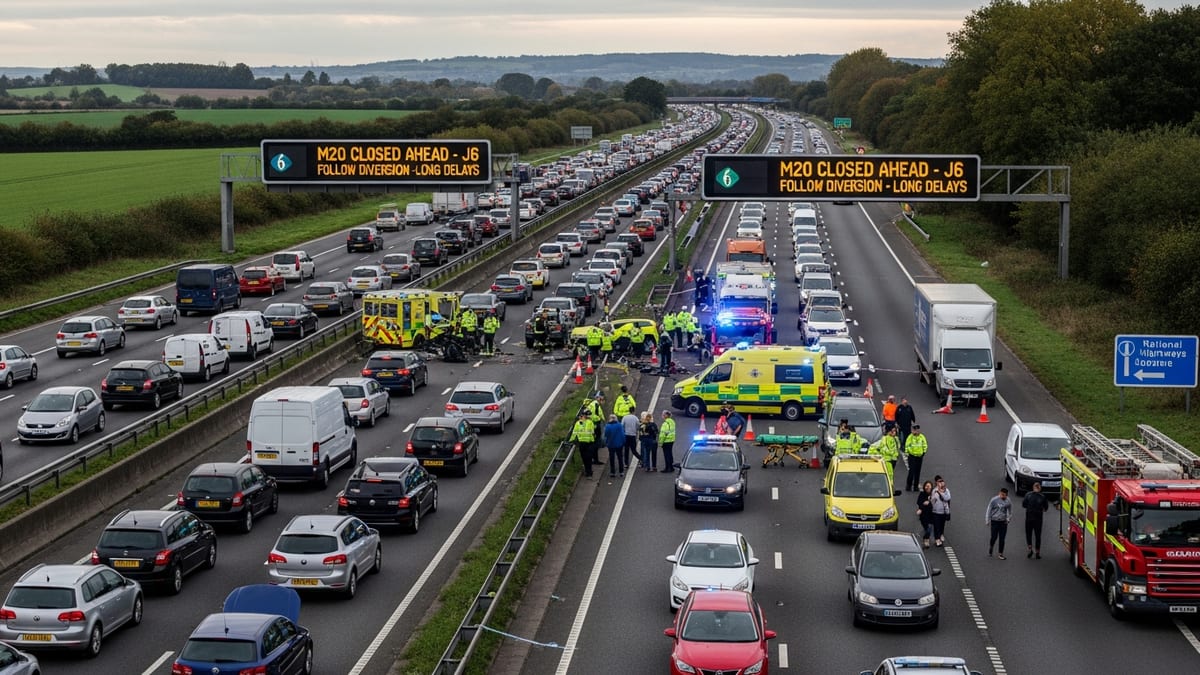
Live delays building on key motorway corridors
Publicly available traffic data on 7 November 2026 indicates heavy congestion on parts of the M6 and M1, with knock-on effects across the wider Midlands motorway network. Live incident feeds show long delays northbound on the M6 between junctions 15 and 17 near Stoke-on-Trent and Crewe, and further southbound queues forming around junctions 21 to 22 near Warrington.
On the M1, National Highways data collated by independent traffic trackers points to northbound congestion between junctions 23 and 25 in Leicestershire and Derbyshire, with reported delays of more than 20 minutes in some sections. Additional slow-moving traffic is being recorded closer to the south of the route between junctions 5 and 8 near Watford, indicating pressure along several distinct stretches of the motorway at the same time.
Traffic maps for the M42 highlight separate disruption, including reports of a northbound lane closure near junction 5A in the Solihull and Knowle area following an incident. Although clearance times are estimated, operators caution that exact reopening times can change at short notice. The A42, which links the M42 near Ashby-de-la-Zouch to the M1 around junction 23A, is also flagged in strategic planning documents as a frequent pinch point when the neighbouring motorways are under pressure.
While not every incident currently leads to standstill traffic, the combination of active collisions, lane closures, and background roadworks is producing a pattern of stop-start conditions that is affecting freight traffic as well as private motorists.
Roadworks, renewals and HS2 works add to disruption
Alongside live incidents, a programme of planned works is limiting capacity at several critical junctions. Information published by National Highways and collated by third-party traffic services shows continuing lane and hard-shoulder closures on the link roads between the M6 at junction 4A and the M42 at junction 8, with 50 mph temporary speed limits in force as part of construction activity.
Separate listings for tonight into Sunday morning confirm a full overnight closure of the M6 southbound link from junction 4A to the M42 southbound, with all lanes and the hard shoulder shut between approximately 20:40 on 6 November and 05:00 on 7 November. Diversions are signposted locally, but traffic planners warn that any overrun or residual queues at reopening time can affect Saturday morning journeys for travellers heading towards Birmingham Airport and the National Exhibition Centre.
Longer-running infrastructure schemes are also reshaping traffic patterns around the M42 and A42 corridor. Transport authorities in the West Midlands report that improvement works around M42 junction 6, closely tied to the future HS2 Interchange station near the NEC, continue into late 2026, involving repeated weekend and overnight closures, reduced lanes and temporary layouts. In parallel, HS2-related engineering works over both the M42 and M6 are scheduled between June and November 2026, with diversion routes via the M6 and A roads clearly signposted when full closures are required.
Further north, maintenance projects and technology upgrades on the M6 between junctions 11A and 12 are highlighted on motorway overhead signs, with advisory messages warning of “tech repairs in progress” and urging drivers to allow extra time. These works add to a pattern of recurring roadworks across the spine of the network, which can intensify delay whenever collisions or bad weather occur.
Temporary orders and safety restrictions on the wider network
Recent legal notices underline that some of the disruption on the M6 and M42 is supported by formal temporary traffic orders. A statutory instrument known as the M6 Toll Motorway (M6 Junction 3A to M6 Junction 11A) and M42 Motorway (Temporary Prohibition of Traffic) Order 2026, which came into force at the end of January 2026, enables phased closures on sections of the M6 Toll and nearby stretches of the M42 when required for works or safety interventions.
These types of orders allow the Secretary of State for Transport, acting as the traffic authority for those routes, to prohibit traffic on defined segments of motorway for limited periods. In practical terms, this means that drivers may encounter occasional full overnight closures or narrow-lane running on approaches to the M6 Toll and the northern M42, particularly when construction, resurfacing or bridge works are underway.
Elsewhere, regional traffic information from France shows that roads designated A42 there are also currently affected by events and restrictions, including reports of obstacles and temporary tonnage limits around Dagneux and Marle. While unrelated operationally to the British A42, this coincidence underlines the wider European context in which many long-distance freight operators are navigating multiple disruption points on major strategic routes in a short period.
Local and regional planning papers from the English Midlands further note that corridors including the M6, M1, M42, A38, A42 and A453 consistently appear as some of the most congestion-prone in the region, especially during adverse weather or when incidents trigger long rolling queues. The present combination of live incidents, roadworks and strategic upgrades is broadly consistent with that assessment.
What drivers are experiencing on the ground
Reports shared on public forums over recent months suggest that delays and closures on the M6, M42 and M1 have become a regular frustration for both commuters and long-distance drivers. Users describe encountering multiple overnight lane closures within relatively short distances, particularly on the M6, where some report passing through a succession of works zones with only one lane open in places.
Other motorists highlight confusion stemming from digital navigation tools that display frequent warnings of possible motorway closures, sometimes without matching what drivers then encounter on the road. In late July, several users reported repeated prompts on sections of the M1 and M42 asking about road closures, despite the carriageway remaining open, while others found themselves unexpectedly diverted where short-term police or highways interventions were in place.
On the northbound M6 around Staffordshire, travellers recount journeys where overhead signs flagged delays exceeding two hours between junctions 12 and 15 following incidents and unplanned closures. In some cases, drivers who continued on the motorway reportedly encountered standstill conditions, whereas those who diverted early via alternative trunk routes such as the A50 or A34 were able to avoid the worst of the tailbacks.
Feedback from drivers also points to wider anxiety about the interaction between heavy traffic, smart motorway features and lane closures. Several contributors say they have experienced abrupt slowdowns where reduced speed limits appeared on overhead gantries with limited warning of stopped vehicles or upcoming works, reinforcing concerns about journey reliability and safety.
Advice for travellers planning weekend and holiday journeys
Travel and transport services recommend that anyone intending to use the M6, M42, A42 or M1 in the coming days checks live information as close as possible to departure. National Highways’ own channels, alongside independent traffic trackers, provide incident maps, average delay times and details of scheduled closures and diversions. Because conditions can change quickly, particularly during overnight works and in poor visibility, journey plans made the night before may already be out of date by the time a driver reaches the network.
Motorists heading to key hubs such as Birmingham Airport, the NEC, East Midlands Airport or long-distance rail and coach interchanges are advised to allow generous extra time. The M42 link to the M6 around junctions 4A and 8, together with the A42 and M1 corridor through Leicestershire and Derbyshire, form the primary motorway access to several of these destinations, and any closure at one point can rapidly create queues many miles away.
Alternative routes may ease journeys in some cases, but transport planners caution that diverting large volumes of motorway traffic onto parallel A roads can quickly generate congestion through smaller towns and villages. Where diversions are signposted by highways teams, travellers are generally encouraged to follow them rather than relying solely on satellite navigation shortcuts along minor roads.
Given the scale of current and planned works, particularly around the M42 junction 6 improvement scheme and HS2-related construction, prolonged periods of intermittent disruption are expected to continue across parts of the Midlands motorway network into 2027. For now, drivers are being urged by travel services to treat journey times on the M6, M42, A42 and M1 as highly variable, build in spare time, and be prepared to adapt routes in response to live traffic warnings.