


More news on this day
Hundreds of air travellers were left stranded at Amsterdam Schiphol Airport on Monday as a wave of operational disruption triggered 265 delays and at least 27 cancellations on services operated by KLM, Delta Air Lines, Lufthansa, Qatar Airways, Emirates and other carriers to major hubs including Paris, London, Frankfurt and Zurich.
Get the latest news straight to your inbox!
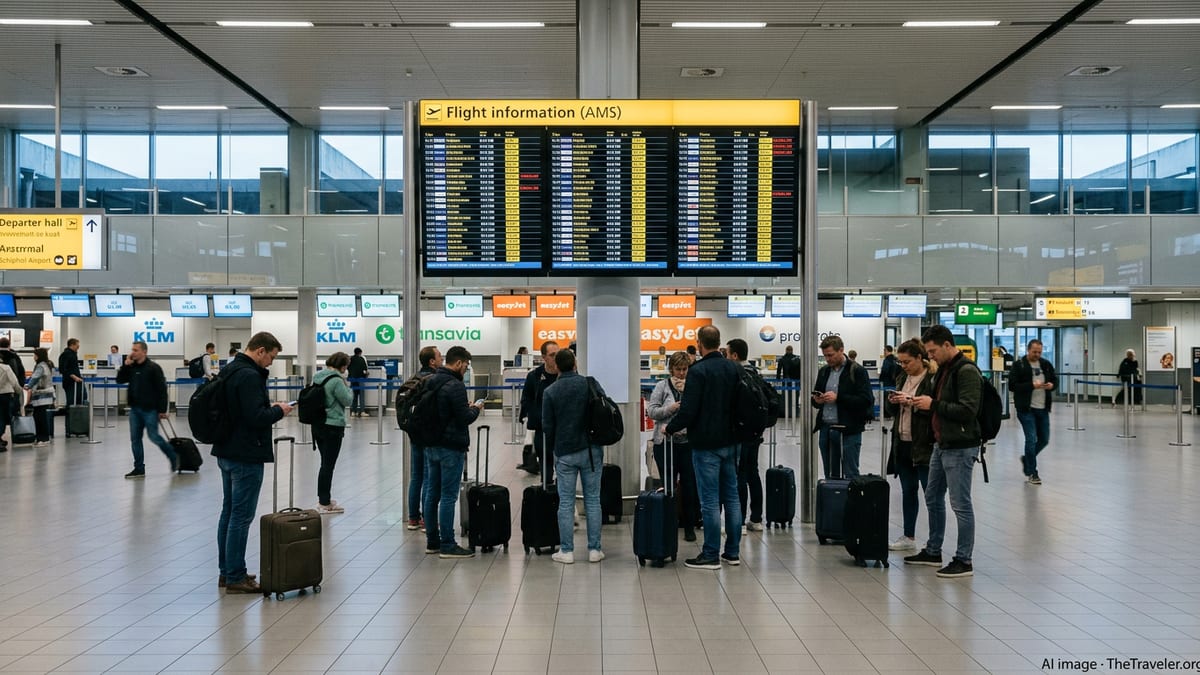
Schiphol Hub Gridlocks as Delays Cascade Across Europe
Publicly available flight tracking data and live airport departure boards on 8 June indicate that Schiphol experienced widespread disruption, with dozens of services departing late or failing to depart at all. The pattern shows delays stretching from short intra-European hops to long haul connections, creating a gridlock effect at the Dutch hub and spilling over into other major airports.
Reports from airline-focused outlets and aviation blogs describe a sharp build-up of congestion at key departure banks, where multiple KLM and Delta services ordinarily feed transatlantic and intra-European connections. When early flights left behind schedule or were removed from the schedule, the resulting lack of inbound aircraft and crew availability began to affect later rotations, extending delays into the afternoon and evening.
According to published coverage monitoring the situation, services to London, Paris, Frankfurt, Zurich and several Southern European destinations were among the most heavily affected. Parallel disruption at other European hubs in recent days, including London Heathrow and Paris, has added another layer of complexity for airlines attempting to re-route stranded passengers via alternative gateways.
The disruption comes during what has already been a volatile year for European aviation, with Eurocontrol data showing a persistent rise in average delay minutes per flight and recurrent capacity issues at several of the continent’s largest hubs.
Major Airlines Hit: KLM, Delta, Lufthansa, Qatar Airways and Emirates
The latest disruption at Schiphol has affected a broad mix of airlines using the airport as a primary or secondary hub. KLM, as the home carrier with the largest operation at Amsterdam, appears to have borne the brunt, with its tightly timed bank structure particularly vulnerable to schedule shocks. Delta, which co-operates extensive transatlantic services with KLM, also faced significant knock-on delays as its Amsterdam-bound and onward flights lost their planned connections.
Published reports on recent European network performance indicate that Lufthansa, Qatar Airways and Emirates were likewise caught in the ripple effects. For Lufthansa, any irregularity at Amsterdam can undermine carefully balanced connections into Frankfurt and Munich, while disruptions affecting Qatar Airways and Emirates services have consequences for passengers connecting onward through Doha and Dubai to Asia, Africa and Australasia.
Observers note that some of these carriers have already been navigating separate regional challenges this year, from industrial action in parts of the Lufthansa network to security-related airspace constraints prompting schedule reshuffles for Gulf carriers. When layered onto an already constrained operating environment, even a modest spike in delays at a critical node such as Schiphol can quickly multiply into widespread missed connections and overnight strandings.
Travel industry commentary suggests that the combination of summer-season demand, tight aircraft utilization and variable staffing levels across ground handling, security and air traffic control has left little slack in the system. As a result, airlines have fewer options to deploy spare aircraft or crews when disruption hits, increasing the probability that delays change into outright cancellations.
From Missed Connections to Overnight Stays for Passengers
Passenger accounts shared on social media and travel forums on Monday describe hours-long queues at customer service desks, crowded departure halls and a scramble to secure scarce rebooking options. Many travellers reported missing onward connections to cities including Paris, London, Frankfurt and Zurich after their initial flights into Amsterdam arrived late or were cancelled.
Several accounts reference overnight stays in airport hotels or makeshift sleeping arrangements in terminal seating areas as travellers waited for rebooked itineraries departing the following day. In some cases, the disruption transformed what was supposed to be a straightforward one-stop journey into a multi-leg trip involving alternative hubs, such as routing through Toronto, Dubai or other European gateways to reach final destinations.
Publicly available information on passenger rights highlights that, under European regulations, travellers whose flights are significantly delayed or cancelled may be entitled to assistance such as meals, refreshments and accommodation, and in certain circumstances financial compensation. However, previous episodes of large-scale disruption at Schiphol have shown that exercising those rights can be challenging when thousands of travellers are seeking help at the same time and call centres and digital channels are saturated.
Forum posts related to earlier disruption events at the airport have advised travellers not to wait passively for automatic rebooking, but instead to use airline apps and websites to search for options proactively. The latest wave of delays appears to have revived that advice, with many passengers indicating that self-service tools provided the quickest path to securing alternative flights.
Knock-On Impacts at Paris, London, Frankfurt, Zurich and Beyond
The disruption in Amsterdam has not been contained to the Netherlands. Because Schiphol functions as a central hub feeding and receiving traffic from other major airports, delays there have translated into late arrivals or missed departures in at least half a dozen cities. Monitoring of arrivals boards and route-level tracking shows irregular operations on services linking Amsterdam with Paris, London, Frankfurt and Zurich, among others.
In practical terms, this means that an aircraft leaving Amsterdam late may arrive in London or Frankfurt too far behind schedule to operate its next planned sector, prompting further delays or an aircraft swap. Likewise, connecting passengers who were scheduled to travel via Schiphol to reach those cities have been forced onto later flights or rerouted completely, increasing load pressure across the wider European network.
Some long haul markets have also felt the impact. With transatlantic routes from Amsterdam, Paris and London already operating close to capacity during peak periods, even a modest number of cancellations or heavily delayed departures can leave airlines with limited ability to accommodate displaced passengers for several days. Aviation analysts note that this is particularly problematic for travellers heading to long-haul destinations that are not served daily, or that rely on specific narrow connection windows.
Industry data for early June suggests that Europe’s main hubs have been running with relatively little spare runway and gate capacity, meaning that efforts to recover from one day of irregular operations can stretch well into the next. For passengers, that can translate into rolling delays that persist even after the original trigger event at Schiphol has been brought under control.
What Travellers Can Do if Their Flight Is Affected
While airlines and airports work to stabilize operations, travel experts recommend that passengers facing delays or cancellations from Amsterdam or other affected hubs take a proactive approach. Checking flight status frequently through airline apps, websites and airport information boards is considered essential, particularly as departure times can change multiple times in quick succession.
Publicly available guidance from carriers such as KLM and Delta outlines that, in the event of significant delays or cancellations, travellers may be able to change their bookings without additional fees, request refunds in certain cases, or opt for travel vouchers. Many airlines also permit same-day rebooking via digital channels, which can be faster than waiting in line at physical counters during large disruption events.
Passengers are also advised, in widely shared online checklists, to document expenses for meals, transport and accommodation when delays stretch into many hours, as these records can be important for later reimbursement or compensation claims. For itineraries involving connections to or from long haul flights, keeping boarding passes and confirmation emails is particularly important when establishing entitlement under European or other regional passenger rights frameworks.
With the summer peak approaching and recent history showing how quickly disruption at a single hub can spread across continents, many frequent travellers are building additional buffer time into their itineraries and considering alternative routings where practical. The latest wave of delays at Amsterdam Schiphol underscores how finely balanced Europe’s air travel system has become, and how quickly routine travel plans can unravel when that balance is disturbed.