


More news on this day
Passengers traveling through Amman’s Queen Alia International Airport are facing rolling delays and cancellations this week, as regional missile tensions and intermittent airspace precautions ripple through one of the Middle East’s key aviation hubs at the height of the summer travel season.
Get the latest news straight to your inbox!
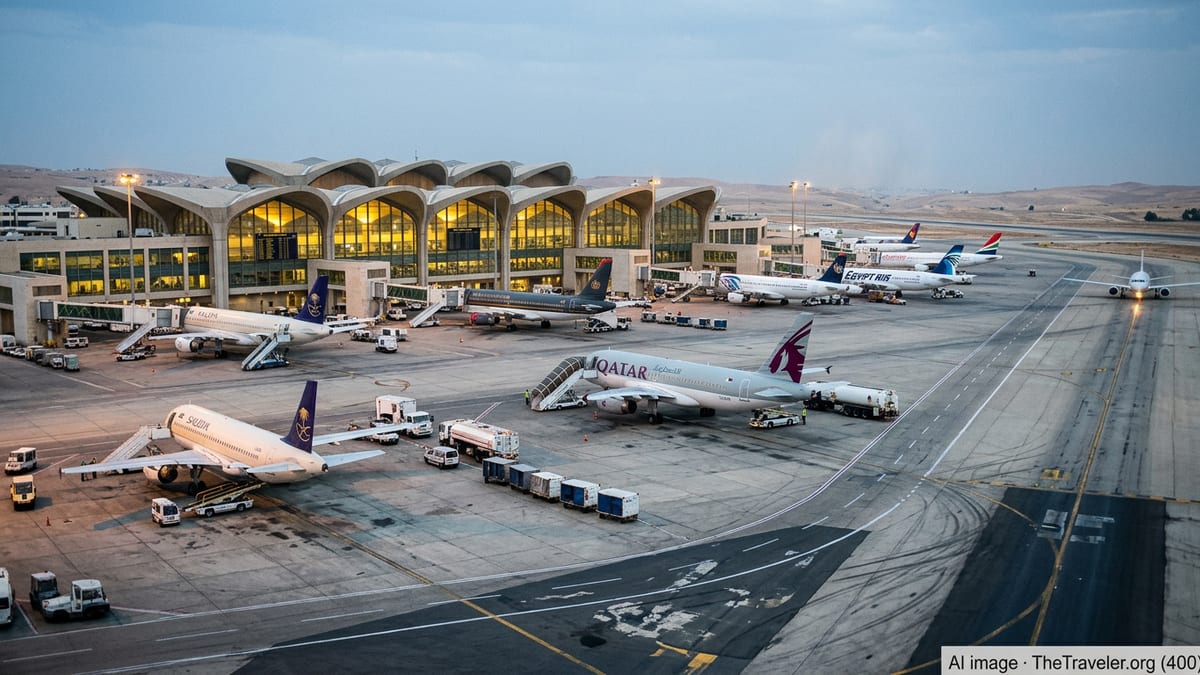
Regional Security Crisis Hits a Major Transit Hub
Queen Alia International Airport, Jordan’s primary gateway and a critical connector between Europe, the Gulf and Asia, has become a focal point of the latest wave of aviation disruption across the region. Recent missile attacks attributed to Iran on targets in neighboring states have prompted airlines and air-navigation authorities to reassess routings, trigger temporary airspace restrictions and, in some cases, cancel planned services into Amman.
Published coverage from regional outlets in recent days describes multiple cancellations affecting flights operating to and from Queen Alia, particularly those connecting Amman with Gulf and European destinations. Some airlines have pulled individual rotations or reduced frequencies, citing operational and safety assessments linked to the broader security situation rather than specific damage or incidents at the airport itself.
Publicly available flight-tracking and airport timetable data show an uneven picture. A portion of scheduled services are operating close to normal times, while others are listed as delayed, rerouted or cancelled altogether. This patchwork schedule has left passengers grappling with last-minute changes and long waits for rebooking options during one of the busiest travel periods of the year.
Travel industry analyses note that Jordan’s airspace sits on key long-haul corridors between Europe and the Gulf and onward to Asia. As a result, even short-lived airspace measures or updated risk assessments can cascade quickly, affecting not only travelers originating in Jordan but also those using Amman as a connecting point.
Authorities Stress Normal Operations as Disruptions Persist
Jordan’s Civil Aviation Regulatory Commission has recently emphasized in public statements that Jordanian airspace remains fully open and that operations at Queen Alia are proceeding according to scheduled flight plans. The regulator has highlighted ongoing coordination with airlines and air-navigation partners to manage any operational impacts stemming from the regional security environment.
Travel advisories and aviation risk summaries compiled by international organizations, however, continue to flag Jordan’s Flight Information Region for heightened monitoring due to nearby conflict zones. These notices encourage airlines to incorporate additional risk assessments into their routing and scheduling decisions, contributing to a more cautious operating posture for some carriers.
Airport arrivals and departures boards reviewed in recent days show many flights marked on time alongside an identifiable stream of cancellations and schedule changes. The mixed picture underlines the distinction between the formal status of the airspace, which remains open, and the individual decisions airlines are making about specific flights, routing options and crew deployments.
Travel blogs and passenger forums tracking Amman operations through the summer report a pattern in which national carrier Royal Jordanian and select regional airlines maintain relatively robust schedules, while some foreign low-cost and leisure operators have thinned their operations or withdrawn certain flights altogether.
Passengers Confront Uncertainty and Last-Minute Changes
The uneven operating environment has created significant uncertainty for travelers. Accounts shared on travel forums describe passengers arriving at departure airports in Europe and the Gulf only to discover that onward segments to Amman have been cancelled or heavily delayed. Others report successful journeys that nonetheless involved last-minute aircraft swaps, new routings through alternative hubs or extended layovers.
Publicly available information from consumer-rights and airline-policy resources indicates that options for affected passengers vary considerably depending on the carrier and fare type. Some airlines are offering free date changes or rerouting through alternative hubs, while others are applying standard change fees and fare differences, leaving travelers to weigh whether to postpone trips or accept more complex itineraries.
Experts and frequent travelers contributing to online discussions suggest that those with imminent departures to Jordan build in extra buffer time, particularly when itineraries rely on tight connections or mix different carriers on separate tickets. They also highlight the importance of monitoring both airline notifications and airport-arrivals pages, since changes are sometimes reflected in operational data before email or app alerts reach passengers.
Reports from recent arrivals into Queen Alia suggest that landside conditions at the terminal remain relatively orderly, with the primary strain falling on airline ticket counters, call centers and digital customer-service channels as travelers attempt to secure new seats after cancellations.
Airlines Adjust Schedules as Summer Peaks
Airline scheduling data and network updates compiled by aviation trackers show that some carriers serving Amman have trimmed their summer flying programs or adjusted timings to account for potential rerouting and crew constraints. This is particularly evident among low-cost and point-to-point operators that have less flexibility to absorb sudden operational shocks on thin routes.
In contrast, hub-and-spoke airlines with larger fleets and multiple daily frequencies on key corridors appear better able to shuffle aircraft and crews, either maintaining service to Amman or substituting connections through alternative hubs. Jordan’s home carrier, which uses Queen Alia as its principal hub, continues to market a broad network to and from Amman while acknowledging in public information that isolated flights may be subject to delay or change.
Industry bulletins covering the broader Middle East note that Queen Alia is not alone in facing summer turbulence. Airports across the region, including major hubs in the Gulf, are working through their own combinations of weather, traffic congestion and security-related airspace measures. For Amman, this has reinforced its dual role as both an origin-and-destination market and a versatile backup routing option for airlines seeking alternatives around congested or restricted skies.
Capacity analysts suggest that if the current security tensions ease, schedules to and from Amman could normalize relatively quickly, as there have been no reports of physical damage to the airport’s infrastructure or long-term closure of its facilities. For now, however, the operational environment remains fluid, and airlines are likely to retain contingency plans for sudden shifts in risk assessments.
What Travelers Through Amman Should Expect Now
For passengers planning to transit Queen Alia in the coming days, publicly available guidance from airlines, travel agencies and government advisories points to a similar set of recommendations. Travelers are encouraged to reconfirm flights frequently in the 24 to 48 hours before departure, ensure that airlines have up-to-date contact details and consider options that provide greater flexibility for changes.
Some travel advisories also draw attention to the possibility of temporary airspace restrictions or reroutings that may lengthen flight times, even when services operate as scheduled. This can be particularly relevant for long-haul itineraries linking Europe and North America to destinations further east via Amman, where additional routing mileage may affect arrival times and onward connections.
Insurance specialists and consumer advocates note that comprehensive travel insurance policies with explicit coverage for security-related disruption can help mitigate financial risk, though coverage terms differ widely. Passengers are advised in publicly available guidance to review policy wording carefully and to document any cancellations or delays for potential claims.
While the overarching message from Jordanian aviation authorities is that Queen Alia International Airport remains open and functioning, the real-world experience for passengers is one of elevated uncertainty. Until regional tensions ease and airline confidence in stable routings returns, travelers using Amman’s main airport are likely to continue navigating an unpredictable mix of normal operations and sudden disruption.