


More news on this day
Germany’s busiest air hubs in Frankfurt, Munich, Berlin Brandenburg, Düsseldorf, and Stuttgart experienced significant disruption this weekend, with publicly available tracking data showing around 1,216 flights delayed and at least 43 services canceled, affecting carriers including Lufthansa, Eurowings, Condor, Ryanair, easyJet, and several smaller operators across domestic and international networks.
Get the latest news straight to your inbox!
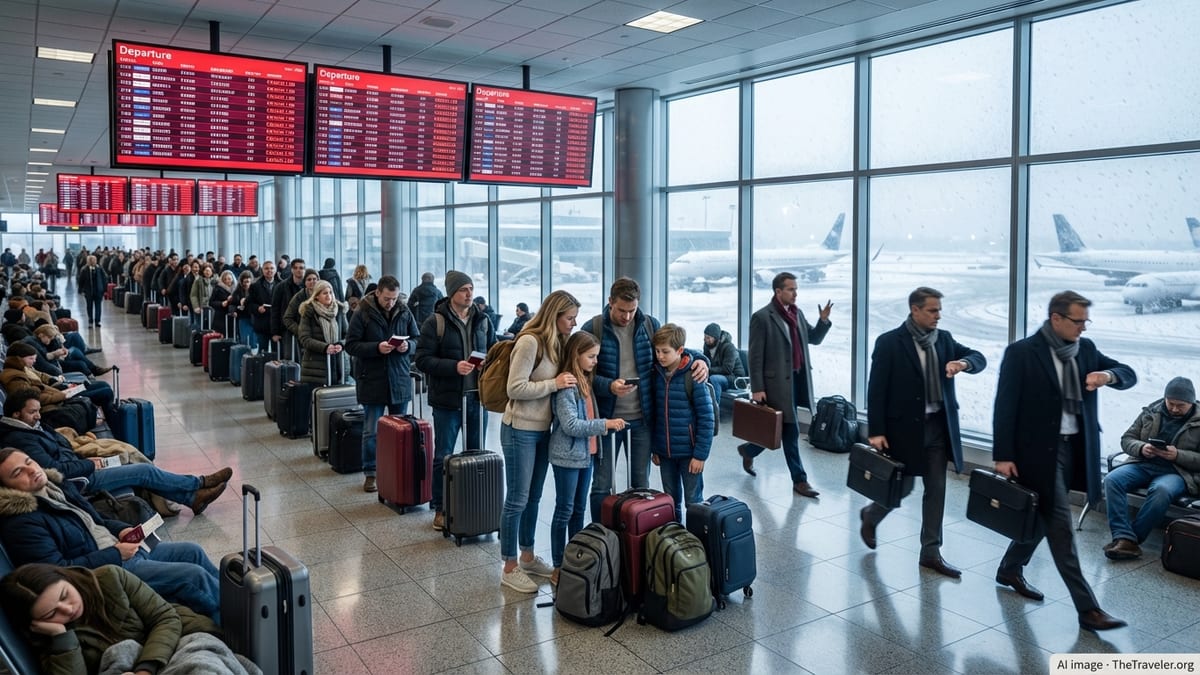
Widespread Disruptions Across Germany’s Key Hubs
The disruption has been most visible at Frankfurt and Munich, Germany’s primary long haul gateways, but has also rippled through Berlin Brandenburg, Düsseldorf, and Stuttgart. Flight status boards at these airports showed dense clusters of late departures and arrivals throughout Sunday, with knock on effects on regional connections and overnight rotations.
Publicly available flight monitoring platforms indicate that delays ranged from short schedule slips of 20 to 40 minutes to extended hold ups of several hours. While most services eventually departed, the volume of delayed flights led to missed connections, rebookings, and crowding in terminal areas as passengers attempted to rearrange travel plans.
Airlines most affected include Germany’s flag carrier Lufthansa and its low cost subsidiary Eurowings, alongside leisure operator Condor and major pan European budget airlines such as Ryanair and easyJet. Smaller European carriers with codeshare or feeder arrangements into the German hubs also reported schedule disruptions as rotations fell behind.
Germany’s aviation market remains centered on these large nodes, with recent traffic analyses underscoring Frankfurt’s position as the country’s largest airport by departures and highlighting Munich, Berlin, Düsseldorf, and Stuttgart as critical secondary hubs. When irregular operations hit several of these airports at once, schedule resilience is quickly tested across the wider European network.
Weather, Congested Airspace, and Operational Strain
Initial assessments from aviation data providers point to a combination of summer storm activity, temporarily restricted airspace, and existing operational strain as key drivers behind the spike in delays and cancellations. Thunderstorm warnings have affected parts of central Germany this weekend, with convective weather requiring aircraft to adjust flight paths, accept longer routings, or wait on the ground until conditions improved.
In tightly scheduled networks, these kinds of weather related constraints can rapidly cascade. Aircraft and crews caught out of position at one airport force airlines to retime or consolidate flights at others. Short haul services within Germany, including high frequency shuttles linking Frankfurt, Munich, and Berlin, are particularly vulnerable because they rely on fast turnarounds and tight connection windows.
The disruptions come in the context of a generally stretched European aviation system in 2026. Recent monitoring reports describe a pattern of reduced schedule buffers, persistent staffing challenges at some airports, and recurring pressure from industrial actions and infrastructure upgrades. In Germany, large hub airports have at times struggled with long queues at border control and security during peak waves, making recovery from any disruption slower.
Over recent months, travelers using Frankfurt and other major German airports have reported congestion at checkpoints and lengthy lines, which can magnify the impact of even modest delays. When flights are held to accommodate connecting passengers stuck in queues, later departures in turn affect arrival punctuality at downstream destinations.
Impact on Airlines and Passengers
For airlines, an irregular operations day of this scale carries both direct and indirect costs. Extra fuel burn from holding patterns and diversion routings, extended crew duty times, and the need for overnight aircraft and staff positioning all add to operational expenses. Budget and network carriers alike may also face compensation claims from passengers on flights that fall within Europe’s consumer protections for long delays and cancellations when the causes are determined to be within airline control.
For travelers, the consequences are immediate and often stressful. Passengers caught up in the disruption have faced missed connections to long haul services, particularly those transferring through Frankfurt and Munich, where onward flights to North America, Asia, and the Middle East leave in tightly timed banks. Others on intra European leisure routes from Berlin, Düsseldorf, and Stuttgart have encountered late arrivals at holiday destinations or shortened weekend trips.
Accommodation and rebooking options can quickly become scarce when multiple airports in the same country experience problems on the same day. Reports from previous disruption episodes in Germany show that nearby hotels often reach capacity early, while alternative routings via other European hubs sell out or become significantly more expensive as travelers compete for remaining seats.
In addition, ground transport alternatives sometimes struggle to absorb the sudden demand created by mass flight delays. While Germany’s rail network offers extensive domestic connectivity and is frequently used as a backup option for short haul trips, recent coverage has highlighted its own challenges with punctuality and capacity, limiting its ability to fully offset widespread airline disruption.
Domestic and International Routes Affected
The pattern of delays and cancellations has cut across both domestic German and international services. High frequency shuttles linking major cities such as Frankfurt, Munich, Berlin, Düsseldorf, Stuttgart, Hamburg, and Cologne have seen multiple disrupted rotations, complicating travel for business passengers and those relying on same day trips.
Internationally, the effects have been felt on popular European city pairs and holiday corridors. Routes from Germany to Mediterranean destinations, including Spain, Italy, Greece, and Turkey, have seen clusters of delayed departures, affecting flights run by Lufthansa and Eurowings as well as Condor, Ryanair, and easyJet. Some long haul services from Frankfurt and Munich to North America and Asia have also been impacted when inbound aircraft arrived late or when connecting passenger flows could not be processed in time.
Smaller regional airports that depend heavily on feed from the main hubs have experienced knock on effects. When aircraft arriving from Frankfurt or Munich are delayed, onward domestic or cross border services may depart late or shift to different aircraft types, creating further rebookings. Travelers on these routes are often more exposed to schedule changes because there are fewer daily frequencies and limited alternative connections.
Aviation analysts note that periods of intense disruption at core German airports can reverberate across the continent, as many airlines use Frankfurt, Munich, and Berlin as transfer points within broader European and intercontinental networks. As a result, irregular operations concentrated in Germany can still be felt as far away as secondary airports in southern and eastern Europe that rely on these hubs for connectivity.
What Travelers Can Do If Their Flight Is Affected
Given the scale of Sunday’s disruption, travelers booked through German hubs in the coming days may benefit from taking additional precautions. Passenger advocacy groups and industry guidance commonly recommend checking flight status early and often on both airline and airport channels, as schedules can change multiple times in a short period when operations are strained.
For journeys involving tight connections, some travel advisers suggest building in longer layovers at Frankfurt, Munich, and Berlin in particular, where queues at border control or security can extend connection times beyond what was typical in previous years. Where practical, choosing earlier flights in the day or avoiding the busiest late afternoon departure waves may provide more recovery options if something goes wrong.
Travelers who experience long delays or cancellations are generally encouraged to keep documentation of disruption times, rebooking confirmations, and any additional expenses. This information can be useful when seeking refunds, compensation, or travel insurance claims later. In the European context, national enforcement bodies and consumer organizations publish guidance on passenger rights that can help clarify eligibility in specific situations.
With summer travel demand expected to remain strong and Germany’s major airports operating close to capacity, observers anticipate that periods of instability may persist through the peak season. For passengers, careful planning, flexible itineraries, and an awareness of backup options such as rail or alternate routings may prove essential tools for navigating an increasingly unpredictable travel environment.