


More news on this day
Hundreds of travelers were left stranded and schedules severely disrupted at Athens International Airport on June 9 as a wave of operational bottlenecks pushed 351 flights into delay and forced at least three cancellations, affecting a wide swath of domestic and international services run by Aegean Airlines, Sky Express, Ryanair, Lufthansa, Emirates and other major carriers.
Get the latest news straight to your inbox!
Operational Strain Hits Greece’s Busiest Hub
Athens International Airport, Greece’s primary gateway and one of Europe’s key summer hubs, experienced heavy disruption on June 9 just as peak tourist traffic accelerated into high season. Publicly available flight-tracking boards for the day showed 351 arrivals and departures operating behind schedule and three services removed from the schedule altogether, creating knock-on delays across the network serving Greece’s islands and major European cities.
The disruption came as the airport is managing strong growth in passenger numbers and flights. Athens has expanded its role as a connecting hub between Europe, the Middle East and North America, with carriers such as Aegean Airlines, Sky Express, Ryanair, Lufthansa, Emirates and others all increasing seasonal capacity to destinations including London, Paris and Rome, as well as popular island routes to Santorini and other Aegean gateways.
European aviation monitoring data for spring and early summer 2026 indicates that the Athens air traffic control area has been facing persistent capacity pressure, with average delay minutes per flight rising compared with earlier periods. Analysts have linked these trends to a combination of staffing limitations, dense summer schedules and weather-related constraints in parts of the region, making the system more vulnerable to daily fluctuations in demand.
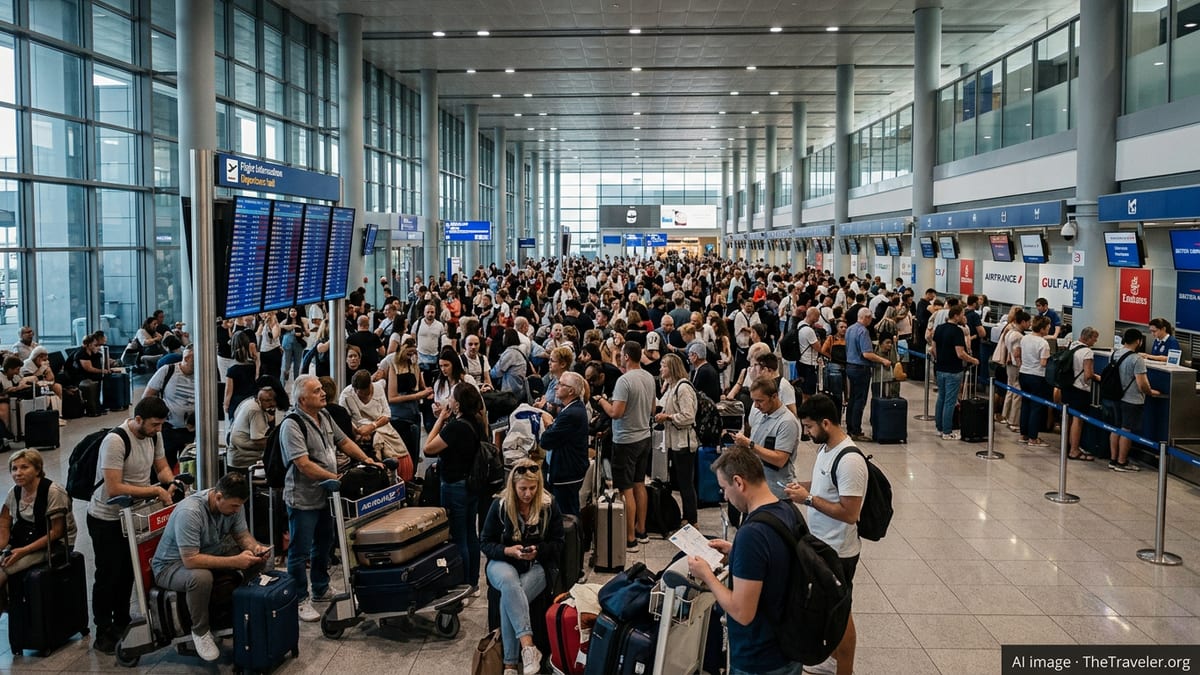
On June 9, that pressure translated into visible queues at check-in, longer waits at security and crowded gate areas as passengers on delayed flights waited for revised departure times and rebooked connections. Social media posts and traveler forums showed images and accounts of packed departure halls, missed onward flights and extended waits for information on rebooking and compensation.
Wide Impact Across Aegean, Sky Express and European Carriers
Aegean Airlines, Greece’s flag carrier and the largest operator at Athens International Airport, saw delays ripple across both its domestic island network and key European routes. Tracking services showed hold-ups on flights between Athens and major cities such as Rome and Berlin, as well as on high-demand island sectors including connections to Santorini and other leisure destinations.
Regional operator Sky Express, which relies heavily on Athens as a hub for its domestic services, also experienced schedule irregularities. Flight-status platforms indicated that several Sky Express departures between Athens and the islands operated behind schedule, while at least one Athens to Santorini service was marked as cancelled on June 9. Industry data already shows that a significant share of the airline’s departures from Athens are subject to delays, and the latest disruption added fresh strain on passengers trying to complete same-day island connections.
Low-cost carrier Ryanair, which runs a mix of domestic and international services to and from Athens, was likewise caught in the congestion. Delays on its Greek routes, combined with congested airspace over central Europe, contributed to late arrivals and departures on city pairs linking Athens to northern and western European markets.
Legacy network airlines such as Lufthansa and long-haul operators including Emirates, which connect Athens with major hubs such as Frankfurt, Munich, Dubai and New York, also faced schedule pressure as late inbound aircraft shortened turnarounds and complicated connection windows. For some long-haul travelers, missed onward flights at European or Middle Eastern hubs extended total journey times by many hours.
Knock-On Delays for London, Paris, Rome and Key Holiday Routes
The timing of the disruption proved particularly problematic because it affected routes that are already running close to capacity. Flights linking Athens with London, Paris and Rome, among the most heavily traveled city pairs from the Greek capital, reported a mix of late departures and arrivals, according to online tracking data. Even modest delays on these trunk routes can cascade through airlines’ daily rotations, affecting subsequent flights on the same aircraft.
Holiday traffic to the islands was also affected. Services between Athens and Santorini, one of the airport’s busiest domestic links by passenger volume, encountered a combination of delays and at least one same-day cancellation. Travelers connecting from long-haul flights into the domestic network reported missed ferries, lost hotel nights and the need to purchase last-minute tickets on alternative departures to reach their final destinations.
The disruption underscored how tightly coupled Athens has become with broader European and intercontinental networks. A delayed departure from Athens to a hub such as Frankfurt or London can cause missed connections for travelers heading onward to North America, the Middle East or Asia, while late inbound flights from those regions can destabilize evening bank departures to Greek islands and regional European cities.
Travel advisors monitoring the situation noted that even a few cancelled flights at a major hub can amplify the effect of rolling delays, especially when average load factors are high and spare seats on later flights are limited. With aircraft and crew operating near full utilization in June, options for rapid recovery were constrained.
Structural Challenges: Capacity, Regulation and Summer Demand
The events of June 9 highlight ongoing structural challenges affecting Athens International Airport and Greek airspace. European aviation performance reports for early 2026 show that the Athens area control center has recorded some of the higher average en-route delay minutes in the region, often attributed to capacity limits and staffing issues within the air traffic management system. These constraints mean that even routine disruptions can quickly accumulate into significant schedule irregularities.
At the same time, new European border systems are adding complexity for certain categories of travelers. The full deployment of the European Union’s Entry/Exit System in March 2026 for many non-EU nationals arriving in and departing from the Schengen Area has introduced new registration and verification steps. While designed to enhance border security and manage data, these procedures can lengthen processing times at peak hours, particularly during the busy summer season when arrivals from long-haul markets surge.
Operational rules governing airport slot management and prior-permission requirements in Greece also influence how airlines can respond to disruption. Guidance for summer 2026 indicates that requests to significantly extend already confirmed flights may trigger the need for new slot approvals. In practice, this means some heavily delayed services are more likely to be cancelled and refiled than simply pushed back, contributing to the mix of delays and cancellations observed on June 9.
Weather patterns around Europe further complicate planning. Recent weeks have seen thunderstorms and low-visibility conditions affecting major hubs such as Frankfurt, which in turn have delayed flights inbound to Athens and constrained onward connections. When such external factors combine with local capacity limitations, the result is often a day of widespread delays, as experienced by travelers in Athens.
What Passengers Can Expect and How to Prepare
The scale of disruption at Athens International Airport on June 9 serves as a reminder for travelers to build more resilience into their itineraries, especially during peak summer months. Aviation consumer advocates note that for complex journeys involving a domestic connection in Greece and an onward long-haul leg, leaving several hours between flights can reduce the risk of missed connections.
Passengers flying with Aegean, Sky Express, Ryanair, Lufthansa, Emirates and other carriers affected by significant delays or cancellations may also have entitlements under European air passenger rights rules. In many cases, airlines are obliged to provide care in the form of meals, refreshments and accommodation during long disruptions, and in specific circumstances financial compensation may be available when delays or cancellations are not caused by extraordinary circumstances.
Travelers are increasingly turning to real-time flight-tracking platforms and airport information services to monitor the status of their flights on days when congestion is reported. These tools can help passengers anticipate longer queues, adjust arrival times at the airport and, where possible, make alternative arrangements before reaching the terminal.
With the summer travel season entering its busiest phase, aviation data suggests that Athens and other Mediterranean hubs will remain under pressure. Unless additional capacity or operational flexibility is introduced, days like June 9, with hundreds of delayed flights and a handful of cancellations impacting a broad range of domestic and international routes, may continue to test the patience and planning of travelers heading to and from Greece.