


More news on this day
Jakarta’s Soekarno-Hatta International Airport has been hit by a fresh wave of disruption, with publicly available tracking data indicating 118 flight delays and 17 cancellations affecting Garuda Indonesia, Batik Air, Citilink, Super Air Jet, Lion Air and other carriers on routes across Indonesia, Singapore, Malaysia, Vietnam and China.
Get the latest news straight to your inbox!
Wide-Ranging Disruptions Across Domestic and Regional Networks
The latest operational turbulence at Soekarno-Hatta, Indonesia’s primary aviation hub serving Greater Jakarta, has rippled far beyond the capital’s airspace. Flight status boards on major tracking platforms show delays clustering around peak morning and evening waves, when domestic rotations to cities such as Denpasar, Makassar, Medan and Surabaya are heavily scheduled alongside international departures to Singapore, Kuala Lumpur, Ho Chi Minh City and major Chinese gateways.
Carriers most affected include Garuda Indonesia, Batik Air, Citilink, Lion Air and Super Air Jet, all of which maintain significant bases at Soekarno-Hatta and operate dense short-haul schedules. Their networks are closely intertwined, with multiple airlines often serving the same trunk routes. Industry analyses note that this structure can amplify the impact of a single delayed aircraft as late arrivals cascade into subsequent legs around the archipelago and into Southeast Asia and China.
Recent coverage by specialist aviation outlets highlights how a similar disruption pattern was observed only weeks earlier, when more than one hundred delays and over twenty cancellations were recorded in a short period at Soekarno-Hatta. That earlier episode also centered on the same group of Indonesian carriers, underscoring the vulnerability of the country’s hub-and-spoke system to even short bouts of operational stress.
Published data on routes such as Jakarta to Denpasar and Jakarta to Bandar Lampung, where Garuda Indonesia, Batik Air, Lion Air, Citilink, Super Air Jet and other airlines compete head-to-head, further illustrates how routine timetable tightness can leave little margin when turnaround times slip. When several aircraft on those sectors are held on the ground, the knock-on effect is quickly felt on onward flights to regional destinations.
Passengers Confront Crowded Terminals and Rolling Delays
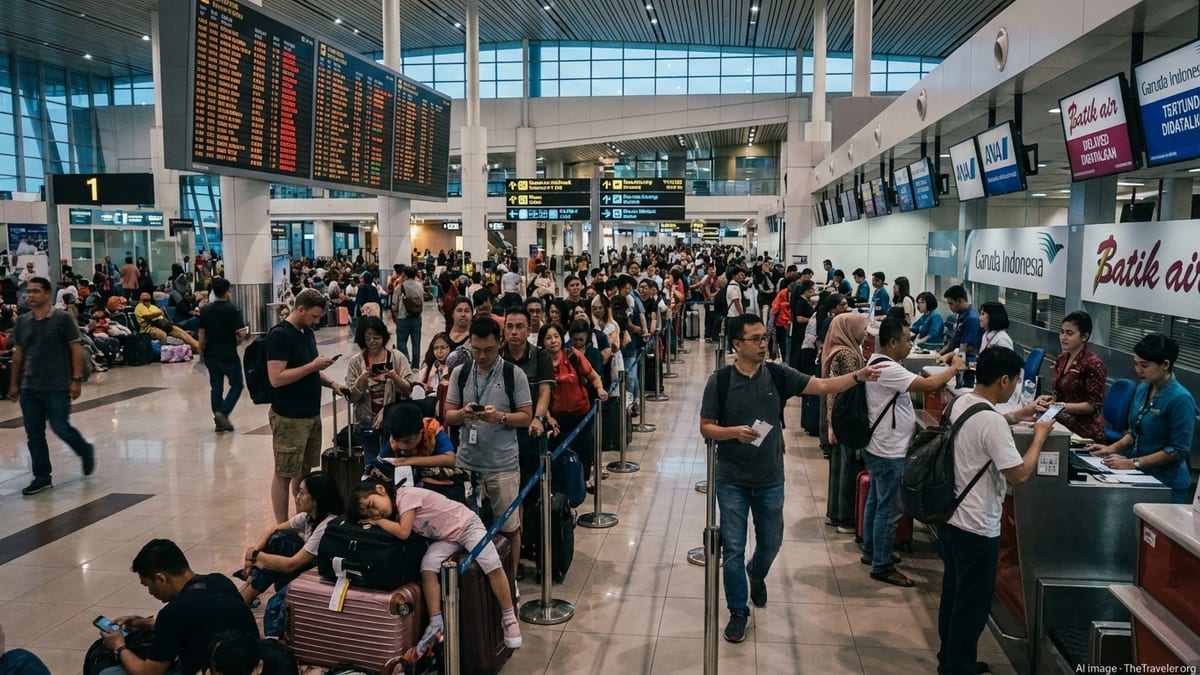
For travelers passing through Soekarno-Hatta, the statistics translate into crowded departure halls, longer queues at check-in and security, and last-minute gate changes. Publicly accessible arrival and departure boards show a patchwork of statuses, with flights variously marked as delayed, boarding, diverted or cancelled, particularly among services operated by Batik Air, Citilink, Lion Air and Super Air Jet.
Observers report that some passengers on domestic flights have faced delays running to several hours, while others have had journeys extended by missed connections or unplanned overnight stays. Viral social media clips in recent weeks have captured tense scenes around Indonesian carriers’ counters after significant schedule disruptions, including one widely shared incident involving a Super Air Jet service where travelers complained of a delay stretching to nine hours.
Airline customer policies play a crucial role in how these events are experienced. Public information from Indonesia’s Ministry of Transportation and airline websites sets out compensation rules and rebooking options for delayed or cancelled services, but implementation can vary in practice. During periods of concentrated disruption such as the current wave at Soekarno-Hatta, re-accommodating large numbers of passengers onto alternative services can take time, especially on already busy domestic corridors.
Travel forums reflect a growing awareness among frequent flyers of the differing on-time reputations of Indonesian carriers. Commenters often place Garuda Indonesia and, to a lesser extent, Citilink near the top of their reliability rankings, while expressing more mixed views on Lion Air Group operators such as Lion Air, Batik Air and Super Air Jet. The latest disruption figures are likely to feed into those perceptions as travelers reassess their options on popular routes.
Operational Pressures at Indonesia’s Busiest Hub
Soekarno-Hatta’s status as the country’s principal gateway and a key Southeast Asian hub means that even modest fluctuations in on-time performance quickly become visible. The airport handles a high volume of quick-turnaround narrowbody operations, with multiple airlines scheduling departures only minutes apart on the same routes. Academic studies on on-time performance at the airport have previously identified tight turnarounds, air traffic congestion and weather-related constraints as recurring challenges.
Published research into Indonesian airline punctuality has also documented how carriers such as Garuda Indonesia, Citilink, Lion Air, Batik Air and Super Air Jet routinely operate at utilization levels that leave minimal buffer. When operations are smooth, this allows airlines to maximize aircraft productivity. However, the same efficiency can expose networks to rapid schedule deterioration once a series of delays begins, particularly at single-runway or high-density airports.
Weather remains a significant variable. Earlier this year, heavy rainfall around Jakarta contributed to go-arounds, extended holding patterns and occasional diversions at Soekarno-Hatta. While current disruption figures have not been definitively linked to meteorological causes, the pattern of clustered delays and cancellations around specific time windows is consistent with scenarios where storms or low visibility temporarily constrain arrivals and departures.
Infrastructure and terminal layout are also potential stress points. Commentators have previously pointed to the complexity of transfers between terminals at Soekarno-Hatta, including for passengers holding separate tickets on different low-cost carriers. When flights arrive late and terminal changes are involved, missed connections and baggage complications can multiply the impact of relatively short primary delays.
Regional Ripple Effects Reaching Singapore, Malaysia, Vietnam and China
The wave of 118 delays and 17 cancellations at Soekarno-Hatta is not confined to domestic routes. Flight-tracking data shows knock-on effects along key regional corridors linking Indonesia with Singapore, Malaysia, Vietnam and China, where Jakarta functions both as an origin and as a transit point for passengers connecting from secondary Indonesian cities.
Services to Singapore and Kuala Lumpur are particularly exposed, given their role as high-frequency trunk routes used by both business and leisure travelers. When Jakarta-origin flights operate behind schedule, onward passengers risk missing evening banks of departures from those hubs to Europe, the Middle East and North Asia. Similar concerns apply to services connecting Jakarta with Ho Chi Minh City and Chinese cities, where regional carriers and Indonesian airlines coordinate schedules around limited slot availability.
Recent industry commentary has noted that foreign airlines serving Jakarta, including regional operators from Singapore, Malaysia and China, have adjusted schedules or equipment in response to broader reliability concerns on the Indonesia leg of their networks. While the current disruption period is driven primarily by Indonesian carriers, any sustained pattern of delays could prompt further tactical changes by overseas airlines seeking to protect long-haul connections.
For travelers planning multi-sector itineraries that include Jakarta, the latest events underline the importance of longer connection windows. Travel advisors commonly recommend more generous layovers when flying with a mix of low-cost and full-service airlines in Southeast Asia. The concentration of delays among certain carriers at Soekarno-Hatta raises the stakes for passengers who pair tight domestic segments with evening international departures.
What Travelers Can Do as Disruptions Continue
While the current episode adds to a series of recent disruptions at Jakarta’s main airport, there are practical steps that travelers can take to reduce their exposure. Aviation analysts broadly advise booking through itineraries on a single ticket where possible, particularly when connecting from domestic Indonesian flights to international services out of Jakarta, Singapore or Kuala Lumpur. This approach can improve rebooking options if an initial leg is delayed or cancelled.
Monitoring real-time flight status on tracking platforms and airline channels remains essential, especially for early-morning departures and late-evening returns that have featured prominently in recent delay statistics. Travelers departing from secondary Indonesian cities may also wish to consider earlier flights into Jakarta to build additional buffer before long-haul departures to destinations in Europe, North Asia or Australia.
The current disruption wave also highlights the value of understanding each carrier’s customer care and compensation policies before departure. Indonesian regulations set minimum standards for assistance in the event of significant delay or cancellation, but implementation can vary by airline and circumstances. Passengers who are informed about their entitlements are generally better positioned to navigate crowded service desks when problems arise.
With the region’s air travel demand continuing to recover, operational resilience at hubs such as Soekarno-Hatta is likely to remain a central concern for both airlines and travelers. The latest tally of 118 delays and 17 cancellations across Garuda Indonesia, Batik Air, Citilink, Super Air Jet, Lion Air and other airlines serves as a reminder that tight schedules and complex networks can quickly unravel when conditions deteriorate, sending shockwaves across domestic and regional skies.