


More news on this day
Air Macau is set to restart nonstop flights between Macau and Fukuoka from July 1 to August 31, 2026, creating a tightly focused summer corridor for Japan-bound travelers seeking alternatives amid a volatile regional aviation landscape.
Get the latest news straight to your inbox!
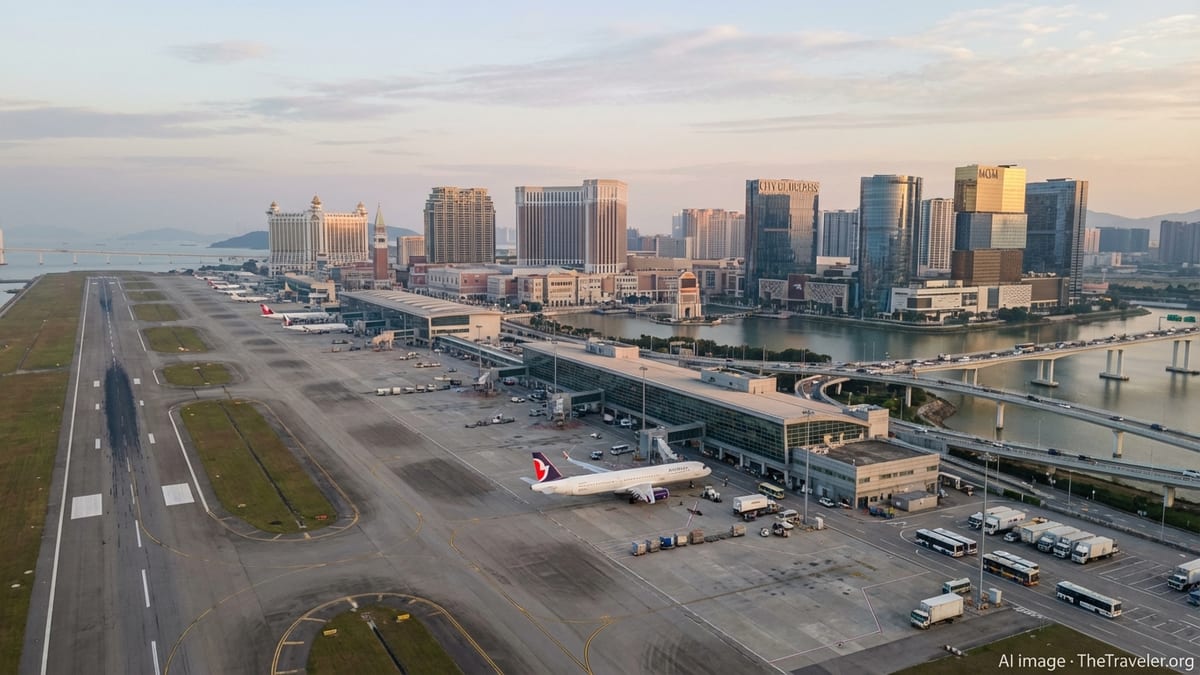
Seasonal Macau–Fukuoka Link Returns After Six-Year Pause
Publicly available schedules from Fukuoka Airport and route-tracking services show that Air Macau will resume passenger flights on the Macau–Fukuoka route on July 1, 2026, for the first time since services were halted in March 2020. The seasonal operation is currently scheduled to run only through August 31, positioning the link squarely as a summer offering.
Industry data indicates that the service will operate three times a week between Macau International Airport and Fukuoka Airport, with a block time of about three hours and twenty minutes. The route is currently the only planned nonstop connection between the two cities for the period, giving it outsize importance for travelers looking to bypass major hubs in Tokyo, Osaka, or Hong Kong.
Operational filings and airport notices point to Airbus A320-family aircraft as the backbone of the route, with configurations of around 150 to 190 seats. This places the Macau–Fukuoka link in the narrow-body leisure and regional-business segment, where airlines are trying to match capacity more closely to volatile demand patterns.
While the schedule is still subject to regulatory clearance and potential adjustment, the restart underscores how carriers are selectively reactivating niche regional routes that can support both tourism flows and onward connectivity without committing to year-round service.
Strategic Timing Amid Fuel Volatility and Network Cuts
The decision to launch the direct summer service comes at a time when regional carriers are navigating higher fuel costs and tightening capacity. Macau airport authorities have publicly acknowledged the pressure from elevated fuel prices, while also stressing plans to expand the network into mainland China and Northeast Asia in mid-2026. Air Macau itself has recently outlined flight reductions in other months, which highlights how carefully this seasonal deployment is being calibrated.
By confining the Macau–Fukuoka operation to July and August, Air Macau appears to be targeting the peak holiday season in both Japan and Greater China, when outbound leisure traffic is strongest and yields can better support thinner point-to-point routes. The move contrasts with broader cuts elsewhere in the network, suggesting that the carrier views Fukuoka as a high-potential niche rather than a marginal add-on.
Fukuoka’s position as a gateway to Kyushu also helps justify the seasonal restart. The city serves as a launchpad for domestic connections and rail links across southern Japan, allowing a single international flight from Macau to feed into a variety of summer itineraries without requiring Air Macau to assume additional long-haul or domestic risk.
In this context, the Fukuoka flights function less as a stand-alone experiment and more as part of a diversified regional strategy. The carrier and airport stakeholders appear to be prioritizing a mix of limited seasonal routes and more stable trunk connections, seeking to balance exposure to demand shocks with the need to rebuild Macau’s connectivity profile.
Offering a Detour Around Regional Air Travel Turbulence
The summer reopening of Macau–Fukuoka is particularly notable given ongoing disruptions and congestion elsewhere in the region. Travelers across East Asia have been facing a patchwork of capacity cuts, last-minute schedule changes, and reroutings through alternate hubs, especially on itineraries that previously relied on a dense web of short-haul connections.
With the direct Macau–Fukuoka service, passengers bound for Kyushu gain an option that avoids multiple domestic transfers or long detours via Tokyo or Seoul. For travelers in southern China or Southeast Asia who can reach Macau relatively easily, the route offers a way to consolidate connections at a smaller hub rather than contend with queues and slot constraints at larger airports.
Route-mapping platforms show that, once active, the service will sit alongside Air Macau’s broader Northeast Asia network, including links to Tokyo, Osaka, and Seoul. This gives the airline an opportunity to market Macau as a comparatively low-friction jumping-off point for Japan, especially during a season when many major hubs are expected to operate near capacity.
The effect is to partially insulate a slice of summer travelers from the wider regional turbulence, even if the protection is modest and concentrated in a two-month window. For tourism operators and passengers focused on Kyushu, however, having a simple, single-flight option can be a meaningful difference in trip planning.
Capacity, Schedule Details, and Traveler Takeaways
Flight timetable data compiled by aviation trackers indicates that Air Macau plans to operate the route three times per week, typically aligned to midweek and end-of-week peaks. A commonly referenced pattern has departures from Macau in the morning, arriving in Fukuoka around early afternoon, with the return sector leaving Fukuoka mid-afternoon and reaching Macau by early evening.
Seat maps and equipment listings suggest that most flights will use Airbus A320-family aircraft configured with a small premium cabin and a majority of economy seating. That mix reflects the route’s dual role: serving leisure passengers drawn by Kyushu’s onsen towns and coastal scenery, while still accommodating regional business and gaming-related traffic moving through Macau.
For travelers, the main advantage lies in simplicity. Instead of connecting through larger, busier hubs, passengers can move directly between Macau and Fukuoka in a single hop and then use Fukuoka’s domestic network or rail system to reach destinations across Kyushu and beyond. This can cut travel time compared with itineraries that involve backtracking through major metropolitan airports.
However, the limited operating window and three-times-weekly frequency mean that flexibility will be constrained. Travelers planning to rely on the route are likely to need to book early and build itineraries around the specific operating days, particularly during peak holiday weeks when demand for Kyushu and Macau is typically strongest.
Macau’s Broader Push to Rebuild Regional Connectivity
The return of Macau–Fukuoka fits into a broader effort by Macau International Airport and its home carriers to rebuild and diversify regional connectivity after several years of disruption. Industry databases covering Air Macau’s network as of June 2026 show a portfolio of more than 30 destinations across mainland China and Asia, with new or restored links to markets such as Manila and additional cities in Japan and Southeast Asia.
Airport-level statistics for the first quarter of 2026 indicate a double-digit increase in passenger traffic year-on-year, driven by returning tourism and gaming activity alongside growing outbound demand. Within that context, niche seasonal routes like Fukuoka provide both a marketing boost and a practical way to absorb peak-season flows without overcommitting capacity in shoulder periods.
For Japan, the Macau–Fukuoka route adds another spoke to an increasingly complex web of regional links that now stretches beyond Tokyo and Osaka to cities like Fukuoka, Sapporo, and secondary hubs in Kyushu and Shikoku. This supports tourism strategies aimed at dispersing visitors more evenly across the country and encouraging travel to less crowded destinations.
Whether the route continues beyond summer 2026 will likely depend on load factors, fare performance, and the broader regional environment, including fuel prices and competitive moves by other carriers. For now, Air Macau’s decision to bring back the Macau–Fukuoka connection on a seasonal basis signals that targeted, time-limited regional routes can still find a place in an era of cautious capacity planning and heightened operational risk.