


More news on this day
Passengers at Cairo International Airport faced hours of disruption today as more than 130 delayed departures and at least 15 cancellations snarled domestic and international traffic on routes linking Egypt to major hubs including Dubai, London, New York, Frankfurt, and Paris.
Get the latest news straight to your inbox!
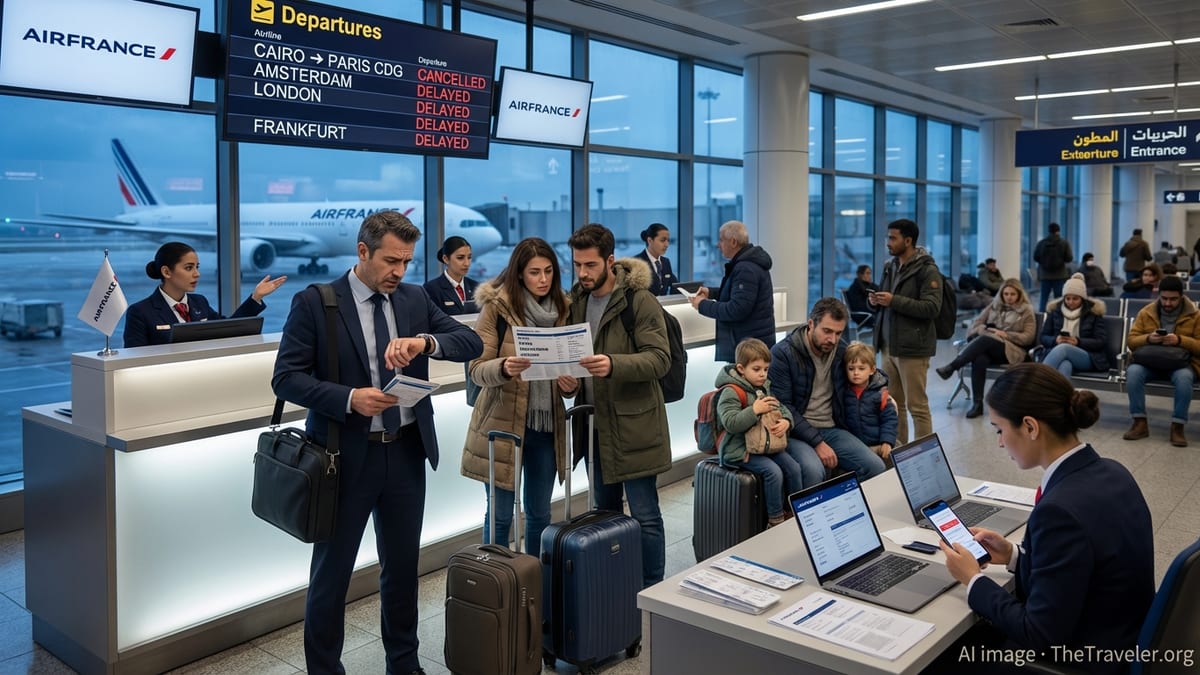
Widespread Disruptions Hit Egypt’s Busiest Hub
Live airport boards and third-party flight trackers for May 12 indicate an unusually high volume of delayed and canceled flights at Cairo International Airport, with disruption concentrated across the morning and early afternoon departure banks. The pattern shows dozens of services pushed well past their scheduled departure times and a cluster of outright cancellations, affecting both regional and long haul travel.
Publicly available flight data points to at least 131 delayed services and 15 cancellations over the course of the day, an elevated figure for the country’s primary international gateway. EgyptAir, which uses Cairo as its main hub, appears to be most heavily affected, but schedules for other carriers operating into and out of Cairo are also showing knock-on delays.
Arrivals into Cairo have been similarly strained, with flights from cities such as Istanbul, Port Sudan, Asmara, and Beirut among those listed as canceled or heavily delayed. Travelers transiting through the airport on their way to onward destinations across Africa, Europe, the Gulf, and Asia have reported extended waits as connection windows evaporate and rebooking queues lengthen.
The operational pressure comes as Cairo continues to position itself as a regional transfer hub, with expanding long haul services and ongoing infrastructure upgrades at its terminals. On days of irregular operations, the airport’s role as a major connecting point amplifies the impact of every delayed departure or missed arrival.
Major Carriers Affected on High-Profile Routes
EgyptAir’s own network shows multiple delays on services from Cairo to destinations including Shanghai and N’Djamena, reflecting the strain on aircraft rotations and crew scheduling. At the same time, flights arriving into Cairo from Asia and the Gulf are operating on revised timetables, further complicating the airline’s hub-and-spoke operations.
Emirates services between Cairo and Dubai have also been touched by today’s disruption, with at least one rotation arriving behind schedule after departure from Cairo. While published information suggests the Dubai route remains broadly operational, even modest delays on such a key corridor can cascade across onward connections to Europe, North America, and Asia for passengers relying on tight transfer windows in Dubai.
Lufthansa’s Cairo services feed into Frankfurt, one of Europe’s busiest hubs, and are an important link for travelers heading to and from North America and the wider continent. Delays from Cairo risk disrupting not only point-to-point passengers but also those connecting onward to cities such as London, Paris, and New York. Recent schedule adjustments related to fuel costs and broader European capacity constraints mean there is often less slack in the system when irregular operations occur.
Transatlantic travelers are feeling the impact as well. Cairo’s long haul links into London, Paris, and key US gateways like New York form part of complex itineraries that may combine EgyptAir, European network carriers, and Gulf airlines. Disruptions on any segment of these chains can lead to missed onward flights, unexpected overnight stays, or the need to reroute via alternative hubs such as Istanbul, Doha, or Abu Dhabi.
Regional Instability and Fuel Costs Add to Airline Strain
The latest disruption in Cairo comes against the backdrop of a turbulent year for global aviation, particularly across the Middle East. Airports including Dubai have recently operated with constrained capacity and modified schedules amid ongoing regional security concerns, creating a fragile network in which even routine weather or technical issues can cause outsized disruption.
At the same time, industry analyses highlight a sharp rise in jet fuel prices over the spring and summer months of 2026, prompting airlines worldwide to trim schedules and consolidate frequencies on less profitable routes. Carriers such as Lufthansa and United have already announced significant reductions in planned flying, and regional operators are increasingly cautious about adding spare capacity that could absorb irregular-operation shocks.
In this environment, large network airlines are operating closer to the edge of their available resources. With fewer standby aircraft and leaner crew rosters, a cluster of delays at a hub like Cairo can quickly snowball into a network-wide problem, as aircraft and staff end up out of position for subsequent rotations. Passengers experience this as rolling delays, last-minute schedule changes, and diminished options for same-day rebooking.
Experts in consumer aviation rights note that sustained cost pressures often translate into more fragile operations for travelers, particularly at secondary and regional hubs. Cairo’s ambition to act as a bridge between Africa, Europe, and Asia means it is especially exposed when global fuel markets are volatile and neighboring hubs are already dealing with their own disruption.
Stranded Passengers Face Long Queues and Limited Clarity
Reports from social media and traveler forums describe crowded departure halls at Cairo International Airport today, with long lines forming at airline service desks as passengers seek rebooking options. Many travelers connecting onward to Dubai, London, Frankfurt, Paris, and New York appear to be among the hardest hit, as missed connections ripple through already-tight transfer windows.
Travelers recount being directed between self-service kiosks, airline counters, and call centers in search of updated itineraries. With multiple carriers affected and aircraft rotations running behind schedule, available seats on alternative flights are limited, particularly on popular evening departures to Europe and overnight services to North America.
Families traveling with children, tour groups returning from Nile and Red Sea holidays, and business travelers on tight schedules are all contending with the same bottlenecks. Some passengers have reported settling in for overnight stays in airport seating areas after learning that onward flights to key hubs are fully booked or significantly delayed.
Publicly available airport guidance emphasizes the importance of checking flight status before traveling to the terminal, but many passengers caught in today’s disruption were already in transit or mid-journey when delays escalated. For those stuck airside between flights, options are often limited to waiting for updated boarding information or seeking assistance from ground staff overwhelmed by demand.
What Travelers Can Do If Flying Via Cairo
Travel and aviation specialists suggest that passengers scheduled to connect through Cairo in the coming days closely monitor their flight status using official airline tools and airport departure boards. With disruptions still working their way through aircraft rotations, further knock-on delays remain possible even after the current backlog begins to ease.
Where feasible, travelers with flexible plans are advised to build in longer connection times, particularly if their itineraries involve onward flights to distant hubs such as Dubai, London, Frankfurt, Paris, or New York. Longer layovers increase the chances of making onward flights even when initial departures are delayed, and can reduce the stress of racing between terminals or gates.
Passengers already affected by today’s disruption may be eligible for assistance under airline policies, depending on factors such as the cause of delay, length of disruption, and whether the journey is within or departing from jurisdictions with specific air passenger protections. Travel insurance providers also frequently offer coverage for extended delays, missed connections, and related accommodation costs, although terms vary widely.
With peak summer travel approaching and fuel-driven schedule changes still working through the global system, analysts expect further pockets of disruption across major hubs. For travelers using Cairo International Airport as a gateway between continents, careful planning, vigilant monitoring of flight information, and a degree of flexibility may prove essential in navigating an increasingly unpredictable travel landscape.