

More news on this day
Air travelers across the United States are facing another bruising travel day as a combination of storms, airport construction, and chronic airspace constraints trigger massive delays and cancellations for American Airlines, United Airlines, and Delta Air Lines, with thousands of passengers disrupted at major hubs in New York, Charlotte, Denver, and San Francisco.
Get the latest news straight to your inbox!
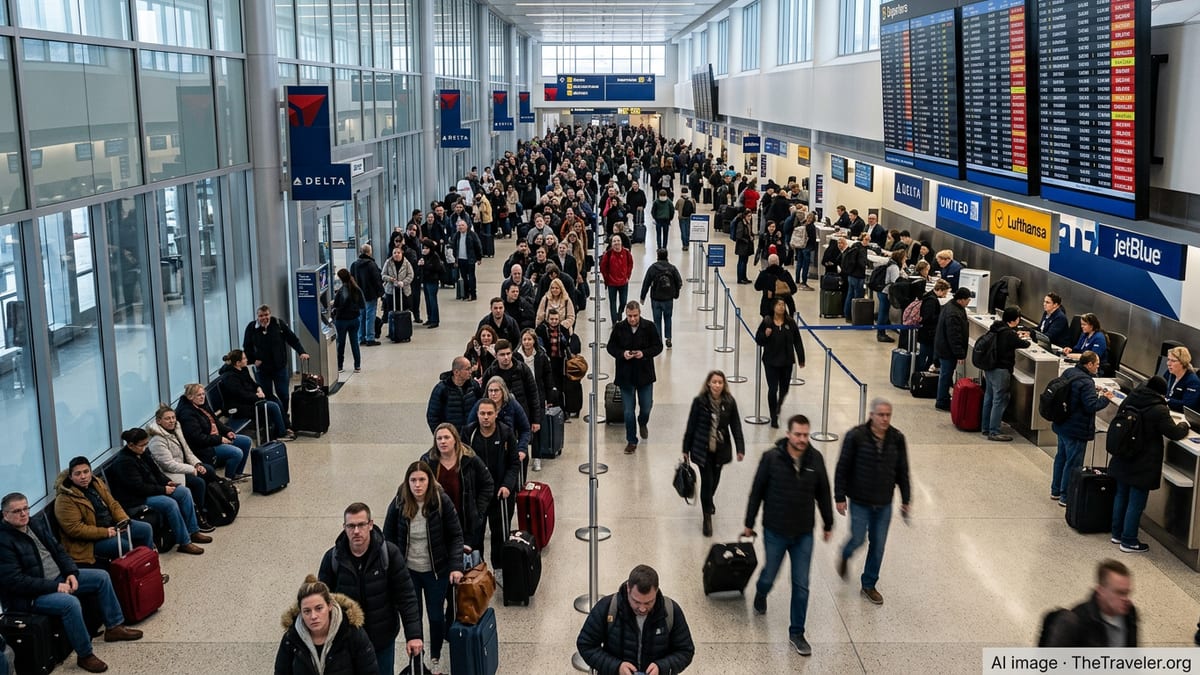
Weather Turmoil and Ground Stops Ripple Through Denver and San Francisco
Spring storms over the Rockies and the West Coast have placed Denver International Airport and San Francisco International Airport under recurring traffic management programs, including ground stops and ground delay measures. Publicly available Federal Aviation Administration data indicates that Denver has periodically held arriving flights on the ground elsewhere while high winds and thunderstorms moved through the area, quickly backing up departures and arrivals.
Local coverage in Colorado reports that recent high winds and storm cells over Denver prompted ground stops and average departure delays that, while sometimes logged at only minutes on paper, cascaded into missed connections and rolling disruption throughout the afternoon and evening. With United operating a large connecting hub in Denver and Delta and American both feeding regional traffic through the airport, any pause in arrivals or departures has quickly rippled into full flights, tight connection windows, and crowded rebooking queues around the network.
On the West Coast, FAA advisories show that San Francisco has faced a series of ground delay programs tied to low ceilings, coastal weather patterns, and ongoing airfield and airspace constraints. When these programs are active, the number of takeoffs and landings is capped below normal capacity, forcing airlines to hold flights at origin airports and lengthening scheduled gate holds. For travelers on United’s extensive transcontinental and Pacific routes from San Francisco, even modest reductions in hourly capacity can translate into long waits and missed onward flights.
Travel analytics and aviation reports suggest that the combination of Denver storms and San Francisco capacity limits has contributed to hundreds of delayed flights systemwide in recent days, with United, Delta, and American all absorbing schedule changes as they juggle aircraft and crews across tightly banked hub operations.
New York Congestion Compounded by Infrastructure and Weather Strains
In the New York region, a convergence of severe weather, airfield work, and persistent air traffic control staffing challenges has pushed already congested airspace to the breaking point. Recent reports on LaGuardia Airport describe how a runway sinkhole and subsequent infrastructure repairs left the facility operating with significantly reduced capacity just as powerful thunderstorms swept across the city, resulting in waves of cancellations and lengthy delays on peak travel days.
John F. Kennedy International and LaGuardia have also been subject to periodic ground delay programs and departure metering initiatives. According to published FAA air traffic updates, these measures are being used more frequently when demand exceeds what the limited runways and terminal airspace can safely accommodate. For American, Delta, and United, all of which maintain major schedules in the New York market either directly or via regional partners, that means aircraft often sit on the ground at origin airports for extended periods waiting for an open slot into the region.
Travel coverage focused on New York indicates that delays of 45 minutes to more than an hour are increasingly common during afternoon and evening peaks, particularly when thunderstorms or low visibility coincide with infrastructure projects. When early flights on shuttle-style routes between New York, Boston, and Washington depart late, the same aircraft frequently cycle through the day behind schedule, turning a single late pushback into a string of missed connections for travelers bound for the West Coast, the Midwest, or the Southeast.
Publicly available federal documentation on New York area operations also highlights ongoing staffing and capacity constraints in the regional air traffic control system, especially at key approach and departure facilities. These chronic bottlenecks, combined with infrastructure repairs and volatile East Coast weather, have left the Big Three carriers with little room to recover when disruptions hit, making New York a persistent flashpoint for cancellations and rolling delays.
Charlotte and Hub Construction Pressures Strain American’s Network
Further south, Charlotte Douglas International Airport has emerged as another vulnerability point during the latest wave of disruptions, particularly for American Airlines, which uses the airport as one of its primary connecting hubs. Federal planning and construction documents show that Charlotte has been managing multi-year runway and taxiway rehabilitation work that reduces peak capacity and can amplify the impact of storms or strong traffic surges.
Industry analyses and consumer guides focused on American Airlines note that the carrier’s reliance on large hub complexes such as Charlotte means weather or construction at a single airport can ripple across dozens of downstream routes. When arriving flights are slowed or held due to constrained arrival rates, turn times for onward departures lengthen, crews can outrun their duty limits, and aircraft are left out of position for subsequent legs.
Recent consumer discussions and explanatory material about American’s cancellation patterns describe how a single weather delay at a hub like Charlotte can lead to last-minute cancellations hours later on routes that are themselves experiencing clear skies. This is particularly acute during peak travel periods when spare aircraft and reserve crews are limited, leaving the airline with few options to recover without scrubbing flights.
Operationally, Charlotte’s role as a key connection point between the Northeast, the Southeast, and the central United States also means that disruptions there can indirectly affect travelers in cities that never see severe weather themselves. Passengers connecting through the airport on itineraries between New York and smaller regional destinations, or between Midwestern cities and Florida, have reported multi-hour delays and missed trips as American works to untangle its banked hub schedule following storms or construction-driven slowdowns.
Systemwide Impact on American, United, and Delta Performance
Aggregate tracking data compiled from flight-status services and aviation analytics providers show that, on several recent days, the United States has recorded thousands of delayed flights and hundreds of cancellations, with American, United, and Delta consistently appearing among the carriers most affected. While smaller airlines can sometimes adjust quickly by pruning thin schedules or swapping aircraft, the Big Three operate dense hub-and-spoke networks that are particularly vulnerable to weather and airspace shocks at a handful of key nodes.
Reports focusing on airline punctuality indicate that United’s operations have been especially challenged at Denver and San Francisco, where weather-driven ground stops and coastal arrival-management constraints have coincided with heavy demand. Delta, meanwhile, has continued to contend with scrutiny over its ability to recover from major disruptions after a high-profile technology outage in 2024 led to thousands of cancellations. Although the current wave of delays is driven primarily by weather and airport capacity rather than internal system failures, consumer advocates point out that passengers remember how quickly or slowly airlines recovered from past crises.
American’s recent performance has drawn attention in part because of its heavy exposure to infrastructure-sensitive hubs such as Charlotte and the New York airports. Documentation and consumer-oriented briefings on the carrier emphasize that tightly banked schedules help maximize connectivity but also leave limited room for error. When a single bank is delayed by thunderstorms, runway work, or ground delay programs, entire sequences of flights can fall behind, leading to cancellation rates that outpace those of some competitors on the same day.
Across all three airlines, current disruption patterns underscore how closely intertwined major U.S. hubs have become. A storm over Denver or a capacity restriction at San Francisco no longer stays local; instead, it interacts with existing constraints in New York and construction pressures in Charlotte to create a nationwide web of missed connections, rebookings, and overnight delays that impact travelers from coast to coast.
What Travelers Can Expect in the Days Ahead
Aviation planners and travel analysts suggest that, with the busy summer season ramping up, similar waves of disruption are likely whenever severe weather intersects with already constrained airports and airspace. FAA traffic outlooks and airport construction schedules indicate that both New York and key hubs such as Charlotte and San Francisco will continue to operate with varying degrees of reduced capacity due to maintenance, modernization projects, and staffing limitations.
Consumer advocates and travel industry reporting commonly recommend that passengers build additional flexibility into their plans on days when storms are forecast for the Northeast, Rockies, or major hub regions. Booking earlier departures, avoiding very tight connections through high-risk hubs, and monitoring flight status through airline apps or flight-tracking tools can reduce the risk of being stranded when ground stops or ground delay programs suddenly take effect.
For American, United, and Delta, the current pattern of cascading delays and cancellations highlights the ongoing challenge of operating high-frequency hub schedules in an environment where weather volatility and structural capacity limits are becoming more pronounced. Industry observers note that investments in technology, crew scheduling resilience, and operational buffers may help over time, but that in the near term, passengers flying through New York, Charlotte, Denver, and San Francisco should be prepared for continued periods of disruption when storms and heavy demand collide.
As airlines and regulators navigate the coming weeks, the interplay of weather systems, infrastructure projects, and airspace management across these key hubs will remain a central factor shaping the reliability of U.S. domestic air travel and the experience of millions of customers on the country’s largest carriers.