


May can be a superb time to explore Croatia’s islands, but it is not simply “summer without the crowds”. Ferries are on mixed winter and shoulder-season timetables, some catamarans have not yet started, and the Adriatic is warming but still fresh. If you plan to island hop in May 2027, you need to understand which routes run year round, which are seasonal, and how that affects where you base yourself, how you book and even whether you will actually want to swim.
Get the latest updates straight to your inbox!
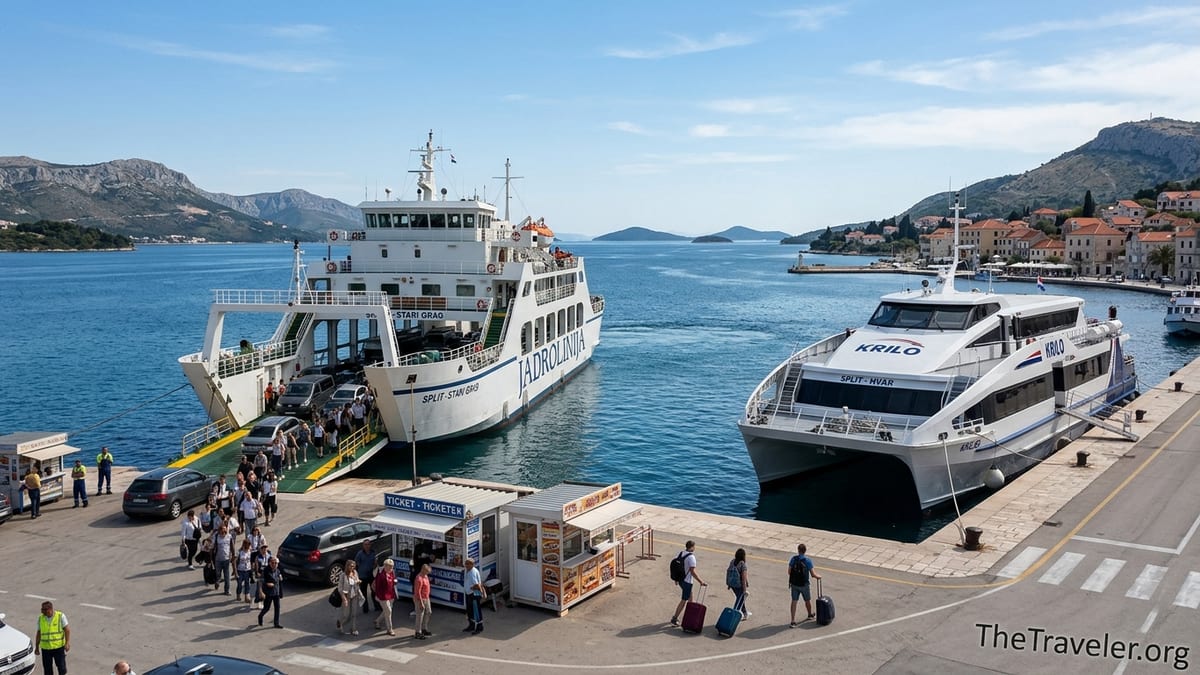
Year round ferries vs seasonal catamarans
Croatia’s island network is built on two very different types of service. Year round “public service obligation” ferries and subsidised catamarans connect key islands with the mainland through winter, mainly for residents. These include vehicle ferries such as Jadrolinija’s Split to Stari Grad on Hvar and Split to Supetar on Brač, and passenger catamarans like the state supported early-morning boats from Hvar to Split used by commuters. They usually run at least once daily even in January, with more departures layered on as the season progresses.
Layered on top of this, from late spring to early autumn, are commercial, seasonal fast catamarans. Operators such as Jadrolinija, Krilo (Kapetan Luka) and TP Line add high speed passenger-only links that are aimed squarely at tourists. These are the services that link Split directly to Hvar Town, Bol on Brač, Vis Town and Korčula Town in around one to two hours, as well as routes from Dubrovnik to Mljet, Korčula, Lastovo and sometimes Hvar. They typically start between late April and late May, then ramp up from mid June through September.
For May 2026, Jadrolinija introduced catamaran line 641 Split to Hvar Town with a seasonal timetable from 1 May to October, priced at 25 euros one way with an extra fee for large luggage. That 2026 pattern is a useful benchmark for 2027, but it is not a guarantee that identical dates or frequencies will apply. Published information for 2027 at the time of writing confirms that operators intend to repeat a similar shoulder-season pattern, but final start dates, extra sailings and any price adjustments are usually confirmed in the first quarter of the year. Travellers planning early May crossings should therefore plan around the year round ferries first, and treat seasonal catamarans as a bonus that must be checked again before booking flights.
The crucial practical difference is this: car ferries such as Split to Stari Grad or Split to Supetar almost certainly run in early May 2027, while some of the direct fast catamarans that make one-way island hopping easy may not yet exist, or may operate only on certain days. That shapes which islands are truly “practical” before the full summer timetable arrives.
Key routes from Split and Dubrovnik in May 2027
From Split, the most robust island links in May are to Hvar via Stari Grad, Brač via Supetar, Šolta via Rogač and Vis by direct ferry. Jadrolinija’s car ferry line 635 Split to Stari Grad normally sails multiple times daily throughout the year, with more departures added in high season. In 2026, off-peak car plus driver prices on this line were roughly 35 to 40 euros one way up to late May and again from late September, rising into the 40 to 50 euro range during peak dates, while foot passengers paid significantly less. It is reasonable to expect a similar price structure in 2027, with modest annual adjustments.
The passenger-only Split to Hvar Town catamarans are more seasonal. In 2026, Jadrolinija’s line 641 ran with two daily sailings in each direction from early May, with a shoulder pattern around 10:10 from Split and corresponding mid-morning returns from Hvar, then an extra departure added in high summer. Krilo’s fast services and TP Line’s state supported morning departures between Hvar and Split provided additional options, turning the route into an almost hourly corridor by July. For May 2027, the operators have signalled a similar structure but have not yet locked specific 1 to 2 May start dates. Travellers arriving in the first half of May should therefore check whether Krilo or Jadrolinija list their catamarans as “from late April” or “from mid May” before committing to same-day island connections.
Towards Brač, the year round Split to Supetar car ferries are the backbone, with several departures a day even in low season and up to seven daily in summer 2026. Seasonal catamarans to Bol and onward to Jelsa on Hvar run with shorter seasons. In practical terms that means Supetar remains easy for a short May break, while Bol, although often accessible, may offer fewer daily crossings and somewhat reduced evening options until at least mid May.
To Vis, the classic white Jadrolinija ferries link Split and Vis Town throughout the year. There is less seasonal variation, but shoulder-season timetables typically mean one or two departures each way per day in May rather than the fuller peak schedule. Korčula is similar. In recent seasons, at least one daily fast passenger route has linked Split with Hvar, Korčula Town and sometimes Mljet, but this has largely been a high-summer service. In early May 2027, you are more likely to reach Korčula via a combination of car ferries such as Split to Vela Luka on Korčula or via the Pelješac peninsula, rather than a direct catamaran that runs every day.
From Dubrovnik, most nearby islands depend heavily on seasonal passenger catamarans. Summer 2026 saw Krilo and other operators linking Dubrovnik with Sobra on Mljet, Korčula Town, and sometimes Hvar, running once or twice daily by June. In shoulder season, some of these routes scaled back to several days a week, or started only in the second half of May. Travelers considering Dubrovnik based island hopping in early May 2027 should assume Mljet and Korčula are possible but with limited frequency and should build itineraries that can absorb a missed or cancelled departure by staying flexible about which island they visit first.
Ports, islands and the difference between ferries and catamarans
Croatia’s port names can be confusing. On Hvar, Hvar Town and Stari Grad are entirely different ports, about 20 kilometres apart by road. All car ferries from Split dock in Stari Grad, which is a quiet harbour town with a charming old core but limited nightlife. Hvar Town, where most beach bars and party venues are located, is served only by passenger catamarans and by local buses or taxis from Stari Grad. If you arrive with a rental car on the Stari Grad ferry but your accommodation is in Hvar Town, you should allow around 30 to 40 minutes’ driving, or time to connect with the bus that usually meets the ferry.
On Korčula, Korčula Town sits on the eastern side of the island and is the terminus for most fast catamarans, while Vela Luka on the western side is the main car ferry port. In practice this means that a family driving from Split will usually land in Vela Luka and then cross the island by road to reach Korčula Town, while backpackers without a car tend to arrive directly into Korčula’s old town by catamaran from Split, Hvar or Dubrovnik once those routes are fully running.
The difference between car ferries and passenger-only catamarans is not just whether you can bring a vehicle. Car ferries are larger, slower ships with open decks and enclosed saloons. They are more tolerant of rough seas and are less likely to cancel because of wind. They also accept luggage of almost any size at no extra cost, within reason. Catamarans are fast, narrower vessels with airline-style seating, luggage racks and limited exterior access. They can be more exposed to crosswinds and choppy seas and are sometimes cancelled or rerouted when the Bora or strong southerly winds pick up in spring.
For travellers with mobility needs, this difference matters. Many car ferries load passengers via wide ramps with relatively gentle gradients and have lifts between vehicle decks and passenger lounges. Catamaran boarding often involves quicker gangways, occasional steps and more pronounced movement at the quay in swell. If accessible boarding is a priority, it is worth checking with the operator before travel and, where possible, favouring the larger vehicle ferries in May when sea conditions can still be unsettled.
Weather, sea temperatures and realistic swimming expectations in May
By May, Croatia’s air temperatures along the Adriatic have usually shifted firmly into spring. Long term climate data for Split and Dubrovnik show average daytime highs in the low to mid twenties Celsius, with cooler evenings. However, the sea lags behind the air. Long term averages for Split indicate that sea surface temperatures in May sit around 18 to 19 degrees Celsius, sometimes climbing above 20 degrees in warmer years but also dropping towards 16 to 17 degrees in cooler spells. Further north around Istria and Kvarner, May sea temperatures tend to be slightly lower, while Dubrovnik is often similar or very marginally warmer.
For experienced or enthusiastic swimmers, those figures are acceptable, especially on sunny, still days. Locals in Split happily play the shallow water ball game picigin in Bačvice Bay year round, and by May you will see regular recreational swimming, especially late in the month. For many casual holidaymakers, however, 18 degrees still feels bracing. The difference between a sheltered bay that has warmed up after a week of sunshine and an exposed headland in a brisk north wind can be dramatic.
Sheltered beaches and south facing coves are the most realistic swimming spots in May. On Hvar, the small pebbly bays around Hvar Town, such as Pokonji Dol or the inlets facing the Pakleni islands, warm faster than the exposed north coast. On Brač, Zlatni Rat near Bol is famous but can be windy and cooler, while smaller coves towards Sumartin may offer calmer water. Around Korčula Town, sheltered beaches such as Luka Korčulanska or nearby islets often feel comfortable for a quick dip before more open water does.
Rainfall in May decreases compared with April but is still noticeably higher than in peak summer. It is wise to allow for at least one wet or windy day in a week-long itinerary. Those days can disrupt smaller catamaran crossings, particularly where routes traverse more open stretches between islands. In May 2026, for example, passengers on fast routes between Split, Hvar and Korčula reported occasional weather-related cancellations, while the larger car ferries, though delayed, generally still operated. For May 2027, similar patterns are likely. A flexible plan and a willingness to tweak the order of your islands are essential.
Comparing destinations for May travel
Split and Dubrovnik are the obvious hubs. In May, Split’s historic centre around Diocletian’s Palace is lively but not yet overwhelmed, with most restaurants already operating daily, nightlife in full swing at weekends and enough people on the Riva promenade to create atmosphere. Beaches such as Bačvice, Firule and Kašjuni are in use on sunny days, though full-scale beach club operations and evening DJ sets may still be limited to Fridays and Saturdays, especially in early May.
Dubrovnik in May combines reasonable restaurant choice in the Old Town with more breathable crowds compared with July and August. The city walls, cable car and nearby Lokrum island all operate, but the late night scene is softer than in peak season. Boat trips to Elaphite islands such as Lopud and Šipan run, though often with fewer daily departures and a quieter onboard atmosphere than the summer party cruises advertised in July.
Among the islands, Hvar Town remains one of the most attractive bases in May. Most hotels and many apartments are open, and you can expect a good spread of open-air bars and harbourside restaurants, particularly from mid May onward. However, the full roster of beach clubs and high-profile DJs that define Hvar’s party image rarely arrive before late June. Those looking for nightlife in May will find relaxed wine bars and a few late venues, but not the all-night scene. Stari Grad, by contrast, is peaceful, with a handful of konobas and cafes open for a quieter stay.
Brač offers a more low key experience. Supetar and Bol both support a solid core of restaurants by May, but beach clubs around Zlatni Rat tend to operate in a more subdued mode, with full staffing and event programs usually reserved for high season. Korčula Town has enough year round residents that restaurants and wine bars remain open in May, and the compact old town feels pleasantly active rather than crowded. Vis is the quietest of this group in May. Many accommodations open, but some boat excursions, especially to the Blue Cave on Biševo, may operate on reduced schedules or not at all in early May if sea conditions are uncertain.
Further north, Zadar and the Istrian towns of Rovinj and Pula can be very rewarding in May. Zadar’s old town, sea organ and nearby island ferries make it a strong shoulder-season base, with a good year round restaurant scene. Istrian towns combine Venetian-style harbours, truffle and seafood restaurants and access to hilltop villages. Beaches here see fewer swimmers than Dalmatia in May due to slightly cooler water, but coastal walks and cycling are at their best before the summer heat.
Why some summer experiences do not exist yet in May
Many of the experiences that dominate social media feeds from Croatian summers simply do not run at full scale in May. Operators schedule party-focused boat tours, beach clubs and late night ferries to match peak demand, which usually runs from late June to early September. In May, demand is strong enough for regular sightseeing excursions but rarely for the multi-stop “party boats” that link Hvar, the Pakleni islands and Blue Cave in a single day with open bars and sunset DJs.
This pattern reflects both economics and weather. A speedboat packed with guests heading to a remote beach club makes commercial sense when water temperatures are over 23 degrees and sunset is near 9 pm. In early May, when evenings are cooler, sea temperatures sit closer to 18 degrees and the risk of wind-driven waves is higher, operators often restrict themselves to daytime sightseeing tours that can be cancelled or rerouted more easily. It is common, for example, for Blue Cave tours from Split and Hvar to begin advertising daily departures only from mid May or even June, with earlier dates marked as “on request, weather permitting”.
Late night ferries are also affected. In July, extra evening catamarans and water taxis shuttle people back from Hvar to nearby coves and islands well after midnight. In May, scheduled public services generally wind up earlier, often by early evening, and water taxis operate ad hoc on a smaller scale. Travellers expecting to club until 3 am and then “grab a late ferry” back to Split will be disappointed. The last regular catamarans to the mainland tend to leave Hvar Town late afternoon or early evening even in high season, while the very late departures visible on some timetables are usually car ferries to Stari Grad operating in the opposite direction.
Restaurants and bars broadly follow the same logic. On Hvar, Brač and Korčula, many waterfront restaurants open by May and operate daily, but some rooftop cocktail bars, exclusive beach venues and high end seasonal hotels still prepare for a June start. On quieter islands, you may find that only a subset of eateries in each village is open, particularly on weeknights. This makes May attractive for travellers who prefer a calmer, more local atmosphere, while those chasing peak buzz should time their trips later.
Sample itineraries and budgets for May 2027
A realistic seven day island hopping itinerary in May 2027 could start in Split. Day one, arrive and overnight in Split. Day two, take the morning car ferry or catamaran to Hvar. If the direct Hvar Town catamaran is operating by your dates, it is the simplest; if not, travel to Stari Grad and connect by bus or taxi to Hvar Town. Spend days three and four exploring Hvar and the Pakleni islands on day boats that are already running by mid May in most recent seasons.
On day five, sail from Hvar to Korčula Town if a shoulder season catamaran is available. If not, return to Split and transfer by bus and ferry via Pelješac or by a longer, combined bus and boat route to Korčula. Day six is for Korčula’s old town, Lumbarda’s vineyards and nearby coves, followed by a final travel day back to Split or Dubrovnik depending on where onward flights are most reliable. Building the itinerary around confirmed year round links between Split, Stari Grad, Supetar and Korčula via the mainland, then upgrading to direct catamarans once their 2027 dates and frequencies are published, will keep plans realistic.
An alternative May plan for those who dislike repacking is to base in a single coastal city and focus on day trips. Split works especially well for this. With a week in Split you could take day ferries to Brač via Supetar, visit Hvar Town using an early morning catamaran and an afternoon return, explore Šolta’s Rogač and Maslinica on another day, and still fit in land excursions to Krka National Park or Trogir. Zadar and Dubrovnik offer similar patterns, though in May 2027 their island timetables may not be as dense as Split’s network.
In terms of budgets, concrete numbers for May 2027 will not be final until accommodation and operators release next year’s rates, but 2026 patterns give useful guidance. In May 2026, a mid range hotel for two in Split or Hvar often cost 100 to 150 euros per night, rising to 200 to 300 euros for the same or similar room in July and August. This implies that a couple spending seven nights in May could pay 700 to 1,050 euros for mid range accommodation, compared with 1,400 to 2,100 euros in peak season. Ferry tickets on key routes such as Split to Hvar or Split to Brač clustered around 7 to 10 euros each way for foot passengers on car ferries and around 20 to 30 euros each way on fast catamarans, suggesting that a week of island hopping might add roughly 80 to 150 euros per person in sea transport.
Using those 2026 ranges, a solo traveller in May 2027 might budget around 80 to 120 euros per day for accommodation in a private room, 25 to 40 euros for meals and coffee if mixing restaurant dinners with bakery lunches, and 10 to 20 euros per day averaged across ferries and local buses. That produces a rough weekly budget of 800 to 1,200 euros. A couple sharing a mid range room and eating out once daily could reasonably plan on 1,400 to 2,000 euros for a week including ferries. A family of four in an apartment, cooking some meals and choosing one or two paid boat trips might look at 2,000 to 3,000 euros for a week, excluding flights, with clear savings compared to equivalent July and August stays.
Planning for cancellations, luggage and missed seasonal ferries
Sea conditions in May are not usually extreme, but they are variable enough that catamaran cancellations are part of travel reality. When strong northerly Bora winds or southerly storms set in, operators may cancel or consolidate departures, especially on smaller or longer routes. Car ferries, because of their size and stability, are less affected but can still be delayed. You should allow slack in your itinerary where possible, particularly around critical connections such as outbound flights.
If a planned seasonal ferry does not yet operate in May 2027 or is cancelled at short notice, the most common fallback is to backtrack to a mainland hub. For example, if a direct Hvar to Dubrovnik catamaran you hoped to use only runs from June, you could travel from Hvar to Split, then take an intercity bus down the coast to Dubrovnik instead. If Blue Cave excursions from Vis or Hvar are cancelled for a few days, you can often redirect to local hikes, wine tasting or inland villages until conditions improve.
Luggage on Croatian ferries is generally straightforward. Vehicle ferries include standard suitcases in the ticket price, and passengers typically leave larger bags in racks near the boarding deck or even in parked cars during the crossing. Catamarans often specify one standard suitcase and one small hand item in the base fare, with a modest extra charge for additional or oversized bags. In 2026, a typical extra luggage fee on a Split to Hvar catamaran was around 5 euros per additional piece, a figure unlikely to shift dramatically by 2027, though travellers should always confirm on the operator’s latest price list.
Accessible boarding requires a little more planning. Most operators advise passengers with reduced mobility to contact them ahead of time. On busier routes in May, staff are accustomed to helping with portable ramps and guiding passengers to the most stable seating. Where there is a genuine risk that boarding a catamaran in choppy seas will be difficult, the safer alternative is to rely on the more predictable car ferries and adjust your accommodation choice accordingly. For example, if gangways at Hvar Town feel challenging, basing in Stari Grad and using road transfers can be a better option.
Verdict: which Croatian islands work best in May 2027
For May 2027, the islands that combine practical ferry access, open amenities and a pleasant but not overwhelming atmosphere are Hvar (particularly Hvar Town and Stari Grad together), Brač, Korčula and the coastal hubs of Split and Zadar. Hvar is ideal for travellers who want a mix of nightlife, day trips and attractive coves without the full summer party intensity. Brač suits those chasing beaches, small towns and moderate prices. Korčula offers culture, wine and sheltered swimming spots, plus more certainty that restaurants will be open than on very small islands.
Vis, Mljet and some of the smaller islands around Dubrovnik can be rewarding in May, but they require more planning. Reduced ferry frequencies, occasional weather-related cancellations and incomplete excursion schedules mean that travellers should build extra time into their plans and avoid counting on highly specific experiences, such as a precise Blue Cave time slot, on fixed dates. Similarly, Istrian destinations like Rovinj and Pula are excellent for food, history and walking, but those looking for long days of swimming may prefer to visit later in summer or accept cooler water.
Ultimately, the question is not whether Croatia is worth visiting in May. It is. The Adriatic coast in late spring offers genuine advantages in price, crowd levels and comfort for exploring historic towns. The more precise question is which islands match your expectations under shoulder-season conditions. If you prioritise reliable transport and open facilities, aim for Hvar via Stari Grad, Brač, Korčula and mainland hubs like Split or Zadar. If you enjoy quieter harbours, are comfortable with cooler seas and can be flexible around ferry timetables, then Vis, Mljet and smaller islands can deliver a more secluded experience.
Whatever combination you choose, the key to a successful May 2027 island trip is to treat 2026 schedules and prices only as context, keep an eye on the 2027 timetables as they are finalised, and plan routes around the robust year round ferries first. With that approach, you can enjoy the best of Croatia’s islands before the peak summer rush and still keep your plans resilient when the Adriatic behaves like the living sea it is.