


More news on this day
Flights to and from San Francisco International Airport are facing significant disruption on Wednesday, November 18, 2026, after the Federal Aviation Administration imposed a weather-related ground stop and broader traffic management restrictions because powerful winds from a Pacific storm have reduced the airport’s usable runway capacity.
Get the latest news straight to your inbox!
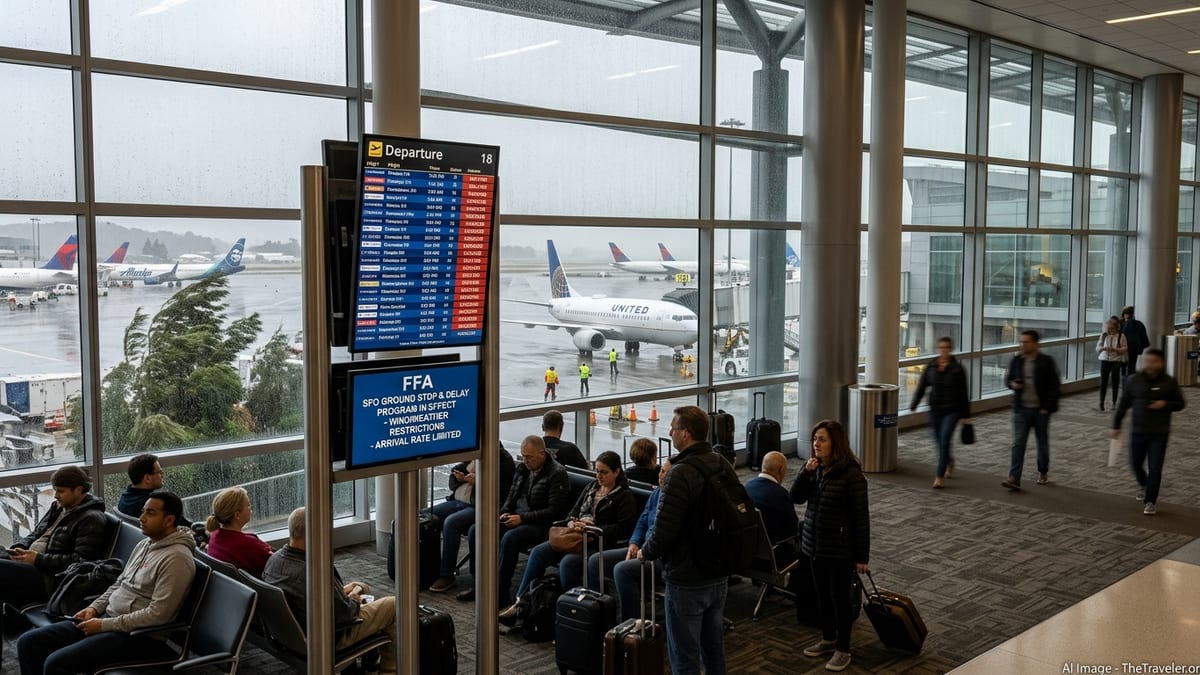
FAA ground stop and delay program in effect for SFO
According to the FAA’s Air Traffic Control System Command Center, San Francisco International Airport is under a ground delay program on November 18 due to “WEATHER / WIND,” limiting the rate at which arriving flights can be accepted. Live FAA-derived status tools that mirror these advisories show a same-day ground stop for SFO, with winds cited as the cause and the stop window extending into late morning local time.
Data from services that track FAA traffic management initiatives indicate that the SFO ground stop was scheduled to keep flights destined for the airport held at their departure points until around 12:00 p.m. Pacific time, while the companion ground delay program meters arrivals at a reduced rate. As of early afternoon UTC updates, these tools reported that SFO arrivals were experiencing average delays of around 90 minutes, with some flights waiting considerably longer for arrival slots.
The FAA’s own public status page for SFO confirms that a Traffic Management Program is in place for arrivals because of wind, meaning the airport is operating with constrained capacity but is not closed. The agency’s advisories describe this as a routine response to adverse weather, intended to maintain safe separation between aircraft when normal runway configurations cannot be used.
Storm system and winds disrupting wider Bay Area travel
The restrictions coincide with a strong Pacific storm, described locally as an atmospheric river, bringing heavy rain and damaging winds across the San Francisco Bay Area on November 18. Regional reporting notes that the storm has already led to weather-related closures of some outdoor facilities and elevated flooding concerns in parts of Northern California.
Airport-focused delay trackers attribute the SFO measures specifically to strong or gusty winds that limit which runways can be used and how they can be configured for arrivals and departures. When winds shift direction or increase in strength, SFO often must rely on less efficient runway combinations, which reduces the number of aircraft that can land per hour even when visibility remains adequate.
The same wind field has affected other transport modes in the region, with local coverage citing disrupted ferry services and difficult driving conditions on exposed bridges and highways. However, current official information does not indicate structural damage or long-term safety issues at SFO itself, and the airport remains open under constrained operations rather than fully shut down.
What the restrictions mean for passengers today
Under FAA definitions, a ground stop requires that flights bound for a specific airport remain on the ground at their origin until the order is lifted or modified. For SFO on November 18, that means many inbound flights from other U.S. airports are temporarily held before takeoff instead of being allowed to depart and then circle or divert if conditions deteriorate further.
A ground delay program, which is running alongside today’s stop, assigns controlled departure times to inbound flights so that they arrive at SFO at a rate the airport can safely handle while operating under wind constraints. This produces typical arrival delays of around an hour or more during the height of the program and can create knock-on departure delays for outbound flights that rely on the same aircraft or crews.
Travelers on transcontinental and transpacific itineraries are particularly exposed to missed connections if their inbound flight to SFO is significantly delayed. Some major airlines serving SFO have issued weather-related travel waivers for November 18, allowing certain passengers to change flights without standard fees, but eligibility varies by carrier and booking channel and should be confirmed directly with the airline.
How this differs from the recent nationwide FAA ground stop
Today’s disruption at SFO is separate from the nationwide FAA ground stop that occurred on Friday, November 13, 2026. That earlier event was triggered by telecommunications and communications-system failures affecting multiple air traffic control centers and led to a temporary halt of departures across the United States until the problem was stabilized.
By contrast, the November 18 measures are localized, weather-driven capacity controls applied specifically to San Francisco International Airport. Current FAA materials describe the SFO restrictions as a response to wind and storm conditions rather than to any underlying technical malfunction, security concern or structural issue at the airport.
While some residual congestion this week can be traced back to the nationwide outage, the ground stop and delay program in effect for SFO on November 18 should be understood as part of the normal toolkit air traffic managers use to handle severe weather at a single airport, rather than a continuation of the systemwide stoppage seen on November 13.
What travelers should do next
Because FAA traffic management initiatives can change quickly as weather evolves, passengers flying into or out of San Francisco on November 18 should check their airline’s mobile app or website frequently for real-time departure and arrival information. The FAA’s public status page for SFO and airline system alerts typically update throughout the day as ground stops and delay programs are adjusted, extended or canceled.
Travelers with tight connections in San Francisco, especially those linking between domestic and long-haul international flights, may want to proactively contact their airline to explore rebooking options or confirm protection on later flights. Where a carrier has published a specific high-wind or storm waiver for SFO, passengers whose travel dates and routes fall within the stated conditions can often switch to alternative flights on nearby days, subject to availability.
Those with departures from SFO later on November 18 should allow extra time at the airport in case security lines or check-in counters become busier due to rolling delays. As the storm system moves through, both the ground stop and the ground delay program are likely to be revised, so the most accurate picture of expected timing will come from same-day checks shortly before leaving for the airport.