


More news on this day
Amtrak has confirmed plans to introduce new electric-hauled "high-capacity" trainsets with more than 640 seats on Northeast Corridor and related routes starting in 2031, a fleet expansion that will rely on upgraded maintenance facilities in Boston and other major East Coast hubs.
Get the latest news straight to your inbox!
What Amtrak Has Announced So Far
In a November 17, 2026 update to its Airo fleet plans, Amtrak confirmed an order for additional 10-car high-capacity trainsets intended to boost seating on Northeast Regional services. Public documentation describing the order notes that each consist is designed for "more than 640" seats and that the new sets are expected to begin entering revenue service in 2031, subject to manufacturing and testing timelines.
The high-capacity trains will be electric-hauled rather than self-propelled, using locomotives on the electrified portions of the Northeast Corridor. Amtrak materials indicate that these sets are part of its corridor fleet strategy and are separate from the long-distance fleet replacement program now being advanced with the Federal Railroad Administration. That means the announcement is focused on dense Northeast Corridor and state-supported routes, not on transcontinental services.
Planned deployment focuses on the core Boston–New York–Washington spine and certain connecting state-supported routes that share the same infrastructure. Amtrak has not yet published train-by-train assignments or a detailed operating plan for the 2031 introduction, so the exact mix of services and frequencies that will see the 640-plus-seat equipment remains to be determined.
What This Means for Boston Services
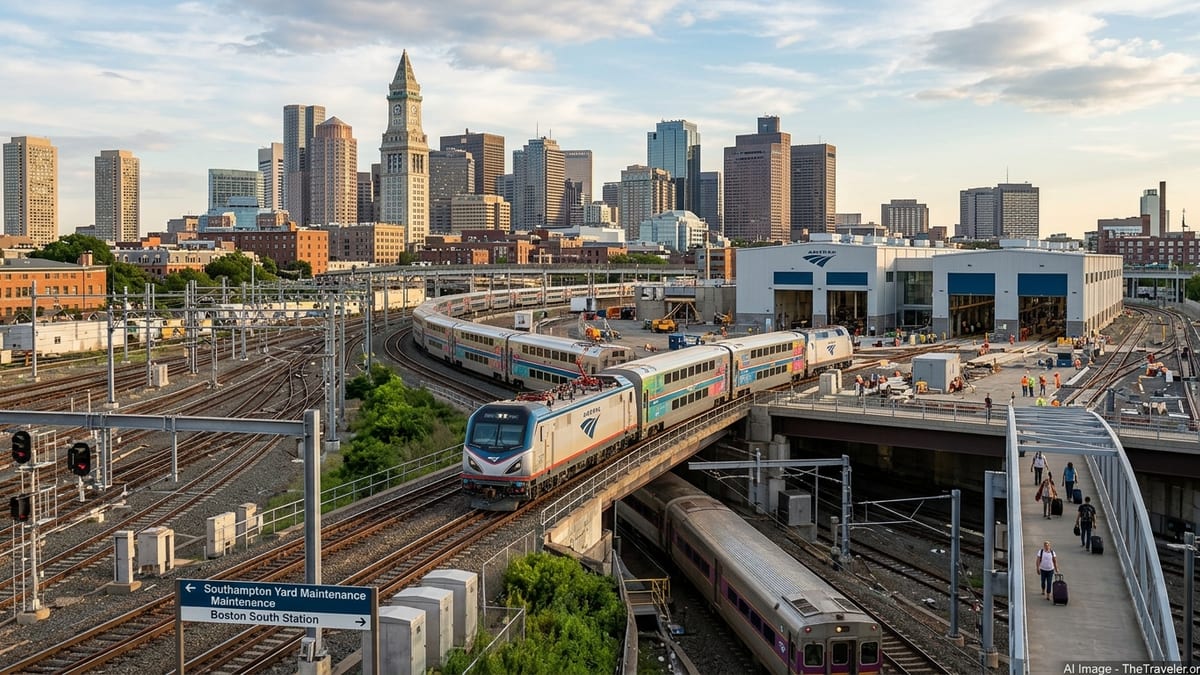
Boston’s role in the rollout is tied less to a specific timetable change and more to its emerging status as a major maintenance base. Amtrak and project documents for the Northeast Corridor Commission describe a multi-hundred-million-dollar modernization of Southampton Yard in South Boston, adding a new two-bay maintenance and inspection facility, upgrading existing service tracks and installing digital systems tailored to Airo and other new fleets.
Recent construction updates confirm that the new facility is being built to support Amtrak Airo trainsets, Acela services and both existing and future long-distance equipment operating to and from Boston. This positions the city as one of several key hubs where next-generation corridor and long-distance trains will be serviced, cleaned and turned, including trains that eventually incorporate the new high-capacity consists when they are assigned to Boston-linked routes.
Today, Boston is already a junction for multiple Amtrak product lines, including Acela, Northeast Regional services, the Downeaster to Maine and the Lake Shore Limited to Chicago. Once the 640-plus-seat trainsets are introduced on the Northeast Corridor, travelers on Boston–New York–Washington services are expected to see some departures operated with the higher-capacity equipment, although Amtrak has not committed to which specific departures or how many daily round-trips will use them.
Traveler Impact: More Seats, Few Details on Interiors or Fares
The clearest traveler benefit from the announcement is scale. A train consist offering more than 640 seats represents a substantial increase in capacity compared with many current locomotive-hauled Northeast Regional formations. For peak-period trains that routinely sell out between Boston, New York and Washington, the larger consists are expected to reduce crowding and increase the number of seats available without adding more train paths on an already busy corridor.
However, many of the details passengers typically care about remain open. Amtrak has not released final interior layouts, seat configurations, amenity lists or branding for the high-capacity sets beyond placing them within the broader Airo family. No fare structure changes or new pricing tiers have been announced in conjunction with the order, and any such adjustments would likely be clarified closer to entry into service.
For now, travelers planning trips for late 2020s and early 2030s should treat the 2031 date as the start of a phased introduction rather than a firm deadline by which all Boston–New York–Washington trains will operate with the new fleet. Early deployments are typically limited in number while crews are trained and the equipment proves itself in daily service.
How This Fits Into Amtrak’s Wider “New Era” Fleet Plans
The high-capacity corridor trainsets are one element of Amtrak’s broader "New Era" modernization, which also includes the NextGen Acela fleet now running on the Northeast Corridor and Airo trainsets scheduled to enter service on Cascades, Northeast Regional and other state-supported routes later this decade. Facility upgrades at key yards, including Boston’s Southampton Yard, New York’s Sunnyside Yard and Washington’s Ivy City Yard, are being designed specifically to support those fleets and enable faster, more efficient maintenance.
Amtrak and federal rail planners have stressed that the long-distance fleet replacement is a distinct program, involving separate procurements and timelines for trains that operate on overnight and cross-country routes. Those long-distance cars are expected to remain in mixed service with existing equipment well into the 2030s, even as the high-capacity corridor trains arrive for the Northeast Corridor and adjacent corridors.
In practical terms, travelers will see a layered transformation. NextGen Acela sets are already in operation, Airo-branded trains are due to roll out in the late 2020s, and the 640-plus-seat high-capacity trainsets are planned to follow from 2031 onward. Each step adds capacity and modern equipment to specific markets rather than replacing the entire national network at once.
What Travelers Should Watch Next
Because the 640-plus-seat high-capacity trains are still in the procurement and design phase, the most relevant developments for travelers over the next few years will be facility completions and earlier fleet milestones. In Boston, that means watching progress at Southampton Yard, where Amtrak has already reported major construction milestones on the new maintenance and inspection building that will service Airo, Acela and long-distance trains.
As 2031 approaches, travelers on Boston–New York–Washington routes should look for updated schedules, equipment assignments and booking information in official Amtrak channels. These will indicate which departures are slated to use the high-capacity trainsets, what on-board layout they offer and whether any new fare products appear alongside the expanded seating.
Until those specifics are released, passengers planning trips in the region can continue to book existing services, including NextGen Acela and forthcoming Airo-operated trains, while treating the high-capacity fleet as a longer-term enhancement that is planned but not yet visible in day-to-day operations.