


Melbourne Airport is one of the few major airports in Australia without a direct train into the city. While most visitors are pointed straight toward the red SkyBus coaches outside each terminal, there is a much cheaper way into town using ordinary public transport. It is slower, less comfortable with luggage and involves a connection in the suburb of Broadmeadows, but for budget-conscious travellers it can reduce the cost of an airport transfer to little more than a standard city fare.
Get the latest updates straight to your inbox!
Melbourne’s Airport Transport Options in Context
From Melbourne Airport, most visitors choose between SkyBus, taxi or rideshare to reach the central business district. SkyBus runs a frequent express service between the airport and Southern Cross Station on the western edge of the CBD. In 2026, a one-way adult fare is typically in the mid-20 dollar range per person, with minor variations depending on promotions and return or multi-trip deals. Travel time is usually 30 to 45 minutes depending on traffic. Taxis or rideshare often cost several times more than SkyBus, especially once tolls and airport surcharges are added, but provide a door-to-door ride that can be good value for groups of three or four.
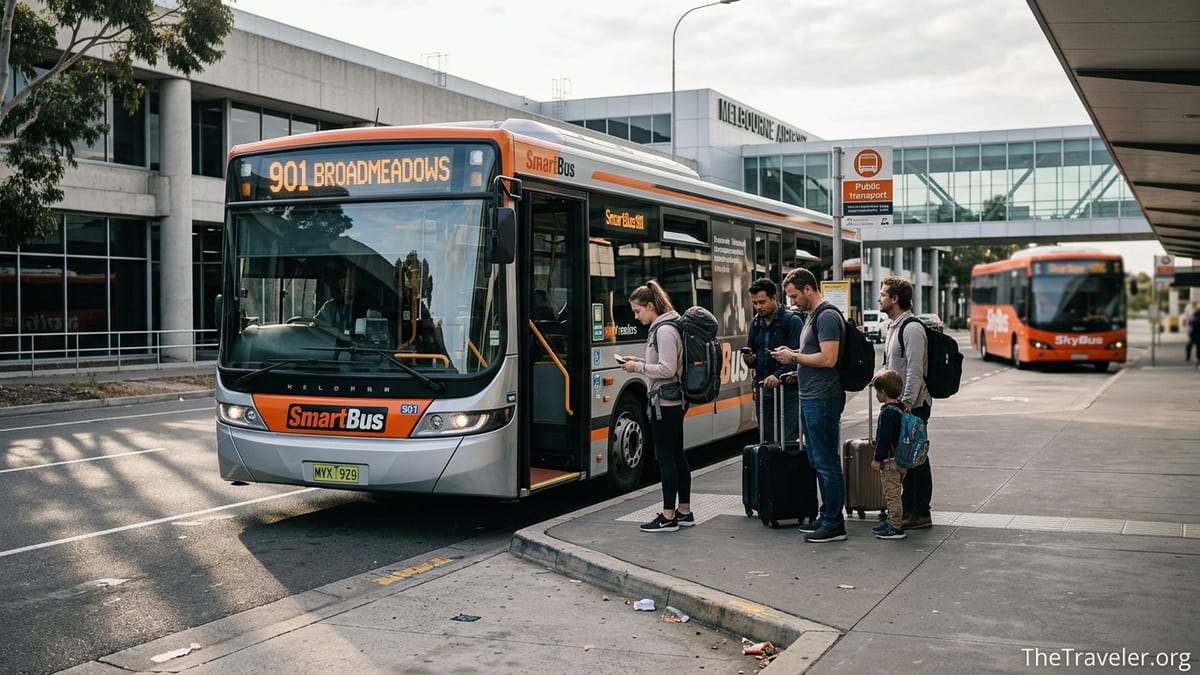
What many first-time visitors do not realise is that ordinary public buses also serve Melbourne Airport. The most important is SmartBus route 901, a long orbital route that stops at the airport and then continues to Broadmeadows station before looping around Melbourne’s outer suburbs. A standard myki fare on this route is capped at the same daily maximum as any other metropolitan trip, so you pay roughly what a commuter would pay, not a premium airport price. In practice, that can bring the cost of travel from the airport to the CBD down to around half, or even less, of the SkyBus fare for a solo traveller, and dramatically less for families when combined with current concessions and youth policies.
The trade-off is that you are no longer on a dedicated airport coach but on a suburban bus and then a suburban train, sharing space with commuters and school students. There are no luggage racks, the journey is slower and you need to feel confident with a transfer at Broadmeadows. For independent travellers, students, digital nomads and long-stay visitors who will be using public transport anyway, those compromises can be worth it. This guide explains exactly how the public transport option works, what to expect at each step and when it still makes more sense to pay for SkyBus instead.
How the 901 Bus and Broadmeadows Train Connection Work
The backbone of the budget route from Melbourne Airport to the city is SmartBus route 901 combined with the Craigieburn train line. The 901 stops at the airport’s “Public Transport / Public Bus” bay, a signed area separate from the SkyBus bays. From here, buses depart for Broadmeadows station and then continue on a long orbital route to the east and south of the city. For airport travellers, Broadmeadows is the key stop, because it is the first major interchange on the line with a frequent suburban train service into the CBD.
Travel time from the airport to Broadmeadows by 901 is usually around 20 to 25 minutes, depending on traffic on the Tullamarine Freeway and Pascoe Vale Road. Buses are scheduled roughly every 15 minutes during weekday daytimes and every 15 to 30 minutes in evenings and on weekends. Overnight on Friday and Saturday the 901 forms part of Melbourne’s Night Network, which means buses continue to run, albeit less frequently, giving you a late-night budget option when SkyBus services also thin out but still run.
At Broadmeadows station, you change from the 901 bus to a city-bound train on the Craigieburn line. Trains from Broadmeadows to Flinders Street Station usually take about 25 minutes and run every 10 to 20 minutes during most of the day. In total, if connections line up smoothly, the airport to CBD journey via 901 and Broadmeadows can be done in around 60 to 70 minutes. If you arrive just after a bus or train has left, it is realistic to allow 90 minutes or more. That is the main disadvantage compared with the largely non-stop SkyBus coach, which aims for closer to 30 to 45 minutes in typical traffic.
To picture it in practice, imagine landing in Terminal 2 around 11 am on a weekday. After clearing immigration, you walk to the public bus stop and check the display: the next 901 to Broadmeadows is in 10 minutes. You tap your myki card, ride 20 minutes to Broadmeadows, walk up to the station concourse and see a city-bound train due in 5 minutes. Twenty-five minutes later you are stepping off at Flinders Street. The whole trip has taken a bit more than an hour and cost roughly the same as any other day of unlimited Zone 1 and 2 travel, instead of paying a separate airport premium.
Understanding Myki, Fares and Daily Caps
To use the 901 bus and the suburban train into Melbourne, you need a myki, the city’s contactless ticketing system. Myki is used on all trams, trains and buses across metropolitan Melbourne and on many regional services in Victoria. You can buy a physical myki card from machines in the terminal, certain airport retailers and most major train stations. The card itself has a small purchase fee, and you then load it with myki Money (pay-as-you-go credit) or a myki Pass for unlimited travel over a set period. You must tap on at the start of your journey and tap off at the end on buses and trains so the system can calculate your fare correctly.
For most short-term visitors, myki Money is the simplest choice. Melbourne uses daily fare caps: once your total travel in Zones 1 and 2 for a day reaches a certain approximate amount, additional trips that day are effectively free. In 2026, the full-fare daily cap for Zones 1 and 2 is a little over 11 Australian dollars, with slightly lower pricing on weekends and public holidays. Children and concession holders typically pay around half, and current Victorian policy lets many under-18s travel free or on heavily discounted Youth myki products. Because the airport, Broadmeadows and the CBD are all within Zones 1 and 2, your airport transfer will never cost more than this cap when using myki Money.
That has important implications if you plan to explore the city the same day. Suppose you arrive in the morning, take the 901 and a Craigieburn train into the CBD, drop your bags at a hotel near Southern Cross, then hop on a tram to St Kilda and later another tram back into town for dinner. With myki Money, you will still only pay up to the daily cap for all these trips combined. By contrast, if you use SkyBus to reach Southern Cross and then start using myki on trams, the SkyBus fare is a separate cost. For anyone planning several public transport journeys in one day, the 901 route effectively lets the airport leg piggyback on the daily cap.
Tourists should also be aware of the Myki Explorer pack, a visitor-oriented bundle that includes a myki card preloaded with enough credit for a day of travel across Zones 1 and 2 plus some attraction discounts. While the exact contents and price can change, it is often sold at key stations and visitor centres. A Traveller who buys this pack at Southern Cross for sightseeing might find that using public transport from the airport on arrival would have allowed them to start benefiting from capped fares immediately instead of paying a separate airport transfer first and then buying the pack later.
Step-by-Step: Navigating Melbourne Airport to Broadmeadows and the CBD
Using regular buses and trains from Melbourne Airport is easier when you know the sequence before you land. After collecting your luggage, follow signs for “Transport” or “Buses & Coaches” but look specifically for the general “Public Bus” area. This is separate from the high-profile SkyBus bays and can feel more low-key, with ordinary bus stop poles and shelters. Here you will find the orange and silver SmartBus 901, usually clearly marked with its route number and destination. Electronic displays list the next departures and often show “Broadmeadows” as one of the intermediate stops even when the bus is ultimately headed toward much further suburbs.
Before you board, make sure you have a myki card with credit. If you have just bought a physical card from a machine, allow a moment to confirm your balance on the screen. Once the bus pulls up, you enter through the front door and tap your myki on the card reader near the driver. If you are unsure whether you are heading toward Broadmeadows, simply ask “Does this 901 go to Broadmeadows station?” Drivers are used to this question from airport travellers. Choose a seat where you can manage your luggage without blocking the aisle, remembering that there are no racks or special storage areas, only regular bus seating.
When the bus reaches Broadmeadows, most passengers bound for the city will get off at the stop directly outside the station. It is a short walk into the station precinct, following the flow of commuters. Inside, you tap your myki again at the ticket barriers, head to the platform for city-bound Craigieburn line trains and check the departure screens for a service heading to Flinders Street or the City Loop. Trains are all myki-only; there are no additional tickets to buy. On arrival in the CBD, you tap off as you leave the train barriers and you are then free to transfer to trams or other trains within the same fare period, still under your daily cap.
One practical example: a budget traveller arriving from Southeast Asia with a backpack and small carry-on at 8 pm might be staying in a hostel near Flinders Street. They buy a myki at the airport machine, take the 901 to Broadmeadows, wait 10 minutes for a train and are checking in by 9.30 pm. The total cost is effectively a single full-fare daily cap, which also covers their tram ride to Fitzroy later that night. Meanwhile, their seatmate on the plane takes SkyBus and then pays separately for trams, spending significantly more on transport for the same day.
Luggage, Comfort and Safety Considerations
The starkest difference between SkyBus and the 901 plus train option is how each handles luggage. SkyBus vehicles are high-capacity airport coaches with large underfloor luggage holds and overhead racks. Staff are used to dealing with suitcases, ski bags and even bulky musical instruments. Once your bag is stowed, you climb into a seat designed for longer-distance comfort. On the 901, by contrast, you are on a regular suburban bus. There are no luggage bays, and the aisle needs to stay clear for other passengers. Travellers with enormous suitcases or multiple bags often find it awkward to position them without getting in the way of prams, shopping trolleys or mobility aids.
On a lightly loaded bus in the middle of the day, this might not matter much. But during peak hours, route 901 can be busy with local commuters and students. You may be standing for part of the ride while trying to corral your suitcase. The same applies on the train from Broadmeadows, which could be crowded with city-bound workers in the morning or event crowds in the evening. If you are a solo backpacker with one medium pack and maybe a small daypack, this is manageable. If you are a family of four with two large roller bags each, the economics of saving on SkyBus fares start to collide with the physical reality of moving all that luggage through crowded suburban vehicles.
Safety is another factor visitors often ask about when they hear the word “Broadmeadows.” The area has an everyday suburban character, with a mixture of shopping centres, apartment blocks and industrial estates, and like many urban hubs it can feel a little rough around the edges at night. The station is staffed during busy periods and covered by CCTV, and thousands of commuters use it daily without incident. That said, many locals suggest that if you are arriving late at night and unfamiliar with the city, you should be especially aware of your belongings, avoid displaying valuables and consider whether the extra savings justify transferring here rather than taking SkyBus or a taxi straight into the CBD.
For example, a solo traveller landing at midnight might technically be able to patch together a journey using the Night Network buses and late trains via Broadmeadows. Yet after a long international flight they could be dealing with fatigue, jet lag and very low suburban foot traffic. In that context, even experienced budget travellers often decide the additional cost of SkyBus or a rideshare is a worthwhile investment in simplicity and peace of mind. Conversely, for a mid-afternoon arrival when both the 901 and trains are busy with regular passengers, the budget route feels more like just another local commute.
Time Versus Money: When Public Transport Really Saves
The financial appeal of using 901 and the Broadmeadows train is clearest for solo travellers or small groups who already plan to use public transport extensively. A single full-fare daily cap for Zones 1 and 2 can cover your airport transfer plus an entire day of trams and trains. If SkyBus costs roughly double that amount per person for a one-way trip, then for one backpacker the savings are immediate. For a couple, the savings can approach the cost of a decent sit-down meal in the city. For a family where children qualify for free or discounted travel under youth policies, the public transport route can make the airport-to-city leg almost negligible in the total holiday budget.
Consider two real-world scenarios. In the first, a digital nomad staying for three weeks in Brunswick lands on a Monday morning. They buy a myki, take the 901 to Broadmeadows, then the train to Jewell station and finally a tram to their co-living space. Over a month, they will use trams and trains daily, so they might even switch to a myki Pass that spreads costs across multiple days at a slightly lower per-day rate. For them, paying for SkyBus on arrival and departure would be an unnecessary duplication, especially given they are comfortable with transfers and suburban stations.
In the second scenario, a couple visiting for a long weekend might land late on Friday and fly out Sunday night. They have booked a hotel near Southern Cross specifically because SkyBus stops there. If they take SkyBus into town and back out again, they pay two fixed fares each but enjoy direct, luggage-friendly transport. Because their sightseeing time is limited, shaving 30 or 40 minutes off the airport commute in each direction may be more valuable than saving a small percentage of their overall trip budget. They still buy a myki to ride trams around the CBD, but they treat the airport journey as a separate cost of convenience.
It is also worth remembering that travel time on public transport is more variable. While SkyBus is subject to traffic, it runs express and has bus lanes on parts of the route. The 901 weaves through local roads to reach Broadmeadows and then you are at the mercy of train headways. If a 901 drops you at Broadmeadows just as a train pulls away and the next one is 18 minutes away, you might find that waiting 10 or 15 minutes for the next 901 and transferring at a different time could paradoxically get you to the CBD sooner. In practice, unless you are tracking both bus and train timetables in real time, that kind of optimisation is too complicated for most jet-lagged visitors.
Why SkyBus Still Makes Sense for Most Tourists
Even dedicated budget travellers will concede that SkyBus is often the correct answer for short visits and first-timers. Its main strength is simplicity. You do not need to understand myki zones or daily caps before boarding. You buy a ticket online or at the kiosk, walk out to the clearly branded red coaches and know that every bus will take you non-stop or with limited stops to Southern Cross Station. From there, many CBD hotels are within walking distance, and staff at Southern Cross can point you toward trams, regional trains or even airport hotel shuttles.
For tourists with heavy luggage, SkyBus is designed for you. There are dedicated luggage holds, the staff are used to surfboards and golf bags, and most seats are comfortable for people who have just stepped off a long-haul flight. The ride is direct, and you do not have to think about transfers in an unfamiliar suburb. Families with small children often appreciate avoiding crowded suburban buses and trains, where prams and tired kids have to be navigated through peak-hour crowds. Elderly travellers or those with mobility issues may also find SkyBus or a door-to-door taxi a far safer and less stressful option than juggling multiple vehicles.
There is also the intangible but real value of starting your trip smoothly. For many visitors, especially those arriving from countries with very different ticketing systems or language, getting to their hotel quickly and predictably ranks higher than saving on fares. Travel advisers often suggest thinking of SkyBus as part of your accommodation budget: if you are already spending several hundred dollars a night on a city hotel, allocating a smaller sum for straightforward airport transfers may maximise your enjoyment of the limited time you have.
That said, SkyBus is not always the fastest option to every destination. If you are staying in a northern suburb like Broadmeadows itself, Pascoe Vale or Coburg, the 901 plus suburban train or bus connections can be geographically more direct. Similarly, long-term visitors who will be in Melbourne for months, such as working holiday makers or international students, often use the public transport route on arrival as a way to immediately familiarise themselves with the myki system and train network they will rely on every day.
The Takeaway
Melbourne offers two very different philosophies for getting from the airport to the city. SkyBus sells simplicity, comfort and a straightforward, dedicated service that feels tailored to visitors. Regular public transport via the 901 bus and Broadmeadows station sells integration with the everyday life of the city and the possibility of cutting your costs to the same level as a local commuter. Both approaches are valid, and which one is “best” depends as much on your luggage, timing and travel style as it does on the cash difference between fares.
If you are confident with public transport, travelling fairly light, arriving at a civilised hour and planning to use myki extensively, the 901 plus train combination is a smart, low-cost choice. With a bit of planning and patience around connections, it can deliver you into the heart of Melbourne for little more than the standard daily cap, effectively making your airport journey just another part of your public transport day. On the other hand, if you are jet-lagged, carrying multiple bags, wrangling children or landing late at night, SkyBus or even a taxi may repay their higher fares in reduced stress and quicker transitions.
Ultimately, the most important thing is to choose the option that aligns with your priorities. If stretching your budget means you can afford an extra night in the city, exploring the public bus and train route via Broadmeadows is well worth considering. If maximising your energy and minimising confusion on arrival matters more than a few extra dollars, stepping straight onto the SkyBus at the terminal doors remains the easiest path into Melbourne.
FAQ
Q1. Can I pay for the 901 bus and train from Melbourne Airport with a credit card instead of a myki?
You generally need a myki to travel on the 901 bus and suburban trains, although Victoria has been trialling limited contactless payment options. For now, assume you will need to buy and top up a myki at the airport or a station and use that to tap on and off.
Q2. How long does it really take to get from Melbourne Airport to the CBD using the 901 and Broadmeadows?
In smooth off-peak conditions, expect around 60 to 70 minutes from the airport bus stop to central city stations such as Flinders Street. In peak hours or if you miss a connection, it can stretch to 90 minutes or slightly more, so always build in buffer time if you have onward commitments.
Q3. Is the Broadmeadows transfer safe at night?
Broadmeadows station is a busy suburban hub with staff for much of the day and CCTV coverage, and many commuters use it without issues. However, at late hours the area can feel quiet and a little rough around the edges, so visitors with heavy luggage or travelling alone may prefer SkyBus or a rideshare if arriving very late.
Q4. How much money can I actually save compared with SkyBus?
A full-fare daily cap on myki for Zones 1 and 2 in 2026 is a little over 11 Australian dollars, which covers your 901 plus train journey and any other public transport that day. A one-way SkyBus ticket typically costs roughly double that per adult. For a solo traveller or pair, the savings can add up to the price of a decent meal; for longer stays, they compound across multiple trips.
Q5. Can I use the same myki card for the rest of my stay in Melbourne?
Yes. Once you have a myki, you can keep using it on all buses, trams and trains in metropolitan Melbourne for as long as you stay. You simply top up with myki Money or load a myki Pass if you will be travelling frequently. The card itself can be reused on future visits, although any unused balance can also be refunded under current policies.
Q6. What if my luggage is too big for the 901 bus?
The 901 has no dedicated luggage storage, only regular seats and limited standing space. If you are carrying very large suitcases, sporting equipment or multiple bags, it can be awkward and inconsiderate to other passengers. In those cases, SkyBus or a taxi, which both provide proper luggage space, are usually better options despite the higher cost.
Q7. Are there other public bus routes from Melbourne Airport into the city?
The 901 is the main SmartBus route useful for an airport-to-city journey via Broadmeadows. There are other local routes serving nearby suburbs, but none offer a simple, frequent one-change trip to the CBD like the 901 plus Craigieburn line combination. For most budget travellers, learning the 901 route is the most practical strategy.
Q8. Does taking the 901 and train count toward my daily myki cap if I am already using trams and trains that day?
Yes. All your eligible travel in Zones 1 and 2 on a given day, including the 901, trains and trams, contributes to the same daily cap. Once you reach that cap, further travel that day does not increase your fare, which is why combining your airport transfer with sightseeing can be very economical.
Q9. Should first-time visitors to Melbourne use SkyBus instead of the bus and train combination?
For many first-time visitors, SkyBus is the easier and less stressful choice, especially after a long flight or with heavy luggage. It removes the need to understand myki and negotiate a suburban transfer immediately on arrival. Confident travellers on tight budgets, however, often prefer to start with the 901 and train because it immediately immerses them in the local transport system they will be using during their stay.
Q10. Can I go directly to suburbs like Brunswick or Coburg more easily using the public transport route?
Yes. If you are staying in northern suburbs such as Brunswick, Coburg or Pascoe Vale, the 901 and connecting trains or buses often provide a more direct path than going via Southern Cross on SkyBus and then backtracking. In these cases, the public transport route can save both money and, depending on connections, sometimes even a little time.