


More news on this day
Turkey’s flagship Mersin–Gaziantep railway modernisation has taken a significant step forward, with a new contract awarded to upgrade key sections of the corridor for 200 km/h passenger operations and higher-capacity freight, reinforcing the route’s role as a strategic gateway between Anatolia and the Mediterranean.
Get the latest news straight to your inbox!
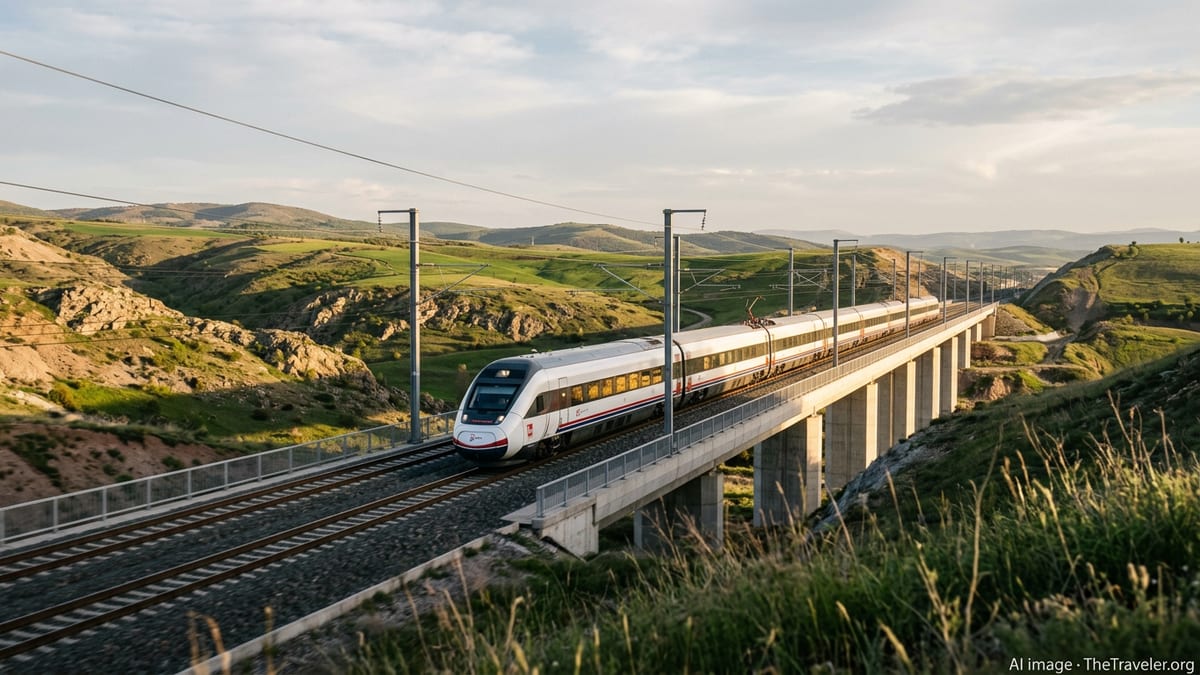
Strategic corridor linking port and inland industry
The Mersin–Gaziantep railway forms part of the wider Mersin–Adana–Osmaniye–Gaziantep high-standard line, a core element of Turkey’s long-term rail modernisation agenda. The upgraded alignment is designed to cut the distance between the port city of Mersin and Gaziantep from more than 360 kilometres to roughly 310 kilometres, while enabling 200 km/h running for passenger trains on much of the route.
Publicly available project information describes the line as a double-track, electrified and signalled corridor intended to carry both high-frequency passenger traffic and heavy freight. Design speeds are set at up to 200 km/h for passenger services, while freight trains are expected to operate at lower but more consistent speeds, supported by modern signalling and dedicated passing capacity.
The line links one of Turkey’s busiest container gateways in Mersin with major industrial and logistics centres inland, including Adana, Osmaniye and Gaziantep. Officials have framed the corridor in previous public statements as a backbone for regional trade, connecting manufacturing clusters in southern and southeastern Turkey with export flows through the Mediterranean.
Recent communications from Turkish authorities highlight the project as part of a broader “development road” concept, positioning the port of Mersin as a key node in future north–south and east–west freight corridors. Upgrading the existing railway to high-standard parameters is seen as crucial for attracting additional cargo away from road transport and into more sustainable rail services.
Internationally financed, multi-lot construction
The newly reported 200 km/h upgrade contract sits within a multi-lot construction strategy that has drawn substantial export credit finance. British and European export credit agencies have previously announced loan guarantees and reinsurance support worth more than 1.5 billion euros for the wider Mersin–Adana–Osmaniye–Gaziantep scheme, citing its role in expanding low-carbon transport and boosting international supply chains.
According to published material from export credit agencies and engineering partners, the project has been divided into several packages covering civil works, track, electrification and signalling. The 200 km/h contract relates to sections where existing conventional infrastructure is being comprehensively rebuilt, including new alignment, bridges and tunnels where needed, in order to accommodate higher speeds and heavier traffic.
Construction responsibility is centred on large Turkish contractors working with a consortium of international suppliers for specialist systems such as overhead contact lines and signalling equipment. Recent corporate communications from European rail-technology firms describe contracts awarded for electrification of around 160 kilometres of double track on the corridor, indicating a steady build-up of work across multiple sections.
Project documentation suggests the corridor is anticipated to carry more than 13 million passengers and tens of millions of tonnes of freight annually in the longer term. By structuring the build-out into distinct lots, the authorities have aimed to advance different segments in parallel, maintain flexibility in procurement, and attract a mix of domestic and foreign contractors.
Travel times and service patterns set to improve
Once the upgrade is completed and 200 km/h operations are fully in place, journey times between Mersin and Gaziantep are expected to fall substantially. Public presentations on the project indicate that end-to-end travel, which can currently exceed six hours by rail depending on routing and connections, is projected to drop to around two to three hours on direct higher-speed services.
The design allows for frequent passenger trains operating at or near the 200 km/h ceiling over long stretches, supported by modern signalling systems and segregated pathways where possible from slower freight. In addition, sections of the corridor around major cities such as Gaziantep are being configured to support regional and commuter services, expanding rail’s role in daily mobility.
For travellers, the combination of faster long-distance trains and enhanced local connectivity is expected to make rail a more attractive option than intercity coaches or private cars for many journeys. For international visitors and business travellers entering the region via Adana or Mersin, the upgraded line will offer a more predictable and comfortable way to reach tourism destinations and industrial zones in southeastern Turkey.
Timelines presented in various planning documents indicate phased openings, with initial segments due to come into service before the full corridor is completed. This staged approach is intended to start delivering benefits to passengers and freight operators as soon as individual sections meet the new standards.
Freight capacity and logistics benefits
The 200 km/h upgrade is not only aimed at faster passenger services. Technical descriptions of the project emphasise its freight dimension, with track geometry, axle-load standards and passing loops specified to handle heavy container and bulk traffic linking inland industrial hubs to Mersin Port.
By increasing line speeds, expanding double-track sections and installing modern signalling, the project is expected to significantly raise overall capacity on the corridor. Forecasts prepared for financiers suggest that annual freight volumes could rise sharply over the coming decades, as manufacturers in Gaziantep and neighbouring provinces shift more exports and inputs onto rail.
The Mersin–Gaziantep axis is already a vital route for textiles, food products, plastics and machinery. With upgraded infrastructure, logistics operators are expected to gain more reliable slots, shorter transit times and improved connections to intermodal terminals and logistics villages under development along the line. This aligns with Turkey’s stated objectives of promoting rail-based logistics and reducing dependence on long-haul trucking.
For the wider region, enhanced freight connectivity could support the growth of logistics clusters and free zones that rely on predictable links to international shipping. In turn, these developments are seen as a way to draw further foreign investment into production and distribution facilities in southern and southeastern Turkey.
Positioning Turkey in regional rail networks
The Mersin–Gaziantep upgrade is also being framed within Turkey’s ambition to position itself as a regional rail hub between Europe, the Middle East and the Caucasus. Higher-standard lines capable of 200 km/h passenger services and competitive freight operations are a key component of plans to integrate with emerging international corridors.
Sector analyses highlight the potential for the corridor to connect with future links toward Şanlıurfa and onward toward border crossings, as well as to existing high-speed and upgraded conventional lines heading west toward Konya, Ankara and Istanbul. In this context, the Mersin–Gaziantep contract is one of several projects designed to stitch together a continuous chain of modern rail infrastructure across the country.
Environmental assessments associated with the financing underline the contribution of electrified rail to decarbonisation goals, citing expected reductions in greenhouse-gas emissions and road congestion once more passengers and freight shift to rail. With energy prices and climate commitments shaping transport policy in Europe and its neighbours, such benefits have become an important factor in securing international backing for large-scale rail schemes.
As construction advances and additional contracts reach award stage, the Mersin–Gaziantep corridor is emerging as a flagship example of how targeted rail upgrades can support tourism, trade and regional integration. For travellers and businesses alike, the move toward 200 km/h operations signals a step change in how southern Turkey is connected to the Mediterranean and beyond.